
Successful subscription! Thank you for subscribing.
Successful subscription! Thank you for subscribing.

June 4, 2026
Can you argue someone into believing in Allah? In the second episode of the Foundations of Faith series, Ustadh Nouman Ali Khan says no and the reason reveals something essential about how faith actually grows.
Why Debates Don’t Build Faith
A debate, he points out, is usually two people with big egos trying to disprove each other. When you are losing a debate, you do not feel like acceptingyour opponent’s arguments. You feel more aggression toward them. Winning a debate might win applause, but it rarely wins hearts and it was never the method of the Quran or the Prophet ﷺ. The Quran’s fundamental call is to let people think on their own terms, independently.
Two Habits, One Believer
So how does the Quran describe the people who find faith? Continuing from the Ayah about the people of sound minds in Surah Ali ’Imran (3), Allah gives two qualities:
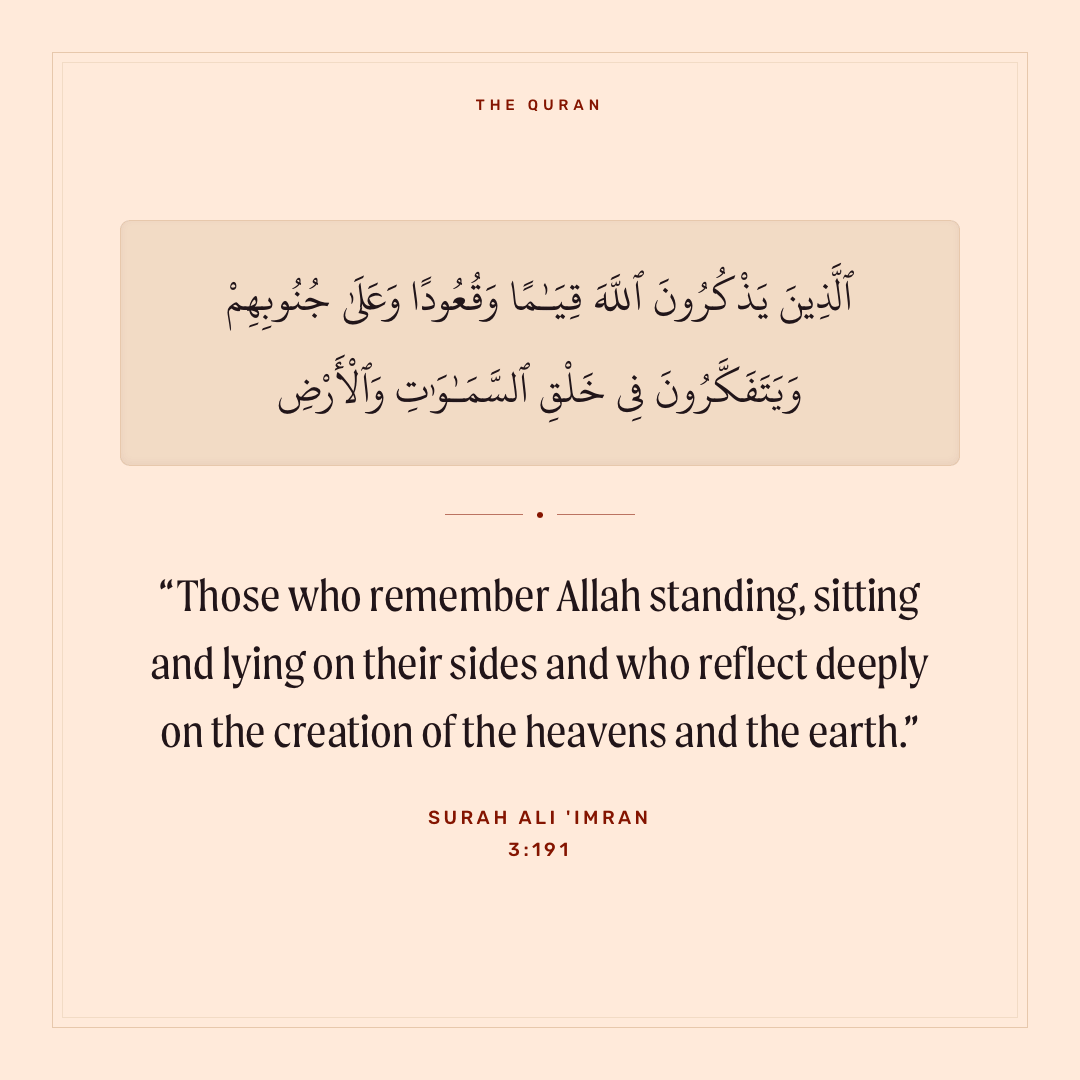
الَّذِينَ يَذْكُرُونَ اللَّهَ قِيَامًا وَقُعُودًا وَعَلَىٰ جُنُوبِهِمْ وَيَتَفَكَّرُونَ فِي خَلْقِ السَّمَاوَاتِ وَالْأَرْضِ
“Those who remember Allah standing, sitting and lying on their sides and who reflect deeply on the creation of the heavens and the earth.” (3:191) 1
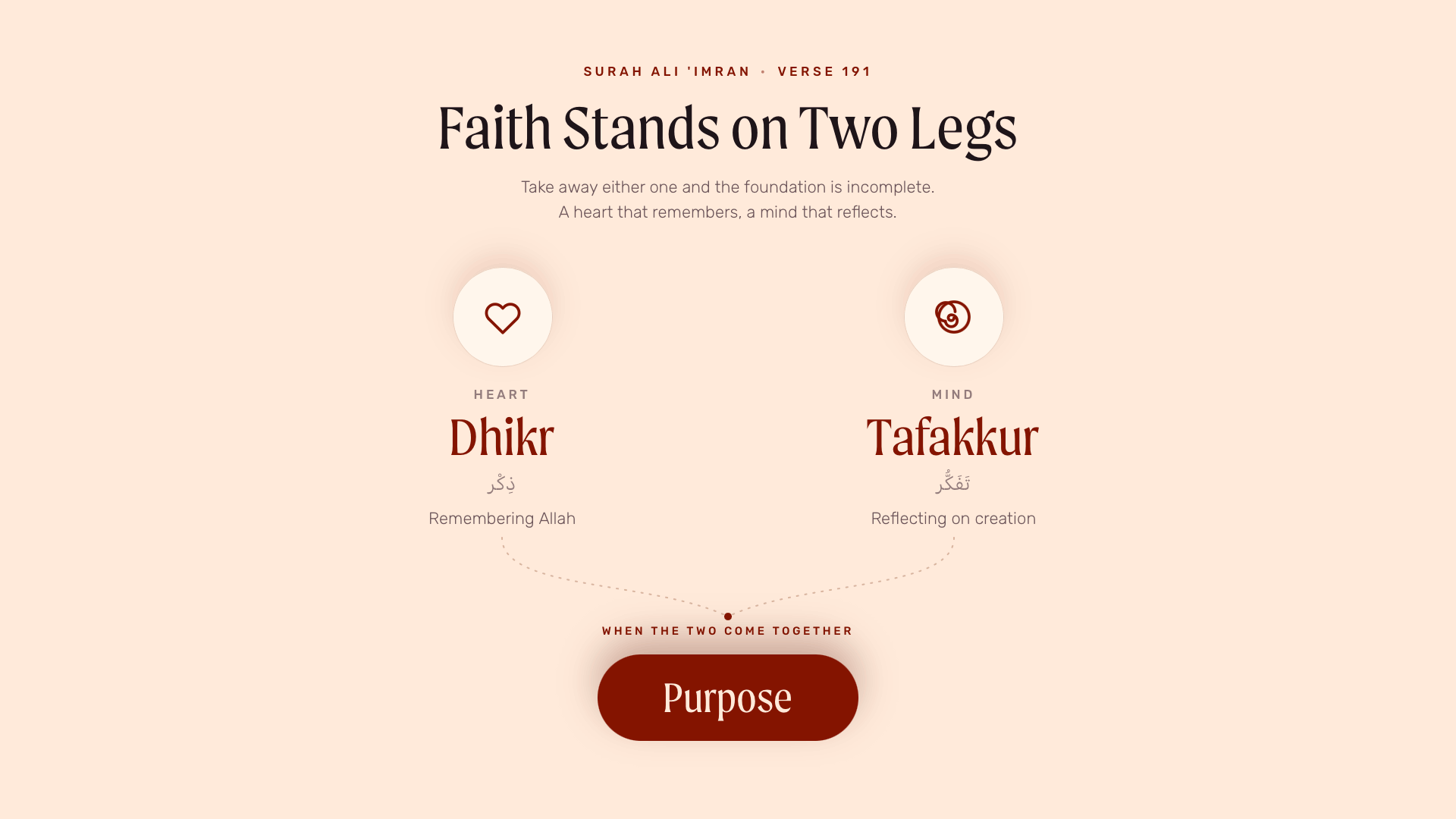
The first quality is dhikr, remembering Allah. The Quran tells us that hearts find rest in the remembrance of Allah (13:28)2, so this is a spiritual exercise. The second quality is tafakkur, thinking deeply about creation, which is an intellectual exercise. Allah describes one people with both habits. Take away either one and the foundation is incomplete.
The Imbalance We All Recognize
Ustadh Nouman names a pattern most of us have seen. There are people who look very religious and accumulate knowledge, yet their prayer is mechanical, they are quick to correct everyone else and it has been a long time since they shed a tear for Allah. There are others who say they just want to be spiritual, that learning is useless, just pray. Neither extreme is Islam. Surah Al-Fatihah (1) teaches us to ask for the straight path, a middle road between those who leaned entirely on spirituality and those who leaned entirely on intellect3. His rule of thumb is worth keeping: if you are learning more, you should be praying more.
When the two come together, the result is purpose. The same passage ends with the cry, “Our Master, You did not create all this without purpose” (3:191)1. A person whose mission once ended at finishing school, getting a job and making money suddenly sees a mission in everything.
A Book for the Mind and the Heart
The Quran itself carries both dimensions. Allah asks, “Do they not reflect deeply on the Quran? Had it been from anyone other than Allah, they would have found much contradiction in it” (4:82)4. Searching for consistency is an intellectual exercise. Then He asks, “Do they not reflect deeply on the Quran, or are there locks upon their hearts?” (47:24)5. That is a spiritual diagnosis. Reflection on the Quran addresses both problems at once, which is why Ustadh Nouman prefers to sit with one Ayah deeply rather than quote twenty in passing. Beautiful things deserve a long stare, the way you linger at an ocean rather than glance and move on.
Faith That Is Not Afraid to Explore
This balance is also why Islam has no quarrel with studying the world. The Quran commands, “Travel through the earth and look at how He began creation” (29:20)6. We are not told that studying the origins of life will damage our faith. We are told to go dig, excavate and explore. The more a person grows in science, the more it should increase their faith and the more their faith grows, the more reason they have to study.
Faith stands on two legs: a heart that remembers and a mind that reflects. Strengthen them together.
Continue the Foundations of Faith series and deepen your study of the Quran on Bayyinah TV.
Notes
[1] Al-Quran, Surah Ali ‘Imran, 3:191, https://quran.com/ali-imran/191 ↩
[2] Al-Quran, Surah Ar-Ra’d, 13:28, https://quran.com/ar-rad/28 ↩
[3] Al-Quran, Surah Al-Fatihah, 1:6-7, https://quran.com/al-fatihah/6-7 ↩
[4] Al-Quran, Surah An-Nisa, 4:82, https://quran.com/an-nisa/82 ↩
[5] Al-Quran, Surah Muhammad, 47:24, https://quran.com/muhammad/24 ↩
[6] Al-Quran, Surah Al-‘Ankabut, 29:20, https://quran.com/al-ankabut/20 ↩

At Bayyinah, we are dedicated to helping you connect directly with the words of Allah beyond translation. Founded by Ustadh Nouman Ali Khan, our mission is to create transformative experiences that deepen your understanding and engagement with the Quran.
Study the Quran and Arabic in a systematic and personalized way through Bayyinah TV. Get started today for free.
Check out our newest articles, fresh off the press and ready for you to dive into!