
Successful subscription! Thank you for subscribing.
Successful subscription! Thank you for subscribing.
July 29, 2026
Surah Al-Mulk is one of the most beloved surahs in the Quran, a thirty-verse Makki surah that the Prophet ﷺ kept close to his heart and returned to nightly. It opens the final stretch of the mushaf, the long run of Makki surahs that carry the Quran to its close and it sets the tone for them with a single breathtaking theme: everything belongs to Allah. This post introduces the surah, the remarkable things the Prophet ﷺ said about it andthe way its opening verses move from God’s absolute kingship to a question that lands on each of us, what are you doing with the life you have been lent?
The Surah He Recited Every Night
Few surahs are surrounded by as many authentic narrations of their virtue as Al-Mulk. The Prophet ﷺ described it as a surah of thirty verses that intercedes for its companion until they are forgiven (Sunan Abu Dawud)1 and it is reported that he would not sleep until he had recited it (Sunan al-Tirmidhi)2. Notice the word the Prophet ﷺ chose: it intercedes not merely for the one who reads it, but for the one who became its companion, the person who built a real, living relationship with its words. The invitation is not to recite Al-Mulk mechanically, but to know it well enough that it knows you.
Blessed Is the One in Whose Hand Is the Kingdom
The surah opens with a word so rich it resists translation (67:1)3.
تَبَارَكَ الَّذِي بِيَدِهِ الْمُلْكُ وَهُوَ عَلَىٰ كُلِّ شَيْءٍ قَدِيرٌ
“Blessed is the One in whose hand is all dominion and He is capable of all things.”
(67:1)
The verb tabaraka carries two ideas at once: an overflowing of good beyond all expectation and a permanence that never wavers. Usually the things that grow large become unstable, but what Allah blesses both increases and endures. So the surah’s very first word announces a King whose dominion is total, whose goodness overflows and whose rule will never crack or fade. Everything you can see and everything you cannot is held in His hand and He is fully capable over all of it.
He Created Death and Life to Test You
From that declaration of power, the surah moves immediately to what that power means for you (67:2)4.
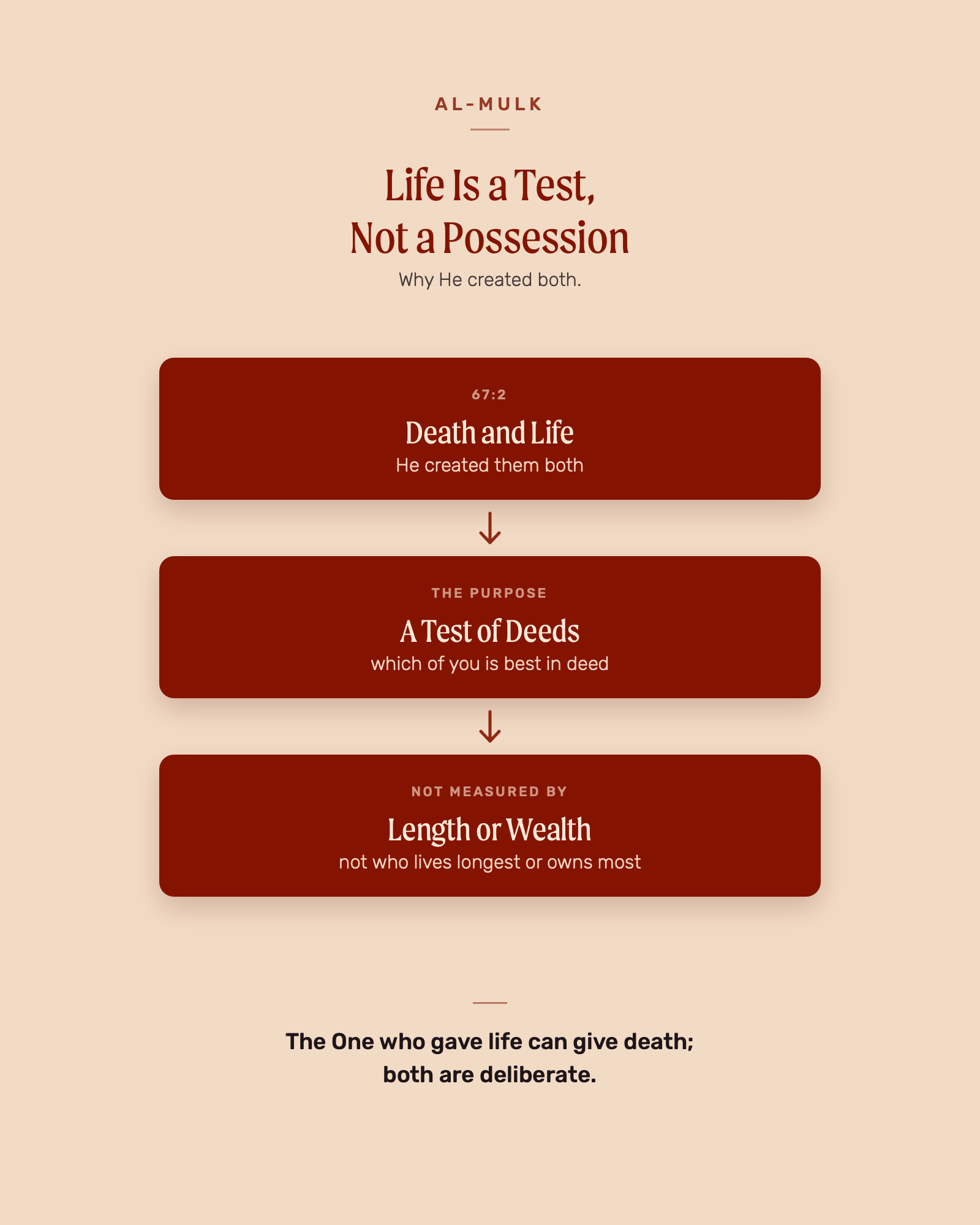
الَّذِي خَلَقَ الْمَوْتَ وَالْحَيَاةَ لِيَبْلُوَكُمْ أَيُّكُمْ أَحْسَنُ عَمَلًا
“He who created death and life to test which of you is best in deed.”
(67:2)
There is something striking here that appears nowhere else in the Quran in quite this way: death is spoken of as something created and it is named before life. A surah of warning sets its tone at once, the One who gave you life is equally able to give you death and both are deliberate acts of a Lord with a purpose. And the purpose is named plainly: not to see who lives longest or accumulates most, but who is best in deed. Life is not a possession to be enjoyed and defended; it is a test, brief and weighed and death is simply the moment the test is collected.
Look Again, Do You See Any Flaw?
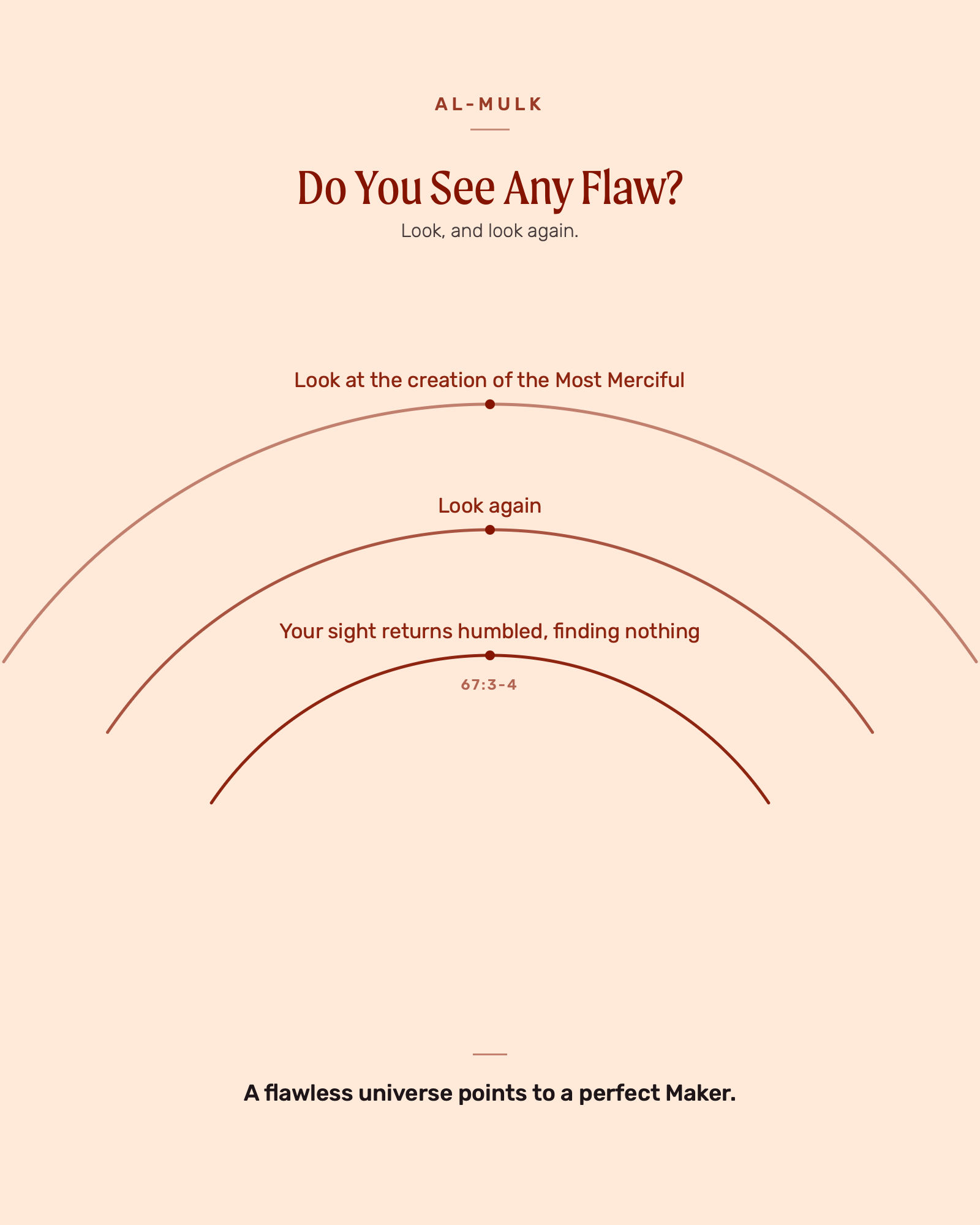
The surah then turns your gaze outward, to the seven heavens layered above you and challenges you to inspect them for a single defect (67:3-4)5. Look at the creation of the Most Merciful, it says; do you see any rift, any crack, any tear? Then look again and again and your sight will come back to you exhausted and humbled, having found nothing. The point is not only astronomy. It is a call to change how you look at reality, to stop viewing the universe as a soulless machine and start seeing it as the flawless work of a Maker. The same perfection that runs through the heavens runs through the seamless join of death into life; everything He made fits and nothing is broken.
The Takeaway
Surah Al-Mulk begins by lifting your eyes to the One who owns everything, then brings the lesson home: He created your death and your life as a test of who you will be and He built a universe so perfect that the longer you study it the more it humbles you. To live with this surah is to carry that perspective into every day, that you are a guest in a kingdom that is not yours, on loan for a short and measured time, being watched not for how much you gather but for how beautifully you act. No wonder the Prophet ﷺ would not sleep without it. It reorders everything.
There is far more to Surah Al-Mulk than a single article can hold. You can explore the full Al-Mulk: A Deeper Look series on Bayyinah TV, alongside the other surahs being opened up in the Deeper Look collection.
Related reading: A Surah in Perfect Symmetry: The Design of Surah Al-Mulk (the companion post in this series).
Notes
[1] Sunan Abu Dawud 1400, https://sunnah.com/abudawud:1400 ↩
[2] Jami` at-Tirmidhi 2891, https://sunnah.com/tirmidhi:2891 ↩
[3] Quran, 67:1, https://quran.com/67/1 ↩
[4] Quran, 67:2, https://quran.com/67/2 ↩
[5] Quran, 67:3-4, https://quran.com/67/3 ↩

At Bayyinah, we are dedicated to helping you connect directly with the words of Allah beyond translation. Founded by Ustadh Nouman Ali Khan, our mission is to create transformative experiences that deepen your understanding and engagement with the Quran.
Study the Quran and Arabic in a systematic and personalized way through Bayyinah TV. Get started today for free.
Check out our newest articles, fresh off the press and ready for you to dive into!