
Successful subscription! Thank you for subscribing.
Successful subscription! Thank you for subscribing.

July 29, 2026
Surah Al-Mutaffifin, the 83rd surah of the Quran, opens with a single word of warning so heavy that it stops you before you even understand why. It begins not with an invitation or a gentle reminder but with an expression of anger and that anger is aimed at a crime most of us would barely notice. The surah is about those who cheat just a little, the ones who shave a fraction off the top and assume nobody sees. In this opening session of the Deeper Look series, Ustadh Nouman Ali Khan walks through these first verses to show how much lives inside them.
A Warning That Begins With Rage
The surah opens with the word ‘wayl’, a term that is famously difficult to translate.1 In Arabic it is used for extreme grief and extreme anger, the kind of thing you say when you want the very worst for someone or when you find yourself in a situation that could not get any worse. Placing it at the very start of a sentence breaks the normal pattern of Arabic, which usually opens with a subject. That break creates shock, mystery and a kind of dread. Something terrible is waiting for a group of people and we do not yet know why.
وَيْلٌۭ لِّلْمُطَفِّفِينَ
“Woe to the defrauders!”
(83:1)
The word ‘mutaffifin’ comes from an image of the little bit that spills over the top when you fill a container, the grains that gather on the rim, the last fraction before the measure is full. A ‘mutaffif’ is someone who quietly takes that fraction, so small that the other person never realizes anything was stolen. This is what stirs the anger you hear in the opening. Allah is not describing armed robbery or open fraud. He is describing the person trying to get away with the least amount of cheating possible and even that enrages Him.
The Two-Faced Cheater
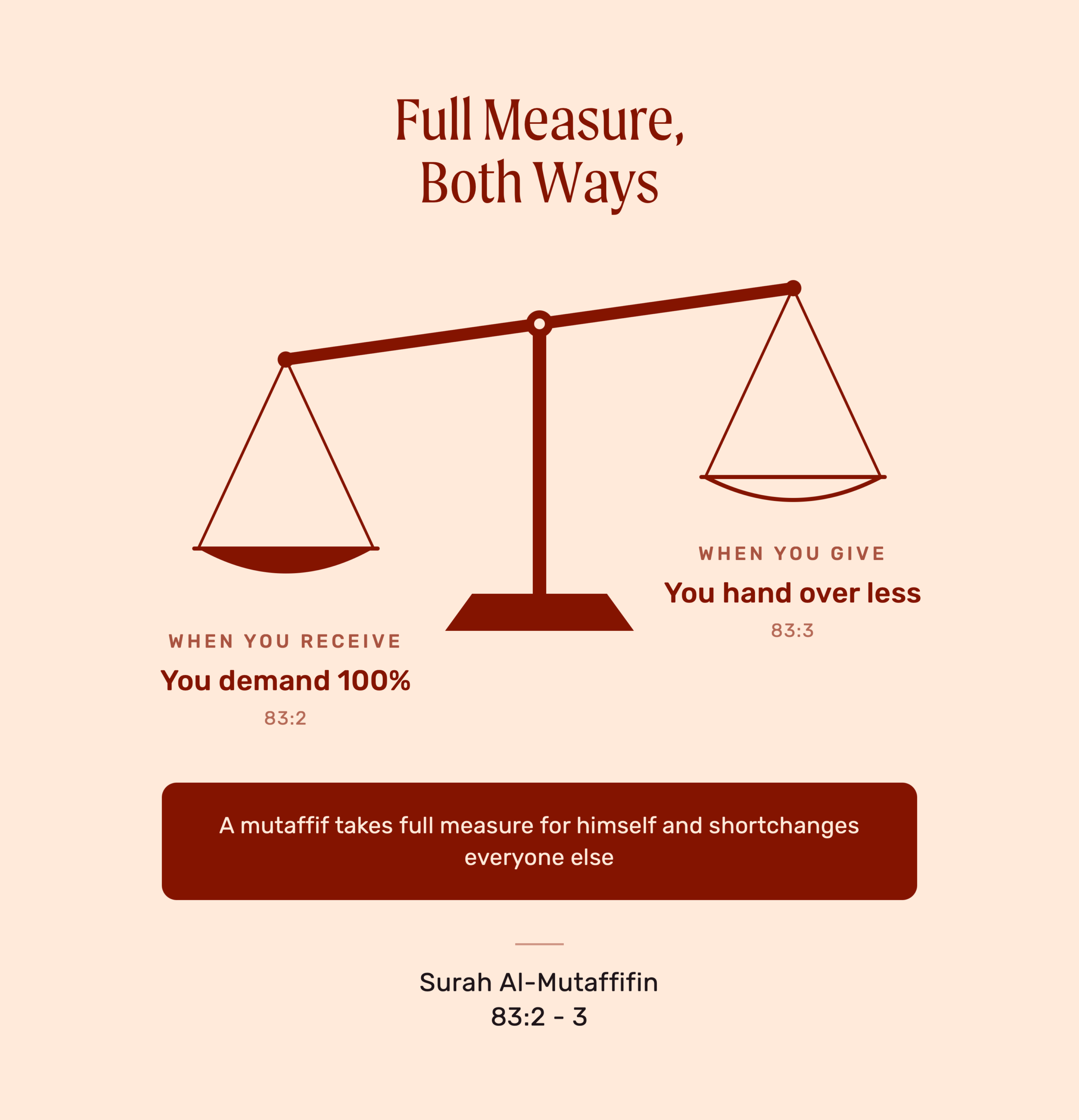
The next verses expose the exact behavior in question. These are people who insist on full measure when they are on the receiving end, then hand over less when it is their turn to give.2 The surah captures both sides of the same person, the one who fights for every penny as a customer yet cuts corners the moment he becomes the seller.
ٱلَّذِينَ إِذَا ٱكْتَالُوا۟ عَلَى ٱلنَّاسِ يَسْتَوْفُونَ وَإِذَا كَالُوهُمْ أَو وَّزَنُوهُمْ يُخْسِرُونَ
“Those who take full measure when they buy from people, but give less when they measure or weigh for buyers.”
(83:2-3)
Ustadh Nouman points out that the wording carries a note of bullying. It pictures a buyer squeezing a desperate seller and it stretches easily into our own world. The employee who sells his hours but quietly does less than the work he was paid for, the contractor who drags out a project to bill more, the company that promises what it never intends to deliver, all of them are practicing the same thing. You do not need a scale and a sack of grain to be a ‘mutaffif’. You only need to take what is not yours while telling yourself it is too small to matter.
The Trial No One Sees Coming
Then comes the question that reframes everything. Do these people not even suspect that they will be raised again for a mighty day, a day when all of humanity stands before the Lord of the worlds?3 The imagery here reads like a courtroom. Someone who commits a financial crime and never imagines he will be caught, never pictures a summons, never expects to stand trial. The verses answer that assumption directly, describing the resurrection and the standing before Allah on a day whose scale dwarfs any earthly court.
What makes it striking is the confidence of the cheater. He behaves as though the reckoning will never arrive and his behavior itself becomes a kind of denial. You do not shortchange people you truly believe you will answer for. The smallness of the crime he thinks he is committing is matched by the smallness of the thought he refuses to entertain, that one day he will have to explain himself before his Creator.
The Record That Cannot Be Erased
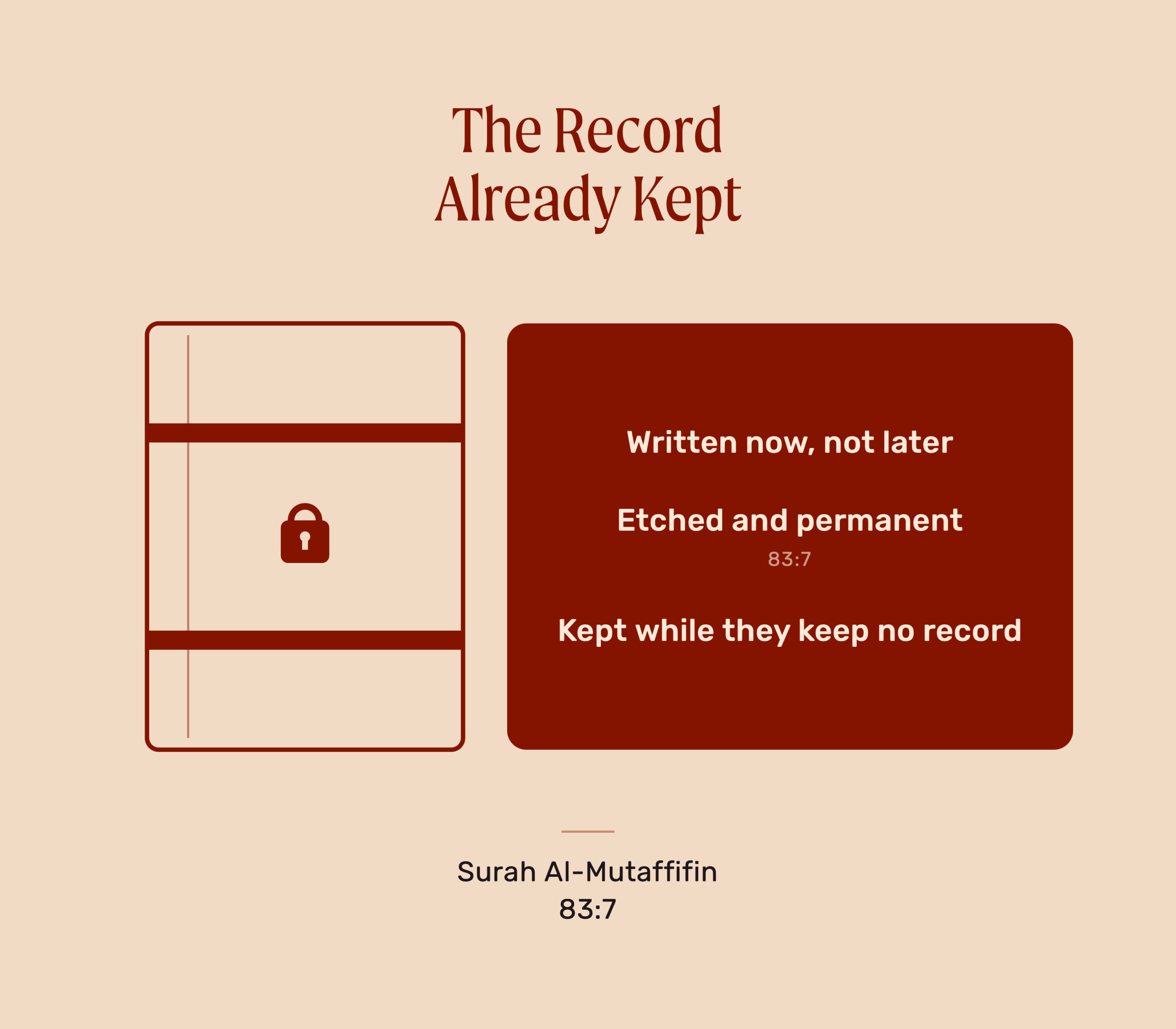
When the surah turns to consequences, it stops calling these people ‘mutaffifin’ and begins calling them ‘fujjar’, a far heavier word tied to the idea of bursting open and losing all restraint.4 The petty cheat who thought his crime was nothing is now named among the truly corrupt. Their record, the surah says, is kept in Sijjin, described with the language of a great and inescapable prison, written in a book that is etched and permanent.
The irony is sharp. These are people who kept careful books for themselves while blurring the measure for everyone else and Allah answers that He is the one keeping the clear and permanent record. The verses use the present tense, which tells us the record already exists. It is not waiting to be written on some distant day. It is being kept right now, whether the person notices it or not.
When Cheating Becomes a Layer on the Heart
The deepest damage is not financial at all. Later in this section the surah explains that the wrong these people earn settles as rust over their hearts.5 The Prophet Muhammad ﷺ described this directly, teaching that each sin leaves a dark spot on the heart and that repentance can polish it clean, but repeated sin without repentance darkens the heart until it is sealed. A person like this can afford to clean and polish everything he owns, yet the one thing growing dirtier by the day is the heart inside him.
Once that layer forms, the heart stops feeling. It cannot take advice, cannot feel shame, cannot recognize the truth even when it is recited aloud. That is why the same people end up dismissing revelation itself as old fables and why the surah warns that they will one day be veiled from their Lord. The small compromise in the marketplace turns out to be the first stone in a wall between a person and Allah.
The Takeaway
The opening of Surah Al-Mutaffifin is a warning that justice matters to Allah regardless of who is dealing with whom. His anger here is not reserved for disbelievers against believers, it is directed at anyone who treats another person unjustly. The lesson is simple and demanding at once, that we owe people the full measure of whatever we have sold them, whether it is grain, hours, service or honesty and that the smallest act of cheating is never as small as it feels.
If this opening has you wanting to sit with the surah more slowly, you can explore the full Al-Mutaffifin: A Deeper Look series on Bayyinah TV, alongside the other surahs being opened up in the Deeper Look collection.
Notes
[1] Quran, 83:1, https://quran.com/83/1 ↩
[2] Quran, 83:2, https://quran.com/83/2 ↩
[3] Quran, 83:4, https://quran.com/83/4 ↩
[4] Quran, 83:7, https://quran.com/83/7 ↩
[5] Quran, 83:14, https://quran.com/83/14 ↩

At Bayyinah, we are dedicated to helping you connect directly with the words of Allah beyond translation. Founded by Ustadh Nouman Ali Khan, our mission is to create transformative experiences that deepen your understanding and engagement with the Quran.
Study the Quran and Arabic in a systematic and personalized way through Bayyinah TV. Get started today for free.
Check out our newest articles, fresh off the press and ready for you to dive into!