
Successful subscription! Thank you for subscribing.
Successful subscription! Thank you for subscribing.

July 29, 2026
Surah Al-A’la is the 87th surah of the Quran and it held a special place in the heart of the Prophet Muhammad ﷺ, who loved to recite it in the Friday prayer and on the two Eids. It opens with a command that appears nowhere else in quite this way, an invitation to glorify the name of your Lord, the Most High. In this opening session of the Deeper Look series, Ustadh Nouman Ali Khan slows down over these first verses to show how much is folded into them. What follows is a gentle map of Allah’s plan, for creation, for His Prophet ﷺ and for us.
A Command That Stands Alone
The Quran has a family of surahs that praise Allah with the word of glorification, tasbih. Some of them open by declaring that everything in the heavens glorifies Allah, but Al-A’la is the only one that opens with the command to do so and it does something rarer still. It does not simply say glorify Allah, it says glorify the name of your Lord, the Most High.1
سَبِّحِ اسْمَ رَبِّكَ الْأَعْلَى
“Glorify the name of your Lord, the Most High.”
(87:1)
The root of tasbih is tied to a kind of swimming, the motion of gliding along the surface without dipping under. A swimmer who slows down begins to sink, so staying above takes constant, active effort. That is the picture Allah gives us. Glorifying Him is not a single phrase we say once and forget, it is a mental exercise we keep up so that our idea of Allah never dips below what He deserves.
Two Sides of the Same Coin
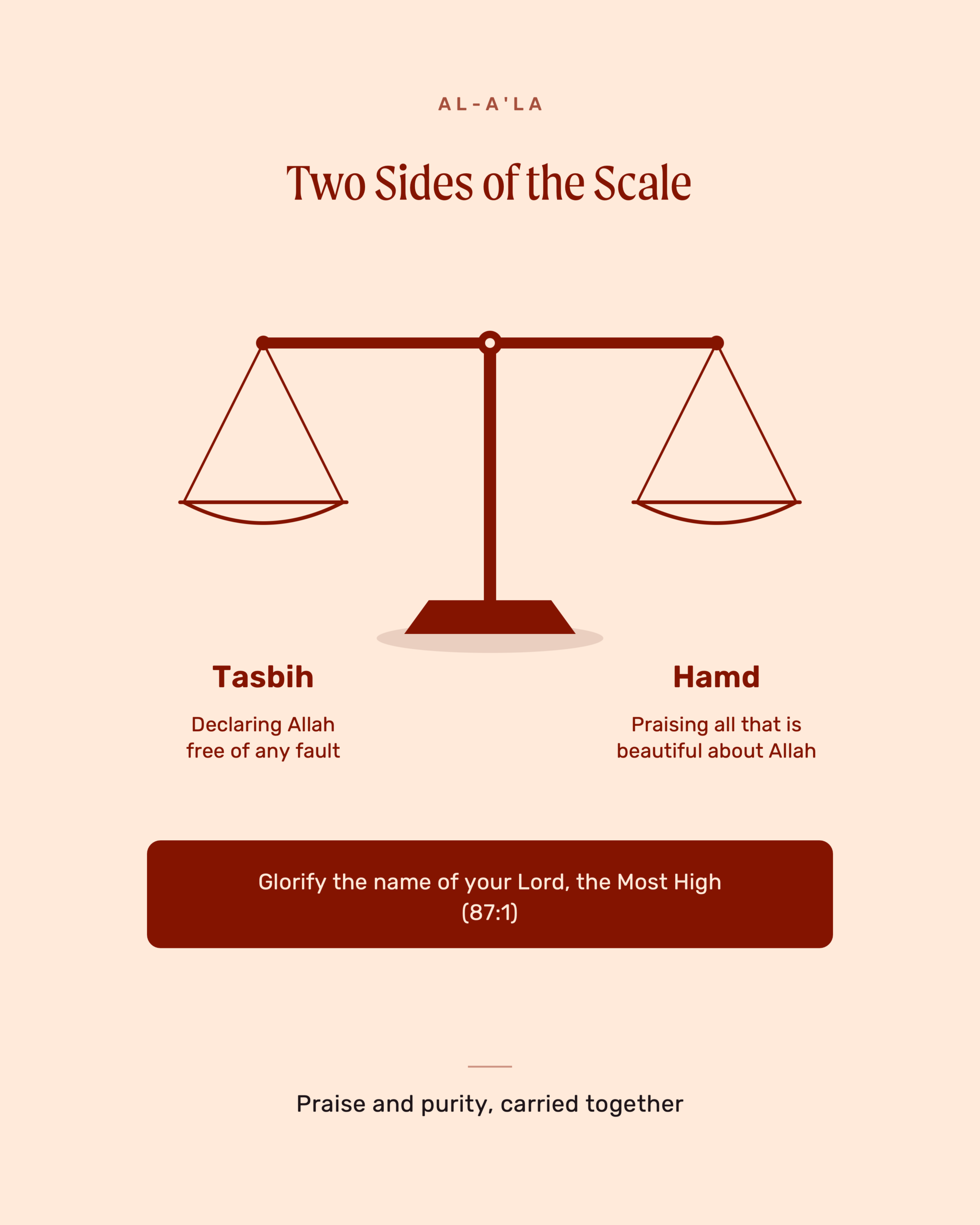
There are two halves to how we relate to Allah in our hearts. On one side we say beautiful and true things about Him, that He is merciful, wise and knowing and this is hamd, praise. On the other side we clear away anything unworthy of Him, that He is free of any partner, any fault, any injustice and this is tasbih. The Prophet Muhammad ﷺ taught that saying “Alhamdulillah” fills the scale and that “SubhanAllah” and “Alhamdulillah” together fill what is between the heavens and the earth, which shows us both halves are meant to be carried together.2 A believer keeps praise and purity balanced and it is that balance that makes our appreciation of Allah whole.
The Care Hidden in His Name
To glorify the name of your Lord is also to guard how we speak of Him. Many of Allah’s descriptions are words we also use for people, that someone is knowing, wise or compassionate. When those same words are turned toward Allah, we strip away every limit we imagine in a human being. Our hearing began at birth and will one day end, it reaches only so far and it was given to us on loan. Allah’s hearing has no beginning, no endand no limit and no one gave it to Him. His descriptions must also be held in balance, never leaning so hard on His mercy that we forget His justice, nor so hard on His power that we lose sight of His forgiveness.
Created, Then Perfected
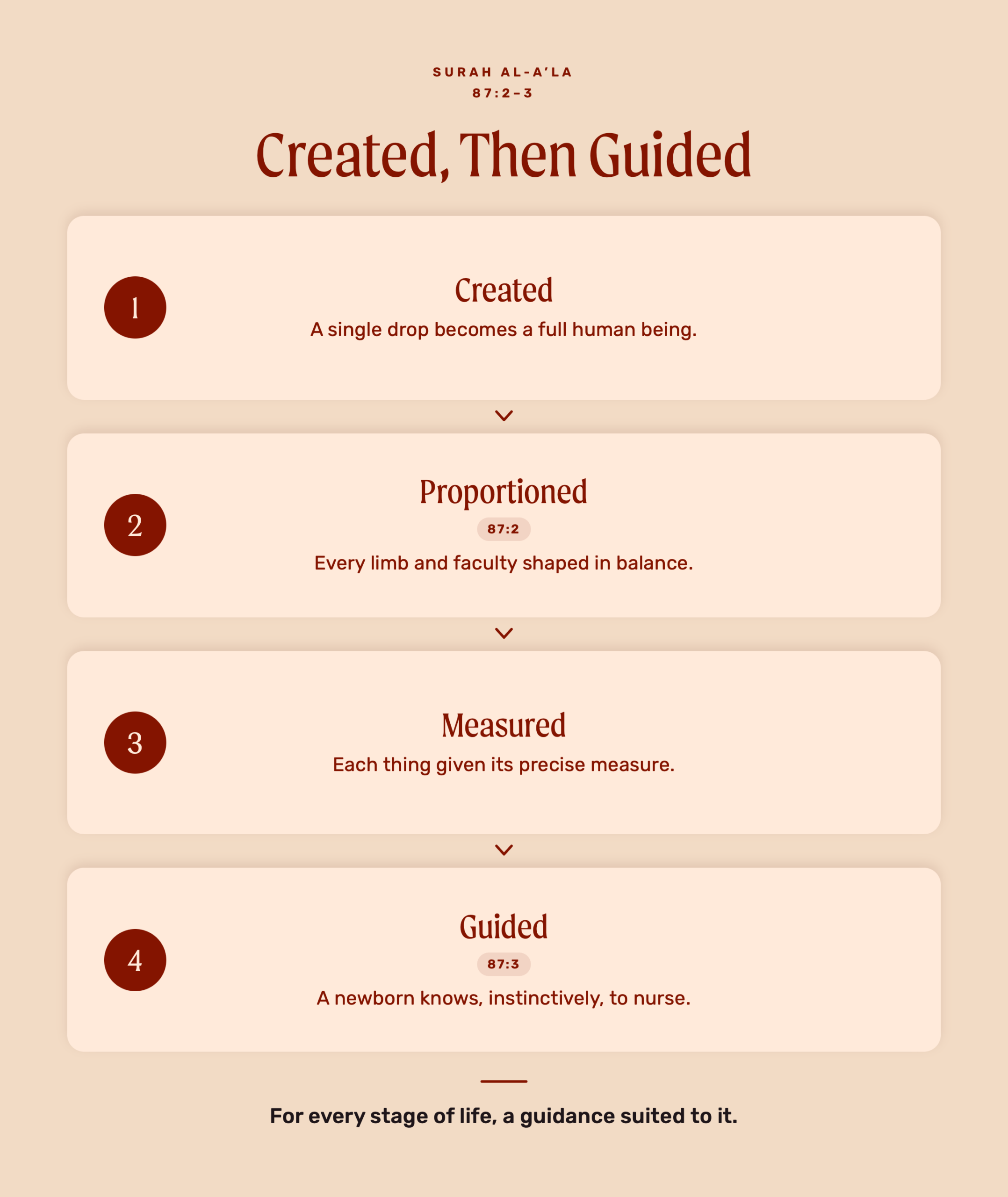
From the name of the Most High, the surah moves into how He works and the language becomes a series of verbs describing His care.3 He created, then He proportioned. A human being begins as the smallest drop and becomes a fully formed person standing upright, every organ in place, every function running in real time. A seed becomes a tree, a grain of pollen becomes honey. Allah does not merely bring things into being, He gives them a finished, balanced, beautiful form.
الَّذِي خَلَقَ فَسَوَّىٰ
“Who created and proportioned.”
(87:2)
Then comes something even more striking. Allah measured out each creation and guided it.4 A newborn takes no orientation course, yet it knows how to nurse the moment it arrives. A bee learns its pathways, a bird learns to leave the nest. For every stage of life there is a guidance suited to that stage, because the guidance a child needs is not the guidance an elder needs. Allah gives both the ability and the direction for using it and by extension He tells us that human beings are always capable of turning back to Him, they only need the guidance to do so.
The Pasture That Does Not Wait
Allah then brings out the pasture, the green growth that grazing animals feed upon and afterward turns it into dark, dried stubble.5 The image carries a quiet warning. Pasture is meant to be eaten while it is fresh and if the animal does not come to it in time, the chance is lost. Revelation is that pasture, a provision offered to humanity and there is a limited window in which we can benefit from it. There is a shepherd’s tenderness woven through this too, since prophets like Musa (AS) and the Prophet Muhammad ﷺ himself tended flocks before they were sent to people, learning patience and mercy with creatures that wander.
A Promise to the Prophet ﷺ
The opening closes by turning directly to the Prophet Muhammad ﷺ, who worried he might forget the revelation as more of it kept arriving. Allah reassures him that He will make him recite and he will not forget.6 The one exception, “except what Allah wills,” is not a threat that pieces will slip away, it points back to the truth that runs through the whole surah.7 Just as no creation grows for a moment without Allah, the preservation of the Quran rests entirely in His hands and it is by His mercy, not the Prophet’s own effort, that it is kept safe.
The Takeaway
The opening of Surah Al-A’la teaches us to keep our idea of Allah high, actively and always, so it never sinks below His majesty. It shows us a God who does not only create but sees every creation through, stage by stage, with a guidance fitted to each moment. When we place our foreheads on the ground and say “SubhanAllah,” we declare Him the Most High from the lowest place we can reach and that is exactly where glorifying Him begins.
If these opening verses have opened something for you, there is far more waiting in the rest of the study. You can explore the full Al-A’la: A Deeper Look series on Bayyinah TV, alongside the other surahs being opened up in the Deeper Look collection.
Notes
[1] Quran, 87:1, https://quran.com/87/1 ↩
[2] Sahih Muslim 223, https://sunnah.com/muslim:223 ↩
[3] Quran, 87:2, https://quran.com/87/2 ↩
[4] Quran, 87:3, https://quran.com/87/3 ↩
[5] Quran, 87:4, https://quran.com/87/4 ↩
[6] Quran, 87:6, https://quran.com/87/6 ↩
[7] Quran, 87:7, https://quran.com/87/7 ↩

At Bayyinah, we are dedicated to helping you connect directly with the words of Allah beyond translation. Founded by Ustadh Nouman Ali Khan, our mission is to create transformative experiences that deepen your understanding and engagement with the Quran.
Study the Quran and Arabic in a systematic and personalized way through Bayyinah TV. Get started today for free.
Check out our newest articles, fresh off the press and ready for you to dive into!