
Successful subscription! Thank you for subscribing.
Successful subscription! Thank you for subscribing.

November 24, 2026
We have got a long task ahead of us today.
In about fifteen minutes we are going to pray Maghrib and that is enough time to get the introduction out of the way.
The purpose of last time’s story was to talk about the origins of Musa (AS), the first part of his story, from when he was born all the way to the point where he got married. That portion of the Quran is in Surat al-Qasas, the 28th surah.
In the second episode, Allah makes a big deal out of the conversation He had with Musa on the mountain and that is actually what we are going to do today. We are going to talk about that conversation and how Allah highlights it in Surah Taha, surah number 20. I am going to see if I can get all the way to ayah number 55 today. But the point is, I’m telling you a story, not giving you a lecture.
Words From the Inside Stay With You
Today’s episode is really important. When this part of the story was given to the Prophet ﷺ, he was actually feeling terribly sad and hurtful things were being said to him by people.
When people say positive things to you, sometimes they do not stick. When people say negative things to you, they stick and they play over and over again in your head. They are like wounds that do not heal. Part of that is what the Prophet ﷺ had to hear all the time.
By the way, if somebody on the outside says something strange to you, you do not care, or even if you remember it, it does not really hurt you that much.
But when loved ones, when family, say mean things, that really hurts. The people in your family are not on the outside. You are supposed to be able to acknowledge that they care about you the way you care about them. They are inside the protected circle, so you are the most vulnerable to them. If the exact same thing were said by somebody outside, it would not matter as much.
What His Own Family Said to Him
Now, the Prophet’s ﷺ job was actually to start with his own family. The Quran told him: wa andhir ‘ashirataka al-aqrabin (وَأَنذِرۡ عَشِيرَتَكَ ٱلۡأَقۡرَبِينَ),1 warn your closest family members first. So his first priority was his closest family and the meanest people to him were actually the people closest to him. They said the most hurtful things.
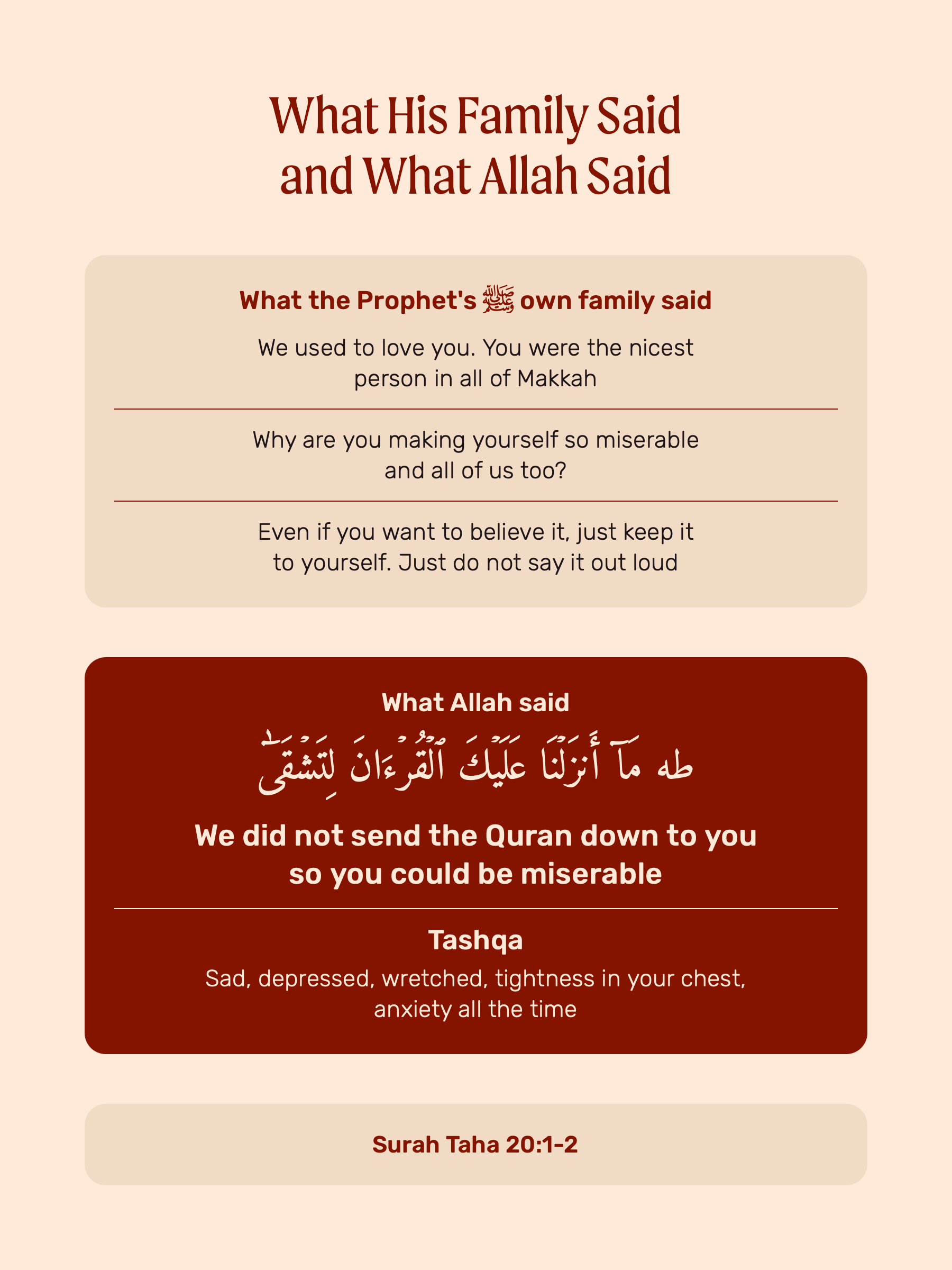
One of the kinds of things they were saying to him was: we used to love you. Everybody liked you. You were the nicest person in all of Makkah. Now you have become our biggest problem. How could you become like that? We had so much hope in you. You are such a disappointment. What has it brought you? You get humiliated wherever you go. You get called insane. You get yelled at and pushed away. Is this the life you want for yourself? We care about you. We love you. Why are you making yourself so miserable and all of us too? Stop. Let us just be the way we used to be, one big happy mushrik tribe. Everything was so much better before you became such an extremist.
The only thing they would say is: you do not have to do anything. Even if you want to believe it, just keep it to yourself. Just do not say it out loud. You want to pray? That is fine. All the best to you. As a matter of fact, Makkah is a free society. We have all kinds of idols. Blue, red, yellow, orange. You want to worship just one God? Go ahead. That is not our problem. Just do not talk about it. This Quran you keep reciting is just making things hard for you and for us. We love you. We are saying this for you.
So you are okay to have whatever belief you want, so long as you do not speak up about it. Their problem was not that he believed these things. As a matter of fact, our Prophet ﷺ before Islam only believed in one God anyway. He never worshipped or believed in idols and they had no problem with that. The difference was that he used to keep it to himself. Now the Quran was telling him: recite, stand up, warn people, read Allah’s word.
Ta Ha. We Did Not Send It Down So You Could Be Miserable
So Allah says to him in Surah Taha: Ta Ha. Ma anzalna ‘alayka al-Qur’ana li-tashqa (طه مَآ أَنزَلۡنَا عَلَيۡكَ ٱلۡقُرۡءَانَ لِتَشۡقَىٰٓ).2 We did not send the Quran down to you so you could be miserable.
We did not send it to you so you could be sad or depressed or wretched, or feel tightness in your chest, or have anxiety all the time. All of those meanings of negative emotion are captured inside the Arabic word tashqa, or shaqawah: to feel bad, to feel sad, to be miserable. That is not why We gave you the Quran.
A Reminder for Anyone With Fear Inside Them
Allah says: I did not give you the Quran so you could be miserable. I only gave it to you for one purpose. It will serve as a reminder, as advice, for anybody who actually has some fear inside them.3
There are some people in Makkah who have that fear inside them and when you say this out loud, it might go into their ears. Yes, your family will be annoyed. They will say: why are you saying this? But at the same time that some people are annoyed by what you are saying, some people’s lives might get turned around because they heard Allah’s words. They have some concern inside them and what you say connects to them. It hits them in their hearts. So you keep doing what you are doing.
A Friend and Then a King
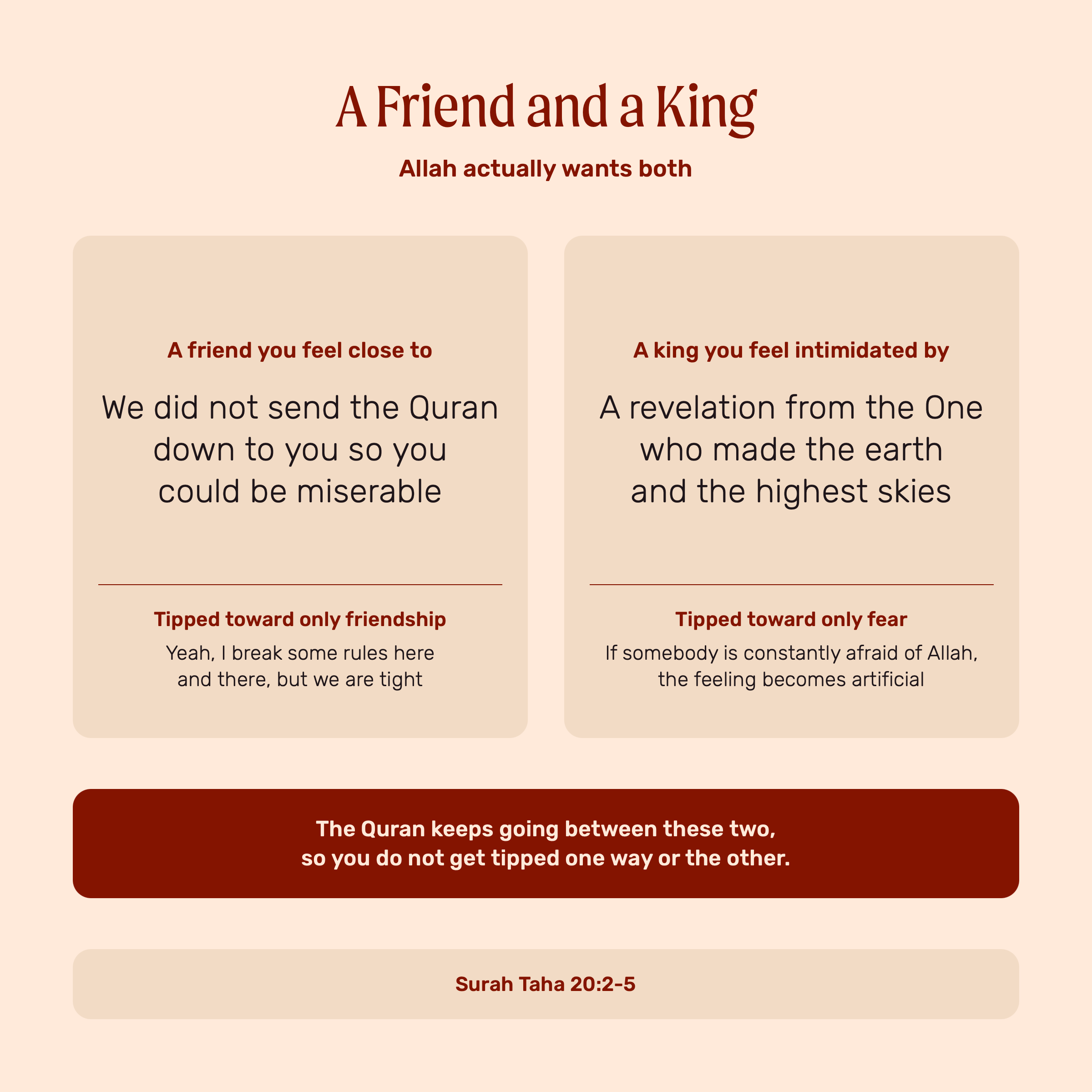
By the way, when someone comes to you and says, “I did not give this to you so you could be sad,” which is Allah’s way of saying don’t be sad, isn’t Allah being close and loving, like a friend? He also tells him to have hope: even though some people are annoyed, some people will benefit.
Then He says: this is a revelation that came down from the One who made the earth and the highest skies.4 In other words, you do not have a choice to decide whether you want to say this or not. This job has descended to you from the heavens.
When Allah says He created the highest skies, who is on top of that throne? Al-Rahmanu ‘ala al-‘arshi istawa (ٱلرَّحۡمَٰنُ عَلَى ٱلۡعَرۡشِ ٱسۡتَوَىٰ).5 Is Allah being close here, or is He being royal? He is being royal. A friend is someone you feel close to. A king is someone you feel intimidated by. So in one ayah Allah was a friend and immediately in the next ayat He is the King you are intimidated by.
This is one of the most important teachings of Islam. You may have friends of different religions who say: God is a friend of mine, I love God, I talk to Him all the time, we are like best friends. Then there are people who say: when somebody talks about Allah, I get so scared. Allah is the King, the Creator of the skies and the earth and He has created Judgment Day. I am terrified of Allah. Two opposite attitudes toward the same God.
What does Allah want? Allah actually wants both. The Prophet ﷺ, on the one hand, is being talked to as if Allah is his closest friend and then he is being reminded that he is being given this responsibility from the Highest of the high. Both of those happen at the same time. That is the reason the Quran is so important, because the Quran keeps going between these two, so you do not get tipped one way or the other.
When You Tip Toward Only Friendship
What happens when you tip one way? If Allah is only your best friend, you start saying: oh, Allah is so good, we are so good. You do not even know how close I am. He knows me real good. Then you start saying to yourself: yeah, I break some rules here and there, but we are tight. We are solid. You would not get it. It is just a me and Allah thing.
In other words, you start becoming so chummy with Allah that you decide what He is okay with and what He is not okay with, because He is such a good friend to you that He is going to let whatever you do slide, as if the only thing in this relationship is friendship and not authority. That is a big problem. People like that are going to be on Judgment Day like: Ya Allah, I thought we were pals. What is this Judgment Day business? My deeds? I thought we were good. No. It does not work that way.
When You Tip Toward Only Fear
On the other hand, there is someone who is really, really afraid of Allah. Human beings can only fear so much until it becomes unhealthy.
Let me tell you something about fear. Sometimes children are afraid of their parents, yes or no? Sometimes. But if your mom or your dad yells at you: Ibrahim! One day, the next day, the next day. Ibrahim is seven, Ibrahim is eight, Ibrahim is ten, Ibrahim is fourteen. Ibrahim is sixteen: what? Ibrahim is nineteen: I don’t have to deal with this. What happens to fear when you are constantly exposed to the same emotion over and over again? You stop feeling afraid. The hayba, the intimidation, goes away. If somebody is constantly afraid of Allah, the feeling becomes artificial. It is supposed to be balanced.
By the way, if you only have fear of Allah, then Allah is someone scary and you cannot love someone you are afraid of all the time. One of the basic parts of my relationship with Allah and your relationship with Allah is that He loves us and we love Him. If you are only afraid of someone, the relationship is not being held by love. It is being held by fear and that is unhealthy.
I have met people like that, who from a very early age were told to fear Allah, even though no child should be told that. They were told: Allah is going to be very angry if you eat those cookies. Do you know Allah was watching when you did not do your homework? I can guarantee you, children, Allah will not ask you on Judgment Day about the homework or those cookies. The fact is, Allah is not angry at those things. Children are creatures of fitrah and Allah created them for Jannah.
If you do that their whole life, then I meet them as adults and they say: I was tired of the fear. I was just told Islam is a scary thing where I am going to get punished and I do not want to live in that anxiety anymore, so I just do not practice it. Their parents say: but I tried to put the fear of Allah in them from the beginning. That is exactly the problem. That is what you did. You made them numb.
So these two sides have to be balanced with each other. I know you are wondering: where is Musa? He is coming. This is how Allah tells the story. We are going to take a break for Maghrib and come right back.
This is the first part of the story night and the parts that follow carry it to its end. Study Moses 2: Moses on the Mountain with Ustadh Nouman Ali Khan on Bayyinah TV
Notes
This post is adapted from the first part of the Moses on the Mountain story night, A Night to Remember, taught on Bayyinah TV by Ustadh Nouman Ali Khan and is written in the voice of that session. Every teaching claim, example and aside in it is taken from the session itself.
[1] Al-Quran, Surah Ash-Shu’ara, 26:214, https://quran.com/26/214
[2] Al-Quran, Surah Taha, 20:1-2, https://quran.com/20/1-2
[3] Al-Quran, Surah Taha, 20:3, https://quran.com/20/3
[4] Al-Quran, Surah Taha, 20:4, https://quran.com/20/4
[5] Al-Quran, Surah Taha, 20:5, https://quran.com/20/5

At Bayyinah, we are dedicated to helping you connect directly with the words of Allah beyond translation. Founded by Ustadh Nouman Ali Khan, our mission is to create transformative experiences that deepen your understanding and engagement with the Quran.
Study the Quran and Arabic in a systematic and personalized way through Bayyinah TV. Get started today for free.
Check out our newest articles, fresh off the press and ready for you to dive into!