Successful subscription! Thank you for subscribing.
Successful subscription! Thank you for subscribing.

November 24, 2026
I am really grateful to all of you for coming, alhamdulillah. I am very excited to share with you some aspects of the story of our wonderful father, Ibrahim (AS).
Ibrahim (AS) is mentioned several times in the Quran and he is also a major figure in Christian and Judaic studies. He is a central figure to all three faiths. But the way we look at Ibrahim (AS) in Islam is actually very different from how our Christian and Jewish brethren look at the same figure. Many of my conversations with a friend of mine who is a rabbi are about Ibrahim (AS) and what they think about him is almost completely different from how we perceive him.
Every Story Is Placed in a Surah for a Reason
The second part of this introduction is my personal view, from whatever Quran studies I have been able to do over the last decade and a half: a Surah of the Quran is perfectly organized. If Allah puts a story in a surah, there is a reason He put the story in that surah.
Most of the time the story is only one small part of a surah. Most of the time He does not even tell us the whole story. He tells us a very small part of it and He tells some other parts somewhere else. So which part He chose to tell and where He chose to tell it, all of it is strategic. All of it is important. None of it should be overlooked. This is part of trying to understand the Quran.
The core conversation I want to have with you is about eleven or twelve ayat. It is not much. It is the 120s to maybe the 130s of Surah Al-Baqarah. It is a beautiful conversation that takes place between Ibrahim (AS) and Allah and that dialogue is what this story is about. But because it is in the 120s of Surah Al-Baqarah, we need to understand some things about the surah first: where this passage is and why it is where it is.
Surah Al-Baqarah can be broken up into nine parts and I expect you to know what those nine parts are by the time I am done, because I want this resting in your minds.
Part Four: Back to a Father
Part four is actually what the title of this program is about, the father of two nations. This is the passage I will be talking to you about in detail, but I first wanted to place it for you. In section four, Allah switches gears. He stops talking to the Israelites and starts talking about Ibrahim (AS).
Why is that important? Adam (AS) is the universal messenger, the father of all of humanity. Then you go to the role model nation that was supposed to be the model for all other nations, the Israelites. Now, interestingly enough, we are going back to another father. We started with a father in section two, Adam. Then we went to children, the children of Israel. Now we are going back to a father again: Ibrahim (AS).
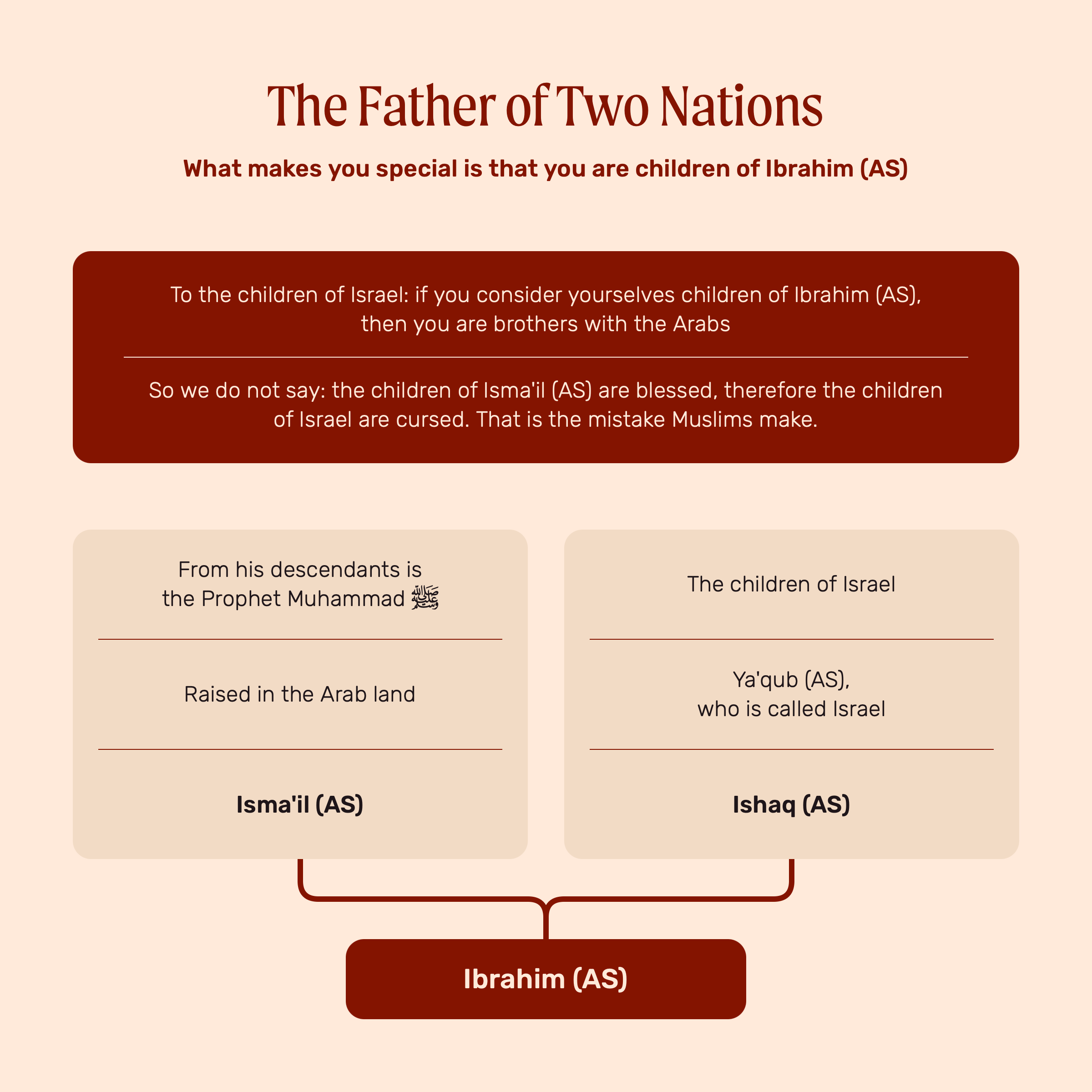
The primary reason the Israelites rejected the Prophet ﷺ is that he did not belong to the blessed family of the children of Israel. Revelation is a gift given to the children of Israel. These are the chosen people of God. God has made special promises to this nation and the other children of Abraham are kind of condemned. As a matter of fact, in biblical and Jewish literature, Isma’il (AS) is not only considered illegitimate but a child who will have evil offspring. This is actually taught off the pulpit. Isma’il (AS) was raised in the Arab land and from his descendants is the Prophet Muhammad ﷺ, so there is no way, in that view, that a child of Ishmael could be receiving revelation.
What is Allah telling the Israelites by going over to Ibrahim? Listen, if you have respect for Ibrahim (AS), you should have respect for all of his lineage. By the way, the other name of Israel is Ya’qub (AS). Before you consider yourselves children of Israel, you should consider yourselves children of Ishaq (AS), who is his father. As you consider yourselves children of Ishaq, you should consider yourselves children of Ibrahim (AS). If you consider yourselves children of Ibrahim, then you are brothers with who? The Arabs. There is no reason for you to think that ethnically, by race or by descent, you are somehow more special than the children of Isma’il, because both of you are tied directly to what makes you special, which is that you are children of Ibrahim (AS).
So Allah is taking them back to the source and the source is Ibrahim (AS). That is why he is the father in my title. He is the father of two nations: the children of Isma’il and the children of Ishaq and through Ishaq, Ya’qub, who is called Israel. The father of both of those lines is him. As far as revelation is concerned, he is in a sense the second Adam. Adam (AS) was told about revelation in the beginning and Ibrahim (AS) is the one from whose descendants revelation will continue on the earth.
Allah tells us about Ibrahim (AS) and his interactions with both of his lineages, which is pretty cool. We are going to see that in this passage. He is going to have love and adoration and prayers with his son Isma’il and their generations and then Ya’qub and Ibrahim will share a prayer also. So both lines are covered beautifully.
That is so we do not say: now the children of Isma’il are blessed, therefore the children of Israel are cursed. That is the mistake Muslims make. We blame the Israelites because they hated the children of Isma’il, but we have become no different. Now we say: look at these Jews, look at these Banu Isra’il, look at what they did, look at how the Quran complained about them. These are definitely inferior people. As a matter of fact, the word “Jewish” has become like a foul word in some Muslim circles. That is exactly the same mistake they made.
Part Five: The Ka’bah
Part five is the Ka’bah. What happens with Ibrahim (AS) is that he raised the foundations of the Ka’bah and now the Muslims are told that they are going to pray once again in the direction of the Ka’bah.
They used to pray in what direction? Toward Jerusalem, because the Prophet ﷺ was told to confirm what was given before him and what was given before him was the tradition of Musa (AS). So he was applying whatever had not been negated from that tradition. Then Allah says: now you must pray in the direction of the Ka’bah. That makes total sense, because you just introduced Ibrahim and Ibrahim (AS) raised the foundations of the Ka’bah. Built is not the right word. He raised its foundations.
So now the Ka’bah is declared the original house that both families should have respect for, Banu Isra’il and Banu Isma’il, because they have a common father, Ibrahim (AS). That is why restoring the place of the Ka’bah was so significant. It determines who truly had loyalty to Ibrahim (AS), who truly is on the religion of Ibrahim: millata abikum Ibrahim (مِّلَّةَ أَبِيكُمۡ إِبۡرَٰهِيمَۚ),1 the religion of your father Ibrahim. If the Israelites really want to claim him, they should claim the house whose foundations he raised.
The Ka’bah is not only the direction of prayer. In a spiritual and religious sense, it is actually the capital of the ummah. We keep putting our direction back toward the Ka’bah all the time and it lives in our hearts. We long and yearn to visit that spiritual capital, because we have affinity with our father, Ibrahim (AS).
Part Nine: The Du’aa
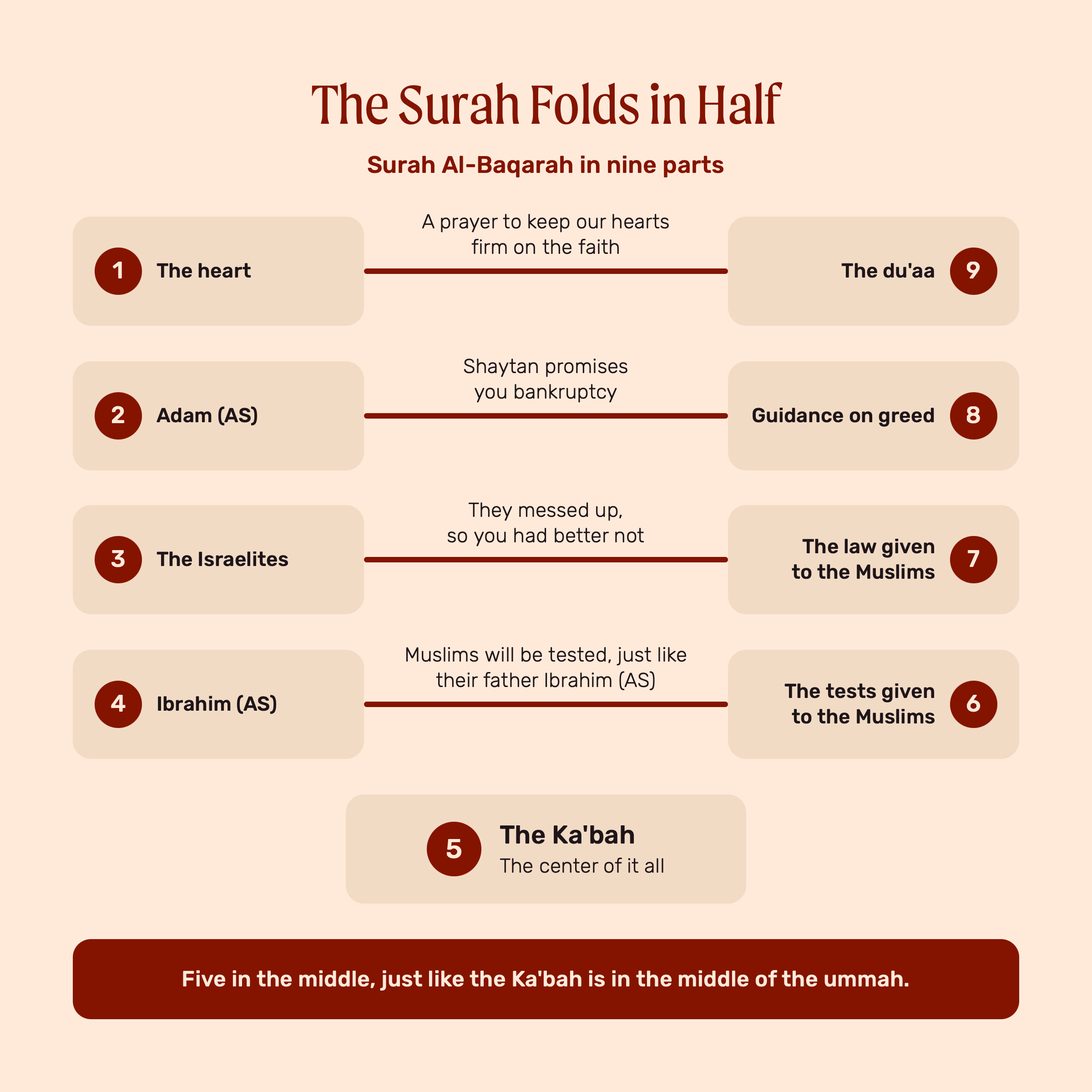
Let us start over, because I want you to be able to walk out of here and tell somebody the nine parts of Baqarah off the top of your head. One, the heart. Two, Adam (AS). Three, Bani Isra’il. Four, Ibrahim (AS). Five, the Ka’bah. Six, the tests given to the Muslims. Seven, the laws given to the Muslims, the Shari’a of Islam. Eight, guidance on greed.
Number nine is the du’aa, a prayer to Allah to secure our faith and not let our hearts fall into disbelief, the way some people before us became hypocrites. It ends with fansurna ‘ala al-qawmi al-kafirin (فَٱنصُرۡنَا عَلَى ٱلۡقَوۡمِ ٱلۡكَٰفِرِينَ).2 It is a prayer to preserve our iman. It validates our faith, which lies in our hearts, right from its beginning: amana al-rasulu bima unzila ilayhi min rabbihi wal-mu’minun (ءَامَنَ ٱلرَّسُولُ بِمَآ أُنزِلَ إِلَيۡهِ مِن رَّبِّهِۦ وَٱلۡمُؤۡمِنُونَۚ).3 Then we make du’aa to Allah: whatever tests You give us, whatever load You put on us, do not put a load on us that we cannot handle like the people before us. Do not make us failures like the people who came before us. Make us pass the test this time.
The Surah Folds in Half
Before I let you go, here is the fun part.
The first section was about the heart and within it there were three kinds of people: believers, disbelievers and hypocrites. In the ninth section we made a prayer to secure faith in our hearts and asked Allah that we not fail when instructions are given to us, because the people who do not carry Allah’s instructions, even after coming to believe, end up becoming hypocrites. At the end of it all we said: aid us against the disbelieving nation. The first section was about the heart and the ninth is a prayer to keep our hearts firm on the faith. The first and the ninth are directly tied to each other.
What was the second section? Adam (AS) was sent to the earth as a khalifah. But what was the act? He ate from the tree. Iblis somehow got him to eat from the tree, which you can summarize in one word as greed. Now go backward from the other end. What is section eight? Allah’s guidance on greed. Within it, Allah says something really interesting: al-shaytanu ya’idukumu al-faqr (ٱلشَّيۡطَٰنُ يَعِدُكُمُ ٱلۡفَقۡرَ),4 Shaytan promises you bankruptcy. Has Shaytan ever promised bankruptcy to anybody before us? To Adam (AS), in section two. Section two and section eight mirror each other and complete each other.
Section three: the Israelites were given a lot of instructions and they did not uphold them. Even after Allah sent them revelation after revelation of what is permissible and impermissible, what they must do and what they should not do, they kept jumbling it all up, even the simplest and clearest instructions. They violated the law of Allah given to them. Now work backward. What is section seven? The law given to the Muslims. They messed up, so you had better not. The law given to the Israelites is contrasted directly with the law given to the Muslims. Isn’t this insanely cool?
Section four: Ibrahim (AS), who passes all of his tests and then Allah makes him an imam over all people. That is the passage we are going to study. Working backward from the other side, what is section six? Muslims will be tested, just like their father Ibrahim (AS).
One and nine, two and eight, three and seven, four and six. What is left? Five, in the middle. Just like the Ka’bah is in the middle of the ummah, the center of it all. SubhanAllah. That is Surah Al-Baqarah and we are on section four. With that introduction to what this surah is and how it is organized, we will get into the passage itself after the break.
This is the first part of the story night and the parts that follow carry it to its end. Study God’s Promise to Prophet Abraham with Ustadh Nouman Ali Khan on Bayyinah TV
Notes
This post is adapted from the first part of the God’s Promise to Prophet Abraham story night, Father of Two Nations, taught on Bayyinah TV by Ustadh Nouman Ali Khan and is written in the voice of that session. Every teaching claim, example and aside in it is taken from the session itself.
[1] Al-Quran, Surah Al-Hajj, 22:78, https://quran.com/22/78
[2] Al-Quran, Surah Al-Baqarah, 2:286, https://quran.com/2/286
[3] Al-Quran, Surah Al-Baqarah, 2:285, https://quran.com/2/285
[4] Al-Quran, Surah Al-Baqarah, 2:268, https://quran.com/2/268

At Bayyinah, we are dedicated to helping you connect directly with the words of Allah beyond translation. Founded by Ustadh Nouman Ali Khan, our mission is to create transformative experiences that deepen your understanding and engagement with the Quran.
Study the Quran and Arabic in a systematic and personalized way through Bayyinah TV. Get started today for free.
Check out our newest articles, fresh off the press and ready for you to dive into!