
Successful subscription! Thank you for subscribing.
Successful subscription! Thank you for subscribing.

November 24, 2026
I just want to start by asking Allah to make this a beautiful evening for all of us and that Allah accepts it for this life and the next life.
You have heard the story of Yusuf (AS) many times before, but tonight we are going to hear it a little bit differently. Some of you are thinking: but I already know that story. No, you do not. Let us find out today what you and I do not realize about it.
Dad, I Love You
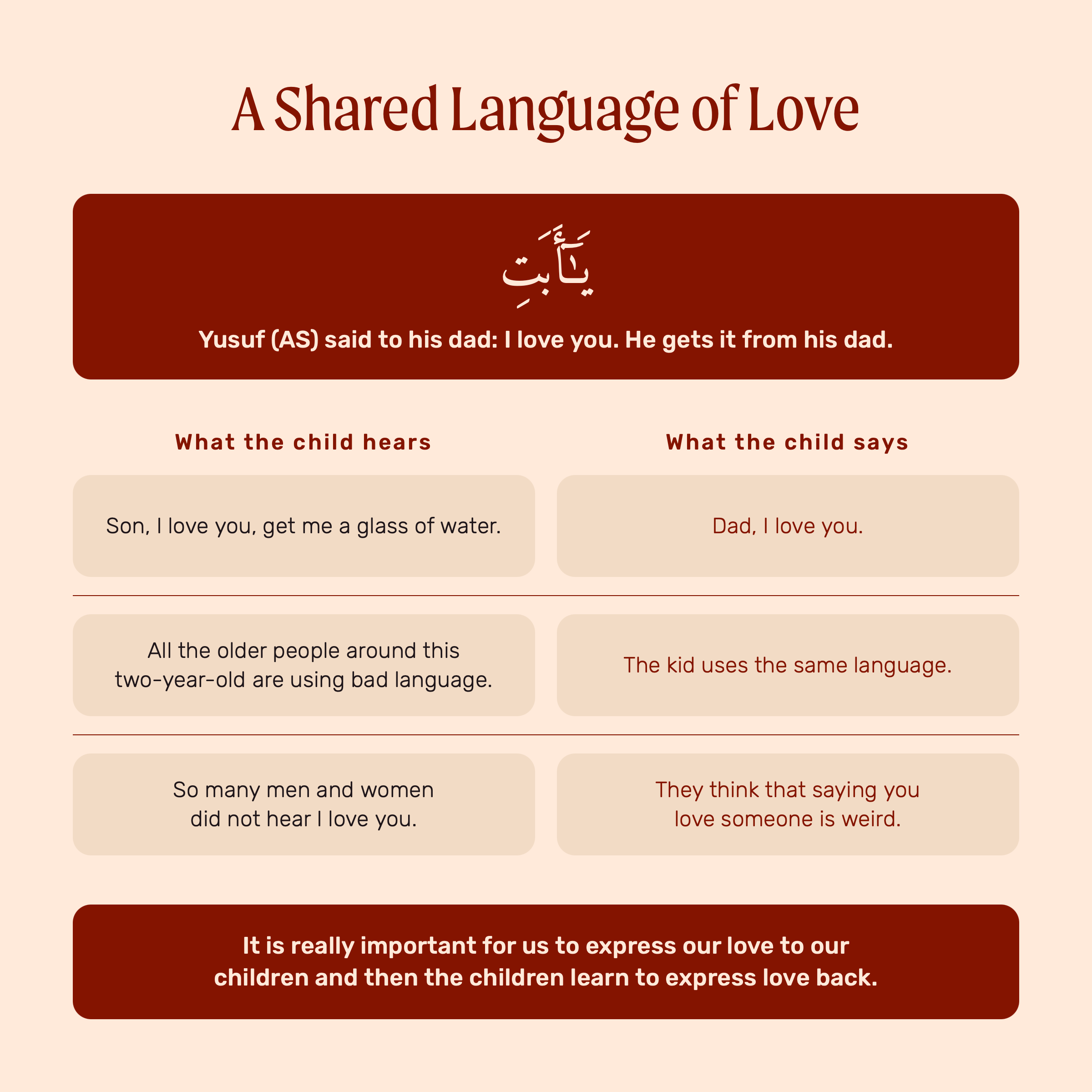
Allah introduces this story to the Prophet ﷺ and the Prophet ﷺ does not know anything about Yusuf yet. Allah says to him: here is what you need to know first. Idh qala Yusufu li-abihi ya abati (إِذۡ قَالَ يُوسُفُ لِأَبِيهِ يَـٰٓأَبَتِ).1 When Yusuf said to his father: dad, I love you.
In some English translations they usually translate ya abati as “my beloved father.” The problem with that translation is that you do not use that English anymore. You do not tell anyone “my beloved son, turn the TV off.” Nobody says that. You say things like “I love you.” So I am going to give you a modern translation of ya abati (يَـٰٓأَبَتِ): dad, I love you.
This is the first thing Allah wanted to tell His Prophet ﷺ about the story. The first thing the Prophet ﷺ learns is that a child came to his dad and said: I love you. You could just say ya abi, but when you add that ending, it becomes a statement of love.
So let us think about that for a second. How many of you normally turn to your father and say, “Hey dad, I love you”? Not normal. Even if you decide today that you are going to text him right now, “I love you, dad,” what is he going to say back? It is weird. We do not do it.
Let us take it a step further. I watch a lot of TikTok, to learn and one time I saw a video of a child, a two-year-old, cursing so badly. People found it so funny. It was so disturbing: a child using filthy language.
But the question is, where did the child learn to speak like that? The parents, the elders, the older brother, the older sister. All the older people around this two-year-old are using bad language and the kid uses the same language.
When Yusuf said to his dad, “I love you,” where did he get it from? He gets it from his dad. His dad always tells him: Yusuf, I love you. Son, I love you, get me a glass of water. Son, I love you, let us pray together. Son, I love you, it is time to go to sleep. Dad keeps saying I love you and Yusuf learns that when he has to talk to dad, the first thing he should say is: dad, I love you. Then he speaks. They both share a language of love with each other.
I Called My Sister
That makes me ask a question and I ask the men in the audience especially: how many of you grew up with your dad telling you he loved you all the time? Son, I love you. I am so proud of you. Did you hear that all the time?
No. Actually, I love my dad and my dad loves me and I did not hear it either. So I thought maybe I am just weird. I called my sister and said: hey, does papa say he loves you? Do you remember him saying it at all when you were little? She said no. So then I asked the stupid question: how do you know he loves you? She goes: I don’t know, he does. That is it.
That is the most common answer in the Muslim world to “does your dad love you?”
The first lesson we are learning is that it is really important for us to express our love to our children and then the children learn to express love back. For so many men and so many women also, they did not hear “I love you.” They did not hear “I miss you.” They did not hear words of love and you know what happens? They think that saying you love someone is weird.
Then that same young man gets married one day and his wife says, “I love you,” and he looks at her like: was I supposed to say something? Uh, me too. He does not know how to express love, because he never learned it. Can we talk about something else?
Five Ways of Showing Love
Psychologists now talk about different ways you can show love, so we are going to talk about them. Just try to remember five ways of showing love.
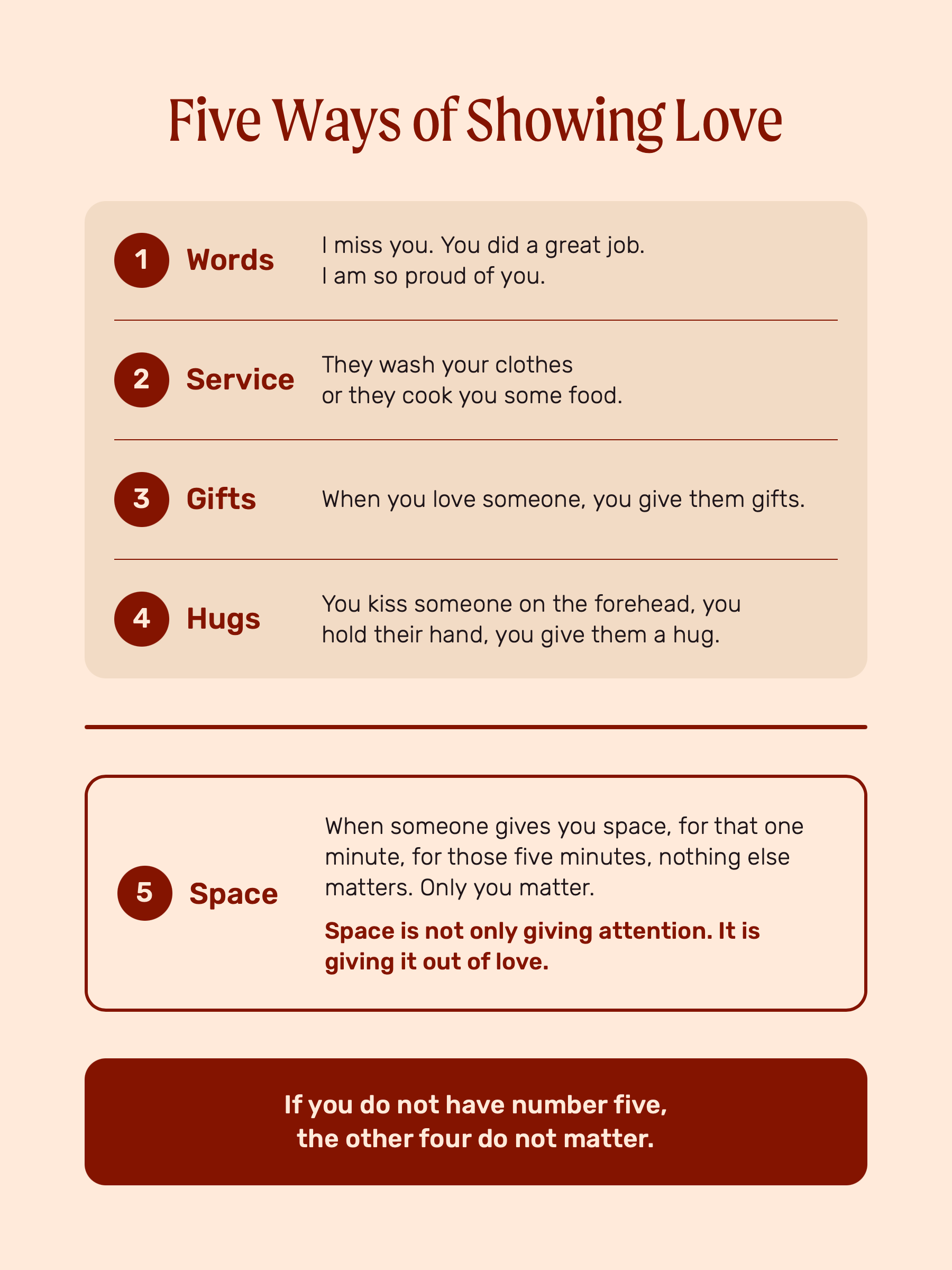
The first one we already talked about: saying it. Words. Words are the first way to show love and it is not just “I love you.” It is things like “I miss you,” “you did a great job,” “I am so proud of you,” “you mean a lot to me.” Acknowledgment and kind words. Those are all words of love, words of affirmation.
By the way, there is one extreme I want to warn you of. Some people hear this and say: that is it, I am going to tell my child I love them, I am going to tell them they are perfect. So they tell their daughter: you are the princess, you are the greatest, you are the best. This little girl turns into a mini Fir’awn. That is not what I mean. You should give love, but you should not create a false sense of self.
Service and the Eggs That Say I Love You
The second way is to do some kind of service.
I know this does not happen in Jakarta. In fact, it does not even happen in Indonesia. It only happens in Malaysia. There are some mothers in Malaysia who are so mean. They say the meanest words, but they make you the best breakfast at the same time. They are telling you: you are so stupid, why can’t you be like your sister, I am so disappointed in you. Eat your eggs.
The words they say sound like “I hate you,” but the eggs are saying what? I love you. There are people whose words are so full of hate, or so empty of love, but they do some service for you. They wash your clothes, or they cook you some food.
For that kind of mother, what is in her mind? Listen, I make the eggs. The eggs are saying I love you for me. I do not need the words.
Gifts and the Lollipop
The third one is gifts, because when you love someone, you give them gifts.
The problem with some people is that they have a really difficult relationship. There is a lot of fighting and arguing and then to fix the whole thing, what do you do? You get a gift. Hey, I got you some strawberry ice cream. When you get a gift, all those other problems are supposed to disappear. The next time you have an argument you can say: remember the time I got you a lollipop? You cannot even appreciate anything.
The gift is proof that I love you. I do not have to have words of love. I do not have to have service. Actually, for some parents, the only relationship they have with their children is gifts. That is why the kids come running to dad: can I have ten dollars? When they get older: can I have the keys to the car? The only thing they need from you is the gifts and when they get old enough, they can afford their own gifts. So now they do not come to you. They have no reason to come to you.
Hugs and Social Distancing Before COVID
The fourth one we will call hugs. Physical affection. You kiss someone on the forehead, you hold their hand, you give them a hug. You physically show love.
In some cultures it is considered bad to show love physically. What happens in many cultures is that the most you will do with your dad is shake his hand. That is it. You already had social distancing with your father before COVID. There is no affection, no “sit next to me,” no “let me put my arm around you.”
The Fifth One Multiplies Everything by Zero
So now we have got four: words, service, gifts and hugs. The last one is so important that if you do not have it, the other four do not matter. You can have all four and it will not be enough. It will be multiplied by zero if you do not have number five.
A friend of mine and I made up a word for it. We call it space. Let me explain what space means.
Let us say you have a sister and her name is Zainab. You go to Zainab and say: hey Zainab, I have a job interview tomorrow, I am really nervous about it, can we talk about it? Zainab is like: mhm, yeah. Zainab, it is a really important job interview, can I just get your attention? Yeah, yeah, I am listening. Zainab, can you put your phone down and look at me for one minute? Zainab says: go ahead, I am listening.
You know what just happened? You were trying to get Zainab to give you space. When someone gives you space, it means that for that one minute, for those five minutes, nothing else matters. Only you matter. It is not the same as paying attention. When Zainab said “I am listening,” she was paying attention, but she still was not giving space. Space means you are not only giving attention, you are giving it out of love. The person who wants that space from you feels completely safe when they talk to you.
Here is an exercise, for yourself. When something bad happens to you, you pick up your phone and there is someone you want to text right away or call right away. That is the person you get space from. There are some people where somebody says “why don’t you talk to your wife, your dad, your brother?” and you say: are you crazy? Have you met my wife? Have you met my dad? Have you met my brother? In other words, there are people in your life you know you love, but you know they cannot give you space.
Yusuf Went Straight to His Dad
The reason I spent so much time on this is that when Yusuf (AS) came to his dad, his dad did not have to say “tell me what you are thinking.” Yusuf went himself. His first thought was to go to dad and say: dad, I love you. “Dad, I love you” could also be code for “dad, I need your space right now.”
The moment dad hears that, he puts away his phone. He stops his ‘ibadah. He stops everything else and turns a hundred percent to his son. The son says: I saw some stars, I saw the sun, I saw the moon and they were all doing sajdah.1 It really bothered me and I needed to talk to someone about it and the first person I should talk to is you.
The fact that we do not think of our fathers when something is bothering us, you know what that means? This part of the Quran got abandoned in the ummah. This is Quran. The Quran is teaching fathers and sons to have this kind of relationship and the real responsibility is on the father to provide the space.
This is the first part of the story night and the parts that follow carry it to its end. Study Prophet Yusuf: Rise Above with Ustadh Nouman Ali Khan on Bayyinah TV
Notes
This post is adapted from the first episode of the Prophet Yusuf story night, Rise Above, taught on Bayyinah TV by Ustadh Nouman Ali Khan and is written in the voice of that session. Every teaching claim, example and aside in it is taken from the session itself. This post covers the first episode only and ends before the story itself moves past the dream.
[1] Al-Quran, Surah Yusuf, 12:4, https://quran.com/12/4

At Bayyinah, we are dedicated to helping you connect directly with the words of Allah beyond translation. Founded by Ustadh Nouman Ali Khan, our mission is to create transformative experiences that deepen your understanding and engagement with the Quran.
Study the Quran and Arabic in a systematic and personalized way through Bayyinah TV. Get started today for free.
Check out our newest articles, fresh off the press and ready for you to dive into!