
Successful subscription! Thank you for subscribing.
Successful subscription! Thank you for subscribing.

November 19, 2026
A student spends a year learning Arabic, works hard at it, finishes the course and then opens the Quran expecting something to have changed, except that very little has. The frustration that follows usually gets turned inward, and the student quietly concludes that they are not good at languages.
The real explanation is almost always simpler than that, because they did learn Arabic; they just did not learn the Arabic the Quran is written in, and nobody ever explained to them that these are two different projects.
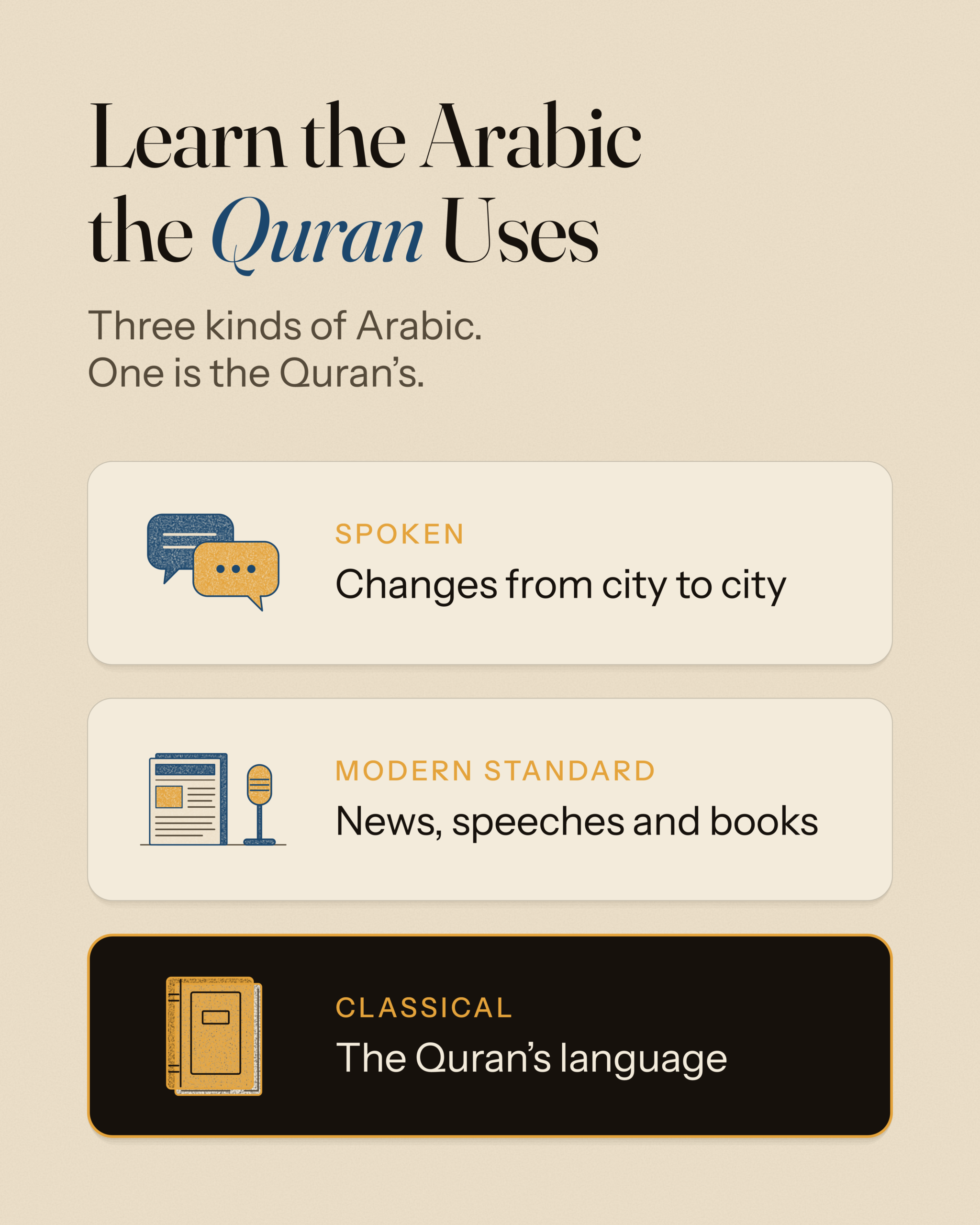
There are three kinds of Arabic, not one
The word “Arabic” covers at least three distinct things, and knowing which one you are studying can save years of misdirected effort.
The first is spoken Arabic, the language of the street, which changes from country to country and often from city to city, so that someone who learns Egyptian will struggle in Morocco and someone who learns the Gulf dialect will hear something quite different in Sudan.
This is not unique to Arabic, since English does exactly the same thing. Americans ask for water, and depending on where you are standing it comes out as water, wader or wooder, while a soda in one state becomes a pop two states over, and asking for either in England may get you offered a fizzy drink, which will stop you entirely the first time you hear it. Spoken Arabic is genuinely useful, so if you are traveling to Cairo then by all means learn Egyptian, but it is not what the Quran is written in.
The second is Modern Standard Arabic, usually called fusha, which is the shared formal register used across the Arab world in newspapers, on Al Jazeera, in speeches and in most books published over the last century. Anyone educated in Arabic can read it regardless of which dialect they grew up speaking, which makes it a serious accomplishment and a genuinely useful one. It is also still not the language of the Quran.
The third is classical Arabic, the language of the Arabs before Islam spread across continents, preserved deliberately by scholars who understood what would otherwise be lost. This is the Quran’s language, and it is considerably richer and denser than what came after it. If classical Arabic is an entire pizza, fusha is one slice of it.
Why the difference is not a technicality
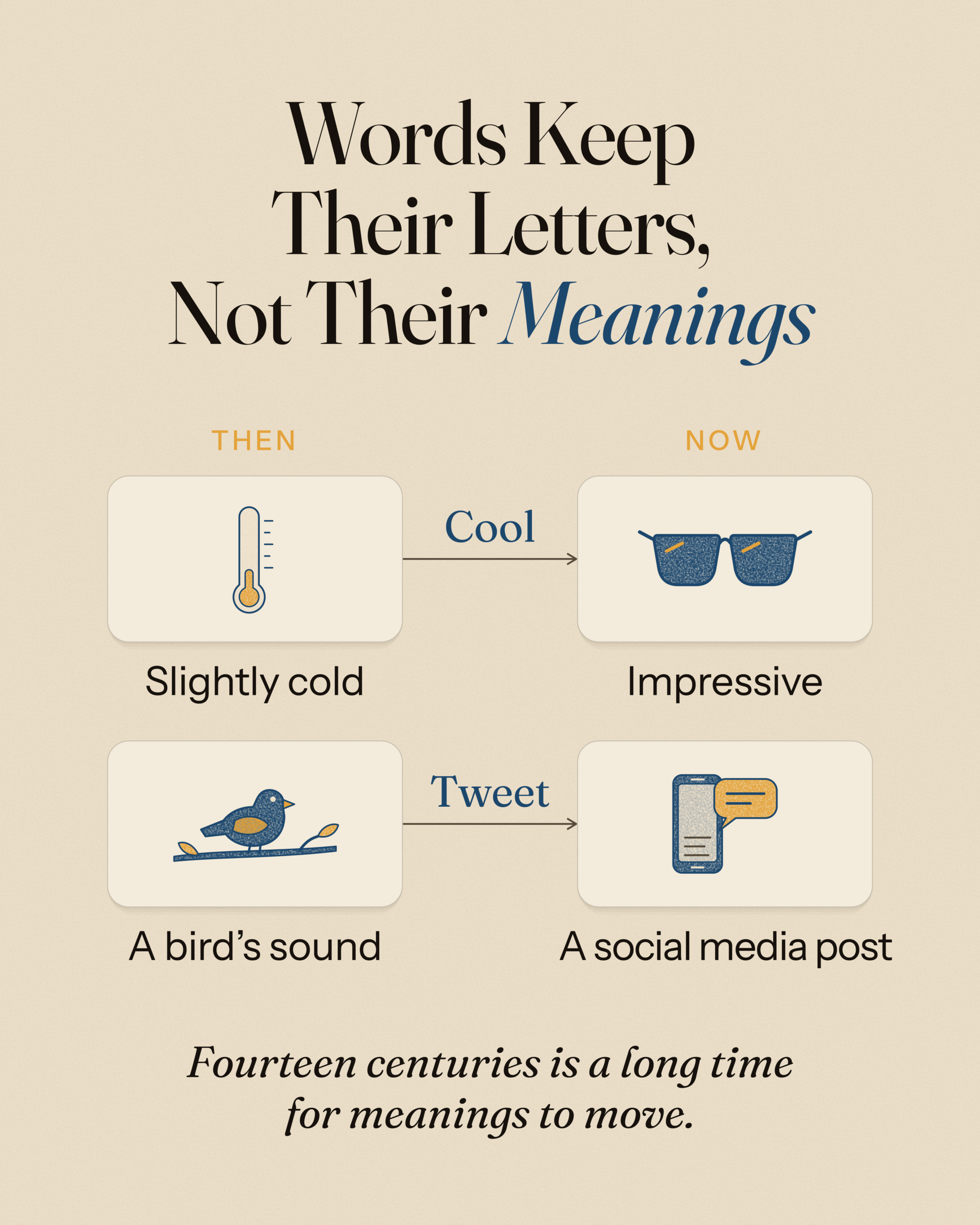
Languages drift over time, with the letters staying exactly where they are while the meanings underneath them move, and fourteen centuries is a very long time for that to happen. English gives us the easiest examples, since calling something cool two hundred years ago meant only that it was slightly cold, and telling someone in 1985 that the president had tweeted something would have left them with no idea what you were describing. The words are not new; their meanings are.
The same process has run right through Arabic, which is why knowing fusha well does not mean you know what an ayah is saying. You may know a word’s current meaning perfectly and still miss entirely what it carried at the moment it was revealed.
This is also why classical Arabic was preserved with such care. Scholars traveled into the desert and sat with Bedouin communities, documenting how particular words were used, which expressions went together and what a term meant in practice rather than in theory. Open a classical Arabic lexicon today and you will not find a one line definition; you will find the history of a word, the poetry it appeared in and the shades of meaning it carried across different usages.
The science and the skill
There is a second distinction that matters at least as much as the first, and almost nobody draws it for new students.
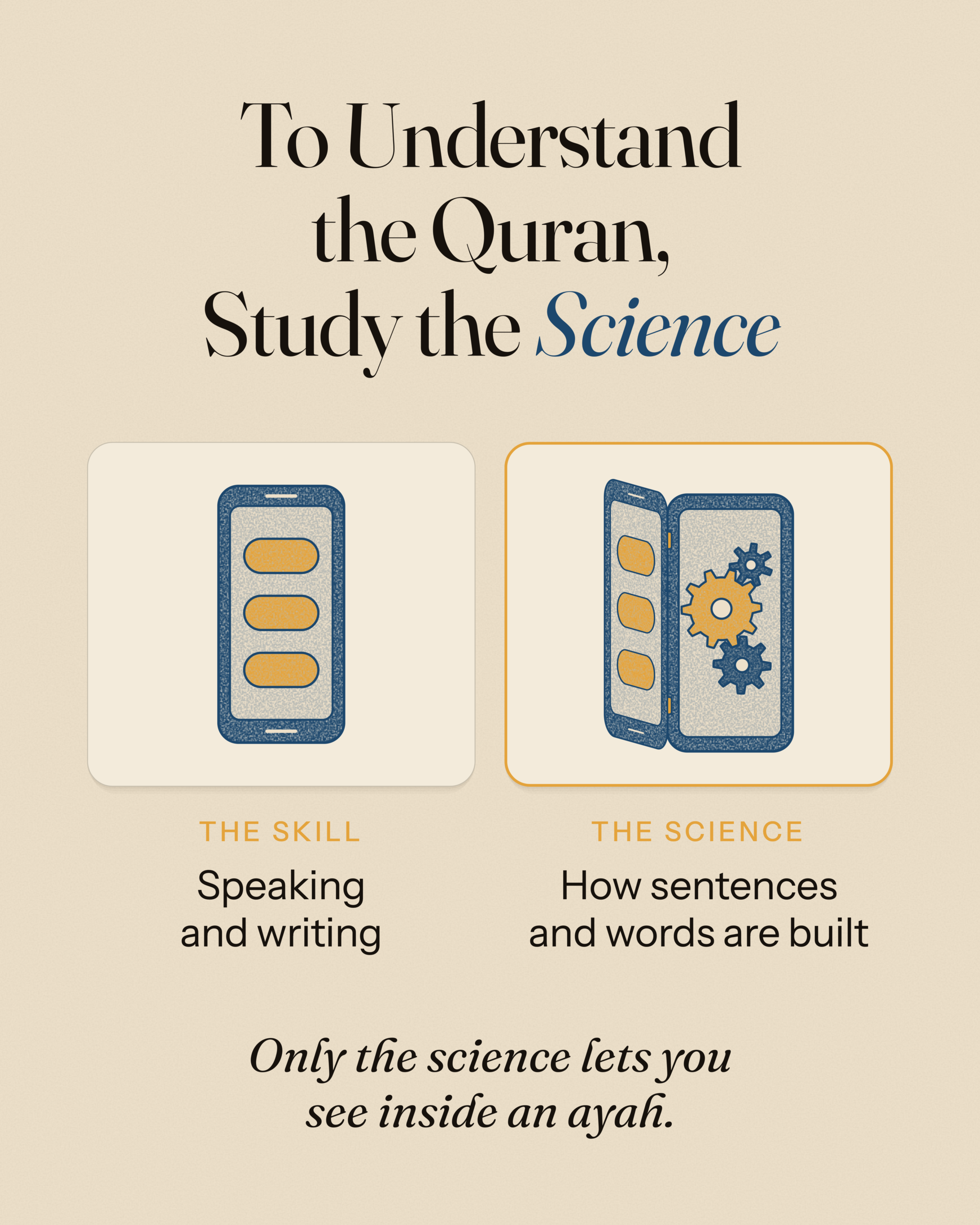
You can study Arabic as a skill, meaning reading, writing, listening and speaking, which is what a university language program teaches and what most people mean when they say they want to learn Arabic.
You can also study it as a science, meaning how the language is built: how a sentence holds together, so that you can tell who is doing what to whom in an ayah, and how a word is constructed from its root, so that a word you have never seen before stops being a stranger. The Arabic tradition calls these nahw and sarf, though the names matter far less than what they let you do.
Ustadh Nouman describes the difference using software, pointing out that everyone who uses an application sees the buttons while a programmer sees the engine underneath, and that studying Arabic as a science means studying the engine.
Here is the comparison that tends to settle the question. Take two people, give each of them a year, and have one study the skill while the other studies the science. After that year the first can hold a thirty minute conversation, write emails and follow a lecture in Arabic, while the second can do none of those things and could not order a shawarma to save his life. Now hand them both a verse of the Quran and ask what is happening inside it, and only one of them can answer.
Choosing on purpose
None of this is an argument that the skill is worthless. It is an argument for knowing which of the two you are buying before you spend a year on it.
People have gone abroad for six months, come home able to converse comfortably, impressed everyone around them and still could not break down a single ayah, because nobody ever taught them the science. That is not a failure of effort on their part. It is a mismatch between what they wanted and what they were given, and it was avoidable.
So the honest framing is this: if your goal is to speak with Arabs and travel comfortably, study the skill and study it properly, but if your goal is to stand in salah and understand what is being recited to you, begin with the science. The second path is also more finite than most people expect, since the foundation of Quranic Arabic is a defined body of material rather than an endless ocean.
Some students work through it in a couple of months and others take three years, and the calendar matters far less than the hours. You are not being asked to learn Arabic so much as to do one specific thing, and that thing has an end.
Start with the foundation. Explore the Bayyinah Arabic app and begin with the first lesson.

At Bayyinah, we are dedicated to helping you connect directly with the words of Allah beyond translation. Founded by Ustadh Nouman Ali Khan, our mission is to create transformative experiences that deepen your understanding and engagement with the Quran.
Study the Quran and Arabic in a systematic and personalized way through Bayyinah TV. Get started today for free.
Check out our newest articles, fresh off the press and ready for you to dive into!