Successful subscription! Thank you for subscribing.
Successful subscription! Thank you for subscribing.

November 2, 2026
I do not want to make this session long. I just want to give you an introduction to the things we are going to be doing.
I decided to call this series Striking Examples.
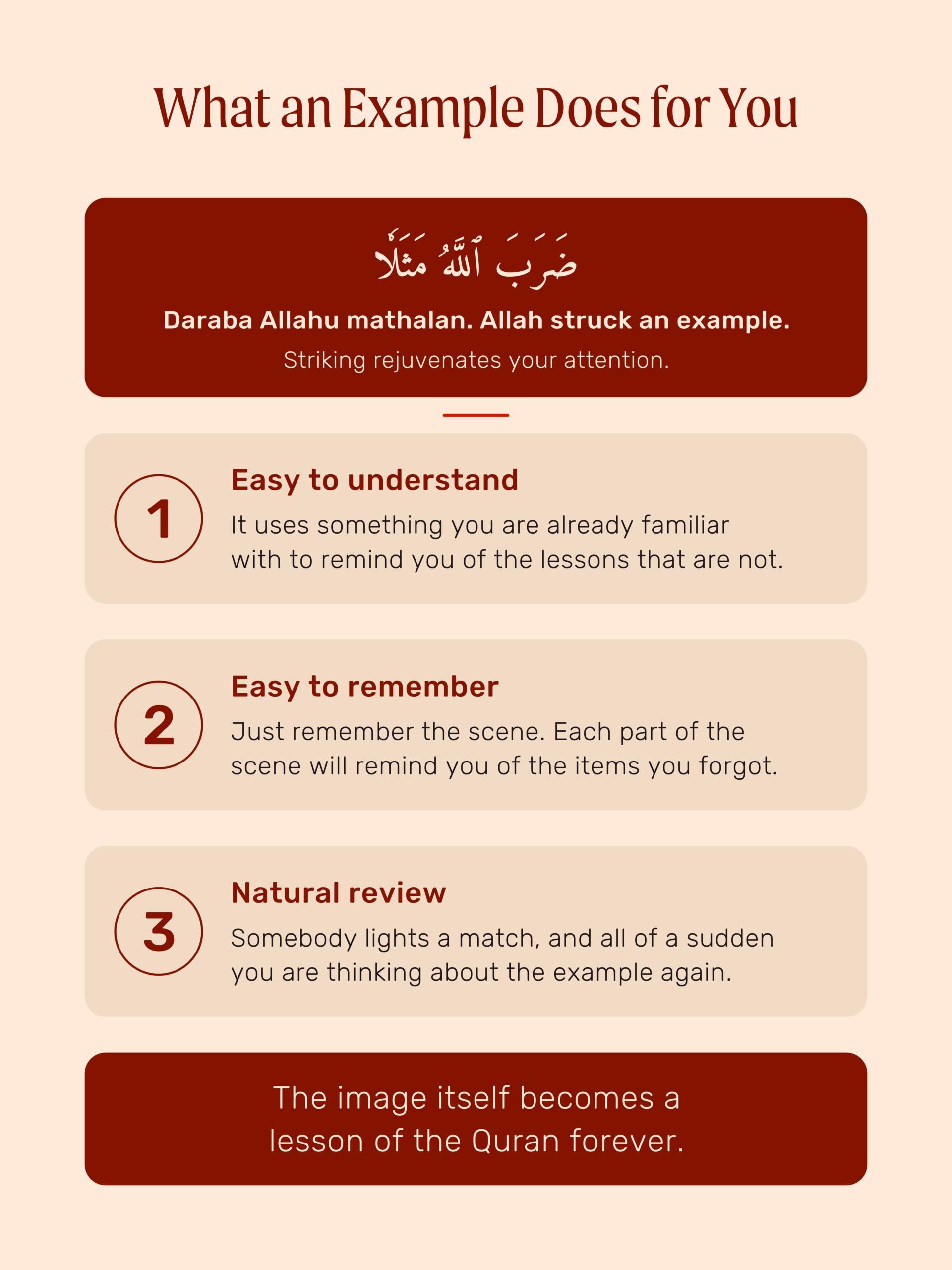
I chose that name because it is inspired by a phrase Allah uses in the Quran, in a few different varieties. Daraba Allahu mathalan (ضَرَبَ ٱللَّهُ مَثَلٗا). Allah struck an example. Quite literally, struck. That is how Allah strikes examples.
Now that sounds strange even in English. We give an example. We do not strike an example. A teacher does not strike an example. He gives one.
So what is this expression doing in the Quran? What is it for?
Nobody Strikes an Example
First let us understand how striking works.
The idea of striking something is to create a sound that is sudden. Shocking. New. Unexpected.
If I, out of nowhere, did that, all of a sudden, what just happened? Even somebody out there stops in the middle of their conversation. What is going on over here?
The idea of striking is to get immediate, spontaneous attention.
In the middle of a class, teachers do not strike an example, but they do strike the table. In some countries, they strike the student. Either way, everybody’s attention comes back.
Or take the courtroom. A proceeding is going on, the lawyer says something or the witness says something and suddenly the whole courtroom is talking. You are not supposed to be talking in the courtroom. So what does the judge have to do? He strikes the hammer to shut everybody up. Order. Order.
Striking rejuvenates your attention. It pulls you back, because now something really fundamental and essential is about to be said.
But Allah Is Already Talking
Here is the question that follows from that. Allah is already speaking in the Quran. The speech is already going on.
The first example we are going to dive into tomorrow is ayah seventeen of Surah Al-Baqarah.1
Think about what that means. A couple of pages of Quran have already gone by. The people listening have been listening from the beginning. Then, all of a sudden, Allah strikes an example.
What is the purpose of that?
You know how you say the final nail in the coffin. The icing on the cake, if you will. The final touch.
This is actually one of Allah’s methodologies in the Quran. He explains something that is very important and that thing is made up of multiple parts, which means it is easy for you to forget.
The Grocery List Problem
Ramadan is here, so many of you had to go do groceries. Special groceries, because we want to make sure we gain weight this Ramadan.
You get sent out with an instruction. Get this, get this, get this, get this, get this. Immediately you say, can you just text it to me? Because that is not going to happen. I am not a hafiz. You want me to know all of this?
That is the problem. When there is a long thing and especially when it is important, it is easy for you to lose sight of what you were supposed to remember.
So here is what Allah does and it is really interesting. He takes multiple lessons that were just taught and He ties them together. He fuses them and presents them as one example.
An Example Is Never New Information
An example is supposed to be so simple. It is supposed to be something you are already familiar with.
The example is not some new lesson. That is the whole point of it. It is only effective if you are already familiar with it. Allah is using something that is already familiar to you to remind you of the lessons that are not.
Every One of Them Is a Scene
Here is the thing I want you to remember. What is the common thread between all of the examples? All of them.
All of them are painting a scene.
It is like a painting. In our culture you could even think of it as a movie clip. In ancient times you might have said it is a picture, but it is actually a moving image.
Tomorrow you are going to see the image of somebody in the middle of a desert. It is dark. It is cold. It is scary. He is rubbing a couple of rocks together, a couple of sticks together, trying to start a fire out there and he is getting desperate, because it is getting more and more dangerous. Hypothermia can set in. There are predators. Snakes. He does not know what dangers lie around him.
Eventually he gets that fire started.
Then the scene begins.
That is ayah seventeen. Before that, Allah is talking about a lot of things that built up and then He brings up the scene. So now it is up to you to understand which part of the scene is reminding you of which of the ayat that came before it, so you can make an easy mental connection with all of those lessons.
Once you do that, that image itself becomes a lesson of the Quran forever.
The Fly That Ruins a Religion
Another one comes to mind immediately. Allah is describing false gods.2
People used to worship idols. They used to believe there were spirits behind those idols, or that they represented children of God, all kinds of other crazy ideas. So they used to sacrifice animals in front of those idols. They used to pour the blood out in front of them. They used to bring milk and put it there. They used to put flowers on the idols and light candles, all of it to show reverence, to show respect.
The problem is, when you have flowers and blood and food and milk sitting out, what does that attract?
Flies.
Now here is the thing. If I went there as a tourist to the temple and I saw that somebody came with a lot of respect and put down a glass of chocolate milk and I said, oh, I like chocolate milk and I decided to help myself, I am going to get beaten up. I might even get killed. You cannot touch that. That is sacred. That is for the wooden, the marble, whatever statue.
But the fly comes. It flies over and has a look. That looks good, I am going to have some. Then it flies away.
The poor guy who is worshiping has to stand there going, hey. Hey. Come on. That is for my god. That is not for you. Come on, leave it alone. Please. Stop destroying my religion.
My god is not powerful enough to stop you from eating his food.
What is the fly doing? Every fly is destroying their religion.
So what does Allah do? He talks about false gods and then He gives you the example of a fly that takes the food away.
You could talk about the religion, the history of that religion, the theology behind it, their philosophy, their arguments and all of it. Or you could just remember the fly and problem solved.
The Difference Between a Teacher and a Good Teacher
The last thing I will share with you today is one more purpose of examples.
Every one of you has been to some kind of learning. You have been in some kind of classroom.
You know the difference between just any teacher and an amazing teacher?
An amazing teacher is able to give you really, really good examples.
He is teaching something and the students are saying, I do not get it, I do not understand. He says, hold on, let us look at this example. Let us break down this example. You say, I still do not get it. Okay, let me give you another example. Now it starts making sense.
Then the teacher even says, hey, when the test comes and you get this question, remember this example. Go through it in your head. Now you will know how to solve this problem.
Now notice this. The example does not benefit the teacher. The teacher already knows the material. The teacher does not have to use an example. The teacher could just say the concept.
You have some teachers who do exactly that. They just read from the book, or they just say the concept. No examples, no explanation, nothing. The test is on Friday. The rest is up to you.
But the teachers who give you one example, then another example, then another example, drill, drill, example, example, what are they doing?
These are the teachers who care about the student. They know that for this student, these examples might save their entire academic life. They are absolutely fundamental for them.
Allah Already Knows. The Examples Are for You.
Allah is al-‘Alim. He knows everything.
Interestingly, He tells us that He gives examples for the benefit of people, while He Himself knows all things.3
So beautiful. Somebody who already knows does not need examples. Somebody who needs to know, somebody who needs to understand, they need examples.
The point of that last comment is this. Allah is not just giving us information in the Quran. Allah is not just delivering wisdom to us in the Quran, or guidance to us in the Quran.
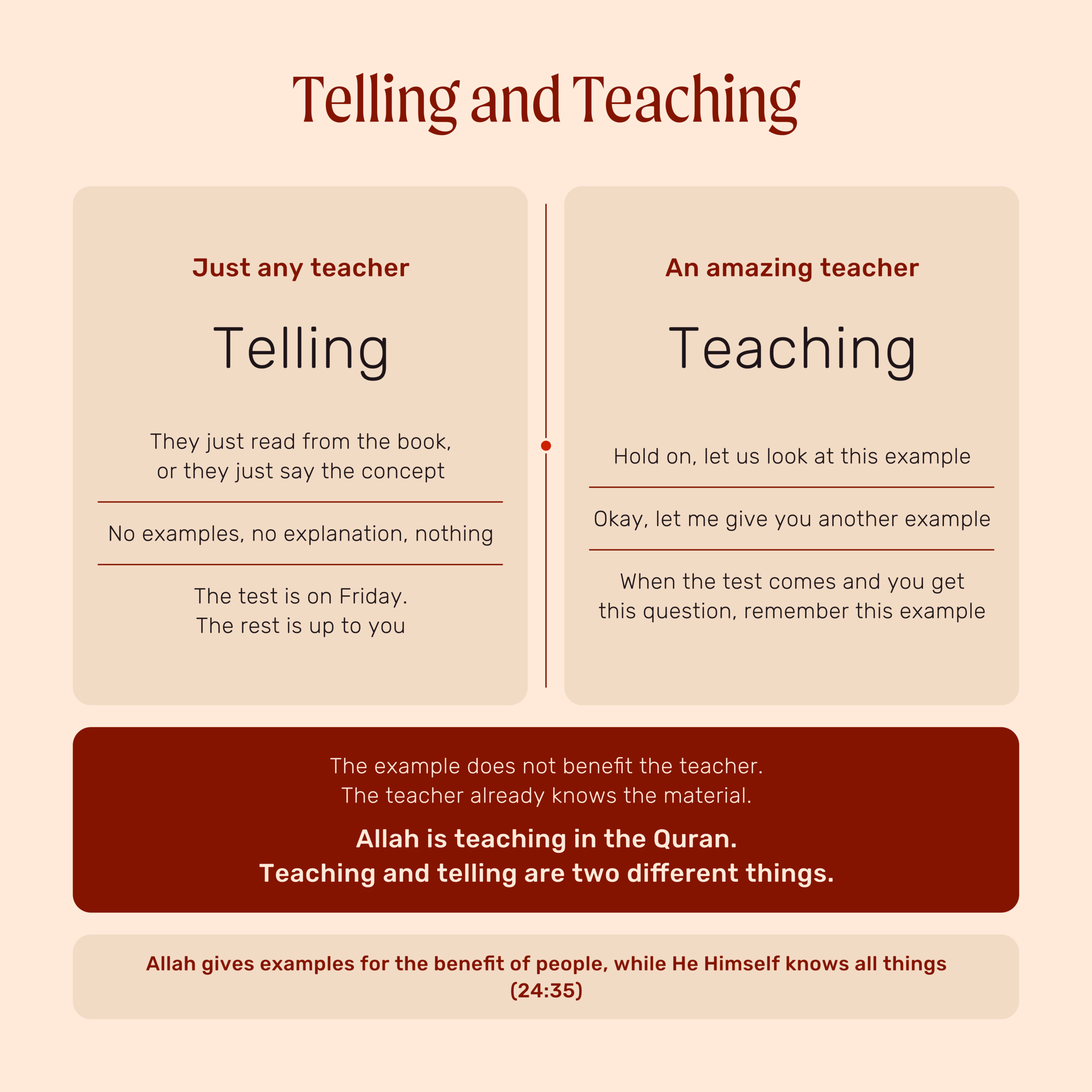
Allah is teaching in the Quran.
Teaching and telling are two different things.
A good teacher genuinely cares about the success of their student. A good teacher chooses the example they know is going to work for the student, the one that is going to benefit them, the one the student is going to remember and use to pass the hard test. A good teacher takes a lot of care and consideration planning the curriculum and especially the examples.
So when Allah gave us His final book, He even described it by saying that He taught the Quran.4 Throughout the history of the world, anybody who teaches anything uses certain tools and one of the most important tools they use is in fact examples.
That is one of the tools Allah has used in the arsenal of the Quran.
A Fly Can Give You a Halaqah
Why is it so fundamental? Because it has multiple benefits for the student.
One, it makes the concept easy to understand.
Two, it makes the concept easy to remember. If you do not remember it, just remember the picture. If you do not remember all the items, just remember the scene. Each part of the scene will remind you of each of the items you forgot. It is excellent for review. It is excellent for retention. It is excellent for understanding to begin with.
Three, it is excellent because next time you are walking around and you see somebody trying to light a fire, or somebody lights a match, or somebody flicks a lighter, or your mom turns the stove on. A fire got lit. All of a sudden your mind got triggered. Mathaluhum kamathali alladhi istawqada naran (مَثَلُهُمۡ كَمَثَلِ ٱلَّذِي ٱسۡتَوۡقَدَ نَارٗا). Oh my God. Yeah. Now you are thinking about it again.
It just becomes natural review for you, because those images tend to repeat themselves. Next time you see a fly sitting on your food, you are like, oh, I remember what was said about that.
You know one of the most amazing things about that? You are not even in a halaqah. You are not in the masjid. You are not sitting and reciting Quran. You are sitting there eating your food and a fly just gave you a halaqah from the ayat of Allah.
That is what happens because of examples. It is a deep benefit Allah has given us and it has made dhikr of Allah easier and easier for us.
So with that, I will conclude our first session.
This is the opening session and fifty-two more work through the Quran’s examples one at a time. Study Striking Examples in the Quran with Ustadh Nouman Ali Khan on Bayyinah TV: Bayyinah TV
Notes
This post is adapted from the opening session of Striking Examples in the Quran on Bayyinah TV and is written in the voice of that session. Every teaching claim, example and aside in it is taken from the session itself. The references below locate the ayat it quotes or works on.
[1] Al-Quran, Surah Al-Baqarah, 2:17, https://quran.com/2/17
[2] Al-Quran, Surah Al-Hajj, 22:73, https://quran.com/22/73
[3] Al-Quran, Surah An-Nur, 24:35, https://quran.com/24/35
[4] Al-Quran, Surah Ar-Rahman, 55:2, https://quran.com/55/2

At Bayyinah, we are dedicated to helping you connect directly with the words of Allah beyond translation. Founded by Ustadh Nouman Ali Khan, our mission is to create transformative experiences that deepen your understanding and engagement with the Quran.
Study the Quran and Arabic in a systematic and personalized way through Bayyinah TV. Get started today for free.
Check out our newest articles, fresh off the press and ready for you to dive into!