Successful subscription! Thank you for subscribing.
Successful subscription! Thank you for subscribing.

November 2, 2026
Today is going to be the hardest of these sessions.
Everyone here is Muslim, so I do not have to give you background about the Quran. The Bible is a different matter. I am not going to assume that everybody has a lot of background and my aim today is to hand you that background. Do not get overwhelmed by the details. The details are only there to illustrate the concepts.
We speak about the Bible as though it is one thing. There is no one single Bible. There are different Bibles depending on which religious tradition is doing the defining. So which one were you asking about?
The Jewish Bible and a Name That Should Stop You
Let us start with the Jewish canon, known as the Jewish Bible, or in academic literature most frequently as the Hebrew Bible.
The name most commonly used within Judaism today is the Tanakh and the word is really cool, because it is an acronym for the arrangement of the Jewish Bible into three sections.
First, the Torah, the first five books, traditionally ascribed to Musa (AS), telling the story from creation to his death and containing the laws given to him. Second, the Nevi’im, the prophets. From the Hebrew navi, written the same way as the Arabic nabi. Third, the Ketuvim, the writings, from katuv, just like the Arabic kitab, meaning something that is written.
There is another name for the Jewish Bible in Jewish tradition and this is the one that should stop you where you are sitting. It is Mikra, which means reading, or that which is read. It comes from the same Semitic root that gives you the word Quran, the root meaning to read or to recite. That name goes back all the way to the early rabbis before Islam. It is found in the Talmud. It was in fact the dominant name until sometime in the medieval or early modern period.
Four Ways the Christian Old Testament Is Not the Same Book
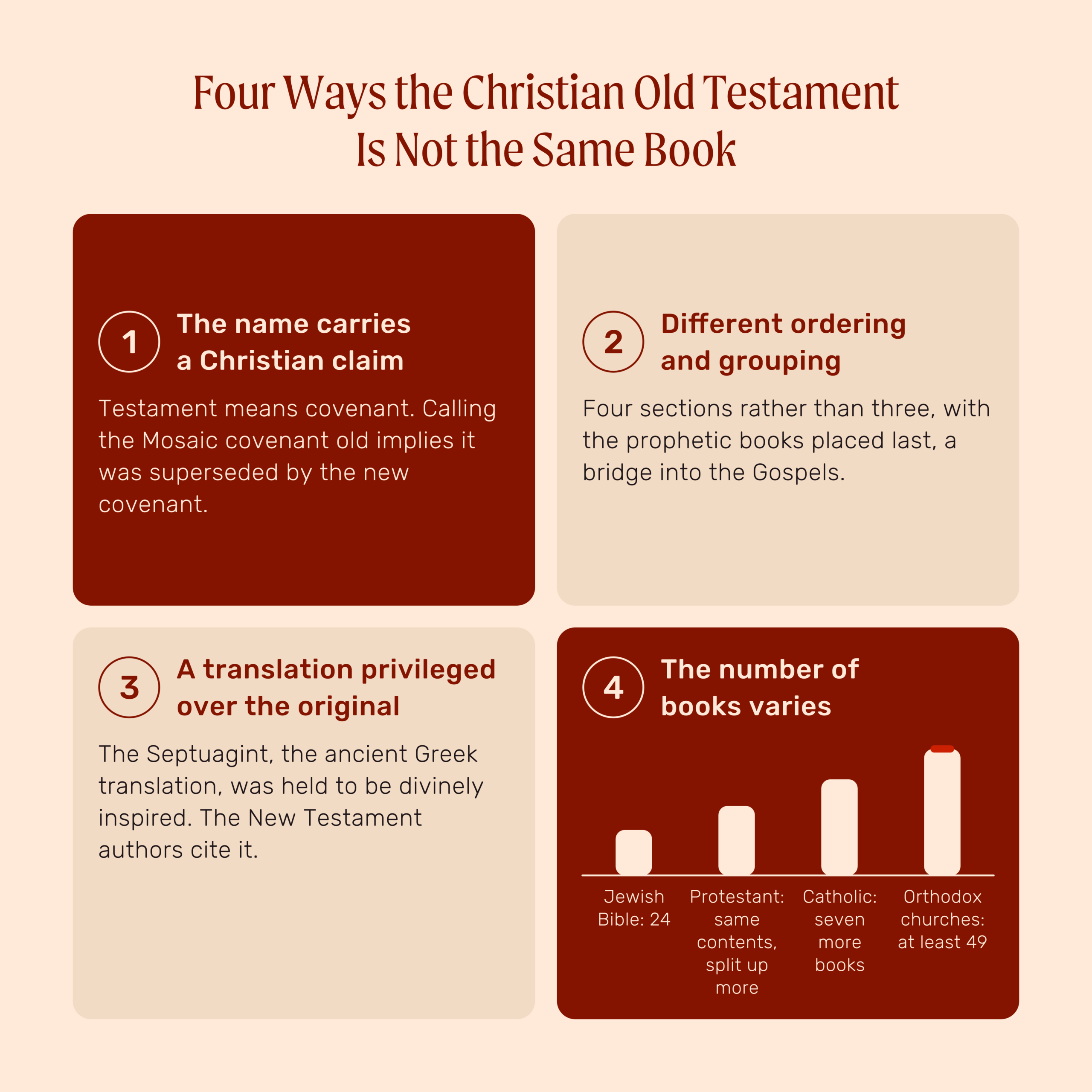
Very often we use Hebrew Bible and Old Testament interchangeably. Even scholars do, because they are mostly the same thing. There are four differences worth knowing.
One. The name itself carries a Christian claim. Testament means covenant and a covenant is a contract that brings about a relationship of commitment between God and human beings. This occurs in the Quran with the terms ‘ahd and mithaq.
Judaism is based on the covenants God made with Abraham, Musa and Dawud (AS). The first is the promise that Abraham (AS) will become the father of a great nation and that through his offspring all the nations of the earth will be blessed. The second is the one God establishes at Mount Sinai, giving the Israelites the Torah and promising to be their God if they obey his commandments. Both of those are affirmed by the Quran, albeit with some corrections. The third, the Davidic covenant, is the pledge that the descendants of Dawud (AS) will rule Israel forever and that one seems to be entirely omitted by the Quran, if not almost explicitly negated.
Calling the Mosaic covenant old implies it was a temporary and preparatory stage, now superseded by the new covenant with Jesus Christ. It is loaded with a Christian theological perspective, which is why scholars often prefer the neutral term Hebrew Bible. So in a conversation with a Jewish person, try to avoid the term Old Testament. It would be much like a group splitting off from Islam claiming a new revelation and then calling the Quran the Old Book.
Two. The ordering and grouping are different. The Christian Old Testament is split into four sections rather than three, primarily by literary genre, with the prophetic books placed last. That is deliberate. In the Christian view those books foretell the events of the life of Jesus (AS), so placing them last forms a natural literary bridge into the New Testament accounts of his ministry, the Gospels. It accordingly closes with the prophecy of Malachi about an unnamed future messenger and the return of the prophet Elijah.
Three. Christians historically privileged a translation over the original. The Septuagint is the ancient Greek translation of the Hebrew Bible, begun around 250 BCE. The word is Latin for seventy, from a legend that seventy-two scribes working independently produced word for word the exact same translation of the Torah into Greek. Related to that legend was the idea that the Greek translation was itself divinely inspired. Not just a translation. Imagine somebody translates the Quran into English and people believe the English translation is itself divinely inspired. There is nothing like that in Islam. That is how they thought of the Septuagint and when the authors of the New Testament cite the Hebrew Bible, they are not actually citing the Hebrew Bible. They are citing the Septuagint.
Later the Protestants called for going back to the original Hebrew. Now, that sounds like it makes a lot of sense, but it creates problems for Christianity, because when the New Testament authors cite Old Testament prophecies of Jesus (AS) they are citing the Greek and sometimes those prophecies do not work in the Hebrew.
Four. The number of books varies. The Jewish Bible has twenty-four books. The Protestant Old Testament has exactly the same contents, just split up more. Samuel, Kings and Chronicles are each split into two and the single book containing the twelve minor prophets is split into twelve. The Catholic Old Testament has seven books beyond that. The Eastern Orthodox and Oriental Orthodox churches have at least forty-nine.
Those extra books are called the deuterocanonical books, meaning second canon. Some Protestant Bibles print them as a separate section called the Apocrypha, which literally means hidden but really means non-canonical.
What the Manuscripts Actually Show
Now transmission. How were these writings preserved and copied and passed on?
Most of the material in the Hebrew Bible has to be dated on internal grounds, because the manuscript evidence is very meager and the earliest manuscripts are hundreds of years removed from their original authorship. Let me be fair here. The Hebrew Bible is by no means exceptional in this. It applies to virtually all ancient texts we have. This is actually another way in which the Quran is distinctive. We have a plethora of very early manuscripts by which we can check whether the Quran has been transmitted accurately.
The earliest manuscript evidence for the Hebrew Bible is the Ketef Hinnom scrolls, dated to around 600 BCE. Two miniature silver scrolls containing a variation of the priestly blessing found in the Book of Numbers. That is not a manuscript of a book. It is a few verses and even in those few verses it is a little variant from what is written in the Hebrew Bible today.
After that, the earliest manuscripts are among the Dead Sea Scrolls, discovered in caves near the Dead Sea in 1947. They include the earliest surviving manuscript collection of the Hebrew Bible, preserving fragments of every book except the Book of Esther. Where we can compare them with the Hebrew Bible as we have it today, we find significant variations from the received standard text, which is called the Masoretic text. The state of the text was still quite fluid at the time.
Then a really long period from the Dead Sea Scrolls all the way until around 900 CE, so well after Islam, from which all we have is a handful of fragmentary manuscripts.
The earliest complete or almost complete manuscripts date to the late ninth through early eleventh century CE. The earliest, from 895 CE, contains only the books of the prophets. Then the Aleppo Codex, from around 930 CE, originally complete, although parts of it are missing today. Finally the Leningrad Codex, dated to 1008 CE, the oldest fully complete manuscript of the Hebrew Bible and the main source for most translations today.
Which produces an ironic result. We have complete manuscripts of the Quran earlier than we have complete manuscripts of the Hebrew Bible.
Everything That Did Not Make It Into the Bible
Canonization did not mean Jews and Christians stopped cherishing other writings, or stopped considering them to have some authority. For rabbinic Jews, the written Torah was interpreted through the continuous and living tradition of the Oral Torah, recorded in the Talmud and in other rabbinic writings. Among Christians, Second Temple Jewish writings and extra-biblical gospels stayed popular alongside the Septuagint and their very popularity among Christians led to their definitive rejection among rabbinic Jews.
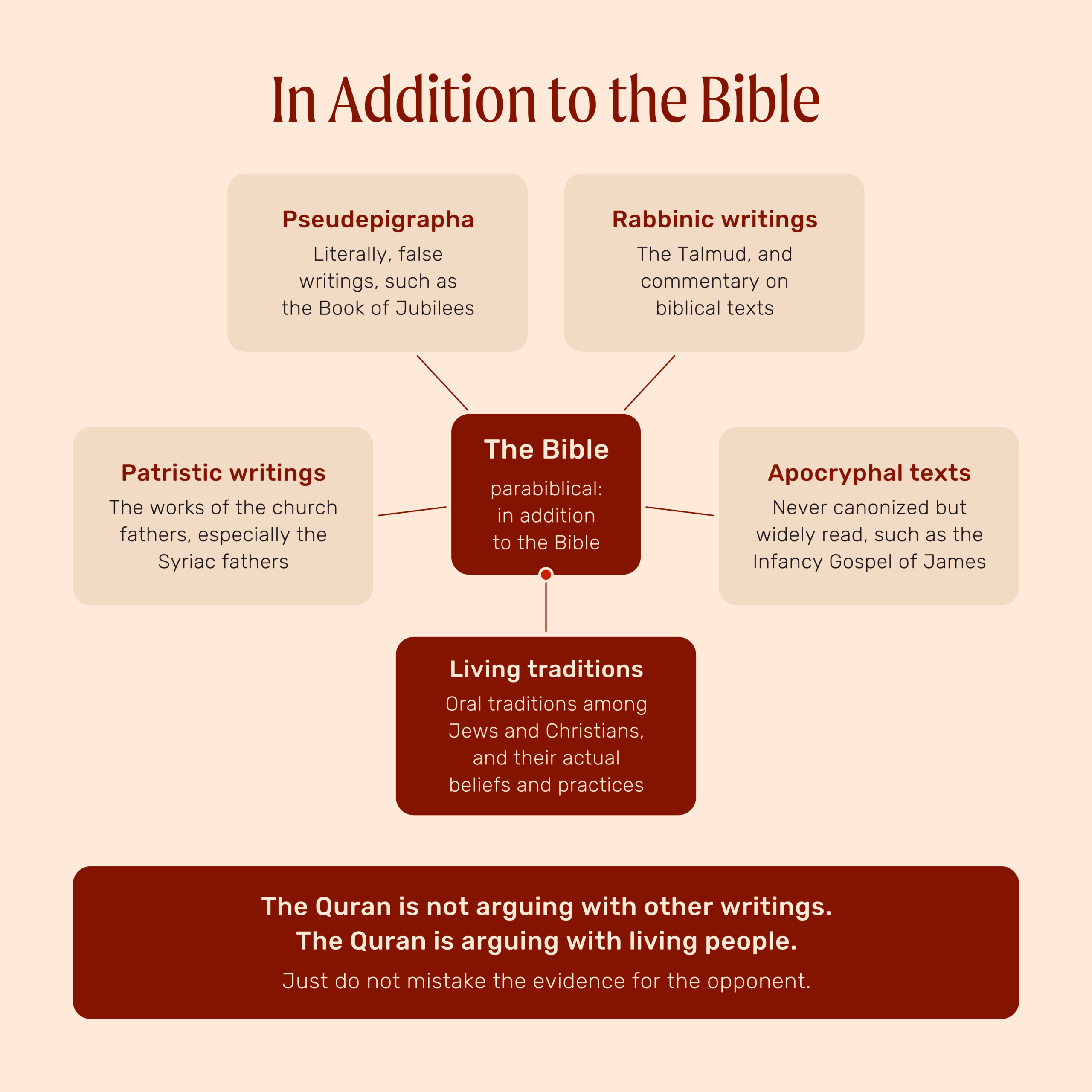
I like the term parabiblical for all of this, because it means in addition to the Bible.
First among these writings is the Pseudepigrapha. The term literally means false writings and it was originally used for works that falsely attributed themselves to famous biblical figures such as Adam (AS), Enoch, Abraham, Moses and Solomon. The contents of the canon had already been decided, so the authors needed to give their works extra authority by claiming these great figures had written them. Scholars now use the term more broadly, for a vast body of extra-canonical Jewish and Christian writings, among them the Book of Enoch, the Apocalypse of Abraham, the Book of Jubilees and the Life of Adam and Eve. We are going to see examples later of how the Quran engages with stories told in these works, just as it engages with the Bible itself.
Then the rabbinic Jewish writings. The Targums, related to the Arabic tarjama, translations, which are Aramaic renderings of the Hebrew Bible so interpretive that they are basically tafsir. The Talmud, a compilation of Jewish oral law and discussion, which is a major source of Jewish theology and law. The Midrash, from the root darash in Hebrew, just like the Arabic root darasa, originally meaning to seek and coming to mean to study. These are collections of rabbinic commentary on biblical texts, explaining difficult passages and filling in narrative gaps. There are also the Piyyutim, liturgical poetry that retells biblical stories.
On the Christian side there are the patristic writings, the works of the church fathers. The Syriac church fathers in particular, especially those from the fourth through fifth centuries, like Ephrem and Jacob of Serugh, will be especially important for us. Syriac is an eastern form of Aramaic, the liturgical language of Syriac Christianity and it matters here because most of the forms of Christianity the Quran engages with are Syriac Christianity.
There are the apocryphal texts, including gospels, acts, epistles and apocalypses, which were never canonized but were widely read anyway. Here is a concrete example of why that matters. Some of the miracles attributed to Jesus (AS) in the Quran and the story of his birth, most closely resemble narratives found in the Infancy Gospel of James rather than in the New Testament Gospels.
There are also Bible translations and Gospel harmonies, such as the Peshitta, which means simple and is related to the Arabic word basit and the Diatessaron, a harmony of the four Gospels that puts them into a single narrative and irons out their differences.
Finally there are the living traditions. Oral traditions among Jews and Christians. Debates within and between the two communities. The actual beliefs and practices of those communities.
Which brings me to the point I want you to leave with today.
When we think about the Quran’s engagement with Jewish and Christian tradition, most scholars now think it is best to treat all of these writings as snapshots of those living oral traditions. Because the Quran is not arguing with other writings. The Quran is arguing with living people, in living Jewish and Christian communities.
We can still use the writings. They are evidence for what those communities believed and we can compare them with the Quran to see how it is engaging with them.
Just do not mistake the evidence for the opponent.
This is the first session of the series and the sessions that follow work through how the Quran engages and corrects these traditions. Study The Quran’s Relationship with the Bible with Ustadh Sharif Randhawa and Ustadh Ahmed Khan on Bayyinah TV: Bayyinah TV
Notes
This post is adapted from Day 1 of The Quran’s Relationship with the Bible, a series taught on Bayyinah TV by Ustadh Sharif Randhawa and Ustadh Ahmed Khan. It is written in the voice of that session. Every teaching claim, example and aside in it is taken from the session itself. Where the session reports the positions of Jewish or Christian traditions, or of academic scholarship, those positions are described as the session describes them.

At Bayyinah, we are dedicated to helping you connect directly with the words of Allah beyond translation. Founded by Ustadh Nouman Ali Khan, our mission is to create transformative experiences that deepen your understanding and engagement with the Quran.
Study the Quran and Arabic in a systematic and personalized way through Bayyinah TV. Get started today for free.
Check out our newest articles, fresh off the press and ready for you to dive into!