Successful subscription! Thank you for subscribing.
Successful subscription! Thank you for subscribing.

November 2, 2026
Head cover. We are finally there.
Al-khimar. Simple definition first: the khimar is something a woman uses to cover her head.
Now here is the thing people say. The Quran never says head cover for women. It just says they should take a veil or a scarf and put it over their chest. That is all it says. It does not talk about no head cover.
Okay. Let me show you what that argument actually looks like.
Put Your Socks On. Now Put Them On Your Nose.
Somebody tells you, put on your socks.
So you say, it never said feet. So I am going to put it on my nose right now, because it never said feet.
You understand the problem with that argument?
The word khimar, by definition, is a cloth that is used to cover the head, like a sock is used to cover feet. So when you say the word khimar, you do not have to say, put your khimar on your head, just like you do not have to say, put your socks on your feet.
Oh, thank you for that. Like I was dying, you know.
So somebody argues that the Quran never mentions head.
Yeah. You do not know Arabic. It never mentioned the head itself? It says khimar.
Here is the part that gets skipped. There are plenty of other words in Arabic for scarves that do not refer to the head. Plenty of them. Not one of them was used. This one was.
Here Is a Funny One. I Got a Khimar Sheep.
Al-mukhammara min ash-shiyah.
Shiyah is sheep. Shaatun, a sheep.
They used to call some sheep mukhammara. Some sheep and some horses were also called mukhammara. Here is what it means. When the sheep’s head is white up to the neck and then the rest of it is black, or the head is black and the rest of it is white, they would say this sheep is wearing khimar.
Man, I got a khimar horse. I got a khimar sheep.
In other words, the word khimar even for animals is for the head.
That ain’t no religious text. This is ancient Arabic. This is ancient Arabic.
A horse that is mukhammar is a horse that has a white head and everything else is whatever it is.
Now Let Me Tell You Exactly How Long It Is
That is number one. Number two is the khimar’s length.
The khimar is a head cover whose length goes slightly above the middle of the stomach. So: below the chest and slightly above the middle of the stomach.
Now, many women of Jahiliyyah times did put the khimar on. They were already wearing it. Here is what they did with it, though. They put it on and then they wrapped up the dangling part with the rest of their ponytail and threw it behind their backs. It used to go down to the middle of their back, about as far as it would have gone in front.
The Quran came and said, the khimar is fine. You just need to undo that little tangle situation and do what with the rest of your khimar?
Drop it in front. Cover yourself with it. Do not show your beauty. Cover yourself, cover yourself.
The idea is that a khimar could be covering the front or covering the back. So Allah said, look, the head cover is already in the meaning of the word. The question is what you do with the rest of it, the part that has a particular length. You throw the rest of it in front to cover.1
What you used to drop in the back, drop it in the front.
Chest, Waist, Knees, Below the Knees. Every One Has Its Own Name.
Now watch what happens when you change the length.
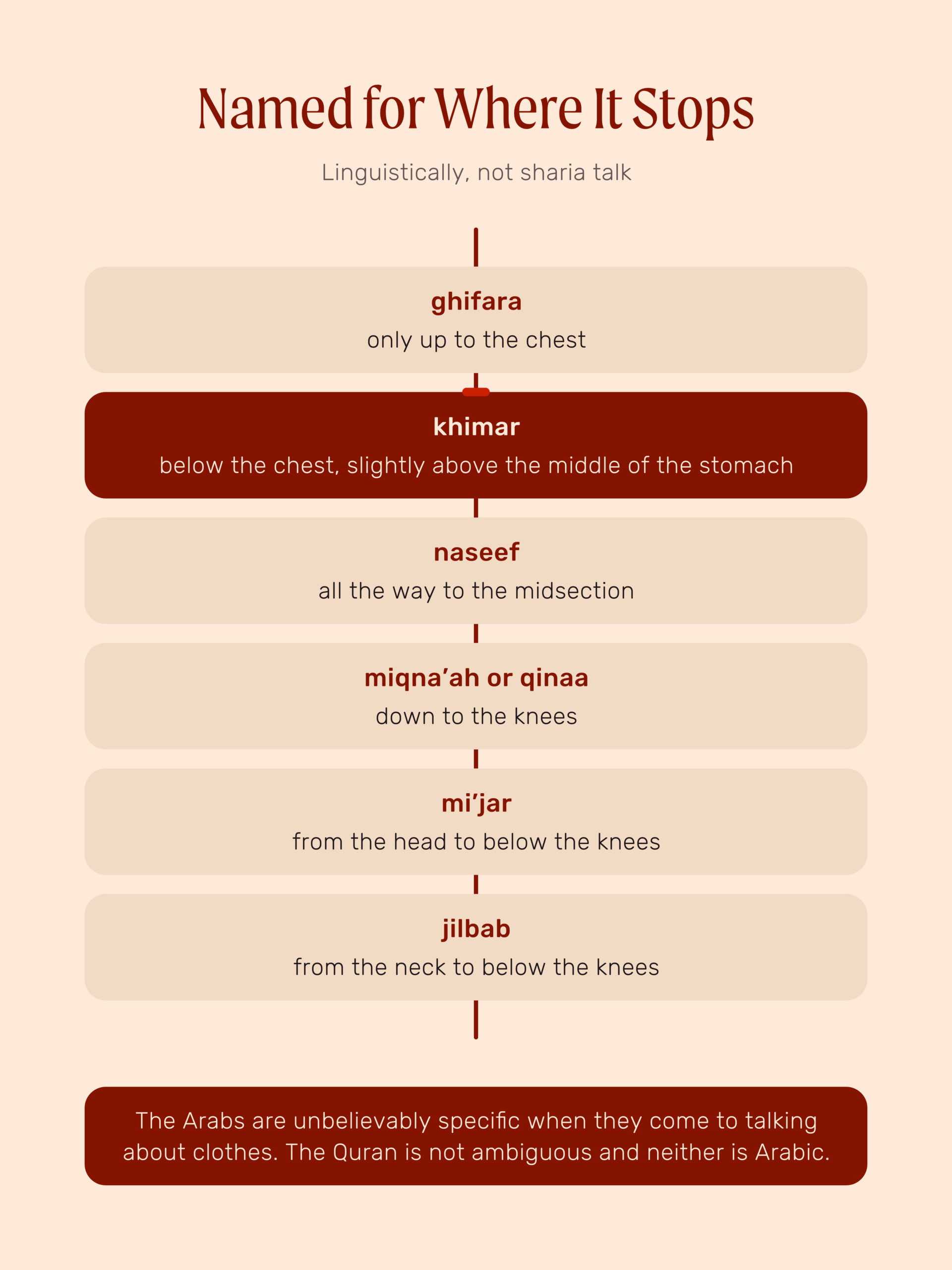
If a head cover is only up to the chest, it is not a khimar. It is a ghifara. That is the Arabic word for it, from ancient times.
So you know how there may be some women whose hijab nowadays is not that long? Linguistically and I am not talking sharia talk here, go talk to a faqih for that, linguistically that would qualify as a ghifara. If it is not right above the belly, right above the midsection of the body, then it is not a khimar.
If it goes all the way to the midsection of the body, then it is called a naseef. Meaning it does your body in nisf, in half. That kind of scarf, a head cover that goes all the way to the half, is called a naseef.
If you have got such a big gigantic hijab that it goes down to your knees, it will be called a miqna’ah or a qinaa. A miqna’ah or a qinaa goes down to the knees.
If it went anywhere below the knees, it will be called a mi’jar. So it started at your head and went all the way to below your knees. That would be a mi’jar.
Then, generally, a cover that drapes you from top to bottom but not necessarily including your head, one that starts at your neck and goes all the way to below your knees, all the way down, that is called a jilbab. A long dress that goes all the way down. An overcoat that goes all the way down. A qamis that goes all the way down. Whatever it is, that is called a jilbab.
Read that ladder again. Chest, ghifara. Waist, naseef. Knees, miqna’ah. Below the knees from the head, mi’jar. Below the knees from the neck, jilbab.
Now the Face Words and Watch How Fine They Get
Okay. Then there is the burqa.
A burqa is a long veil that leaves only the eyes exposed. It is a mask itself that goes all the way down, so the only holes in it are for the eyes.
Now, when a man starts acting like a woman, they say he put a burqa on his beard, over his beard. Meaning, dude has got a beard, he is still wearing a burqa, he is acting like a woman. They use this for a wuss.
By the way, the burqa was used for both horses and women in old Arabic. It is not found in religious literature. It is a cultural term. They had this thing.
Then there is niqab.
The verb means to run into someone accidentally, face to face. Out of fear of running into someone face to face and them being able to identify you, the niqab was worn. The purpose of the niqab was, I do not want people to know who I am.
In the Arabic language it is actually used for a face. One of the words for wajh. From it you get niqab, which actually covers the soft part of the nose. In other words, the niqab is here, on the soft part of the nose. If it is here, then that is niqab.
If it is right under the edge, you know, like some aunties really live on the edge. They have got it right here. Some even have it like here. Those are the best.
If it is actually covering the very edge of the nose, it is called liqam. So if the soft part is covered, it is niqab. When it is right at the edge, it is called liqam.
If it is right up to the eyes, like you know that situation where the niqab actually pokes their eye every time they blink, that is actually called a waswasa. Not with a seen. With a saad. When the niqab is high up and it is right at the eyes, that is called waswasa.
Then some women thought that their face was really beautiful and their opinion was that their lips in particular are attractive. So to cover the lips specifically, they used the litham. It is a lip cover and the verb underneath it actually means to kiss.
This Is Why I Gave You All That Vocabulary
The reason I am giving you this fun vocabulary is to help you understand and to remind myself, that the Arabs are unbelievably specific when they come to talking about clothes.
Look at what you just went through. A word for a cover that stops at the chest. A different word if it goes to the waist. A different word at the knees. A different word below the knees. A different word if it starts at the neck instead of the head. A word for the whole face with the eyes out. A word for the soft part of the nose. A different word for the edge of the nose. A different word for when it rides up into your eyelashes. A word for the lips alone.
The Quran does not just use a random word that is subject to multiple interpretations as far as what it could possibly mean. Because the Arabs are ridiculously clear about that. There is all this stuff to pick from.
So when the khimar is used and anybody argues, well, the Quran is kind of ambiguous about that, listen: the only thing ambiguous is your knowledge of Arabic, my friend.
The Quran is not ambiguous and neither is Arabic.
Ibn Mas’ud (RA) and His Tribe
Abdullah ibn Mas’ud (RA) is from a tribe that actually believed that everything of a woman should be covered, even before Islam. Some of the influences on that tribe were of Jewish origin and some of the Arab Jews were of a particular denomination which believed that even if the pinky of a woman shows, it is the same as zina. So they were pretty extreme.
Ibn Mas’ud (RA) is mentioned specifically because he was of the opinion that the khimar includes covering the face. He was the only one of that opinion. The vast majority of our ulama did not subscribe to it. Classically, among the Sahaba, there is virtually nobody else that can be authentically traced holding it.
Now, there are reasons for some ulama commenting that if a woman is particularly beautiful she should cover her face and so on. That was their precautionary advice. It was not something they said is necessarily from the sharia itself. It was a recommendation they had.
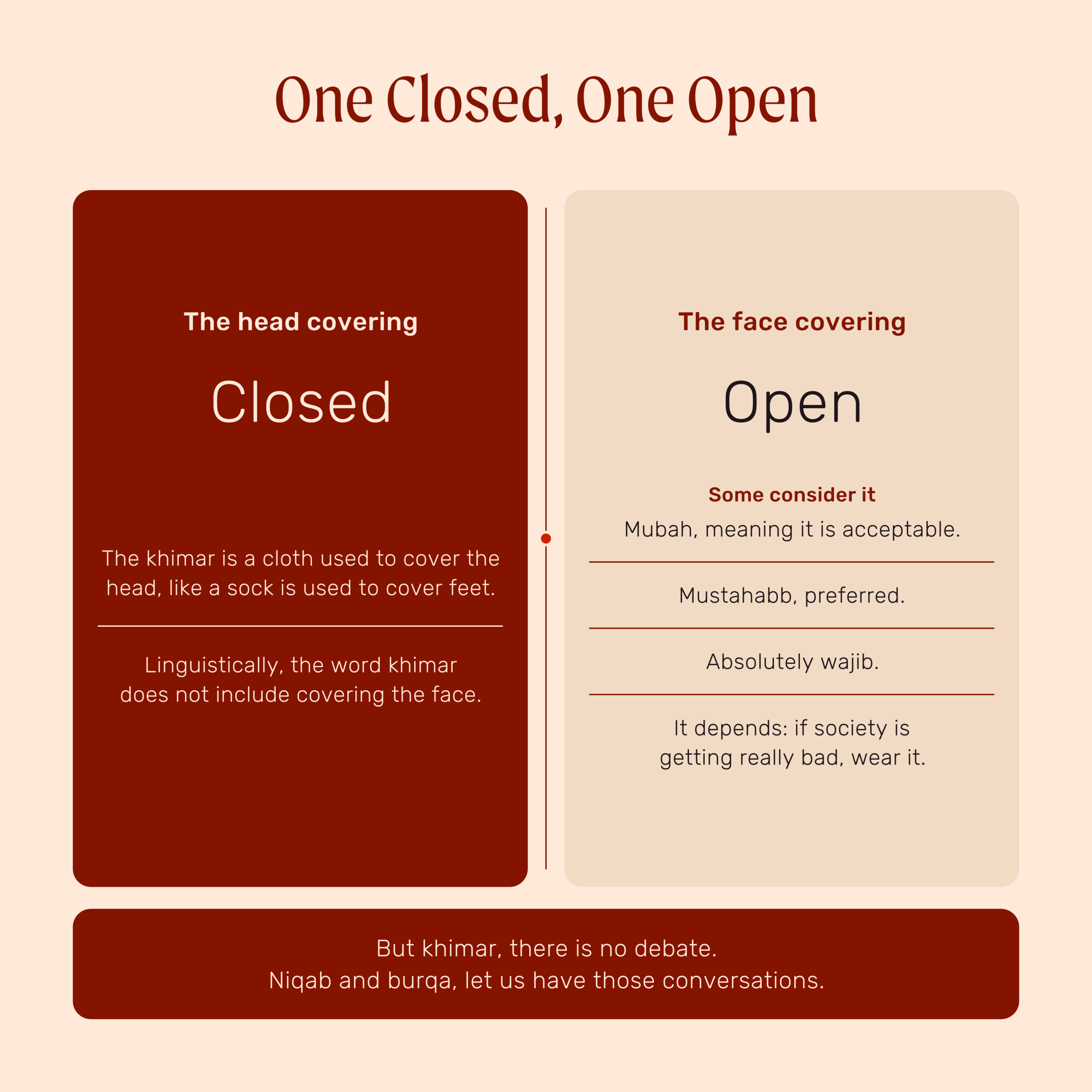
So the word khimar, linguistically at least, does not cover face cover.
Now, in sharia and fiqh discussions, is there a debate about that and commentary about it above and beyond what has been described in the ayah itself? Yes, of course and we respect that. That is a separate issue.
Jilbab and Khimar, That Is Clear, It Is Done
Incidentally, just talking about my personal life. My wife came to the conclusion that it is mubah, meaning it is acceptable, that it is not necessarily an act of worship, but she felt comfortable with it. It is fine, you know.
Mubah, ibaha, means to give permission. So it is allowed, it is fine.
There are others who hold other things. Some consider it mustahabb. Some consider it preferred. Some consider it fard. Some consider it absolutely wajib, et cetera, et cetera. Some say it depends: if society is getting really bad then you should wear it, otherwise you should not have to wear it.
Right. So there is debate about that.
But khimar, there is no debate.
You can have a conversation about niqab. You know about those words now. Yeah. You can have a conversation about burqa. Sure. Let us have those conversations.
But jilbab and khimar, that is clear, it is done. That case is closed. You move on.
Nine more sessions work through this ayah the same way. Study Hijab with Ustadh Nouman Ali Khan on Bayyinah TV: Bayyinah TV
Notes
This post is adapted from session six of Hijab on Bayyinah TV and is written in the voice of that session. Every teaching claim, example and aside in it is taken from the session itself.
[1] Al-Quran, Surah An-Nur, 24:31, https://quran.com/24/31

At Bayyinah, we are dedicated to helping you connect directly with the words of Allah beyond translation. Founded by Ustadh Nouman Ali Khan, our mission is to create transformative experiences that deepen your understanding and engagement with the Quran.
Study the Quran and Arabic in a systematic and personalized way through Bayyinah TV. Get started today for free.
Check out our newest articles, fresh off the press and ready for you to dive into!