Successful subscription! Thank you for subscribing.
Successful subscription! Thank you for subscribing.

October 15, 2026
The subject I want to talk to you about today is really difficult and honestly I do not know why I chose it.
I have been intimidated by this topic for some time. It has been on my mind for at least three or four years and I have been gathering my thoughts on it that whole time and I still have never once sat down and presented my notes on it. What I am going to give you today, if I get through these fourteen pages, is about a ten percent summary of what I actually have written down.
Even if I share one percent of what is in here, if I can be clear, if you can get the point of what I am trying to say, that concerns me far more than covering the quantity.
So what is the subject?
Honoring the Messenger.
Here Is the One Word That Destroys Respect for Anything
Why did I keep thinking about this subject for so long? Why has it been on my mind?
In my personal opinion, the world (not just Muslims, the world) has gone through tremendous change in the last century in a lot of different ways. One of the ways we have gone through a change is criticism. The world has become a lot more cynical and a lot more critical of everything.
Take Western civilization. European, American, Canadian, Western civilization in general. There used to be reverence for certain things. There was respect for certain things, an honor, a regard. Gentlemen and ladies. The Constitution. The Bible. Classical architecture. The arts. There was respect for the arts.
Then the world modernized. It shifted very, very quickly for the West and the rest of the world followed suit. One of the things that changed is that now we live in a time where young people and you can see it in young people more than anybody else, are almost brainwashed into thinking you do not have to have respect for anything.
Here is the one word that destroys all the respect you can have for anything.
Whatever.
The whatever generation is about three decades in now. I was part of the whatever generation. It has evolved to the point where they do not even have time to say whatever anymore. They just say whatev.
They care so little that they do not even care for the last syllable of the word.
So what does that do to you? You become cynical. You are constantly looking to criticize.
It Walks Into Your House and Then Into Your Religion
As a result of that, this attitude has entered into the home.
When this attitude enters the home, it becomes easy for a young person to be critical of their parents. Really easy. It becomes really easy for a husband to be critical of the wife and the wife to be critical of the husband and for them to do this constantly, to live in a constant zone of criticism.
So as a result of that, even within the religion, you will find people asking very critical questions. People who are Muslims.
I personally do not have a problem with critical questions. I do have a problem with questions that are framed in a disrespectful way.
There is a way to ask a question that is still respectful. You can ask your question and not be offensive. Then there is a way to ask a question which clearly smells of disgust and it smells condescending. You can just kind of taste the arrogance in the question.
More and more people, even Muslims, are not too hesitant to say things about the Quran, about the Rasul of Allah ﷺ, in a tone that is actually unheard of in this ummah.
Even when people were confused, they did not ask questions in that tone.
Most of Our Religion Is Attitude
So before I begin, this is the point I want to highlight. I keep telling this to my students over and over again.
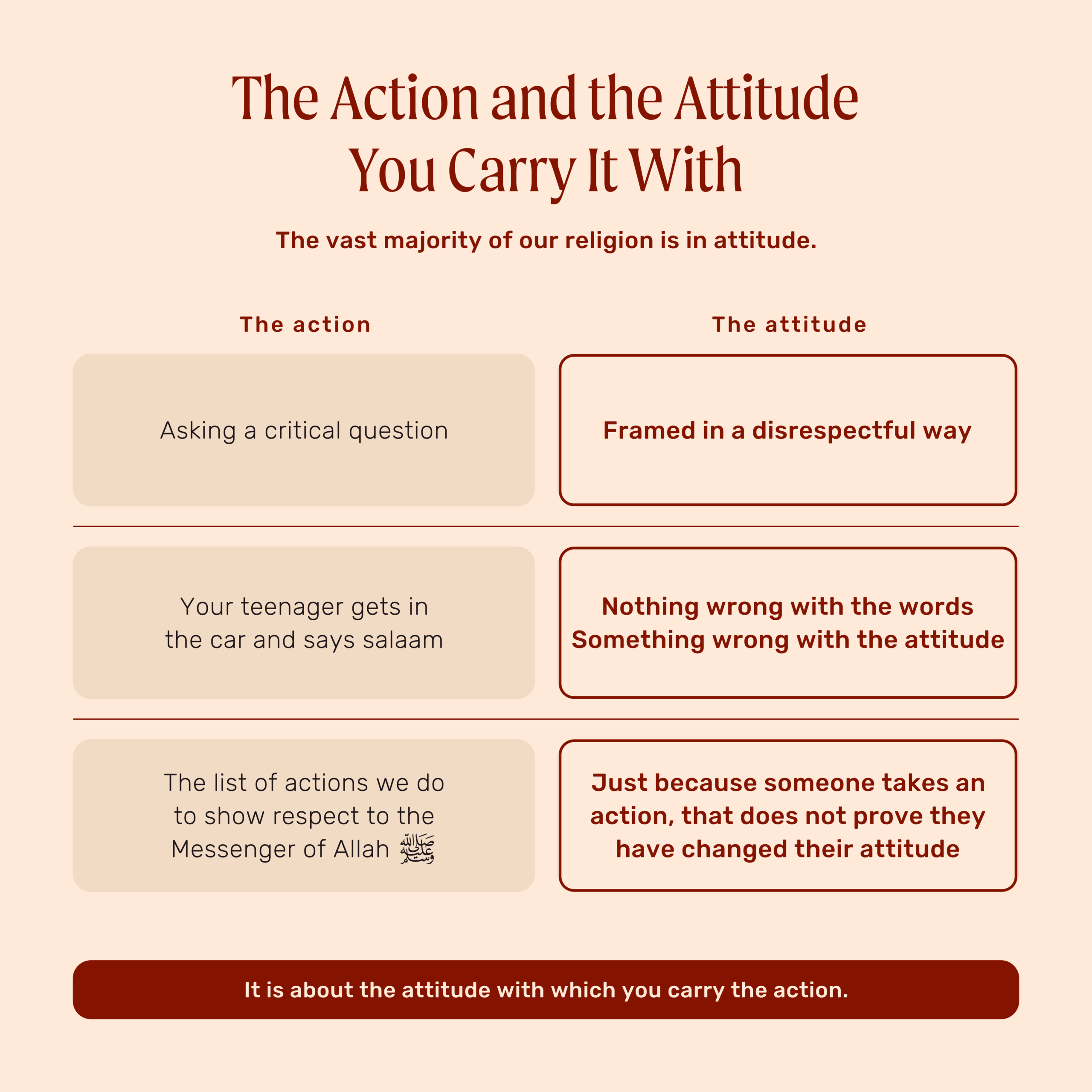
The vast majority of our religion is in attitude.
Most of our religion is about attitudes. It is not about the actions. It is about the attitude with which you carry the action.
For example.
Saying assalamu alaykum wa rahmatullahi wa barakatuh. Good thing or a bad thing? It is a good thing. I hope you know that one. You can call that out.
Now your teenage son or your teenage daughter gets into the car when you pick them up from school and they say it. But they have this face.
Why did you say it like that?
What? I said salaam. I did not say anything wrong.
There is nothing wrong with the words. There is something wrong with what? The attitude. The attitude.
This is just my observation as a Muslim coming up in my young adulthood. A lot of the time, the sermons I heard, the khutbahs I heard, the advice I heard, the overwhelming majority of it was advice about actions. It was not advice about attitudes.
So showing respect to someone and in this case our Messenger ﷺ, is not about actions.
I could tell you how to do it. I could give you the list of actions we do to show respect to the Messenger of Allah ﷺ. But just because someone takes an action, that does not prove they have changed their attitude.
So a few years ago I asked myself a question. What does the Quran do to adjust the attitude of the believers toward the Prophet ﷺ?
What it does is pretty amazing.
Forty Years Before Anybody Called Him the Messenger of Allah ﷺ
Before I get into the subject itself, I want to tell you something about the Companions.
The Messenger of Allah ﷺ was among those people for how many years before he was called the Messenger of Allah?
Forty years.
So a man has spent forty years in a town. He is neighbors with someone. He is somebody’s nephew. He is somebody’s best friend. He is somebody’s husband. He is somebody’s cousin. He is somebody’s uncle.
He has a lot of relationships. He has business partners. He has acquaintances.
It is not one relationship. It is many, many, many relationships.
Some of them are really, really close. Abu Bakr (RA) is really close. His wife Khadijah (RA) is really close. His uncle Hamza (RA) is really close. These are close relationships and I am talking about before Islam. Before becoming a Messenger, he has all of these.
Now he becomes the Messenger of Allah ﷺ. Does he still have those relationships? Does he still have an uncle? Does he still have a wife? Does he still have children? Does he still have friends?
He does. He does.
But something changed.
My Best Friend Does Not Call Me Ustadh
I have a best friend. My best friend does not call me Ustadh Nouman. I will not even tell you what he calls me.
My mom does not call me Ustadh Nouman either. I cannot tell you what she calls me.
The closer your relationship is with someone, the more casual you are and the less formality there is between you. As a matter of fact, the fact that you call me Ustadh Nouman actually means we do not know each other that well. We are not buddies. We are not at that stage.
There are friends I have from back in New York who call me and go, yo, what you doing.
If one of my students on campus said, yo, what you doing? I am kicking you out of this school is what I am doing.
It does not work like that with a teacher. You have to have a certain respect.
Not One Hadith Where He Says “My Friend”
Now take his best friend.
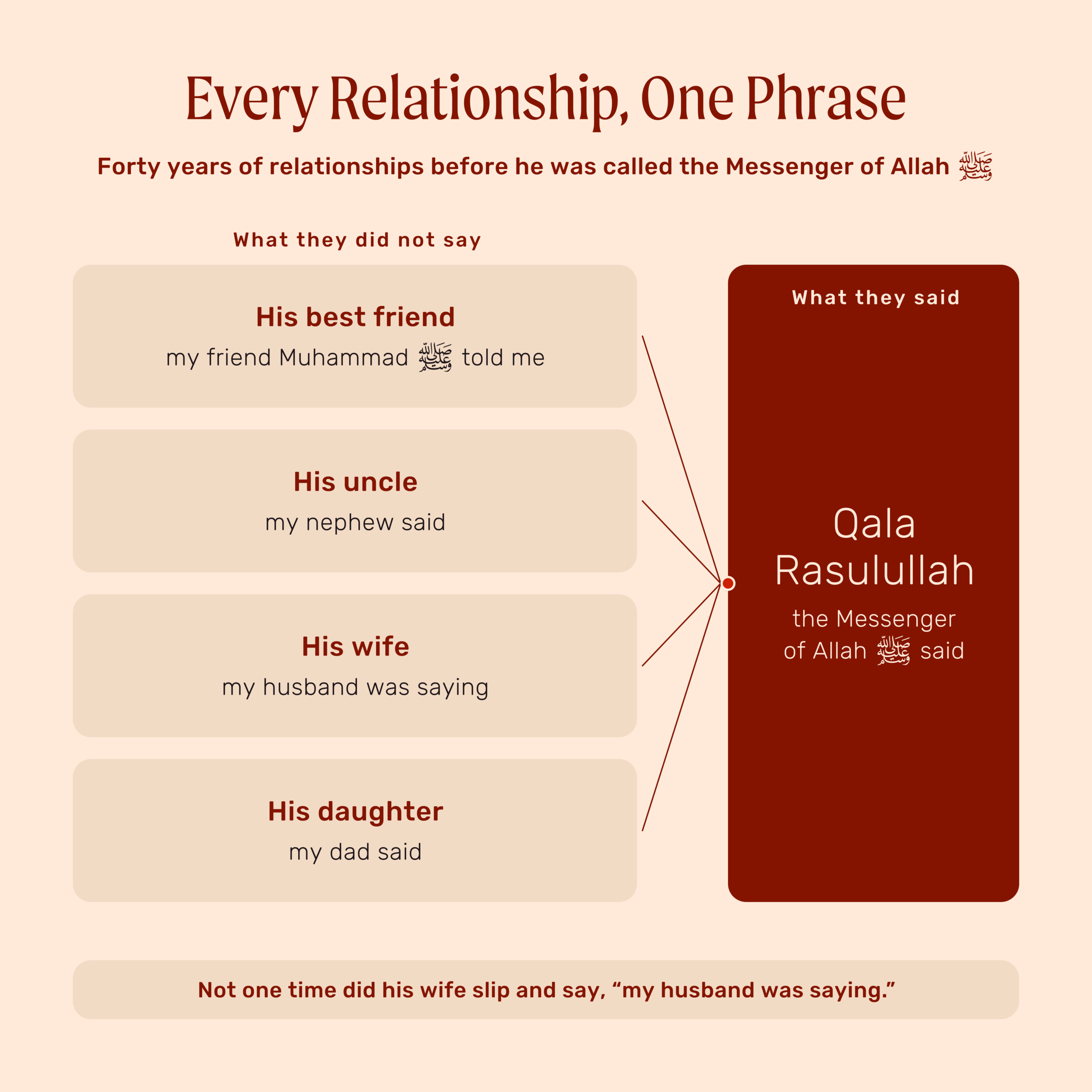
In the entire career that Abu Bakr as-Siddiq (RA) spent with him as his best friend, once he accepted him as the Messenger of Allah ﷺ, you never find a hadith where he says my friend said.
He never says it. He never says my friend told me. He never says my friend Muhammad ﷺ told me.
Every single time you find a hadith from any Sahabi, look at who the Sahabi could be. The Sahabi could be his uncle. The Sahabi could be his best friend. The Companion could be his wife. The Companion could be his daughter.
His daughter does not say my dad said. What does she say?
Qala Rasulullah.
Those words by themselves are amazing, because you know what happened. These people had all of these relationships with the Prophet ﷺ, but the moment they accepted him as a Messenger, the Quran did something to them. Where before they thought of him as a father, as a friend, as a husband, as a nephew, now the first thing that comes into their minds is Rasulullah ﷺ.
Some of Your Uncles Are Tortured, Man
On the one hand, a daughter already has respect for her father. She already does, because he is the elder and it is her father. Naturally you have respect for your father.
Is that the same as an uncle and a nephew? Does the uncle always have respect for a nephew?
No.
Some of you, when you go to your uncle’s house, he slaps you on the back of your head. You are forty-five and he still does it. You cannot do anything about it. He is your uncle. He will call you all kinds of names.
Some of your uncles are tortured, man. Like the poet says, the uncle is a calamity.
Uncles do not necessarily have to have respect for their nephews. That is not a relationship of respect.
But when Hamza (RA) speaks about him, when Abbas (RA) speaks about him (about the Rasul ﷺ, their nephew, their nephew), they do not say, this young one said. They do not say, this young kid from my family said. They do not say, my nephew said.
What do they say?
Qala Rasulullah.
Not One Time Did She Slip
Then take his wife.
She could say, my husband said. You know who that is? That is my husband. You know what he said?
No.
Even she says Qala Rasulullah.
Understand who we are talking about. She is the fourth most, or the third most prolific narrator of hadith there is. The number of hadith narrated from her is in the hundreds, if not the thousands.
Despite the thousands of hadith she narrated, in every single one of them she said Qala Rasulullah.
Is that not incredible?
Not one time did she slip and say, my husband was saying. Not one time.
Something changed in these people. Something changed.
For Us He Is an Institution
For us, calling him Rasulullah ﷺ is easy. It is easy, because for us he is an institution.
We know him through the seerah. We know him through Bukhari. We know him through Muslim. We know him through Tirmidhi. We know him through the books of hadith. We know him through the historical accounts. We know him through the word of Allah.
For us, he is not a person walking among us.
But when he was there, he had all of these relationships that you and I have. So they had to make a major adjustment to showing respect. What does it mean to show respect to him? They learned it.
So my goal today is to get a glimpse. I cannot cover this subject in its entirety. That is impossible. But to get a picture of how Allah teaches us in the Quran to show respect to the Messenger ﷺ, that is my intention today. That is my intentionand hopefully I can make some progress toward that goal.
This is the first of the sessions and the subject it opens is worked through across the rest. Study Honoring the Messenger with Ustadh Nouman Ali Khan on Bayyinah TV: Bayyinah TV
Notes
This post is adapted from the opening session of Honoring the Messenger on Bayyinah TV and is written in the voice of that session. Every teaching claim, example and aside in it is taken from the session itself.

At Bayyinah, we are dedicated to helping you connect directly with the words of Allah beyond translation. Founded by Ustadh Nouman Ali Khan, our mission is to create transformative experiences that deepen your understanding and engagement with the Quran.
Study the Quran and Arabic in a systematic and personalized way through Bayyinah TV. Get started today for free.
Check out our newest articles, fresh off the press and ready for you to dive into!