Successful subscription! Thank you for subscribing.
Successful subscription! Thank you for subscribing.
November 24, 2026
You might think Al-Aqsa was built by a prophet of Bani Israil. Maybe you think it goes back to the time of Sulayman (AS) and that is where the story starts.
One of the companions of the Prophet ﷺ asked him a question. He said: O Messenger of Allah, which masjid was built on the face of the earth first?
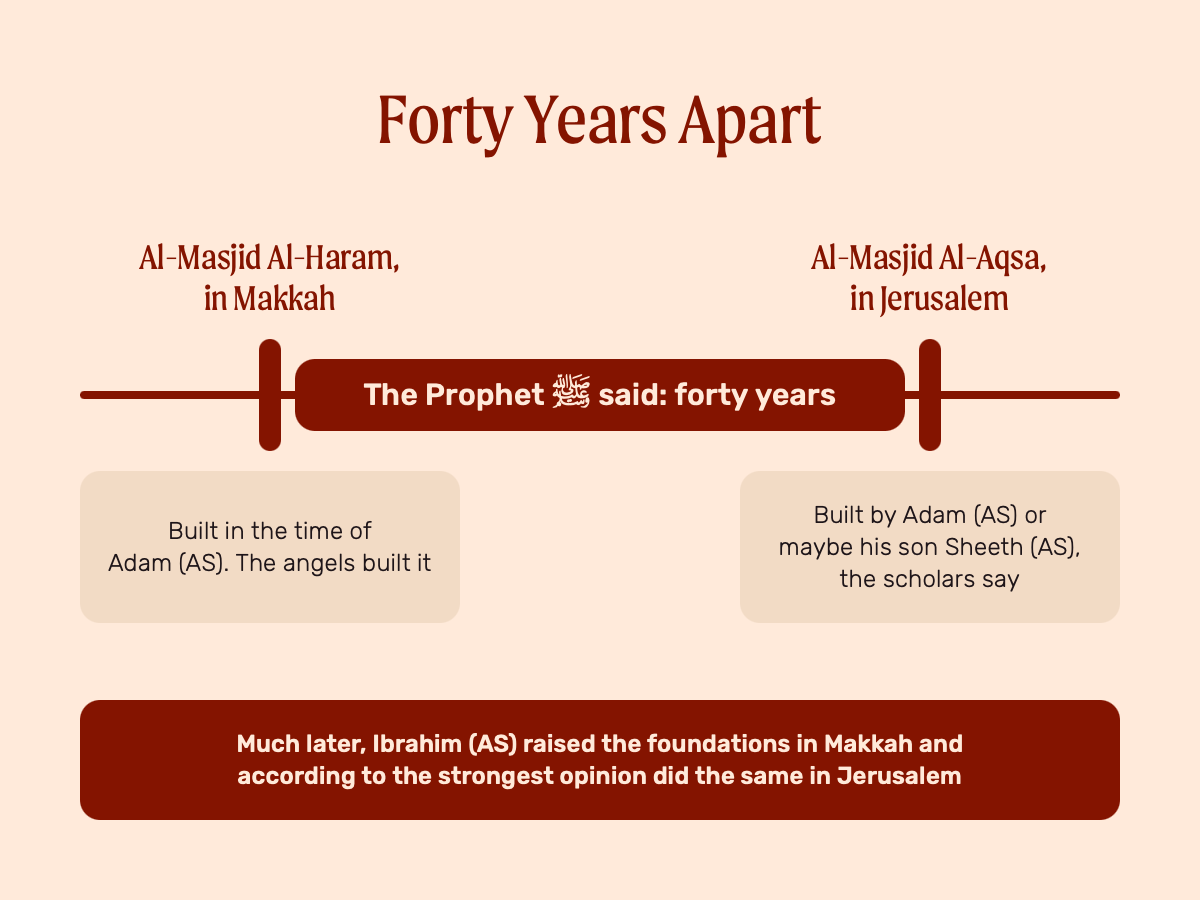
The Prophet ﷺ said: Al-Masjid Al-Haram, in Makkah.
He said: then which one?
He said: Al-Masjid Al-Aqsa.
So he asked him: O Prophet of Allah ﷺ, how many years were there between them? Between the construction of Al-Masjid Al-Haram in Makkah and the construction of Al-Aqsa in Palestine?
The Prophet ﷺ said: forty years.
Only forty years.
So Then Who Built the Ka’bah?
There are a few things we can take from that narration and the first one is a question you have to ask before anything else makes sense. Who built the Ka’bah?
It was not Ibrahim (AS).
It was Adam (AS). That was the first place where Adam (AS) worshiped Allah. He is in Makkah and the angels built it. Ibrahim (AS) came much later and he raised the foundations, but it was already built. It was already constructed. It was already made a sanctuary in the time of Adam (AS).
So hold on to that, because now the forty years has to go somewhere.
Then Who Built Al-Aqsa?
The scholars say that if we look at it from that perspective, then either Adam (AS) also built Masjid Al-Aqsa, or maybe his son Sheeth (AS). There are some narrations that say it was his son Sheeth (AS) who built Al-Aqsa.
Sit with that for a second. We are talking about only forty years between the first masjid and Al-Aqsa.
Ibrahim (AS) Has His Hand in Both of Them
Now here is the other thing we find. Just like Ibrahim (AS) raised the pillars of the Haram in Makkah, he did the same thing in Jerusalem, according to the strongest opinion. Some say it was him. Some say it was his son Ishaq (AS). Some say it was his grandson Ya’qub (AS).
Follow the man’s route for a second.
Ibrahim (AS) goes to Makkah. He builds the Ka’bah, he raises the foundations along with his son Isma’il (AS) and that place becomes the focal point of everybody.
Then he goes back to Jerusalem. He builds another sanctuary there with his son Ishaq (AS), or he instructs his son to build a sanctuary. Because we know Ibrahim (AS) settled in Palestine eventually. He passed away there. He is buried there.
So you have one man building one sanctuary with one son in Makkah and another sanctuary with another son in Jerusalem.
Those two masjids make up two thirds of the holiest masjids in the world.
SubhanAllah. You have Ibrahim (AS) with his hand in both of them, dedicating both of them for the sake of Allah.
Why It Is Called the Furthest
Al-Aqsa means the furthest masjid.
The reason it was called that is because it is the furthest masjid away from the Haram, or it was at the time. The Prophet ﷺ referred to it that way. Allah referred to it that way.
Makkah Was Sanctified by Ibrahim (AS). This One Allah Took On Himself.
There is a beautiful reflection here that I want you to catch.
Ibrahim (AS) sanctified Makkah. The Messenger of Allah ﷺ sanctified Madinah. But Al-Quds, Jerusalem, Allah took it upon Himself to sanctify that one.
Because Allah attributes the barakah of that land to Himself over and over and over in the Quran and it is mentioned frequently throughout. When He speaks about Sulayman (AS), He mentions it. When He speaks about that land at all, He mentions that it is blessed.1
Look at how He says it: not only have We blessed Al-Aqsa, We have blessed the land around it.2
Now Come Forward to Sulayman (AS)
Sulayman (AS) comes into Jerusalem about nine hundred and thirty-three years before ‘Isa (AS) and he is the most important king in the history of that city.
Ibn Abbas (RA) said he built about forty masjids. It was not just Al-Aqsa. Forty masjids throughout the earth.
The Old Testament has a lot of detail about how lavish and how elaborate the masjid was when Sulayman (AS) built it. We do not know if that is actually true or not. What we know is that he builds it out and he invests his heart into it.
Let Me Clear This Up Right Now: Al-Aqsa Is the Whole Rectangle
Before I go any further with this, I want you guys to realize something, so I am going to clear it up from now.
Masjid Al-Aqsa is that entire rectangle. That whole sanctuary. It is humongous. That is actually Al-Masjid Al-Aqsa. The Dome of the Rock is the center of it. That entire compound is Al-Aqsa.
So when I say Sulayman (AS) builds it out, that is what he is building out.
He Finished Building It and Then He Asked for Three Things
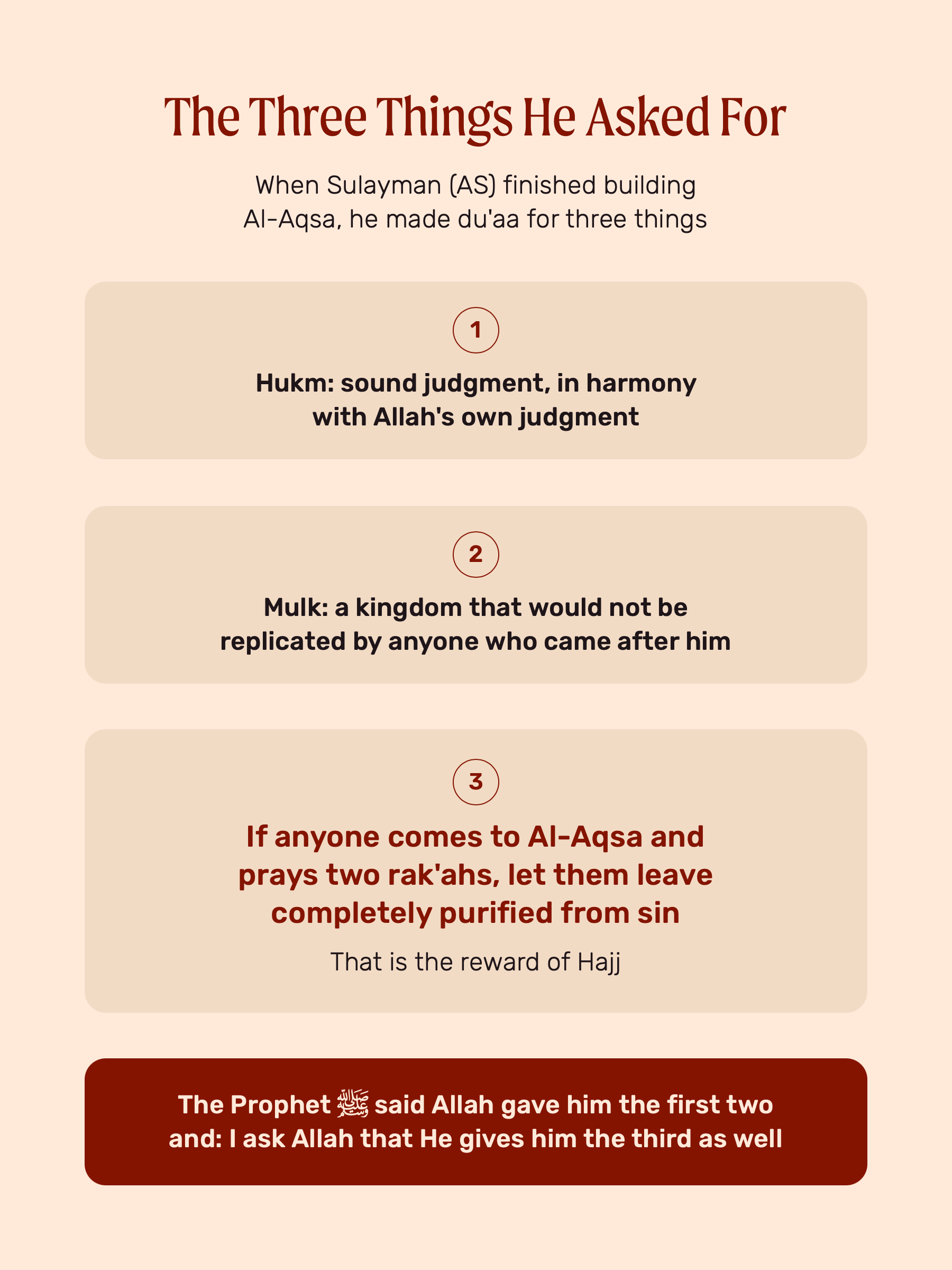
The Prophet ﷺ tells us that Sulayman (AS) does something very beautiful at the end of it. When he finished building it, he made du’aa for three things.
The first one: hukm. He asked Allah for sound judgment. Judgment that was in harmony with Allah’s own judgment.
The second one: mulk. He asked Allah for a kingdom that was customized to him, a kingdom that would not be replicated by anyone who came after him. A special kingdom.
Then he asked Allah for a third thing and listen to this.
The Third One Is Why I Am Telling You Any of This
He asked Allah that nobody would come to this masjid and pray, seeking nothing but the pleasure of Allah (meaning the only intention they came with was to pray in this masjid, nothing else), except that they would leave that salah purified from sin, the way that their mother gave birth to them.
You know what that is? That is the reward of Hajj.
Sulayman (AS) asked Allah that if anyone comes to Al-Aqsa and prays two rak’ahs, comes with the niyyah of salah and the niyyah of prayer and nothing else, then let them leave completely purified from sin, like the day their mother gave birth to them.
Notice something. When Musa (AS) told his people to enter the holy land, the word is muqaddasah, holy and what that means according to the scholars is mutahhirah. It purifies. Anyone who goes to Jerusalem and leaves, leaves purified from his sins. SubhanAllah, that is the actual meaning of the word.
The Prophet ﷺ Put His Own Du’aa Behind It
Now, here is the part that should make you sit up.
The Prophet ﷺ said Allah gave him the first two. The judgment, yes. The kingdom, yes.
Then the Prophet ﷺ said: and I ask Allah that He gives him the third as well.
Do you understand what just happened there? The Messenger of Allah ﷺ basically said, may Allah give him the third thing he asked for as well.
So this is not just an old du’aa made by a king about nine hundred and thirty-three years before ‘Isa (AS). It is a du’aa of Sulayman (AS) with the du’aa of Muhammad ﷺ standing behind it.
Ibn Umar (RA) Would Not Even Drink a Cup of Water
Abdullah ibn Umar (RA) is the one who chases after the sunnah of the Prophet ﷺ and chases after the rewards.
Ibn Umar (RA) used to go all the way from Madinah to Jerusalem just to pray two rak’ahs in Al-Aqsa.
That is the whole trip. That is the entire purpose of the journey. Two rak’ahs.
Then this. Ibn Umar (RA) would not even drink a cup of water in Jerusalem.
Why?
Just so he does not break that niyyah. Just so he does not break that intention that he is only going there for salah. So that he could fulfill that du’aa of Sulayman (AS) that the Prophet ﷺ approved.
The Two First Masjids Meet at the End
Now let me close the circle for you.
The Prophet ﷺ went from Makkah to Jerusalem. Ibrahim (AS) went from Jerusalem to Makkah. These are the first two masjids that have ever been established on this earth, forty years apart.
Bayt Al-Maqdis, that area of Sham, is the place of assembly on the Day of Judgment. We are all resurrected there. All of us.
There is a narration that on that Day the Ka’bah will be brought to Jerusalem. Everyone who made Hajj or Umrah will be hanging onto the cloth of the Ka’bah as it is brought and it will be set down there, at Al-Aqsa.
The two first masjids on the face of the earth end up in the same place.
How many of us have made Hajj or Umrah? How many of us have longed for that moment to pray in Al-Aqsa? May Allah write it down for us and accept it from us and may we be among those holding onto the cloth of the Ka’bah as it comes to Jerusalem.
Because whatever anybody does to that place, Allah always has a plan for it.
This post is one stretch of a much longer seminar on the history and virtues of Masjid Al-Aqsa. Watch it on Bayyinah TV
Notes
This post is adapted from one stretch of a standalone seminar on the history and virtues of Masjid Al-Aqsa on Bayyinah TV and is written in the voice of that session. Every teaching claim, example and aside in it is taken from the session itself.
[1] Al-Quran, Surah Al-Anbiya, 21:81, https://quran.com/21/81
[2] Al-Quran, Surah Al-Isra, 17:1, https://quran.com/17/1

At Bayyinah, we are dedicated to helping you connect directly with the words of Allah beyond translation. Founded by Ustadh Nouman Ali Khan, our mission is to create transformative experiences that deepen your understanding and engagement with the Quran.
Study the Quran and Arabic in a systematic and personalized way through Bayyinah TV. Get started today for free.
Check out our newest articles, fresh off the press and ready for you to dive into!