
Successful subscription! Thank you for subscribing.
Successful subscription! Thank you for subscribing.
November 20, 2026
Why do we study this at all?
Think about what it takes to reach that level. To be the wife of the Prophet ﷺ, to have his company on a consistent basis, to be raised with the messenger ﷺ on the day of judgment. That requires you to be an extraordinary personality. That requires Allah to have a very special love for you.
Allah calls them our mothers.1 Ummahat. So it is on us to love them, honor them and respect them and to hold them at the level we hold the mothers who gave birth to us.
We Are Not Saving the Best for Last
Usually you save the best for last. Here it is the best at the beginning. It starts with Khadijah (RA), Aisha (RA) comes third and you gain more from those two than from any of the others.
I can tell you on a personal level that this was the most difficult lecture I have ever had to prepare, after the lecture I gave about my own mother, may Allah have mercy on her. It is so touching to read about this woman and about her sacrifices.
The sources on her are scarce and you have to go looking for them. That is why if you have ever heard a lecture about Khadijah (RA), you probably heard the same things over and over again. The same two or three or four incidents, some perspective on those and that is it.
We are going to go as deep as we possibly can.
She Was Not Asking for a Resume
Here is how her business ran.
Two caravans go out every single year, one to Sham and one to Yemen. Allah refers to those two journeys in the Quran, the caravan of the winter and the caravan of the summer.2
Khadijah (RA) puts her money into that, but she is not doing the traveling herself. We do not see a single time in her history when she embarked on a journey to Sham or to Yemen. That is not a religious restriction. It was simply not culturally acceptable at that time for a woman to travel by herself, especially an unmarried woman, especially a beautiful one.
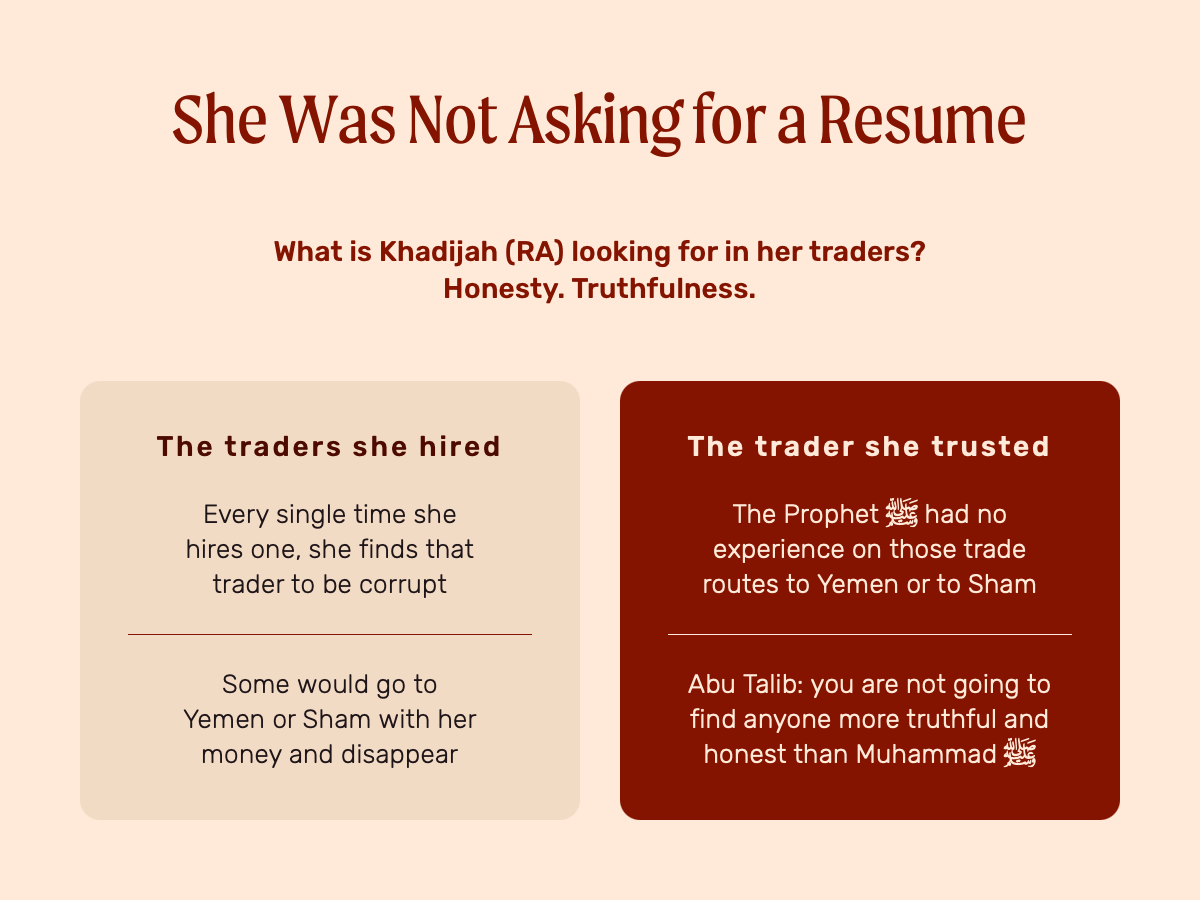
So she hires traders. Numerous traders. Every single time she hires one, she finds that trader to be corrupt and finds that he cheats her.
She actually budgets for a certain amount of money lost to cheating before she even goes into the deal. Most of them would take a little here and a little there, or keep some of the product for themselves. Some would simply never come back. They would go to Yemen or Sham with her money and disappear.
This is where the Prophet ﷺ comes into the picture.
At twelve or thirteen he becomes a shepherd. One of the people he ﷺ worked as a shepherd for was Khadijah’s sister, Hala. That is the first point of contact. So there is one strong recommendation already sitting there for him.
But here is what matters. He ﷺ had no experience leaving Makkah. There may be one incident where he went out with Abu Talib, but he had no experience on those trade routes to Yemen or to Sham. None.
Khadijah (RA) is not looking at that. What is she looking for in her traders? Honesty. Truthfulness. Her attitude is, I do not care about your resume. I do not care if you have been to Yemen ten times and can guarantee me this much profit. I want someone honest.
So she starts asking around. Who is an honest person I can trust with my wealth?
She was referred to Abu Talib. Abu Talib says, if you really want, I can let Muhammad ﷺ go. He is not experienced with this and I do not know if he is prepared to go and do these things. But you know what? He is an honest man. You are not going to find anyone more truthful and honest than Muhammad ﷺ.
So between Abu Talib’s recommendation and Hala’s recommendation, from the woman whose sheep he tended, she says okay.
They meet. They discuss the terms. He ﷺ is barely in his twenties and he is about to take the goods of the richest woman in Makkah out to Sham and trade on her behalf.
She is so desperate for an honest trader that she tells him: if you do the job right, I will give you double the profit. I will double your salary. Just do everything honestly. That is all I am looking for.
He agrees.
The contract they drew up was aqd al-mudarabah. You have the rabb al-mal, the one who owns the capital and the mudarib, the one who goes out and trades using that capital. If a loss is suffered, who suffers it? The rabb al-mal. The one whose money it was.
She gave him the open, unrestricted kind, where you go do what you think is best with the money and the products. That is a far riskier contract and it is very, very risky for a silent partner to give a person that kind of access.
Khadijah (RA) gives it to a man she does not know, who has never once traded on anyone’s behalf outside of Makkah. That much freedom, straight away. The fitrah inside her trusted him that much from the very beginning.
What Maysarah Could Not Stop Talking About
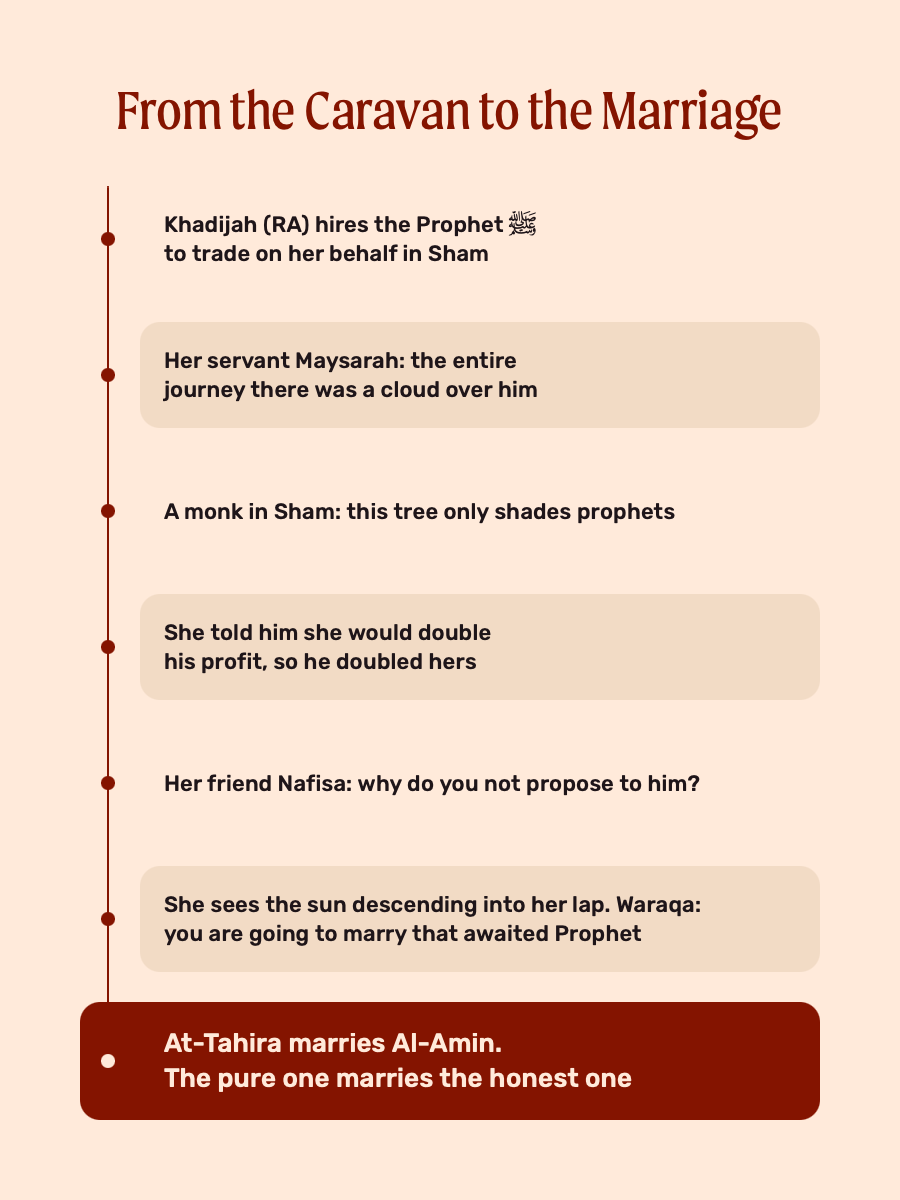
She sends him off to Sham with a huge amount of goods and money and she sends a servant with him named Maysarah.
Right away Maysarah is blown away by his manners and understand why that means something. Maysarah has gone out with basically all of Khadijah’s partners. He has seen what traders do. Now he gets to accompany this man all the way from Makkah to Sham and back.
Maysarah falls in love with him. The humility. The modesty. Not letting people serve him. Being in Maysarah’s service rather than the other way around. In the end he ﷺ does not even let Maysarah do anything, because he is doing all of it himself.
If all Maysarah had to report was that this man’s manners are impeccable, that would have been plenty. But then Maysarah starts seeing very, very strange things.
Maysarah says that the entire journey there was a cloud over him. Even when they raced their camels, the cloud kept pace. It shaded him the whole time.
Then there are the trees. Maysarah said that when they took naps and the sun moved, the tree would extend its branches the other way for him.
Then they reach Sham and he ﷺ is napping under a tree and the tree is doing the same thing. There was a monk in his little place of worship nearby, watching. He comes out and asks Maysarah, because Maysarah was the only one awake, who is this man with you?
Maysarah says, Muhammad ibn Abdullah, min ard al-haram. Muhammad ﷺ, the son of Abdullah, from the land of the Haram.
The monk tells him that no man has ever rested under this tree except that he was a prophet of God. This tree only shades prophets. Watch this man. He is going to end up being a prophet of Allah.
Then they start trading in Sham. In the marketplace it is common practice to swear. Say wallahi. Take an oath. Back then, of course, they were not swearing by Allah. They were swearing by the idols. The traders knew he was from the land of the Haram, so who do you think they told him to swear by? Every time he gets into a transaction, they say, alright, take an oath.
He ﷺ said: I do not recognize them and I do not swear by them.
Maysarah is watching this thinking, another person who does not worship idols. He knows Khadijah does not. Outside of her and a very small group of people, everybody in Makkah does.
Then comes the part that makes the whole thing beautiful.
He ﷺ sold Khadijah’s merchandise. Then he took the money and bought more merchandise in Sham. Then he came back to Makkah and sold that. He made double the money.
That was his amanah. She told him she would double his profit, so he doubled hers, as a sign of loyalty to her.
Can you imagine being her? For fifteen years you have been played by crooks and thieves. Then this man not only gives you exactly what he owed you, he goes and doubles your profit.
Nafisa Played It Smart
Then Nafisa bint Umayyah, a close friend of Khadijah (RA), comes to visit and asks how things are going.
Khadijah (RA) starts talking about the Prophet ﷺ and she is gushing herself. I have never seen a man like this man. This is what Maysarah said about him. This is what he did with the money.
Nafisa says, well, if that is the case, you have been single for a very, very long time. Why do you not propose to him?
We are talking about fifteen years of not being married.
Khadijah (RA) was still not really interested in marriage. She says, I do not even know. Plus I am an old woman. Why would he be interested in someone old like me? He is very handsome. He is not rich but he is at a perfectly acceptable place with his income. He has a respectable lineage, the best lineage. Everything. Why would he want a woman like me?
Nafisa says, let me go hint to him.
Understand where he ﷺ is at this point too. He was turning down marriage proposals because he wanted Abu Talib’s household stable, since Abu Talib had taken care of him when he was most vulnerable.
So Nafisa goes to him and asks, how come you are not married? He says, look, I am taking care of my family.
Nafisa says, what if I told you I could get you married to a really, really beautiful woman, of nobility and good character and everything you could want in a woman?
He says, who is it?
Nafisa says, how about Khadijah?
He says, do you think she would even be interested in me?
Nafisa goes, I do not know. But let me ask her.
You see that? Nafisa does not tell him that Khadijah has already been asking about him and that this is the whole reason she is standing there. Nafisa plays it smart. She says, I am not sure, but let me ask.
So she goes back to Khadijah (RA) and says, alhamdulillah, he is ready, he wants to marry you. Then she comes back to him and tells him Khadijah is interested.
He ﷺ goes to his uncles. He goes to Abu Talib, he goes to Al-Abbas, he goes to Hamza (RA) and he brings them with him to officially propose.
Now, while all of this is going on, Khadijah (RA) sees a dream. In the dream she sees the sun descending into her lap. That is it. Herself and the sun coming down into her lap.
So she goes to Waraqa, the biblical scholar and the wise man of the family and tells him. Waraqa says: you are going to marry that awaited Prophet.
Put this in context. Hira is not the first incident here. Not for him and not for her. Things were planted in both of their hearts and minds long before that cave.
So At-Tahira marries Al-Amin. The pure one marries the honest one, the trustworthy one.
Some of the narrations say Waraqa himself performed the marriage. The mahr was five hundred dirhams.
When we come back, the marriage itself and the household.
This is the first of ten sessions working through the wives of the Prophet ﷺ one at a time. Watch Mothers of the Believers on Bayyinah TV
Notes
This post is adapted from the first session of Mothers of the Believers on Bayyinah TV and is written in the voice of that session. Every teaching claim, example and aside in it is taken from the session itself.
[1] Al-Quran, Surah Al-Ahzab, 33:6, https://quran.com/33/6
[2] Al-Quran, Surah Quraysh, 106:2, https://quran.com/106/2

At Bayyinah, we are dedicated to helping you connect directly with the words of Allah beyond translation. Founded by Ustadh Nouman Ali Khan, our mission is to create transformative experiences that deepen your understanding and engagement with the Quran.
Study the Quran and Arabic in a systematic and personalized way through Bayyinah TV. Get started today for free.
Check out our newest articles, fresh off the press and ready for you to dive into!