
Successful subscription! Thank you for subscribing.
Successful subscription! Thank you for subscribing.
July 29, 2026
Every one of us has felt exposed at some point, aware of a threat we could not see or name. Surah Al-Falaq, the 113th surah of the Quran, meets us exactly there. It is a short surah of only five verses, yet it teaches us how a weak human being reaches for the protection of the One who tears open every darkness.
Two Surahs of Refuge
Surah Al-Falaq is one half of a pair. Together with Surah An-Nas, the surah that follows it, it forms what scholars call al-Mu’awwidhatayn, the two surahs of seeking refuge. According to many narrations, both were revealed at the same time and they complete one another in a way that is easy to miss if you read them apart. Al-Falaq turns our attention to evil that comes from outside us, the harm we can sense in the world around us. An-Nas turns inward, to the whispers and suggestions that slip into the heart until we mistake them for our own thoughts. Placed side by side, they cover the whole spectrum of what can harm a person and both begin with the same instruction: say, I seek refuge.
The Lord Who Tears Open the Dawn
The surah begins by naming the One we turn to.
قُلْ أَعُوذُ بِرَبِّ الْفَلَقِ
“Say, I seek refuge in the Lord of daybreak.”
(113:1)
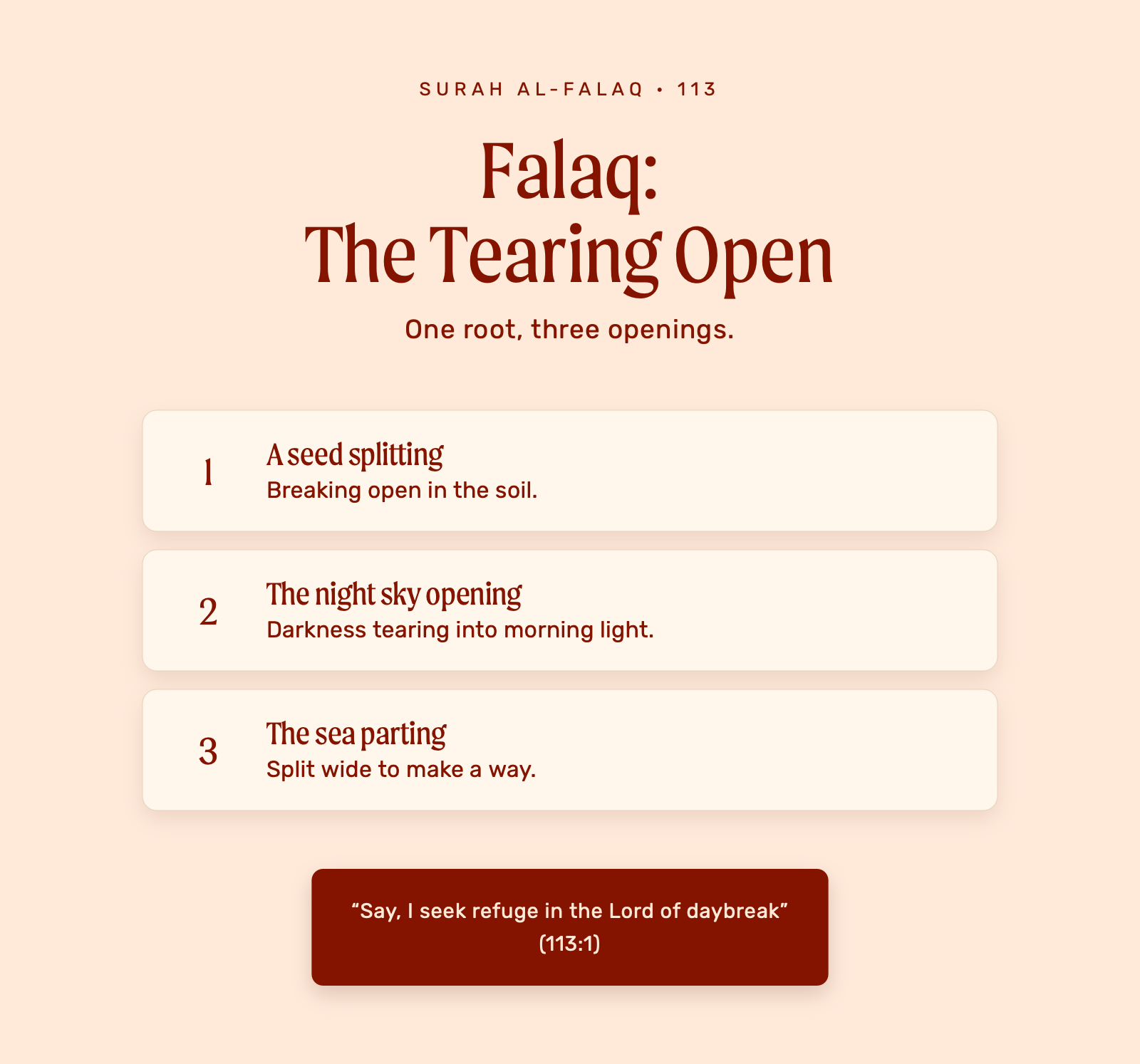
The word falaq is often translated simply as dawn or daybreak and that is true, but the root carries something more vivid. Falaq describes a tearing open, a splitting apart of something that seemed sealed. It is the word used when a seed cracks open beneath the soil, when a rock splits, when the sea was torn apart for Musa (AS). The morning itself is a tearing open, when the night that felt endless is ripped through and a completely different world is revealed.1 So when we call on the Lord of daybreak, we are calling on the One who can break through anything that seems unbreakable. Whatever situation feels sealed shut, whatever darkness looks like it will never lift, we are turning to the One who tears it open in an instant.
What It Actually Means to Seek Refuge
We say “I seek refuge” so often that we rarely stop to feel the weight of the word. In Arabic, the verb behind isti’adha describes something soft clinging to something strong for its very survival, the way a fragile shoot shelters inside a tree or a small creature hides beneath a rock. To seek refuge is to admit you are that fragile thing, that you cannot protect yourself. This runs against our instinct. When someone asks how we are doing, even in real pain, the reflex is to say we are fine, because we do not like to show our weakness. Yet Allah teaches us that before Him, this pride has no place. Saying “I seek refuge” is an act of humility and that humility is the very condition for His protection. Allah does not shelter the one who refuses to admit he needs sheltering.
Three Examples of Outside Evil
After naming the Lord of daybreak, the surah asks for protection from the evil of all that He created, then gives three specific examples of that evil.
مِن شَرِّ مَا خَلَقَ
“From the evil of what He created.”
(113:2)
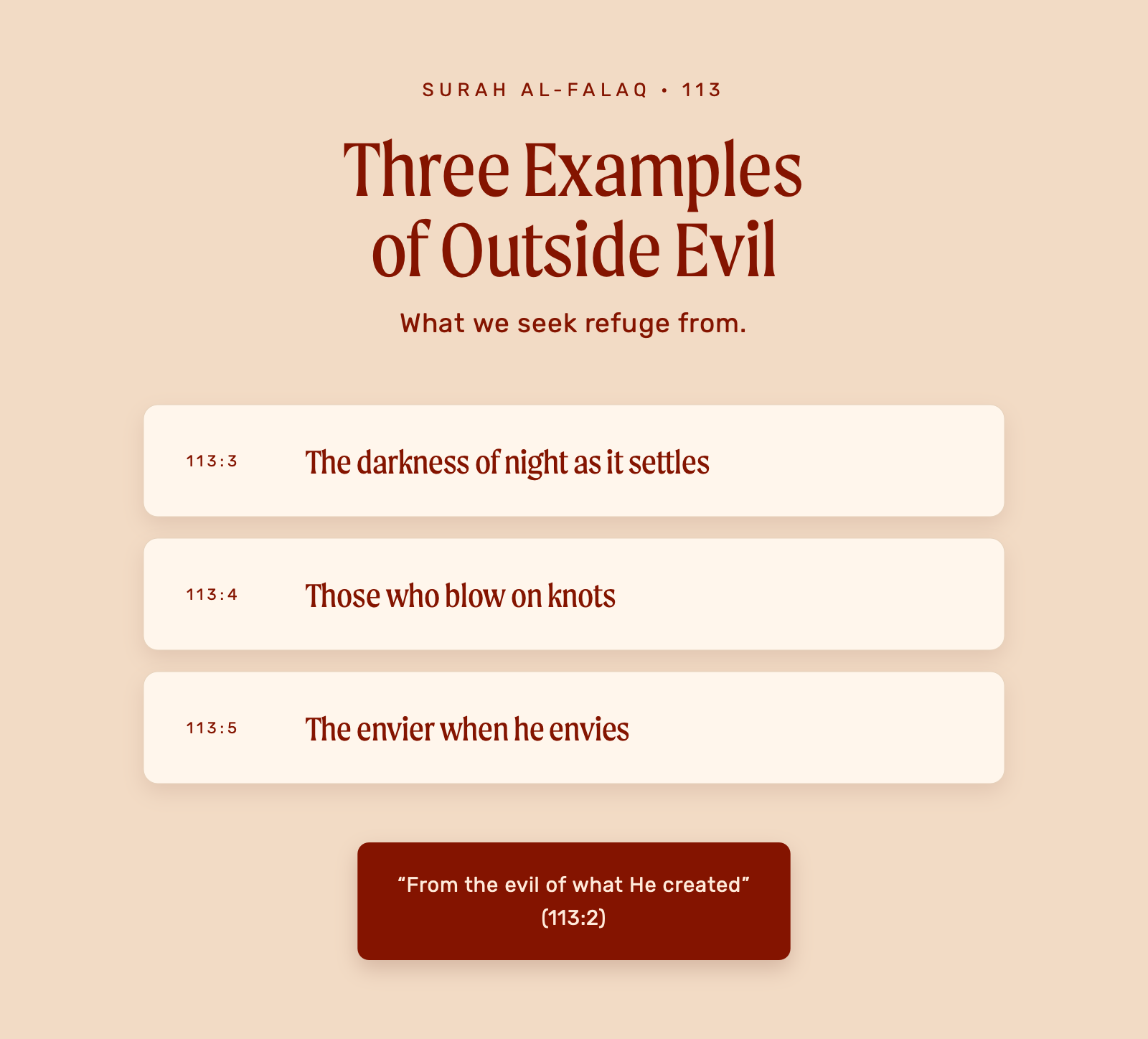
Everything Allah made can be used for good or misused for harm and the surah names three cases. The first is the darkness of the night as it settles in, a time when we feel most vulnerable and most alone.2 The second is those who blow onto knots, the surah’s reference to people who busy themselves with the dark arts of trying to harm others.3 The third is the harm of the envier when he envies.4 It is worth noting that hasad is not simply jealousy. Jealousy is only one small piece of it, so a person can think they have no hasad problem because they feel no envy, while still carrying its other dimensions. The Quran names it as a real danger, the kind that can show even in the way a person looks at you.
Why We Should Not Be Overwhelmed
It is easy to read a surah about hidden evils and come away anxious. That is not the point. Surah Al-Falaq follows Surah Al-Ikhlas, which closes by teaching that Allah is the One we turn to because He alone fulfills every need. Protection is simply one of those needs, perhaps our greatest one, since none of us is truly safe on our own. When we place ourselves under Allah’s protection, we naturally honor Him and stop defying Him, because you do not damage the home of the one who has taken you in. The surah is not asking us to live in fear. It is teaching us where to run and reminding us that the Lord we run to is the same One who tears open the morning.
The Takeaway
Surah Al-Falaq teaches that real safety does not come from denying our weakness but from admitting it before Allah. When we say we seek refuge in the Lord of daybreak, we are holding on tight to the One who can break through any darkness, no matter how sealed it seems. That admission of need is not defeat. It is the beginning of protection.
You can explore the full Al-Falaq: A Deeper Look series on Bayyinah TV, alongside the other surahs being opened up in the Deeper Look collection.
Notes
[1] Quran, 113:1, https://quran.com/113/1 ↩
[2] Quran, 113:3, https://quran.com/113/3 ↩
[3] Quran, 113:4, https://quran.com/113/4 ↩
[4] Quran, 113:5, https://quran.com/113/5 ↩

At Bayyinah, we are dedicated to helping you connect directly with the words of Allah beyond translation. Founded by Ustadh Nouman Ali Khan, our mission is to create transformative experiences that deepen your understanding and engagement with the Quran.
Study the Quran and Arabic in a systematic and personalized way through Bayyinah TV. Get started today for free.
Check out our newest articles, fresh off the press and ready for you to dive into!