
Successful subscription! Thank you for subscribing.
Successful subscription! Thank you for subscribing.
July 29, 2026
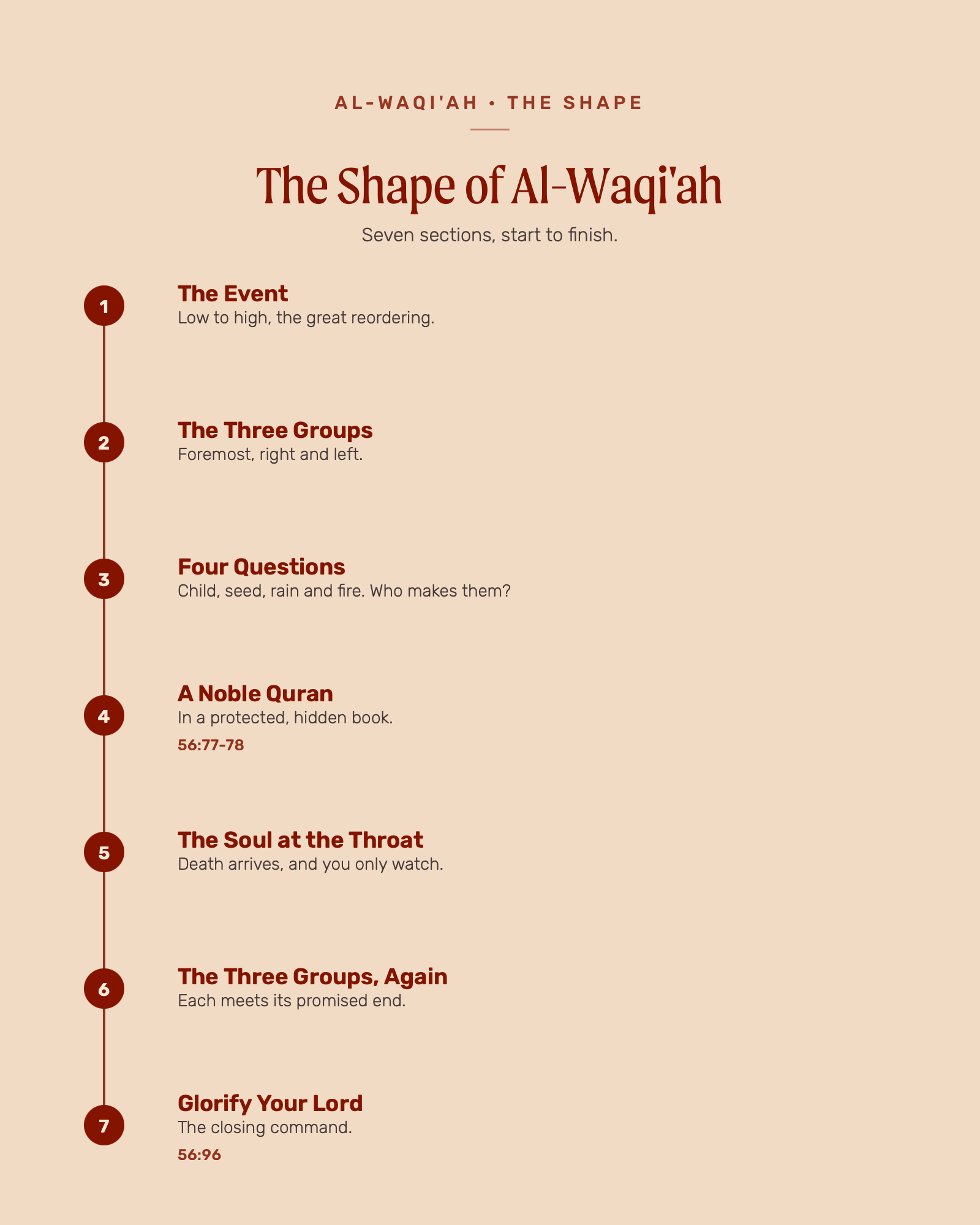
Mapped carefully, Surah Al-Waqi’ah unfolds in seven sections that move with real purpose, from the moment the world ends, through the sorting of humanity, into a set of questions designed to humble us and finally to the Quran and a call to worship. This post traces that structure and shows how its parts mirror and complete one another.
An Event That Brings Down and Lifts Up
The first section describes the Event itself and even here there is a deliberate motion (56:1-3)1. The word for the Event means something powerful crashing down and the opening verses move downward: bringing low, the earth violently shaken, the mountains crumbled. But then the crumbled mountains become scattered dust and dust rises. The section travels from down to up, from collapse to lifting, the very pattern the rest of the surah will follow as it raises some people and lowers others.
The Three Groups
The largest section sorts humanity into three (56:7)2: the foremost, the people of the right and the people of the left. The first two, both bound for Paradise, are described in close parallel, their seating and gathering, the servants and trees that bring them comfort, their drinks, their fruit, their spouses, laid out almost point for point so the reader feels the symmetry. The people of the left are set against them in everything, scorching wind and boiling water where the others have shade and pure springs. The surah’s opening motion continues here too: the foremost and the right are raised to lofty places, while the deniers are brought low.
Questions You Cannot Answer
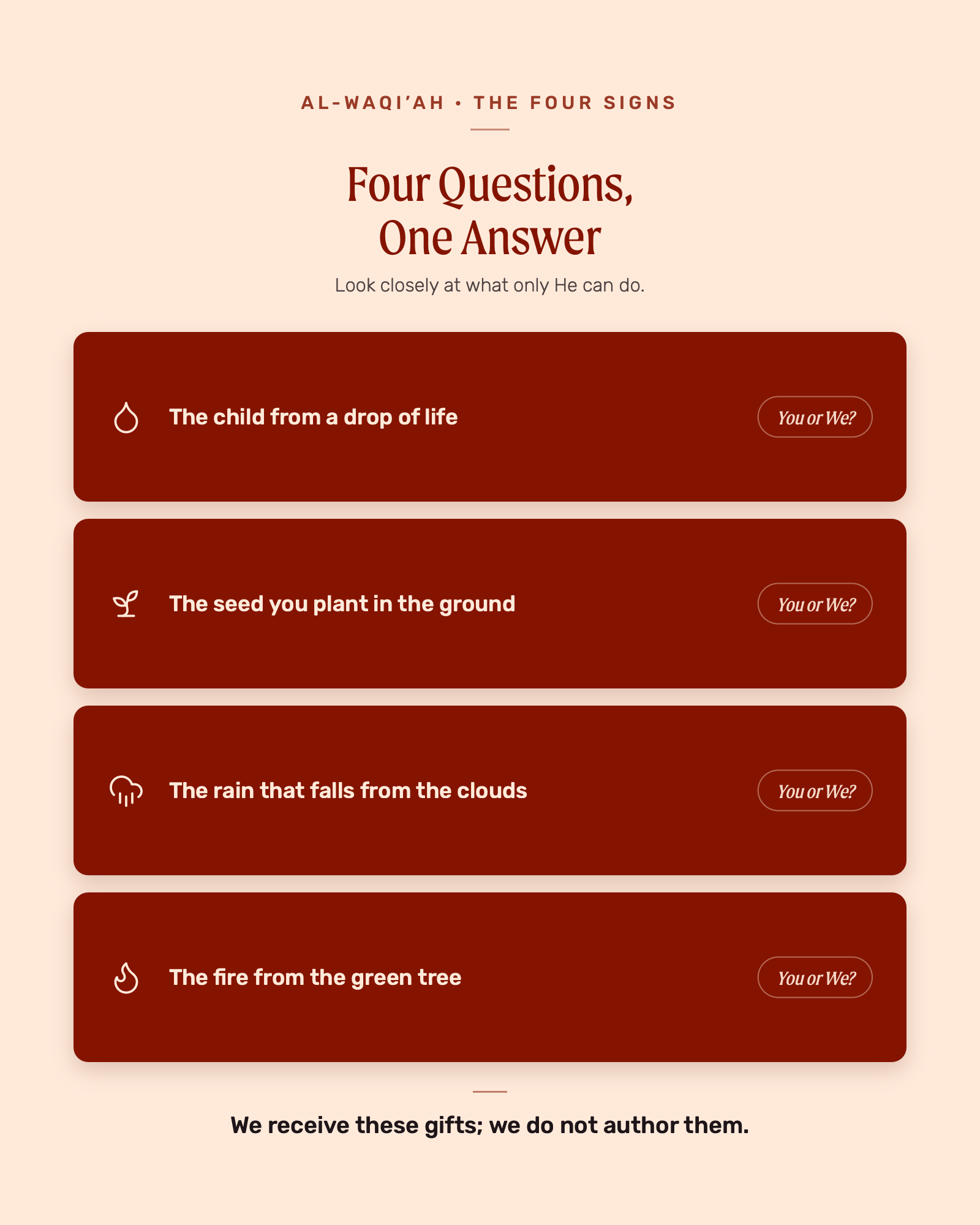
The middle section turns from the next world to this one and it does so by asking. Did you create the drop of life that became a child or did We? Do you grow the seed you plant or do We? Did you send down the rain ordid We? Did you make the fire spring from the green tree or did We? Four honest questions about the things we most take for granted, intimacy and birth, the crop, the water, the fire and each one has only one possible answer. We receive these gifts; we do not author them. The God who made them the first time, the section reminds us, is the same God who will raise us a second time.
A Noble Quran in a Protected Book
The surah then turns to the Quran itself, after an oath by the positions of the stars (56:77-78)3.
إِنَّهُۥ لَقُرْءَانٌ كَرِيمٌ فِى كِتَٰبٍ مَّكْنُونٍ
“Indeed it is a noble Quran, in a well-protected Book.”
(56:77-78)
The word for noble, karim, also describes one who gives without expecting anything in return. So when the deniers try to haggle with the message, to bargain and negotiate over what they will accept, they are violating the very nature of a Quran that asks nothing of them and only gives. It is a generous, guarded, exalted revelation, brought down from the Lord of all the worlds, not something to be bartered with.
Glorify the Name of Your Lord
Finally the surah brings us to the edge of death, the soul rising to the throat while the onlookers can do nothing and then sorts the dying soul once more into the three groups. And it ends with a single command (56:96)4.
فَسَبِّحْ بِٱسْمِ رَبِّكَ ٱلْعَظِيمِ
“So glorify the name of your Lord, the Magnificent.”
(56:96)
After the Event, the three groups, the humbling questions and the defence of the Quran, the surah lands on glorification. It is a fitting close not only to this chapter but to the whole cluster of surahs about the Quran: the run that began with Qaf ends here by handing us a tasbih, a way to praise the name of the Magnificent, which the surahs that follow will carry forward.
The Takeaway
Surah Al-Waqi’ah is a carefully ordered whole. Its sections move from the certainty of the end, to the three destinations awaiting us, to questions that strip away our illusions of self-sufficiency, to the noble Quran and at last to worship. Its opening image, lowering and lifting, becomes the logic of the entire surah. Read it that way and its final command feels earned: once you have seen the Event coming and the gifts you never made, the only thing left to do is glorify the One who did.
There is far more order and depth in Surah Al-Waqi’ah than a single article can hold. You can explore the full Al-Waqi’ah: A Deeper Look series on Bayyinah TV, alongside the other surahs being opened up in the Deeper Look collection.
Related reading: The Inevitable Event: An Introduction to Surah Al-Waqi’ah (the companion post in this series).
Notes
[1] Quran, 56:1-3, https://quran.com/56/1 ↩
[2] Quran, 56:7, https://quran.com/56/7 ↩
[3] Quran, 56:77-78, https://quran.com/56/77 ↩
[4] Quran, 56:96, https://quran.com/56/96 ↩

At Bayyinah, we are dedicated to helping you connect directly with the words of Allah beyond translation. Founded by Ustadh Nouman Ali Khan, our mission is to create transformative experiences that deepen your understanding and engagement with the Quran.
Study the Quran and Arabic in a systematic and personalized way through Bayyinah TV. Get started today for free.
Check out our newest articles, fresh off the press and ready for you to dive into!