Successful subscription! Thank you for subscribing.
Successful subscription! Thank you for subscribing.
September 20, 2026
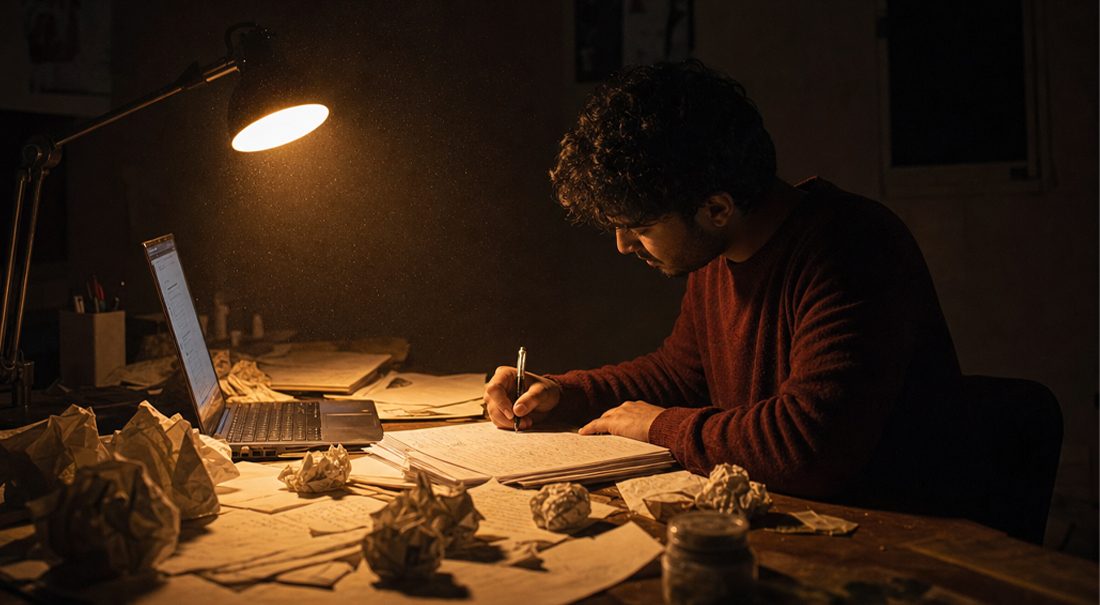
Okay so I want to talk about something that comes up in my DMs more than almost anything else, and it’s not about funnels or email sequences or growing an audience. It’s a quieter question and it usually sounds something like: “I’m building something I believe in, but nobody seems to care. Is that a sign I should stop?”
Abdulkarim Yussif from Ghana asked me a version of this recently. He’s been working on something for months, mostly alone, with very little external signal that it’s working. And what struck me wasn’t the question itself but the weight behind it, because I think most people building in Islamic education or any values-driven space have felt exactly this.
There’s a version of builder culture that’s obsessed with proof of traction. Proof that you’re not wasting your time and I get it, because resources are finite and discernment matters. But I think we’ve imported a framework for validation that doesn’t actually fit the work a lot of us are doing and it’s quietly causing damage.
An Atom’s Weight
Ustadh Nouman’s explanation of Surah Az-Zalzalah changed something for me about how I think about effort that goes unseen.
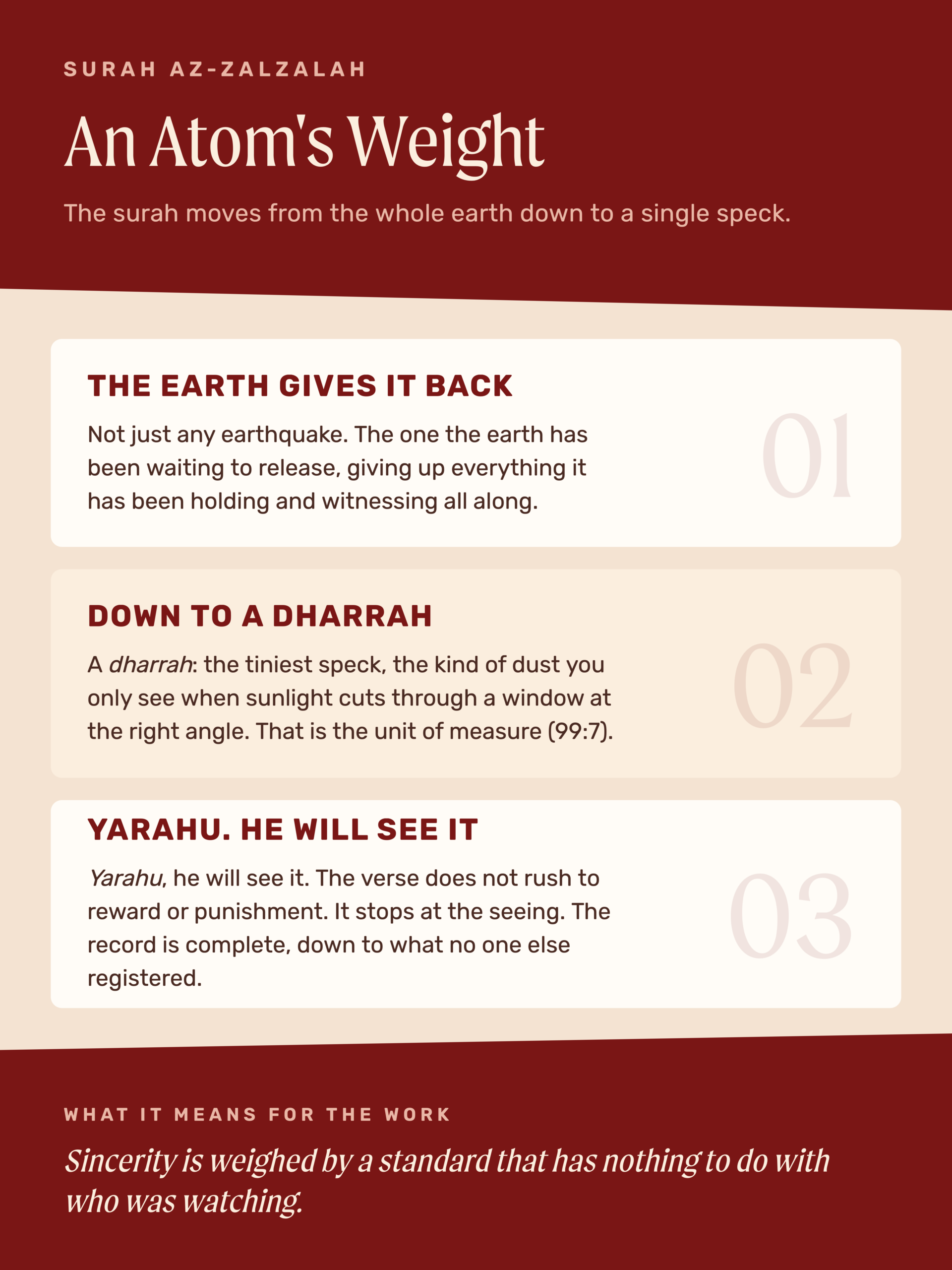
The surah opens with this earthquake image, the earth shaking and giving up everything it has been holding, and in Ustadh’s reading, the word zalzalataha carries something specific: this isn’t just any earthquake, it’s the earthquake the earth has been waiting to release all along. The earth has been holding things, witnessing things and on that day, it gives it all back.
Then you get to 99:7, and Ustadh’s explanation is precise about something the translation alone doesn’t carry. The word dharrah, the tiniest speck, the dust particles you can only see when sunlight cuts through a window at the right angle. And the verb yarahu, “he will see it,” doesn’t describe punishment or reward yet. Just: he will see it. Ustadh says something like, “Allah doesn’t rush to the outcome here. He says you will SEE. The seeing is the point.” That deliberate pause in the surah is doing something. It’s telling you that the record is complete, down to things no one else registered and you will face that completeness.
What that means for the builder working without an audience is not small. It means the sincerity of a thing is being weighed by a standard that has nothing to do with who was watching.
Loneliness Doesn’t Mean You’re Wrong
Here’s the part people don’t expect when they start building something meaningful: the loneliness doesn’t go away when you get better at the work. It’s not a phase you graduate from. It’s part of the structure of doing something that matters before others can see why it matters.
Sabrah Masoud described this to me as feeling like she was “always explaining herself” to people who needed to see results she didn’t have yet. And what I wanted to say to her is that the explaining-yourself feeling is often a sign you’re ahead of the social proof, not behind the actual work.
We’re conditioned to read loneliness as feedback. If no one is with you, maybe you’re going the wrong direction. But in Ustadh’s reading of this surah, the earth bears witness to what happened on it, including everything that happened with no audience, because the absence of an audience was never the point. The deed existed. The sincerity existed. The earth saw it.
That’s not a comfort I want to flatten into a motivational line, because the loneliness is real and it costs something. But I do think it’s a different category of information than we usually treat it as.
Sabr and Tawakkul When the Numbers Don’t Come
We’ve had seasons at Bayyinah where the gap between what we believed we were building and what the funding or the numbers reflected was significant, and I won’t pretend that’s an easy place to operate from. You second-guess the strategy. You second-guess yourself. Sabr gets invoked a lot in those conversations, sometimes helpfully and sometimes as a way of avoiding the harder question of whether you’re being stubborn or faithful.
What I’ve come to think is that sabr and tawakkul are not about suspending your judgment. Tawakkul is not passivity dressed up in a religious frame. It’s doing the work you can actually do, with the resources you actually have, and releasing the outcomes that were never in your hands to begin with. Ustadh often talks about how the Quran uses idha, “when,” not “if,” and the certainty built into that word is the foundation of tawakkul. Not that things will go well by your measure, but that the accounting is real and it is complete and nothing sincere is lost.
The practical version of that, for me, has meant staying closer to the question of whether the work is good than to the question of whether the work is being seen. Those are different questions and they require different kinds of attention. One of them you can actually control.
Allah Sees the Work
The movement in Az-Zalzalah, as Ustadh explains it, goes from macro to micro, from the whole earth shaking to the single speck on the scale and that movement is the argument. The collective event leads to the individual reckoning and the individual reckoning goes all the way down to things that left no trace on anyone else’s memory. The earth gave testimony. The record is not thin.
For anyone building right now with no funding and no following and no external confirmation that the work is real, I want to leave that image with you. The speck. The sunlight catching it through the window. Yarahu. You will see it.
That’s not a small promise.
May Allah make our unseen efforts count for more than our visible ones, give us the patience to build without applause and the clarity to know when to keep going and let nothing sincere we’ve done be lost.
If this resonated, you can join the Bayyinah Works newsletter at bayyinah.com/works.

At Bayyinah, we are dedicated to helping you connect directly with the words of Allah beyond translation. Founded by Ustadh Nouman Ali Khan, our mission is to create transformative experiences that deepen your understanding and engagement with the Quran.
Study the Quran and Arabic in a systematic and personalized way through Bayyinah TV. Get started today for free.
Check out our newest articles, fresh off the press and ready for you to dive into!