Successful subscription! Thank you for subscribing.
Successful subscription! Thank you for subscribing.

August 30, 2026
Munir, a builder wrote to us with a request attached to his encouragement. “I ask that the essays, if you produce them, aren’t AI generated,” he said. “It’s become a trigger in my mind that something was AI generated instead of written from the heart.” He builds software himself, an interactive tool for exploring the Quran’s structure, so he has earned the unease. It’s worth sitting with what he’s describing: reading words and no longer being sure a heart was behind them.
What sincerity actually is
In Ustadh’s explanation of Surah Al-Bayyinah, he spends time on the word mukhlisin in the ayah where people “were commanded only that they worship Allah, making the deen sincerely His” (98:5). The root of the word means to be pure, free from mixture. Sincerity, in his explanation, is doing the thing purely for Allah with no other motive folded into it, no status, no income, no audience quietly sharing the intention.
On that definition, sincerity is a property of a person. A tool has no motives to mix. A pen has never been sincere and has never been insincere either, and the same holds for a printing press, a microphone or a language model.
The tool and the one holding it
Every medium that has ever touched the Quran unsettled the generation that first met it. Zayd ibn Thabit, tasked with compiling the mushaf into one collection, at first asked how he could do something the Prophet ﷺ had not done (Bukhari). Then came recordings of recitation, then translations, then the mushaf on the same screen people use for everything else. Each time, the words of Allah outlived the worry. What varied was the people holding the medium and what they were holding it for.
Which is exactly where Surah Al-Bayyinah locates the whole matter. The ayah doesn’t legislate about pens or parchment. It asks about the purity of the motive in the person.
Where to keep the human
Still, Munir is pointing at something real, because a tool can now produce the artifact of devotion without any devotion having occurred. That is new and it means the question shifts from whether to use a tool to what must never be delegated to one.
In the same surah study, Ustadh warns about what happens when religious knowledge becomes a means of status or gain rather than a way of drawing close to Allah, and says to hold it “with trembling hands,” because it is “a trust, not a trophy.” The trembling hands are the part no machine can supply. A tool can draft, sort, summarize and search. It cannot intend, it cannot check with fear of Allah in its chest and it cannot stand accountable for what goes out under your name.
Humaira, a reader who takes her friends through Surah Aal-Imran on weekends, models the healthy version without trying to. She prepares a one or two page summary of each lesson using Claude and says “it is really helping me synthesise and understand better.” The tool feeds her understanding, and then she is the one who sits in front of people, teaches, answers their questions and answers to Allah for what she taught. The machine made her faster. The amana never left her hands.
A grounded posture
There are two easy postures toward new tools and both cost something. One treats every tool as a threat to sincerity, which quietly grants the tool more spiritual weight than it has. The other adopts everything immediately and asks questions later, which is how sacred work ends up shaped by whatever the software found easiest.
The closing of Surah Al-Bayyinah offers steadier ground. It describes those who feared their Lord and ends with Allah being pleased with them and them being pleased with Him (98:8), and in Ustadh’s words, the believer finds satisfaction in their relationship with Allah rather than in what people think of them. A person anchored there can pick a tool up or put it down and their sincerity doesn’t move, because it was never stored in the tool.
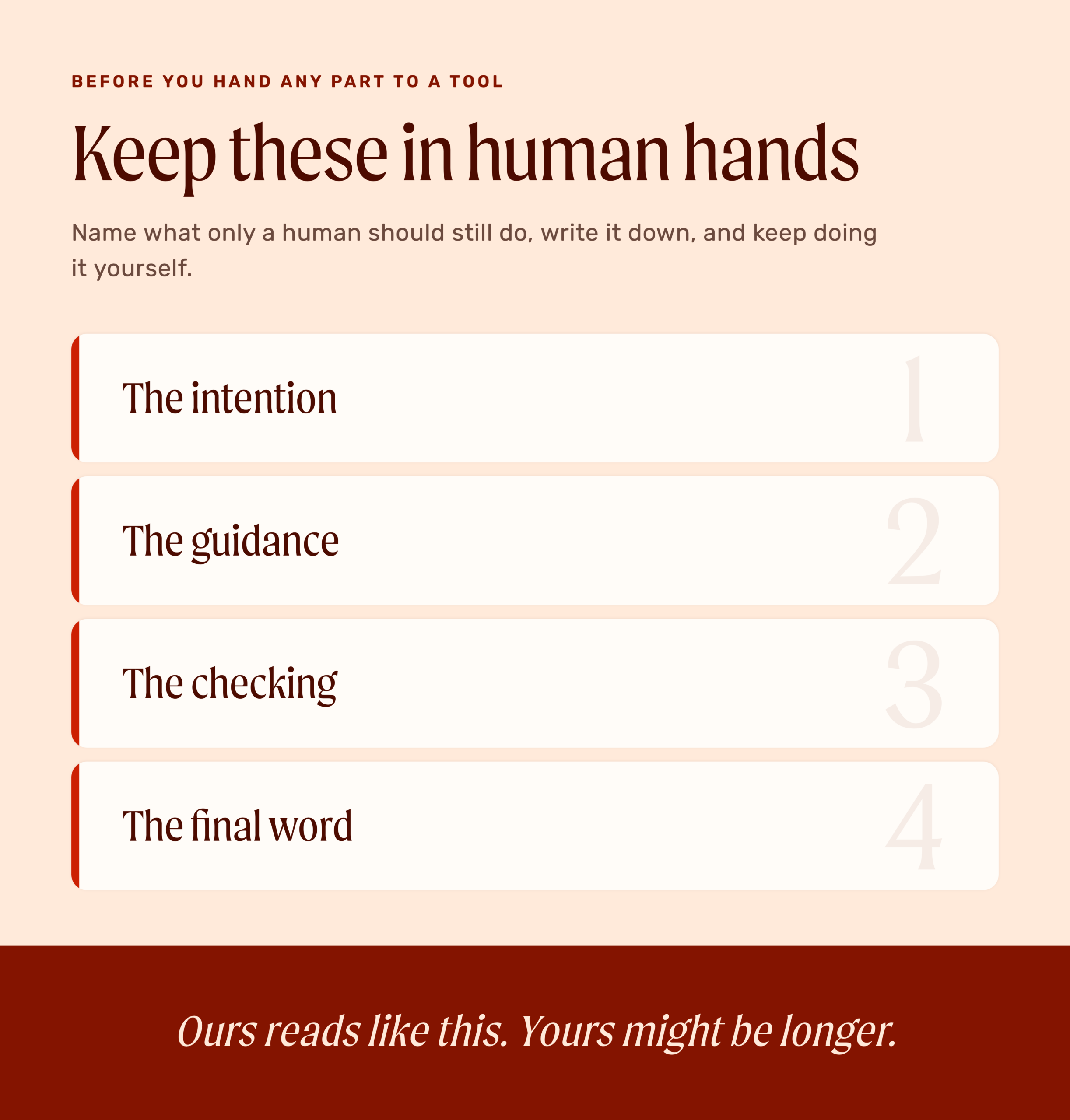
Before you hand any part of sacred work to a tool, name what only a human should still do in it, write it down and keep doing it yourself. Our list currently reads: the intention, the guidance, the checking and the final word. Yours might be longer.
For more of how Bayyinah actually gets built, join the Bayyinah Works newsletter at bayyinah.com/works.

At Bayyinah, we are dedicated to helping you connect directly with the words of Allah beyond translation. Founded by Ustadh Nouman Ali Khan, our mission is to create transformative experiences that deepen your understanding and engagement with the Quran.
Study the Quran and Arabic in a systematic and personalized way through Bayyinah TV. Get started today for free.
Check out our newest articles, fresh off the press and ready for you to dive into!