
Successful subscription! Thank you for subscribing.
Successful subscription! Thank you for subscribing.

July 29, 2026
Surah Al-Layl, the 92nd surah of the Quran, opens with an oath by the night as it settles over everything and within a few short verses it lays out one of the clearest maps of the human condition anywhere in the Quran. It sits right beside Surah Ash-Shams before it, sharing its rhythm of oaths, yet it carries a subject all its own. This surah captures the quiet tension every believer lives inside, the pull between our own effort and the will of Allah. In this first look at the surah, we stay with its opening, where three oaths lead straight into a single striking statement about where all our striving is actually headed.
The Oaths of Contrast
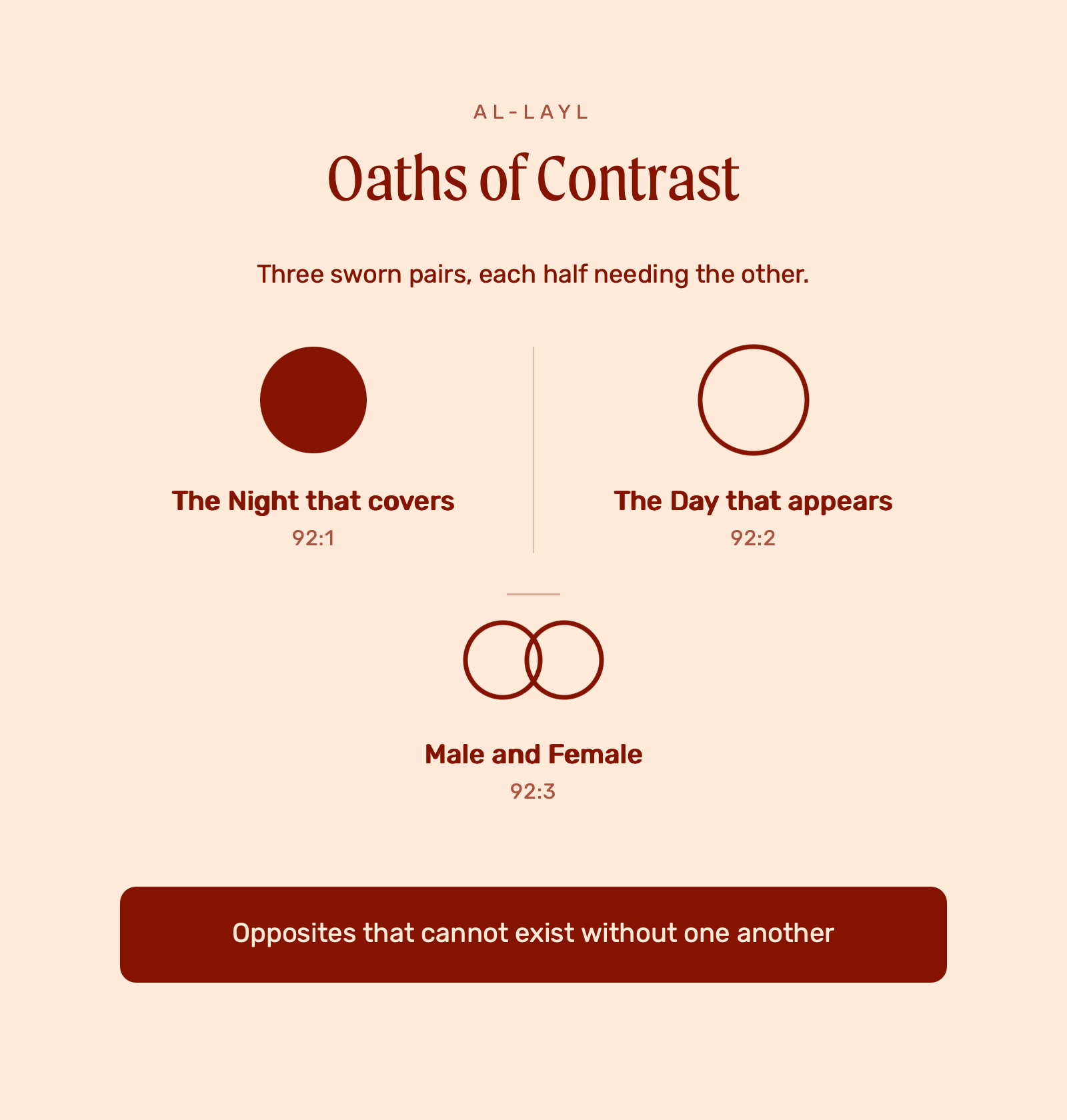
The surah begins the way many of the late short surahs do, by swearing on the natural world. It opens with the night and the day, two realities that could not be more different yet cannot exist without one another.
وَٱلَّيْلِ إِذَا يَغْشَىٰ وَٱلنَّهَارِ إِذَا تَجَلَّىٰ
“By the night as it covers and the day as it appears in brightness.”
(92:1-2)
Night covers everything and hides it, while day arrives in full glory and makes everything clear.1 Then, right after night and day, Allah swears by something that at first seems unrelated, the creation of the male and the female (92:3).2 Ustadh Nouman draws out the link here. In several places the Quran compares men and women to night and day, extreme opposites that need each other, each carrying something of the other, one associated with rest and stillness and the other with activity and responsibility. Night does not snap into day; it turns into it slowly and so does the relationship between two people learning to work with one another despite how differently they were made.
Where All Our Effort Is Headed
These contrasting oaths are not decoration. They set up the central claim of the surah, that human striving itself is divided and pulls in opposite directions.
إِنَّ سَعْيَكُمْ لَشَتَّىٰ
“Indeed, your efforts are diverse.”
(92:4)
Everything that follows is a description of this one verse.3 The word the surah uses points to something scattered, spread out, running in every possible direction, as different from one another as night and day. Some of us are pouring our energy into one kind of life, others into its complete opposite. The rest of the surah simply shows us the two great directions all that effort divides into and asks, quietly, which road we are actually on.
The Three Steps Toward Goodness
The first road belongs to the person whose effort is aimed in the right direction and Ustadh Nouman highlights that it is described in three verbs that climb in a deliberate order.
فَأَمَّا مَنْ أَعْطَىٰ وَٱتَّقَىٰ وَصَدَّقَ بِٱلْحُسْنَىٰ
“As for the one who gives and is mindful of Allah and believes in the best.”
(92:5-6)
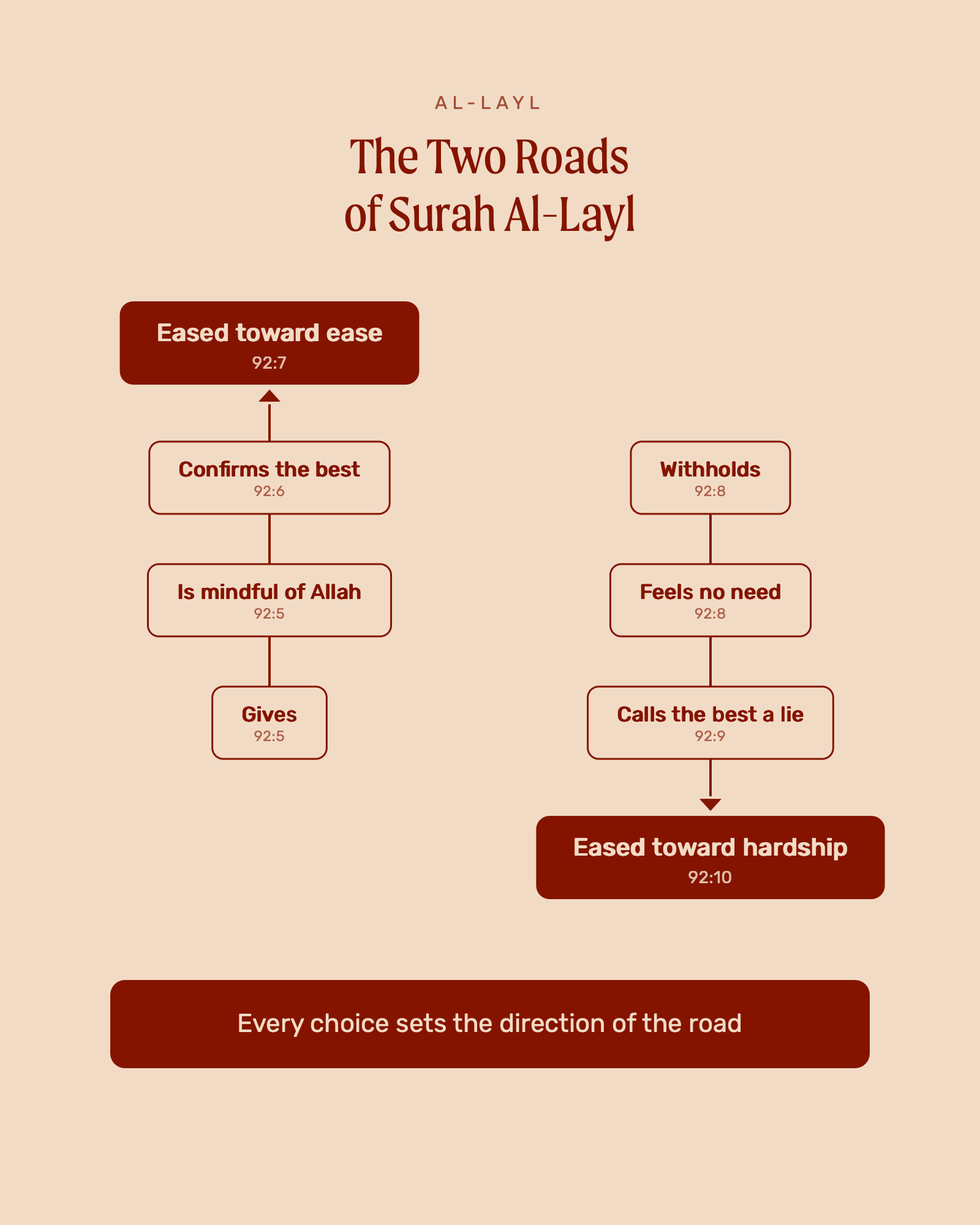
The first step is giving, being a generous person with whatever you have, whether that is money, time, a smile or good advice.4 The second is taqwa, being careful and mindful in your relationship with Allah. So goodness to people comes first, then goodness toward the One who made us. The third step is the one that seals the other two, confirming the truth in its most beautiful form. As Ustadh Nouman explains, this is the person who, when the truth is placed in front of them, humbles themselves before it without hesitation, whatever it costs. It is the quality that companions like Abu Bakr (RA) embodied when the message reached them and they accepted it at once and Allah promises such a person that He will ease their path toward the ultimate ease (92:7).
The Road That Runs the Other Way
The surah then turns the whole picture over. The second road is described with the exact opposites of those first three qualities, step for step downward. Where the first person gave, this one withholds and holds tightly to wealth that wants to leave his hands (92:8). Where the first was mindful, this one feels no need for Allah at all, imagining that his wealth makes him self-sufficient. Where the first confirmed the truth, this one calls the best a lie (92:9). For such a person the path is eased in the opposite direction, toward hardship and his wealth will not save him when he falls (92:10-11).5 Ustadh Nouman points out how the two sequences mirror each other perfectly, three steps rising toward mercy and three steps descending, so that the reader sees exactly how a life takes its shape one choice at a time.
Guidance Is Ours to Give
After laying out both roads, the surah makes a promise that reframes everything.
إِنَّ عَلَيْنَا لَلْهُدَىٰ
“Indeed, upon Us is guidance.”
(92:12)
Guidance, Ustadh Nouman notes, comes in two forms.6 One is simply pointing the way, giving the information. The other is walking alongside someone all the way to the destination. Allah offers both. Notice the order across the surah, effort first and then guidance. When you give, when you show taqwa, when you accept the truth, that is your effort and the ease Allah then places in your path is His guidance meeting you. Take even a single step in the right direction and He does not leave you to walk alone. He accompanies you and because He also owns the very end and the very beginning (92:13), He guarantees to carry you the whole way.
The Takeaway
Surah Al-Layl asks a question we usually avoid, which direction is all our effort actually pointing. The surah does not leave us anxious, because the moment we take one honest step, giving, staying mindful, accepting a truth even when it stings, Allah promises to ease the rest of the road. Our striving matters and His guidance meets it. That is the quiet reassurance folded into the surah’s opening.
You can explore the full Al-Layl: A Deeper Look series on Bayyinah TV, alongside the other surahs being opened up in the Deeper Look collection.
Notes
[1] Quran, 92:1, https://quran.com/92/1 ↩
[2] Quran, 92:3, https://quran.com/92/3 ↩
[3] Quran, 92:4, https://quran.com/92/4 ↩
[4] Quran, 92:5, https://quran.com/92/5 ↩
[5] Quran, 92:11, https://quran.com/92/11 ↩
[6] Quran, 92:12, https://quran.com/92/12 ↩

At Bayyinah, we are dedicated to helping you connect directly with the words of Allah beyond translation. Founded by Ustadh Nouman Ali Khan, our mission is to create transformative experiences that deepen your understanding and engagement with the Quran.
Study the Quran and Arabic in a systematic and personalized way through Bayyinah TV. Get started today for free.
Check out our newest articles, fresh off the press and ready for you to dive into!