Successful subscription! Thank you for subscribing.
Successful subscription! Thank you for subscribing.
July 23, 2026
Surah Al-Baqarah is often the first place a skeptic points to when claiming the Quran is disorganized. Its subjects seem to jump from belief to history to law to finance with no obvious thread. Look more closely at its structure, though and a deliberate symmetry appears, one that ties the final two ayat all the way back to the opening.
This post traces that design, from the special way the closing ayat were revealed, to the ring that mirrors the start of the surah against its end, to the supplication that lifts a weight off every believer.
Two Ayat Received Above the Heavens
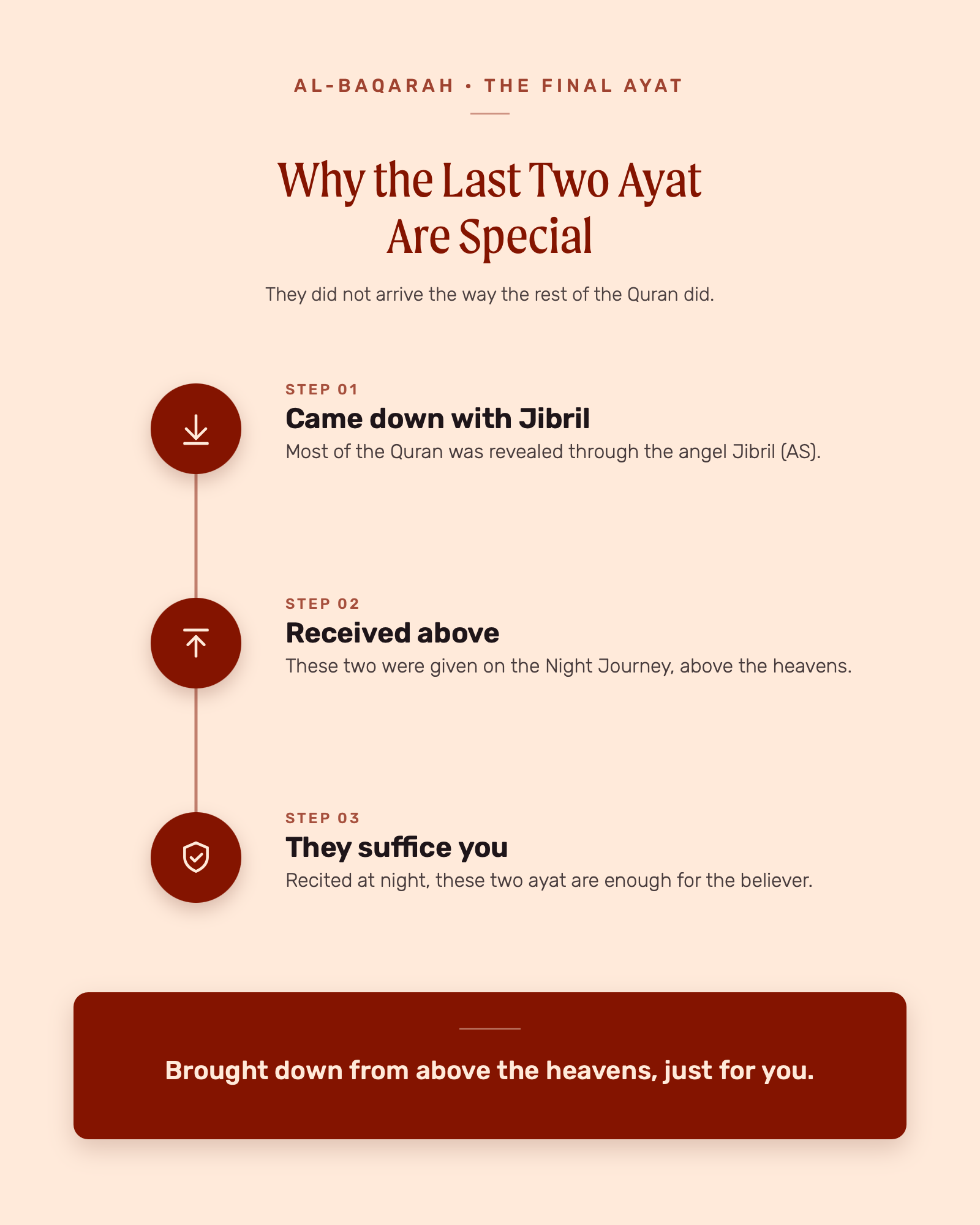
Almost the entire Quran was brought down to the Prophet ﷺ by the angel Jibril (AS). The closing ayat of Surah Al-Baqarah are the famous exception. They were given during the Night Journey, when the Prophet ﷺ ascended beyond where even Jibril (AS) could go and received them directly (Sahih Muslim 173).1 This gives them a station unlike any other passage. The Prophet ﷺ also told us that whoever recites the last two ayat of Surah Al-Baqarah at night, they will be enough for him (Sahih al-Bukhari 5009).2
A Surah Built Like a Ring
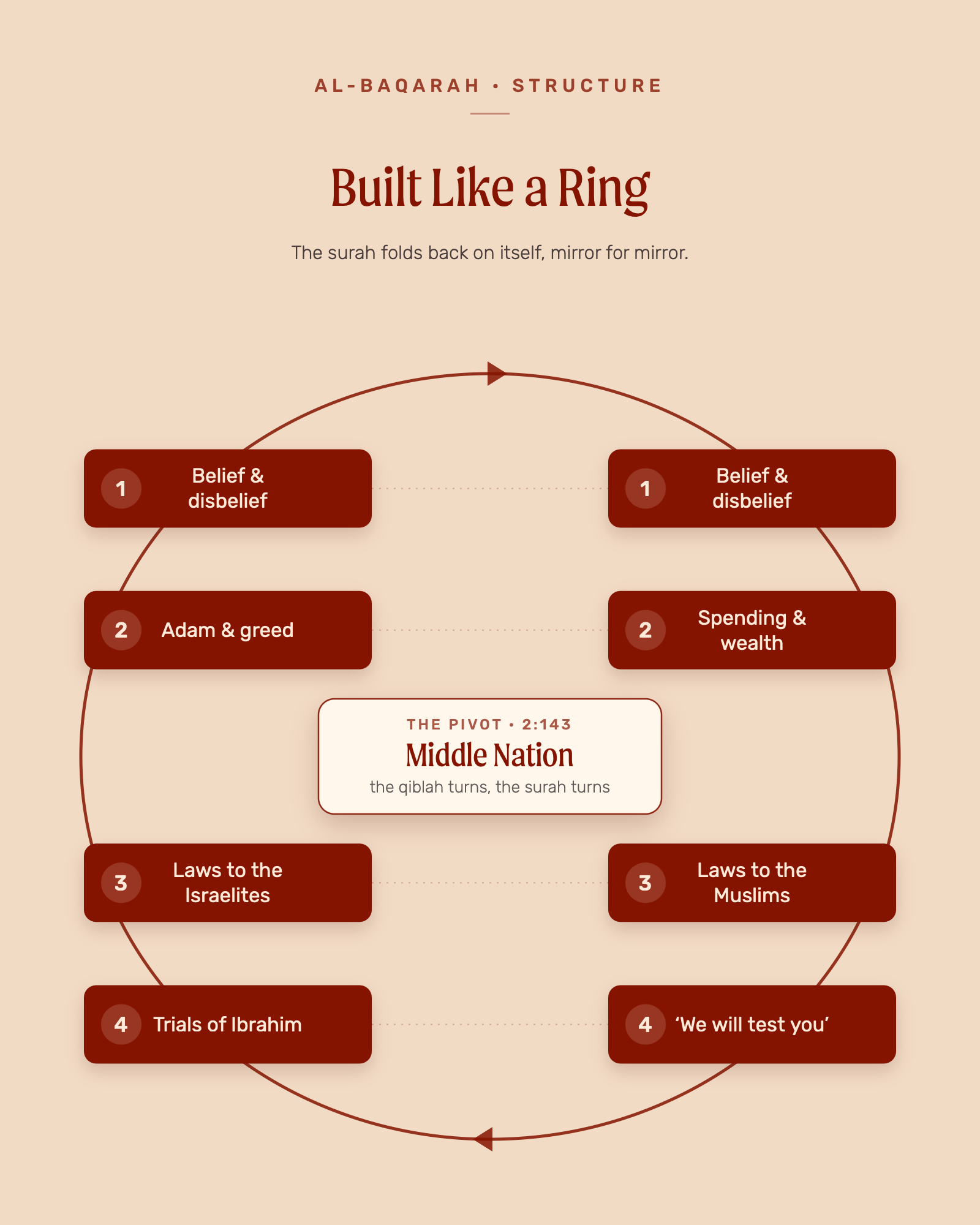
Read from the outside in, Surah Al-Baqarah is strikingly symmetrical. It opens with believers, disbelievers and hypocrites and it closes returning to belief and disbelief. Near the start is the story of Adam (AS) and the greed that cost him the garden; near the end is a long section on greed and money, on spending, interest and honest business. The laws given to the Israelites on one side are mirrored by the laws given to the Muslims on the other. The trials of Ibrahim (AS) early in the surah are answered late by Allah’s promise to test this nation as well. At the very center sits the change of the qiblah and the naming of this community as a middle nation (2:143),3 with the Ka’bah of Ibrahim (AS) at the heart of it all. What looks random is in fact a ring, folded around its own center.
The End Echoes the Beginning
The closing ayat begin with Amana ar-Rasul, “the Messenger believed.”
امَنَ ٱلرَّسُولُ بِمَآ أُنزِلَ إِلَيْهِ مِن رَّبِّهِۦ وَٱلْمُؤْمِنُونَ
“The Messenger believes in what was sent down to him from his Lord and so do the believers.”
(2:285)
Notice that Allah speaks of the Messenger in the third person even while addressing him, an expression of honor. The opening of the surah was also about the Messenger, the unlettered man who could not read yet recited Alif Lam Mim (2:1).4 Both the beginning and the end use a kind of mystery in their wording: the start withholds the meaning of the letters and the end says what was “sent down” before naming who sent it, mirroring the believer’s own journey from hearing the words to recognizing their source. The ayah continues that the believers make no distinction between His messengers and respond, “we hear and we obey” (2:285).5
A Closing Du’a That Lifts the Burden
The surah that began by humbling us ends by reassuring us. Its final ayah opens with a promise:
لَا يُكَلِّفُ ٱللَّهُ نَفْسًا إِلَّا وُسْعَهَا
“Allah does not burden a soul beyond its capacity.”
(2:286)
From there the believers turn to du’a: do not take us to task for forgetting or making mistakes, do not place on us a burden like the one carried by those before us and pardon us (2:286).6 This connects directly to the surah’s warning that forgetfulness and repeated mistakes can pull a person toward hypocrisy, so the community ends by begging to be kept firm. The longest surah in the Quran closes not with a ruling but with a prayer for mercy.
The Takeaway
Surah Al-Baqarah is not a pile of unrelated topics. It is one connected design, folded so that its end speaks back to its beginning and its center holds the Ka’bah and the middle nation. When you recite its final two ayat, the ones received above the heavens, you are not closing a chapter so much as being returned to the very first lesson of the surah: believe, stay humble and ask to be kept on the path.
There is far more symmetry in Surah Al-Baqarah than a single article can hold. You can explore the full Al-Baqarah: A Deeper Look series on Bayyinah TV, alongside the other surahs being opened up in the Deeper Look collection.
Related reading: How the First Two Ayat of Surah Al-Baqarah Teach Us to Read the Quran (the companion post in this series).
Notes
[1] Sahih Muslim 173 (the closing verses given during the Night Journey), https://sunnah.com/muslim:173 ↩
[2] Sahih al-Bukhari 5009 (whoever recites the last two ayat at night, they suffice him), https://sunnah.com/bukhari:5009 ↩
[3] Quran, 2:143, https://quran.com/2/143 ↩
[4] Quran, 2:1, https://quran.com/2/1 ↩
[5] Quran, 2:285, https://quran.com/2/285 ↩
[6] Quran, 2:286, https://quran.com/2/286 ↩

At Bayyinah, we are dedicated to helping you connect directly with the words of Allah beyond translation. Founded by Ustadh Nouman Ali Khan, our mission is to create transformative experiences that deepen your understanding and engagement with the Quran.
Study the Quran and Arabic in a systematic and personalized way through Bayyinah TV. Get started today for free.
Check out our newest articles, fresh off the press and ready for you to dive into!