Successful subscription! Thank you for subscribing.
Successful subscription! Thank you for subscribing.
July 29, 2026
Some warnings arrive with a face you can recognize. Surah Al-Qari’ah, the 101st surah of the Quran, opens with a warning you cannot see coming at all. It names a single event, a loud crashing sound and then asks a question the reader has no way to answer. In this opening session of the Al-Qari’ah: A Deeper Look series, Ustadh Nouman Ali Khan walks through those first verses and shows how a very short surah quietly rearranges everything we thought had value.
A Question With No Human Answer
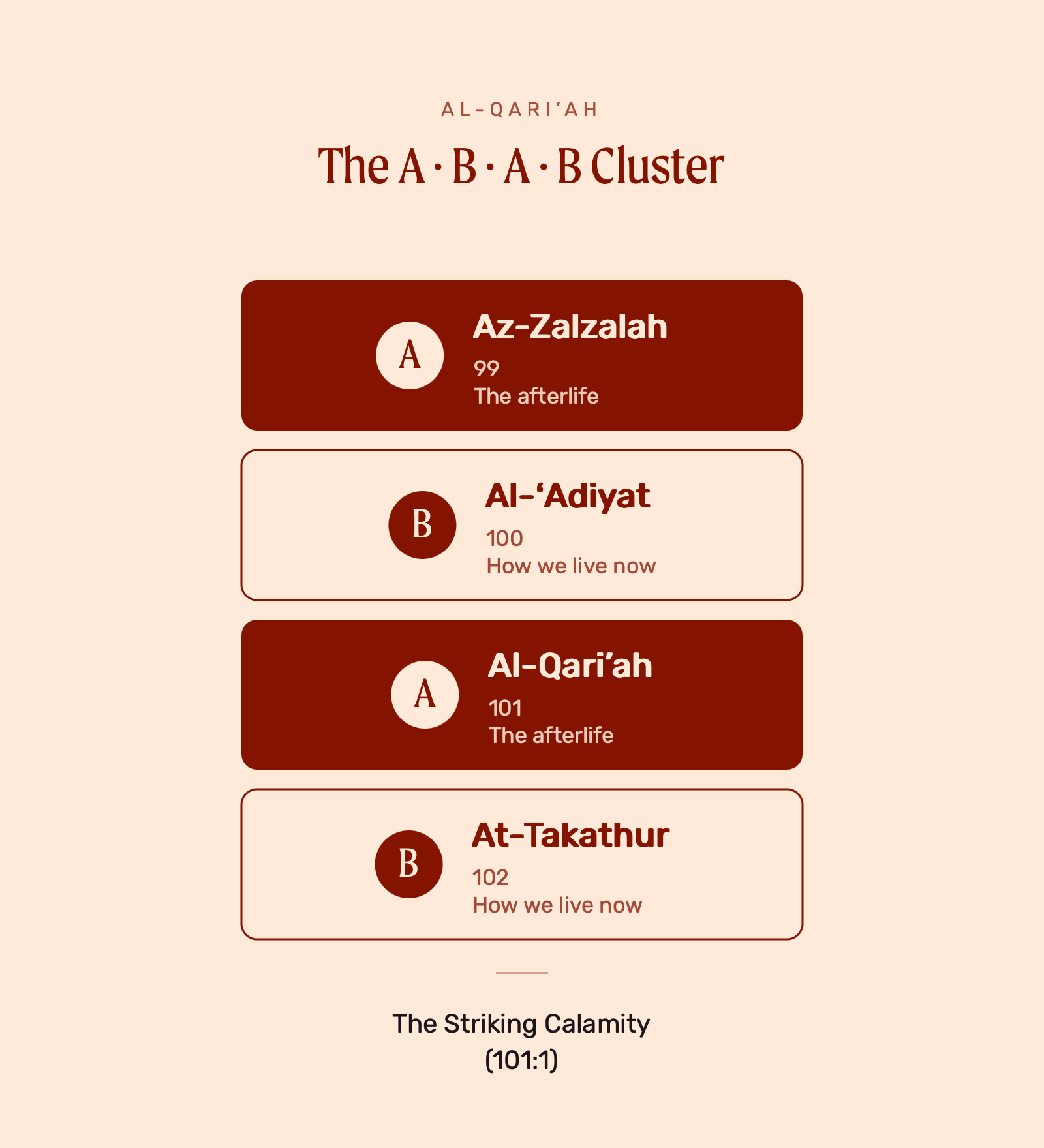
The surah begins with one word, the calamity, before we are even told what it is.1 Then Allah repeats it as a question and then repeats it again in a way that stops us in our tracks.
وَمَآ أَدْرَىٰكَ مَا ٱلْقَارِعَةُ
“And what can make you know what is the striking calamity?”
(101:3)
This style is deliberate. When you say one terrifying word to someone with no context, a loud beating, their first reaction is a question, what beating? Allah captures that reaction and then answers it with a kind of beautiful refusal. The phrasing “what could give you any clue” is telling us there is no clue to be had. This is a moment you cannot prepare for and cannot measure in advance, because the answer lives entirely with Allah. The word Al-Qari’ah itself carries the sense of something struck hard, beaten until nothing is left standing on it, a sound so violent it flattens whatever it hits.
When Weight Loses Its Meaning
Instead of describing the sound directly, the surah shows us the reaction to it. People on that day are scattered like moths and the mountains become like tufts of carded wool.2 Read those two images together and something clicks into place. Moths carry no weight, they scatter in every direction with no sense of where they are going. Mountains are the heaviest things we know, the very symbol nations reach for when they want to describe their own strength and permanence.
يَوْمَ يَكُونُ ٱلنَّاسُ كَٱلْفَرَاشِ ٱلْمَبْثُوثِ
“It is the Day when people will be like scattered moths.”
(101:4)
Both of these become weightless at once. The might of crowds and the mass of mountains, gone. If the two things that carried the most weight in this world suddenly carry nothing, then something else must now be carrying everything. That reversal is the hinge of the whole surah and it sets up the two verses that follow.
The Two Scales We Live By
Ask yourself how anything gets its weight in this life and you find only two answers. Either it has material weight, gold and rice sit on a scale and a number decides their worth or people assign it weight, a degree, a brand, a currency, a look at a party. A luxury bag costs thousands not because of what went into it but because of the name printed on it and we spend our lives adjusting ourselves to whichever scale is watching. Surah Al-Qari’ah removes both scales in a single stroke. People became weightless, so social value is gone. Mountains became weightless, so material value is gone. What is left is a scale we did not build.
Ustadh Nouman points out that the word for scales here also means the things being weighed and both meanings matter. The deeds themselves are placed on Allah’s balance. A word we said and forgot, a “alhamdulillah” offered without a second thought, a moment we made a crying child smile, these felt like nothing at the time. The Prophet ﷺ told us the man who gave water to a thirsty dog walked into Jannah for it and he surely never imagined that small mercy would be the heaviest thing he ever did.3 The deeds we underestimate, good and bad alike, can turn out to be the ones that count.
Three Things on the Balance
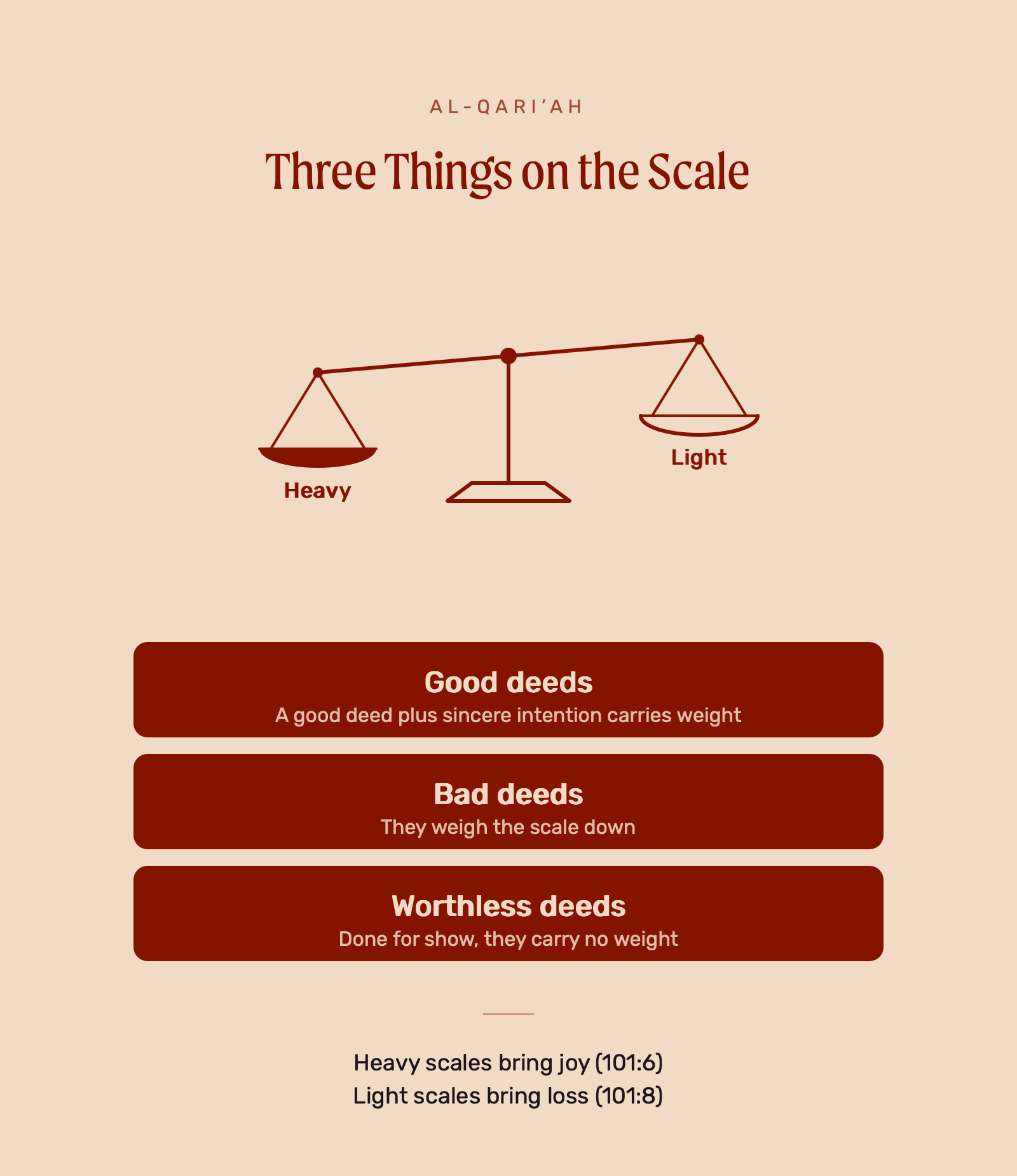
Here is where the surah asks for careful reading. We tend to picture two piles, good deeds against bad. Ustadh Nouman draws out a third. There are good deeds, there are bad deeds and there is a whole pile of things we assumed were achievements that turn out to weigh nothing at all. A career built honestly, wealth earned by legitimate means, years of effort poured into what the world applauds, all of it can land on the scale and register as light.
فَأَمَّا مَن ثَقُلَتْ مَوَٰزِينُهُۥ
“So as for one whose scales are heavy with good deeds.”
(101:6)
Weight, then, comes from two things together, a deed that was genuinely good and an intention that was sincere. Sincerity here is broader than we often make it. It is owed to Allah in acts of worship, in charity, in teaching and calling to the deen and no camera or crowd should change how you carry those out. It is also owed to people, in caring for your parents, providing for your family, being honest with an employer or a client. When you hugged your mother, you did it because she is your mother and that too is sincerity that will carry weight. What matters is what was actually happening in the heart behind the deed.
The Mother That Waits at the End
The surah closes by returning to its own opening, a question answered by a single haunting word. The one whose scales are light is given a startling image, his refuge, his mother, will be Hawiyah.4 A mother gathers, protects and shields her child from harm. This final “mother” does the opposite. She is a deep pit of fire that pulls a person down and blocks every good from reaching him.
فَأُمُّهُۥ هَاوِيَةٌۭ
“His refuge will be an abyss.”
(101:9)
The Arabs used to curse an enemy by wishing that his mother would collapse in grief over what became of him, a way of measuring how much a mother loves her child. This surah leans on that very expression. The person the world envies, who has everything people chase, is bankrupt of the one thing that mattered. Notice what the surah does not say. It never warns that too many bad deeds send you to the fire, it warns that not gathering enough real good is its own quiet ruin.
The Takeaway
Surah Al-Qari’ah lets us see, before the day arrives, what actually has value and what only appears to. The loud sound has not come yet, so we still have time to move weight onto the right side of the scale, with sincere deeds done for Allah and for His creation. The words and small mercies the world overlooks may be the heaviest things we ever do. It is worth asking, honestly, which pile we are filling.
If this opening reframed how you read one of the shortest surahs in the Quran, there is much more waiting. You can explore the full Al-Qari’ah: A Deeper Look series on Bayyinah TV, alongside the other surahs being opened up in the Deeper Look collection.
Notes
[1] Quran, 101:1, https://quran.com/101/1 ↩
[2] Quran, 101:5, https://quran.com/101/5 ↩
[3] Sahih al-Bukhari 2363, https://sunnah.com/bukhari:2363 ↩
[4] Quran, 101:9, https://quran.com/101/9 ↩

At Bayyinah, we are dedicated to helping you connect directly with the words of Allah beyond translation. Founded by Ustadh Nouman Ali Khan, our mission is to create transformative experiences that deepen your understanding and engagement with the Quran.
Study the Quran and Arabic in a systematic and personalized way through Bayyinah TV. Get started today for free.
Check out our newest articles, fresh off the press and ready for you to dive into!