Successful subscription! Thank you for subscribing.
Successful subscription! Thank you for subscribing.
July 19, 2026
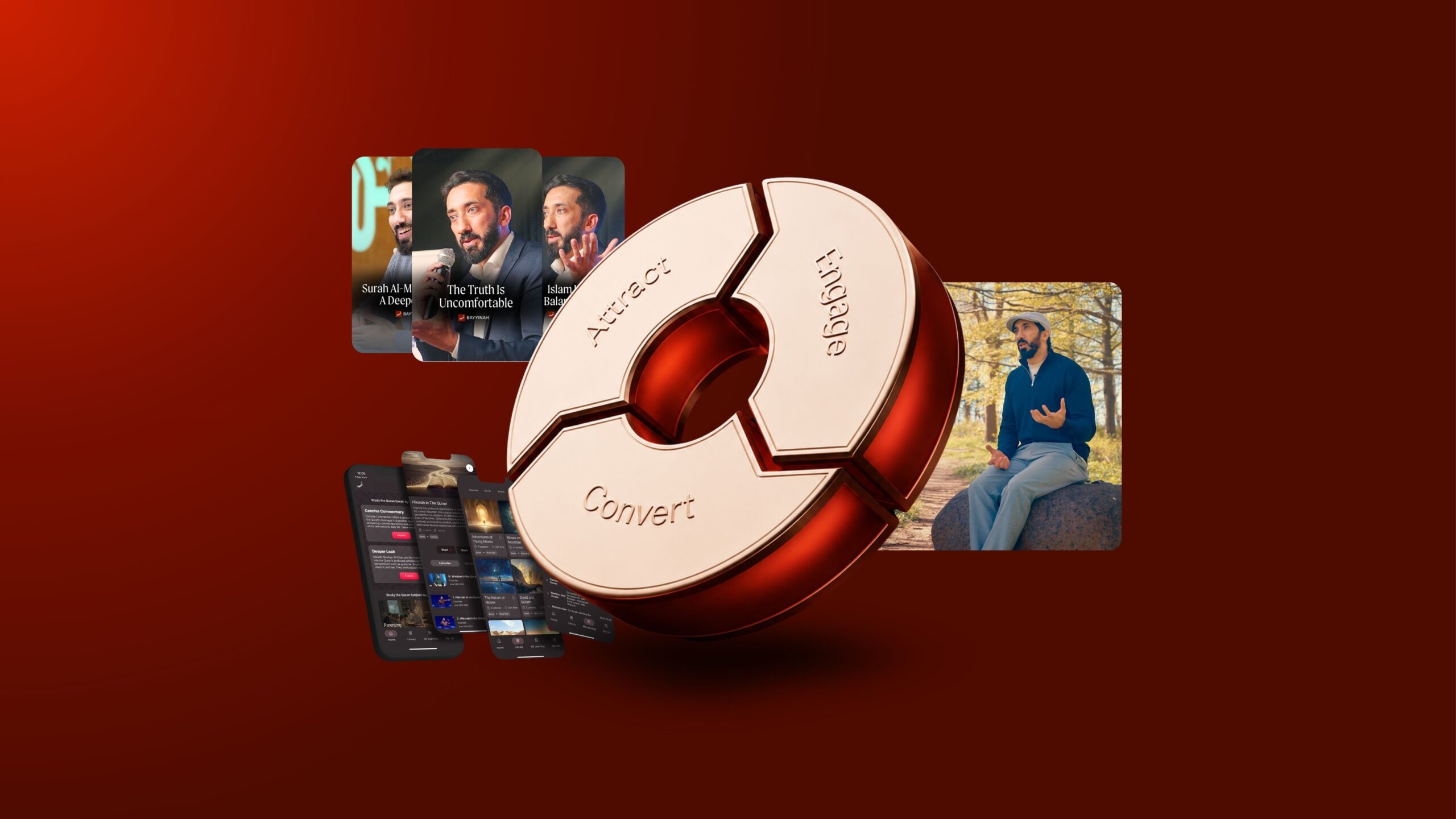
Builders ask us some version of this all the time, usually right after we say we don’t do countdown timers or fake scarcity: okay, so how does anyone actually find you? It’s a fair question, because if you strip the manipulative parts out of the standard playbook, something still has to bring people to the door, and for us that something is a flywheel built almost entirely out of teaching. The easiest way to understand it is to work backwards from the end, which is also how we designed it, because planning forwards tends to produce content while planning backwards produces a path.
Working backwards from the learner
The end of the path is a serious learner on Bayyinah TV, and the doorway to that is a 7-day free trial that collects an email address. The email matters more than it looks, because a follower on YouTube or Instagram is a borrowed relationship that an algorithm can take away tomorrow, whereas someone on our list is a relationship we can actually nurture. So everything upstream of the trial exists to bring the right person to it.
People reach the trial from long free videos on YouTube and Facebook, each carrying a call-to-action to get the full version on Bayyinah TV. People reach those long videos from shorts and reels whose only job is to point at them. The shorts come from the clips, the clips come from a premium course, and the course is where everything started. That is the whole funnel, and the reason it works is that every piece in it has exactly one job.
Why one course becomes months of free content
We take a premium course on Bayyinah TV and cut it into 15 to 30 minute videos for YouTube, released weekly rather than all at once. The weekly rhythm is deliberate, because releasing everything in one splash buys you one good week and then silence, while a drip means the same course keeps showing up in people’s feeds for months, and consistency is what both the algorithms and human trust actually respond to. A typical surah gets taught over a week during Quran Week, seven days of teaching, so one course quietly becomes almost two months of free content without us producing anything new.

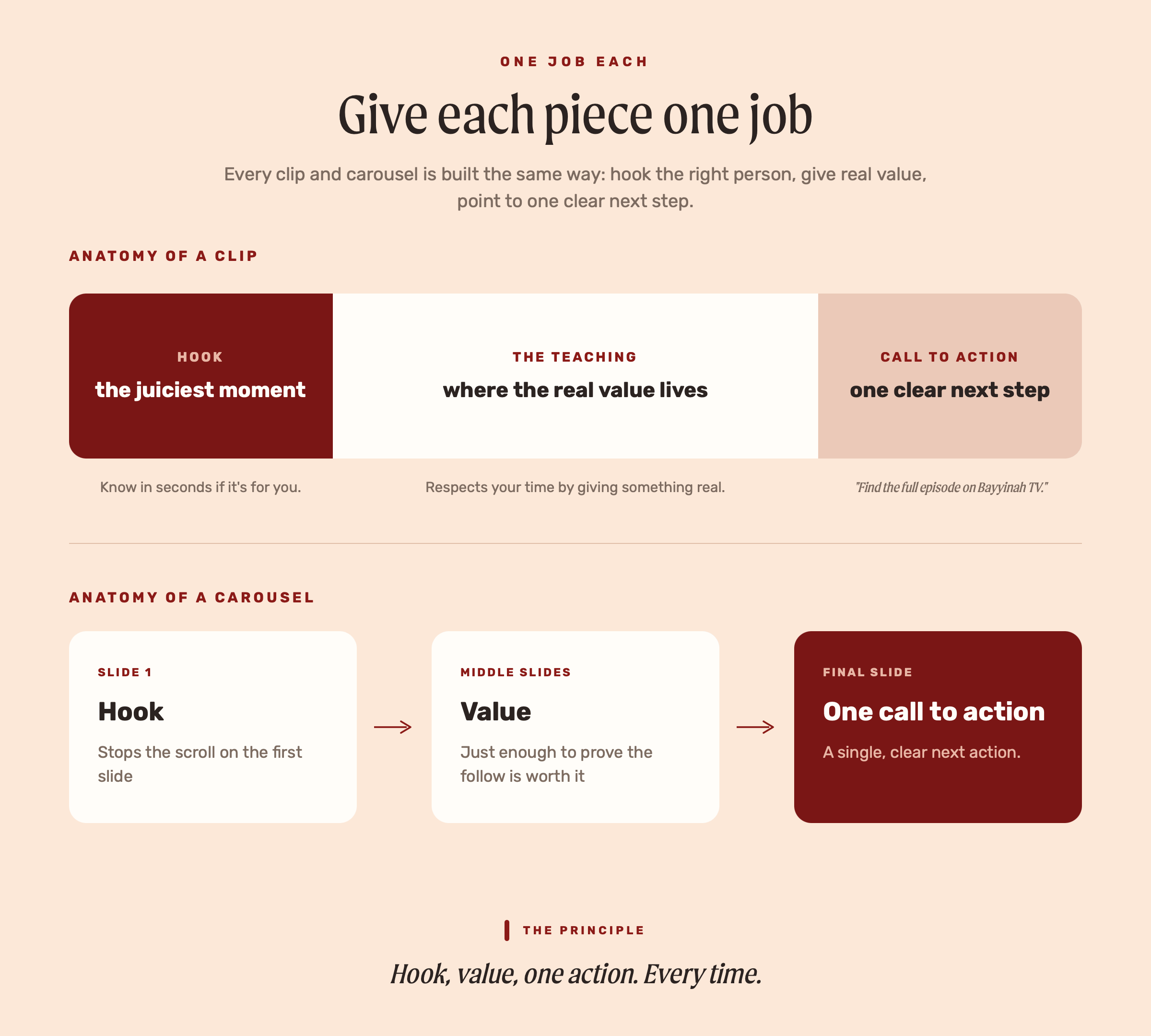
Every clip gets the same treatment: a hook at the beginning, pulled from the juiciest moment of the video so people know within seconds whether this is for them, and a call-to-action at the end, something like “find the full episode on Bayyinah TV.” The hook respects people’s time and the call-to-action respects their intelligence, because we’re telling them plainly where the rest lives instead of hoping they stumble into it.
For each clip we then create one or two shorts that go out as YouTube Shorts and as reels on Instagram and TikTok. Shorts exist in the system because that’s where cold audiences actually are, people who have never heard of us and would never commit to a 25 minute video from a stranger, but will give a stranger 40 seconds. The short earns the clip, the clip earns the trial, and once someone starts the trial, a welcome email series shows them around and nurtures them toward upgrading. Anyone who joins the list by any route, a trial or a free lead magnet like a workbook, then receives biweekly newsletters gently introducing everything we offer, and gently is the operating word, because a list only stays valuable if people are glad to see you in their inbox.
Why we give this much away
This is the halal marketing thesis from this month’s email, running in practice. If marketing is truthfully telling the right person about something that will benefit them, then the cleanest version of it is handing over real benefit first and letting people decide with full information. The Prophet ﷺ taught that when the two parties to a sale are truthful and open with each other, their transaction is blessed (Bukhari), and someone who has watched seven free weeks of a surah series knows exactly what they’re saying yes to, so there’s no bait and switch available even if we wanted one. The teaching itself is also the point, since the Quran tells us to invite to the way of our Lord with wisdom and good instruction (16:125), and free content that genuinely teaches is a better invitation than any ad we could write.
Why we measure instead of guessing
Every link we put out carries UTM tracking parameters, masked behind bitly links so they stay tidy, and Google Analytics then shows us where clicks, leads and sales actually come from. We hold to this because opinions about content are cheap and everyone on a team has one, so without tracking, your strategy quietly becomes whoever argued most confidently in the last meeting. Tracking is how we learned that carousels bring our best leads, and once we saw the numbers, the why made sense: a carousel hooks with the first slide, gives just enough value in the middle to prove the follow is worth it and prompts one clear next action at the end, all in a format people move through at their own pace. We’ve since tested variations, like question and answer carousels for Revealed built as snapshots of Ustadh as if he’s answering in real time, closing with an invitation to ask your own question inside the app, and feature-breakdown carousels for the learning pathways.
The solo builder’s version
None of this actually requires a 25-person team, because the logic scales down. Take one deep piece of work you’ve already made, a course, a workshop recording, a long piece of writing, and cut it into small weekly pieces so it keeps working for months instead of one afternoon. Give each small piece one job, pointing at the bigger piece, and give the bigger piece one job, pointing at a single clear next step that captures an email, so the relationship belongs to you rather than to an algorithm. Tag your links from day one even at tiny scale, because six months in you’ll want to know where your people actually came from and memory won’t tell you. The flywheel is slow at first, ours took years, but it compounds, which the loud tactics never do.
If you want more of how Bayyinah actually gets built, the decisions and the failures included, join the Bayyinah Works newsletter at bayyinah.com/works.

Study the Quran and Arabic in a systematic and personalized way through Bayyinah TV. Get started today for free.
Check out our newest articles, fresh off the press and ready for you to dive into!