Successful subscription! Thank you for subscribing.
Successful subscription! Thank you for subscribing.

July 19, 2026
Ishrath is building financial literacy work grounded in Quran principles, and she described what happens when she sits down to share it: “I feel under attack by shayateen all the time, whispering that I’m a nobody, that I am not an expert.” If you’ve ever hovered over the publish button and closed the tab instead, you know exactly the feeling she means. Sehrish, a brand designer with a corporate 9 to 5, put a quieter version of it when she said she’s been learning how social media actually works “but the content out there is just too much.” Somewhere between the whisper that you’re a nobody and the noise of everyone else promoting constantly, a lot of genuinely good work stays in the drawer.
A healthy fear, pointed the wrong way
Most of us were raised to guard our intentions, and rightly so. We learned that the best charity is the hidden one, that deeds done for show are hollow and that riya can quietly eat a good act from the inside, and all of that training is correct and should stay exactly where it is. The trouble starts when the alarm that was built for acts of worship gets wired to anything that involves being noticed, so that posting about your work sets off the same siren as praying to be admired, even though those are two different situations that deserve to be told apart.
What riya actually is
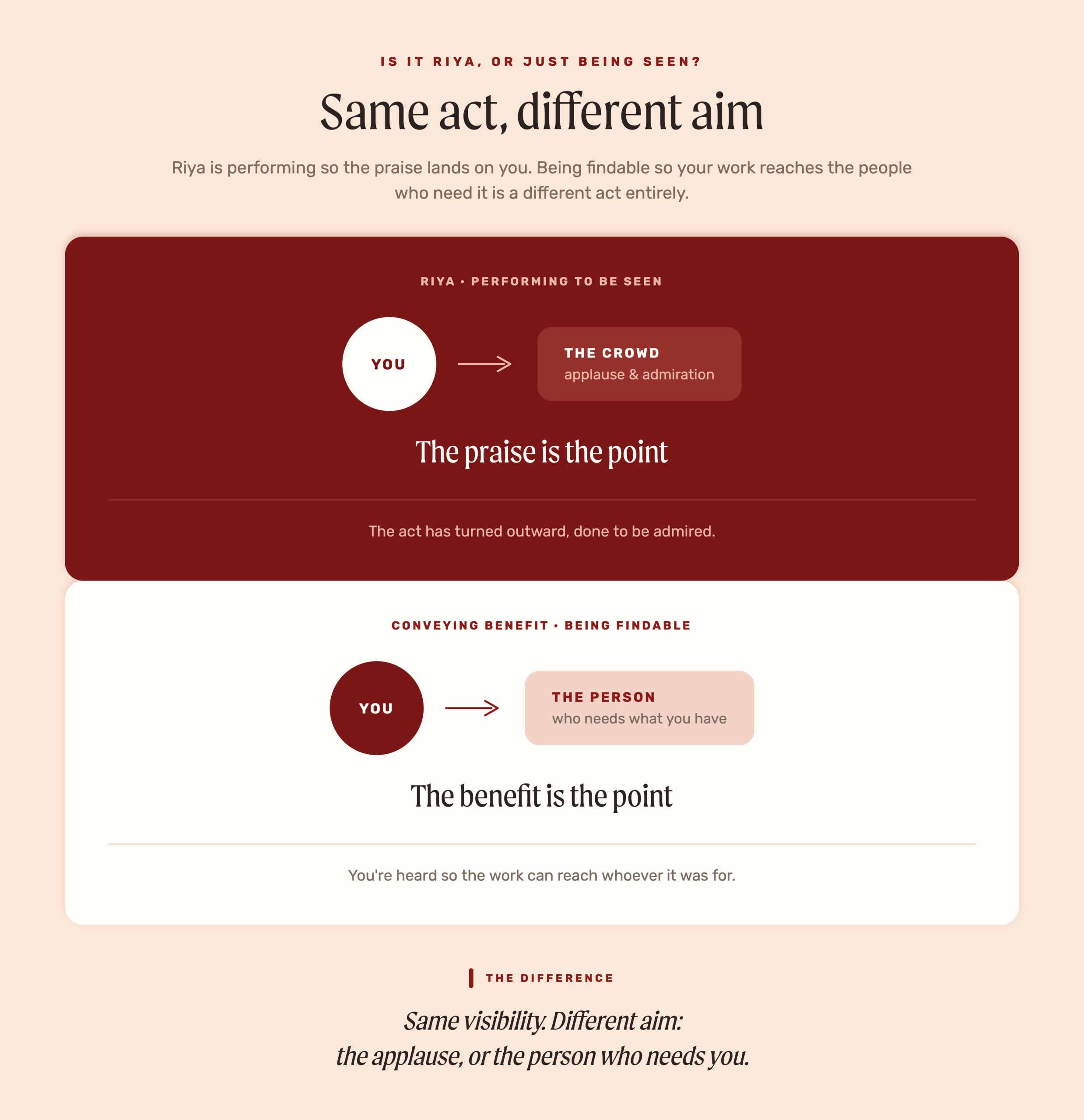
Riya is performing a deed in order to be seen, where the praise itself is the point. Surah Al-Ma’un condemns people who pray while wanting to be watched praying (107:6), and in Ustadh Nouman’s explanation of the surah, the Arabic carries the diagnosis inside itself, because yura’oon is a verb form that specifically means making others see, performing for an audience. Their prayer is still prayer on the outside, yet it has changed direction, since worship is meant to travel vertically between the servant and his Lord, and theirs has turned horizontal, running between a performer and a crowd. That change of direction is the whole disease. Riya points at the applause, while conveying benefit points at the person who needs what you have, and the Prophet ﷺ told us to convey from him even a single ayah (Bukhari), which requires being heard, which requires being findable.
One caveat Ustadh is careful with in that same explanation, and we want to be careful with too: this is a mirror for examining ourselves, never a lens for judging others, because only Allah knows hearts.
Speak of the favor of your Lord
What settles the question for us is that the same Quran that condemns yura’oon also commands a kind of visibility. Surah Ad-Duha closes with “as for the favor of your Lord, speak of it” (93:11), and in Ustadh’s explanation of the surah, that command lands after Allah reminds His Messenger ﷺ of three rescues, sheltered when he was orphaned, guided when he was at a loss and made independent when he was in need. So speaking of the favor means telling people about the times you were in crisis and Allah came through for you. Boasting points at your own deeds, while this speech points at what Allah did when you had nothing, and it exists because your story of His past mercy becomes someone else’s hope in their present crisis. Ustadh’s line for the principle is that you are a pipeline, not a storage tank.
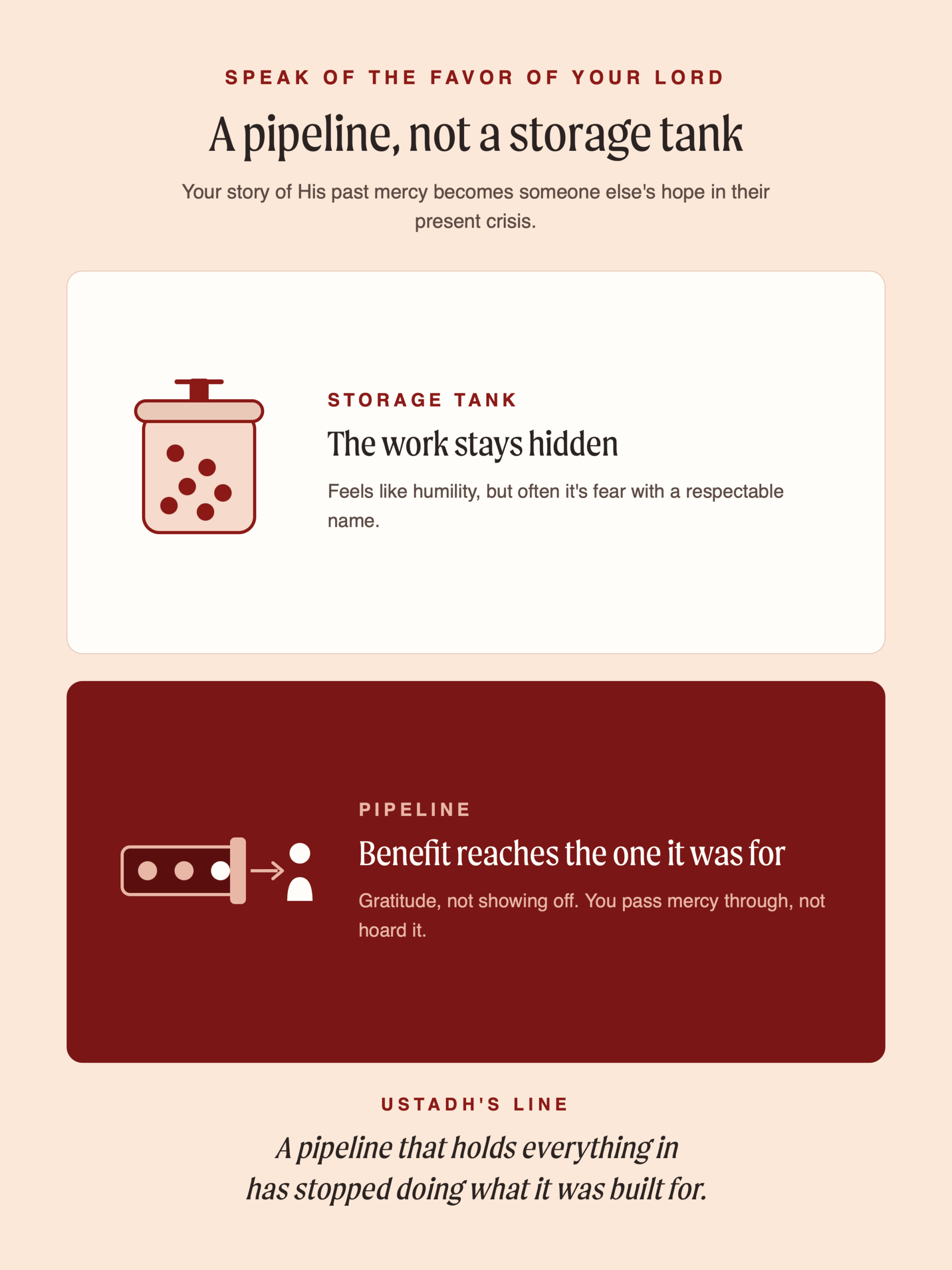
That reframe changes how hiding the work looks, because if Allah placed a skill in your hands and a real need in front of you, the work is carrying something that belongs to other people, and letting it stay hidden has a cost that you’re not the one who pays. The person who needed the financial literacy or the design or the app pays it. Hiding the work can feel like humility, but often it’s fear that found a more respectable name, and a pipeline that holds everything in has stopped doing the thing it was built for. There is a way of being seen that is gratitude rather than showing off, and most sincere people are far closer to it than the whisper wants them to believe.
An intention reset, then one small step
Before you share anything, say quietly what you actually want, something like: O Allah, let this reach whoever You wrote it for, and let it benefit them. That ten second reset re-points the act every single time, and it also gives you an answer to the whisper, because when it asks who you think you are, the honest reply is nobody in particular, and that’s exactly why it’s safe to share, since the work carries the value rather than you.
Then take one step that requires no personal brand at all. Write a single sentence describing what you made and who it helps, and say it, sincerely, in one place where those people already are, a WhatsApp group you’re part of or one friend who fits the description. No logo, no content plan, no niche statement, and notice how much closer this sits to testimony than to advertising, one true sentence offered to the people it was for, because if it helps one person, it was worth being seen for.
May Allah make our work beneficial and keep our intentions clean while people are watching. If you’d like to keep thinking through questions like this with us, the honest behind-the-scenes of how Bayyinah gets built, join the Bayyinah Works newsletter at bayyinah.com/works.

Study the Quran and Arabic in a systematic and personalized way through Bayyinah TV. Get started today for free.
Check out our newest articles, fresh off the press and ready for you to dive into!