
Successful subscription! Thank you for subscribing.
Successful subscription! Thank you for subscribing.

July 29, 2026
Surah Al-Hadid takes its name from iron and iron turns out to be the key to its message. The surah calls a community to wake up, to give and above all to keep its faith in balance, neither hardened into mere legalism nor dissolved into world-denying extremes. This post follows that thread: the wake-up call to the heart, the threefold gift of Book, Balance and iron and the surah’s warning about what happens when religion loses its balance.
Has the Time Not Come?
Midway through, the surah turns to the believers with a tender, piercing question (57:16)1.
أَلَمْ يَأْنِ لِلَّذِينَ ءَامَنُوٓا۟ أَن تَخْشَعَ قُلُوبُهُمْ لِذِكْرِ ٱللَّهِ
“Has the time not come for the believers that their hearts should be humbled at the remembrance of Allah?”
(57:16)
It is addressed to people who already believe, but whose hearts have grown a little hard, who have heard the reminder so often that it no longer moves them. The surah warns against becoming like earlier communities whose long span of time hardened their hearts. It is a call to soften, before the chance is gone, the very softening that makes a believer able to give and to act.
The Book, the Balance and Iron
Near its close, the surah names exactly what Allah sent to set humanity right (57:25)2.
لَقَدْ أَرْسَلْنَا رُسُلَنَا بِٱلْبَيِّنَٰتِ وَأَنزَلْنَا مَعَهُمُ ٱلْكِتَٰبَ وَٱلْمِيزَانَ
“We sent Our messengers with clear proofs and sent down with them the Book and the Balance.”
(57:25)
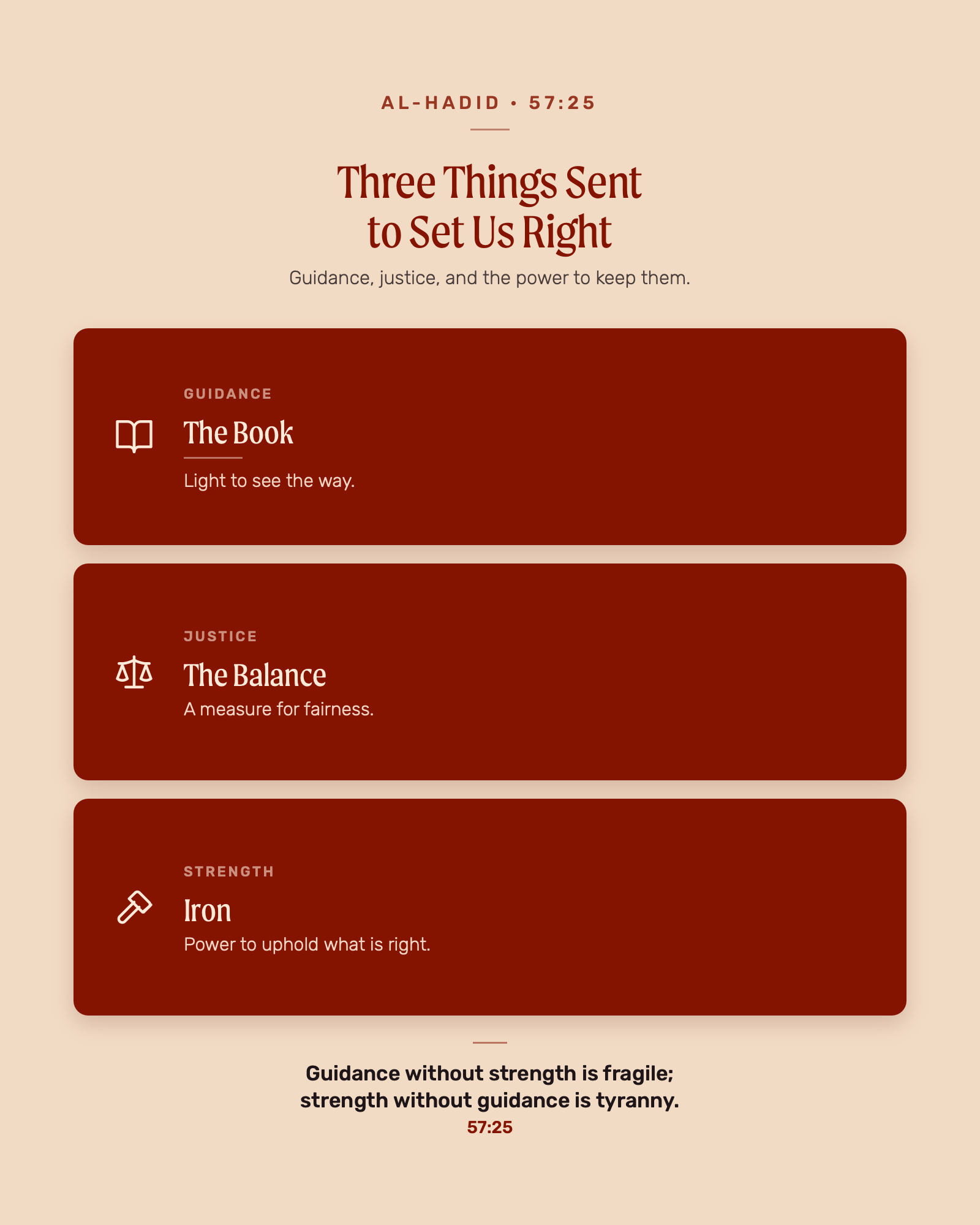
And then it adds that We sent down iron, in which is great might and many benefits. Three things together: the Book, which is guidance; the Balance, which is justice; and iron, which is the strength to establish that justice and protect it. Guidance without the means to uphold it is fragile; force without guidance is tyranny. The surah names all three because a faith that changes the world needs all three and then it asks who will step forward to support this cause. That is the surah giving its name, iron, to the whole question of putting faith into committed, balanced action.
When Religion Loses Its Balance
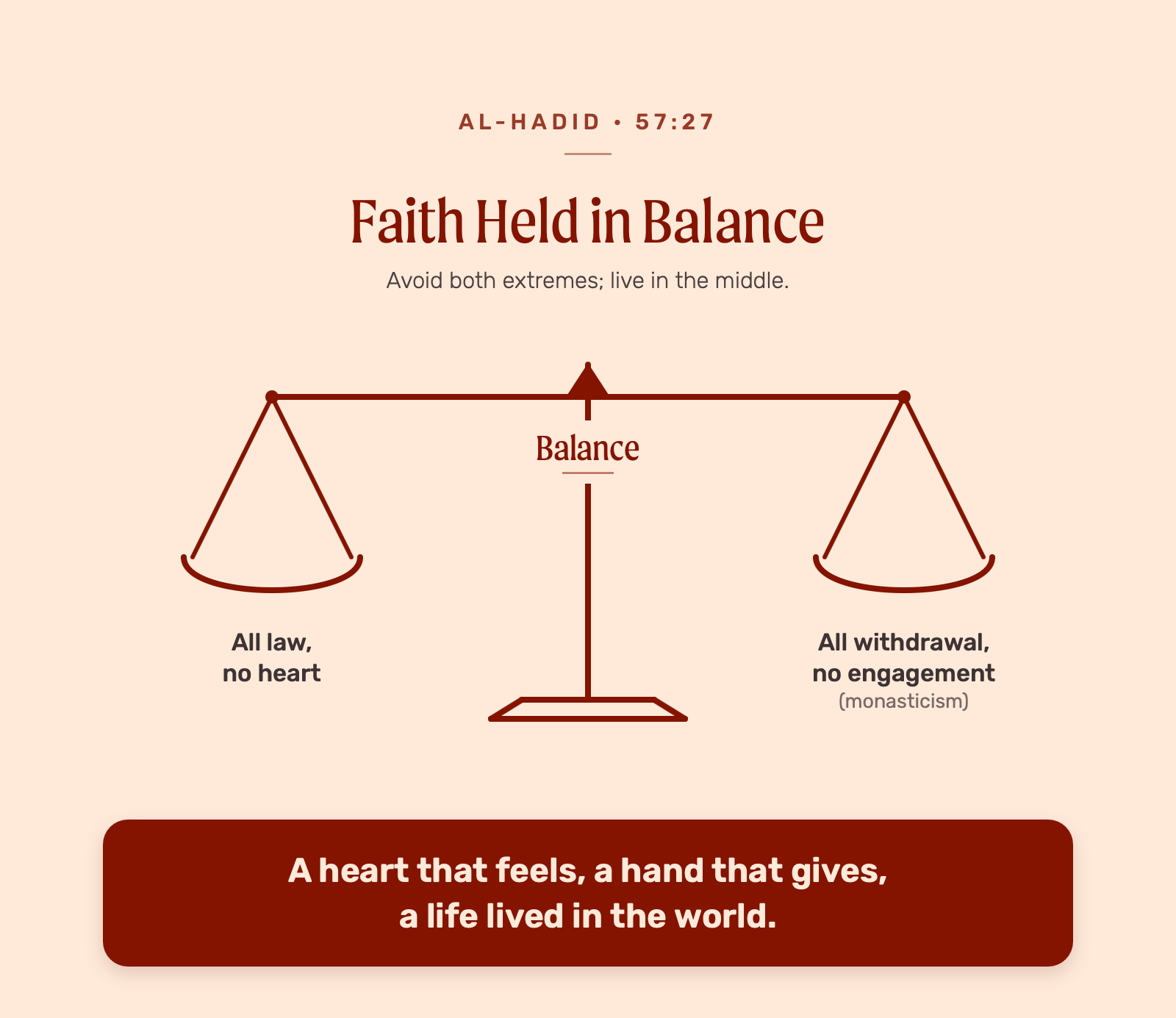
The surah then warns, through history, of what happens when that balance is lost. It recalls the followers of Isa (AS), into whose hearts Allah placed compassion and mercy and notes that they invented monasticism, a life of extreme withdrawal, which Allah had never prescribed for them (57:27)3. Earlier communities had drifted the other way, into rigid legalism. One extreme is all law and no heart; the other is all spirit and no engagement with the world. Both are imbalances and the surah holds them up as a warning that history repeats and that we are not immune.
A Faith That Stays Engaged
The lesson Al-Hadid presses is balance. Religion is not meant to crush a person under endless fear and guilt, nor to pull them out of life altogether, away from family, work and responsibility, in the name of devotion. Guilt is a gift when it leads to repentance and then to doing good, but it becomes destructive when it turns into hopelessness or showy withdrawal. The Prophet ﷺ taught that the most beloved deeds are the steady ones, even if small and that this whole religion is built on balance: five prayers, not endless ones; a month of fasting, not a lifetime; engagement with the world, not flight from it. A humbled heart and an active life, held together, are exactly what the surah is calling for.
The Takeaway
Surah Al-Hadid asks whether our hearts are still soft enough to be moved, reminds us that Allah sent guidance, justice and the strength to uphold them and warns us away from the extremes that wrecked the faith of those before us. Its message, fittingly for the surah of iron, is strength held in balance: a heart that feels, a hand that gives and a life that stays in the world rather than fleeing it. Read it that way and iron stops being a strange title and becomes the perfect image for a faith meant to be both tender and strong.
There is far more to Surah Al-Hadid than a single article can hold. You can explore the full Al-Hadid: A Deeper Look series on Bayyinah TV, alongside the other surahs being opened up in the Deeper Look collection.
Related reading: Building the Worldview First: An Introduction to Surah Al-Hadid (the companion post in this series).
Notes
[1] Quran, 57:16, https://quran.com/57/16 ↩
[2] Quran, 57:25, https://quran.com/57/25 ↩
[3] Quran, 57:27, https://quran.com/57/27 ↩

At Bayyinah, we are dedicated to helping you connect directly with the words of Allah beyond translation. Founded by Ustadh Nouman Ali Khan, our mission is to create transformative experiences that deepen your understanding and engagement with the Quran.
Study the Quran and Arabic in a systematic and personalized way through Bayyinah TV. Get started today for free.
Check out our newest articles, fresh off the press and ready for you to dive into!