
Successful subscription! Thank you for subscribing.
Successful subscription! Thank you for subscribing.

July 29, 2026
Surah Al-Munafiqun is a short Madani surah named after one of the most uncomfortable subjects in the entire Quran: hypocrisy. It is uncomfortable not only because it is hard to face in ourselves, but because, as a subject, it is genuinely complex. This post introduces the surah, why the Quran treats hypocrisy as something layered and difficult and the unforgettable images it uses to expose it.
Why Hypocrisy Is So Hard
There is a pattern worth noticing in the Quran. Some things it deliberately keeps simple, the core of what to believe, the basic call of every prophet, so that anyone can grasp them and yet we often complicate those. Other things it deliberately treats as complex and we tend to oversimplify those. Hypocrisy is the second kind. In our culture, calling someone a hypocrite is easy and quick. But when the Quran first describes the hypocrites, in Surah Al-Baqarah, it does so with some of its most intricate imagery, far more involved than its straightforward portraits of belief and disbelief. That is a signal: this is not a label to throw around casually but a reality to study carefully, beginning with our own hearts.
Words Without a Heart
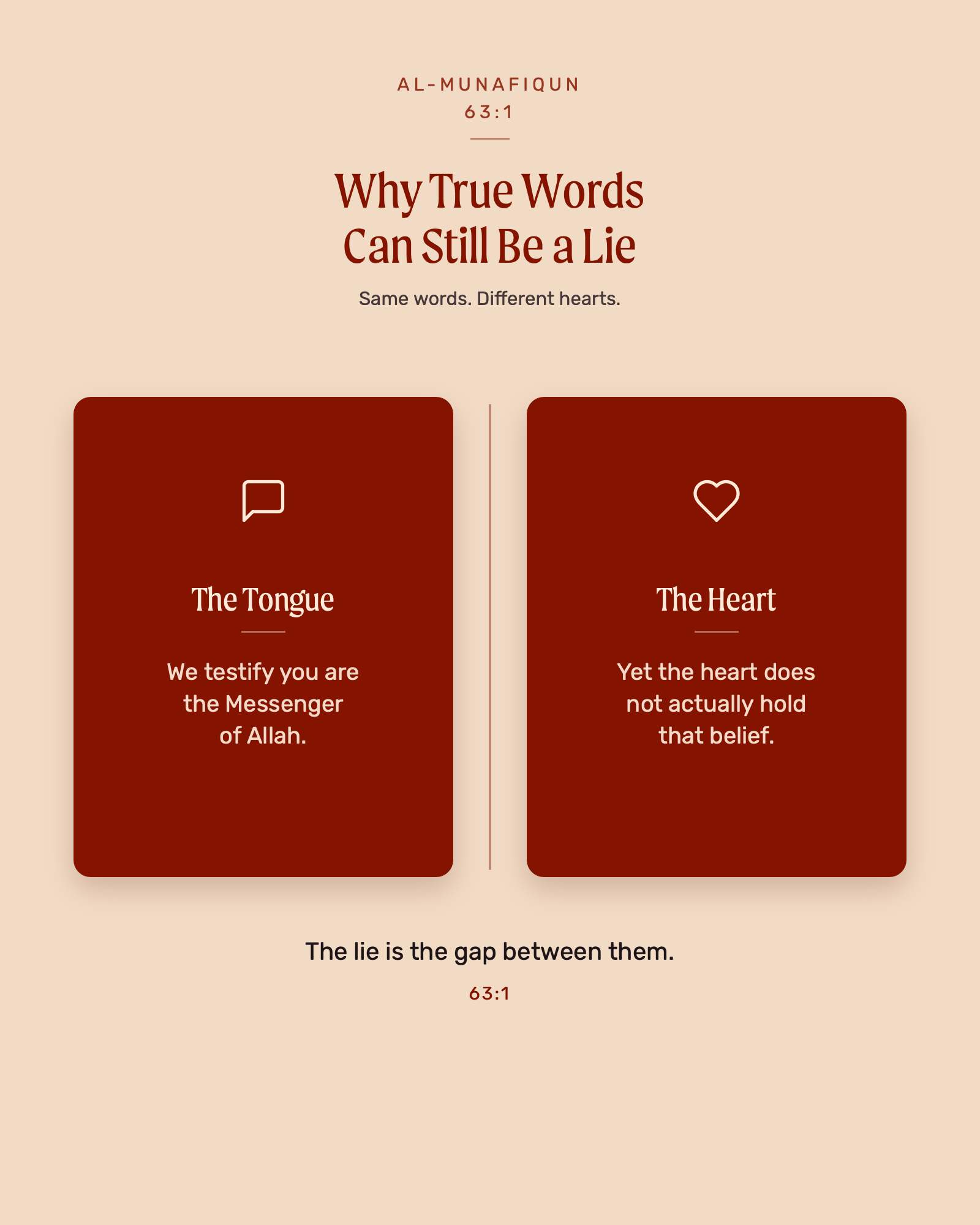
The surah opens with the hypocrites saying something that is actually true (63:1)1: when they come to the Prophet ﷺ, they declare, we testify that you are truly the Messenger of Allah. And Allah responds in the same verse.
وَٱللَّهُ يَشْهَدُ إِنَّ ٱلْمُنَٰفِقِينَ لَكَٰذِبُونَ
“And Allah testifies that the hypocrites are surely liars.”
(63:1)
The striking thing is that what they said was factually correct, the Prophet ﷺ truly is the Messenger of Allah. So how are they liars? Because their tongues were saying what their hearts did not hold. Hypocrisy is not about saying false words; it is about a split between the words and the heart behind them. They were lying not about the fact, but about themselves, claiming a belief they did not actually carry.
Propped-Up Timber
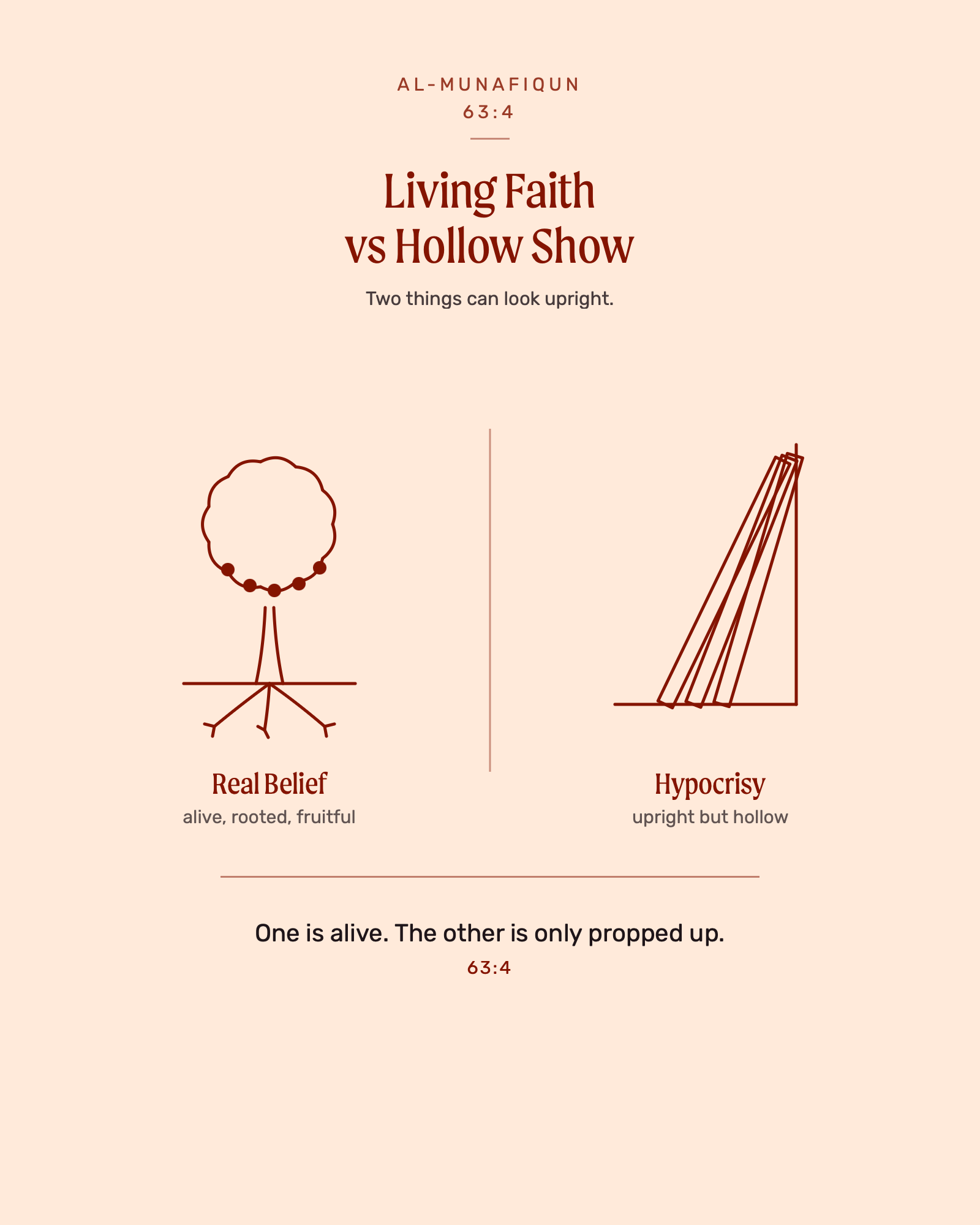
The surah then gives one of its most haunting descriptions (63:4)2. Their physical presence is impressive; when they speak, you listen. And yet, Allah says.
كَأَنَّهُمْ خُشُبٌ مُّسَنَّدَةٌ
“…as if they were propped-up pieces of timber.”
(63:4)
Imagine planks of wood leaning against a wall: upright, imposing, but hollow, lifeless, holding nothing up and rooted in nothing. That is the image of a person who looks the part, sounds impressive, occupies space, but has no living faith inside. The contrast is the whole point. Real belief is a tree, alive and bearing fruit; hypocrisy is dead wood propped into the shape of a tree.
When Pride Speaks
The surah also exposes what hypocrisy says when it feels safe. It records the hypocrites plotting that once they return to Madinah, the mighty among them will drive out the lowly, meaning the believers (63:8)3. Allah corrects them immediately: true might belongs to Allah, His Messenger ﷺ and the believers, though the hypocrites do not know it. Beneath the polished words is an arrogance that ranks itself above the very people it pretends to stand with and the surah drags that hidden contempt into the light.
The Takeaway
Surah Al-Munafiqun refuses to let us treat hypocrisy as a cheap insult for other people. It shows hypocrisy as a gap between the tongue and the heart, a person who can say the truest words and still be a liar, who can look like a pillar and be hollow timber, who can stand among believers while looking down on them. The point is not to go hunting for hypocrites around us. It is to examine the seams in ourselves, where our words and our hearts might not yet line up.
There is far more to Surah Al-Munafiqun than a single article can hold. You can explore the full Al-Munafiqun: A Deeper Look series on Bayyinah TV, alongside the other surahs being opened up in the Deeper Look collection.
Related reading: The Antidote to Hypocrisy: The Message of Surah Al-Munafiqun (the companion post in this series).
Notes
[1] Quran, 63:1, https://quran.com/63/1 ↩
[2] Quran, 63:4, https://quran.com/63/4 ↩
[3] Quran, 63:8, https://quran.com/63/8 ↩

At Bayyinah, we are dedicated to helping you connect directly with the words of Allah beyond translation. Founded by Ustadh Nouman Ali Khan, our mission is to create transformative experiences that deepen your understanding and engagement with the Quran.
Study the Quran and Arabic in a systematic and personalized way through Bayyinah TV. Get started today for free.
Check out our newest articles, fresh off the press and ready for you to dive into!