
Successful subscription! Thank you for subscribing.
Successful subscription! Thank you for subscribing.

July 29, 2026
Some of the shortest passages in the Quran carry the heaviest weight and Surah Al-‘Asr, the 103rd surah, is the clearest example. It is only three verses, yet Ustadh Nouman Ali Khan calls it the hardest surah he has ever tried to teach, because in a single sentence it reorders the way a person sees their entire life.
A Surah the Companions Recited When They Parted
There is a striking habit recorded of the earliest Muslims. Whenever two of the companions of the Prophet Muhammad ﷺ met and then prepared to go their separate ways, they would recite this surah to one another before saying salaam and parting, a practice reported by al-Tabarani in al-Mu’jam al-Awsat. These were people who had memorised much of the Quran, in many cases all of it, so they could have chosen anything to leave each other with. They chose Surah Al-‘Asr. Ustadh Nouman explains that it was as though, in those few words, they were reviewing the whole message of Islam together one more time before separating. Imam Al-Shafi’i (RA) is reported to have said that if people would simply reflect on this surah, it would be enough for them and that if Allah had revealed nothing else, this surah alone would have sufficed humanity.
The Oath by Time as It Runs Out
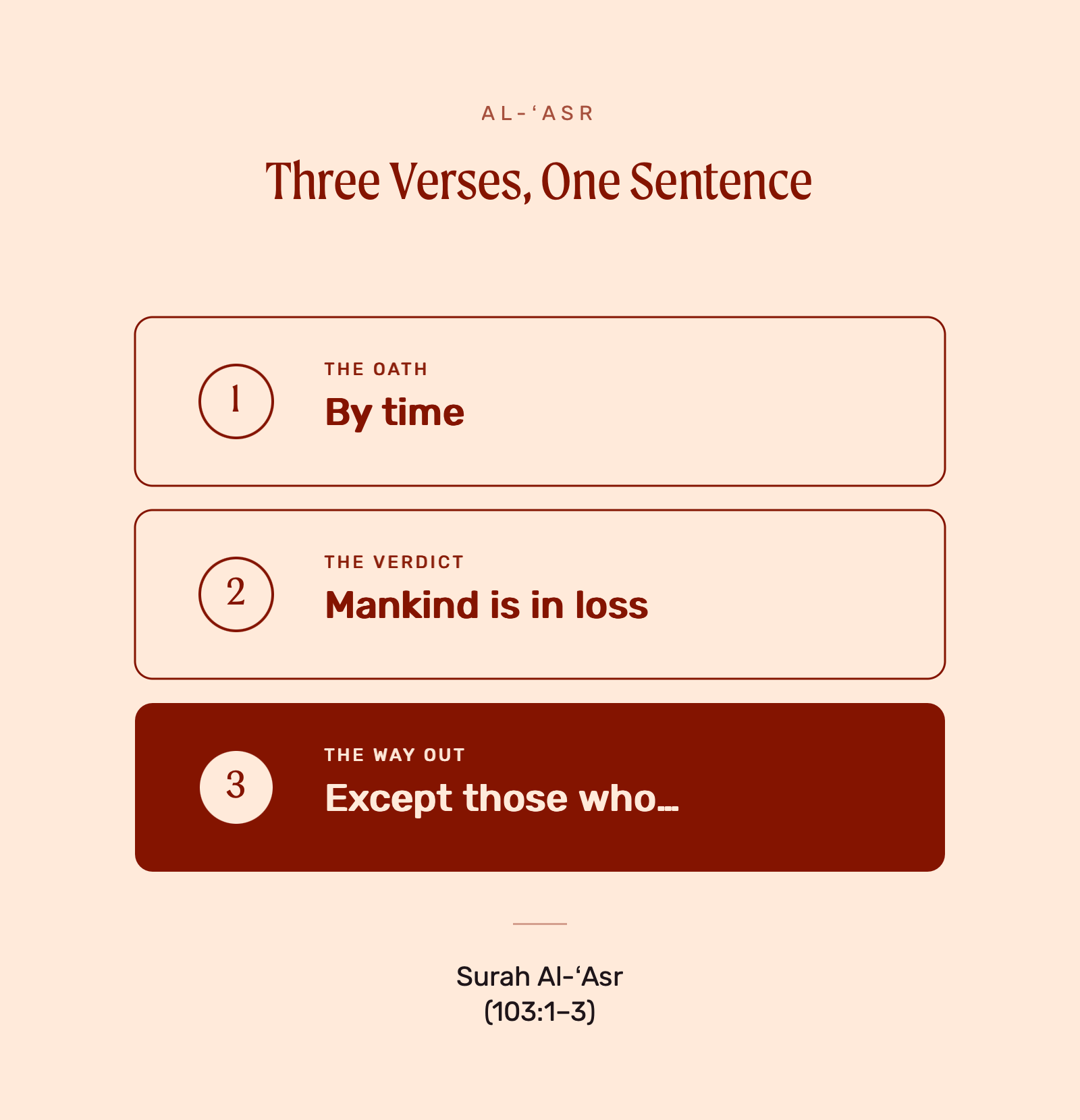
Allah opens not with a command but with an oath.
وَٱلْعَصْرِ
“By time.”
(103:1)
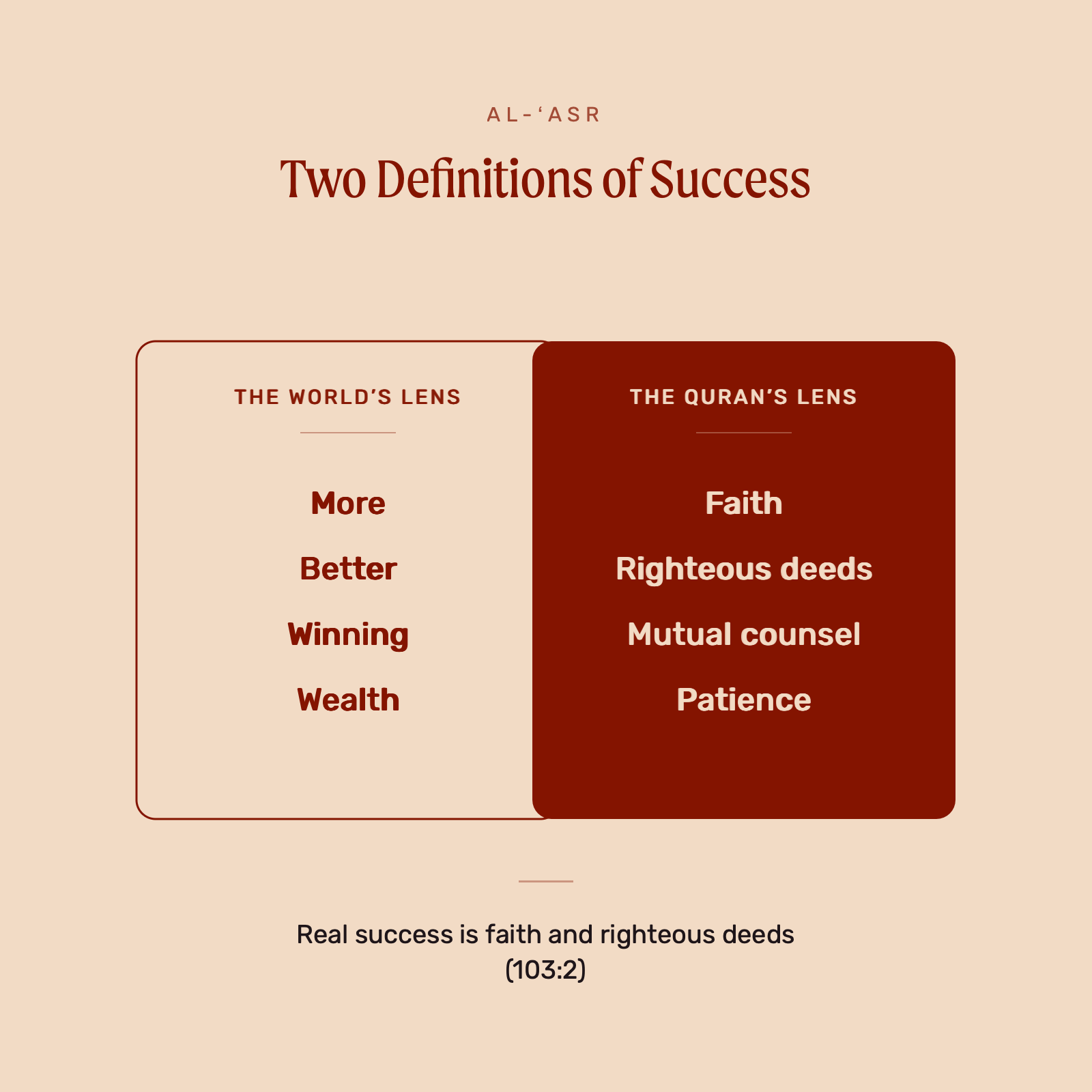
An oath in the Quran is not the point in itself; it is a way of bracing the listener for what is about to be said. And here the very thing Allah swears by is time, which we all know is running out on us with every breath.1 Ustadh Nouman places this surah at the end of a run of surahs that sit together in the ordering of the Quran, from Surah Al-Zalzalah onward, which he understands to be a divinely intended sequence. Those surahs press on one theme: we are consumed by wanting more and we are consumed by wanting better. We chase a better house, a better car, a better phone and once we have those we want more of everything and we measure success entirely by that climb. Surah Al-‘Asr then arrives and, in his words, reverse engineers the whole thing.
A Verdict Over Every Single Human Being
The heart of the surah is its middle verse and Ustadh Nouman calls it the thesis of the whole passage.
إِنَّ ٱلْإِنسَٰنَ لَفِى خُسْرٍ
“Indeed, mankind is in loss.”
(103:2)
This is a heavy statement and what makes it heavier is that it excludes no one at first.2 There are parts of the Quran that speak to some people and not others, but this verse falls on every human being without exception, believer and disbeliever, everyone before us and everyone after. Ustadh Nouman notes that the word for the human being here, al-insan, appears throughout the Quran and again and again Allah reminds us of our humble origin, that we were shaped from dust and from a fluid described as lowly. The lesson is that when we forget where we came from we grow entitled and argumentative and that forgetfulness is itself the first thread of our loss.
A New Definition of Success and Failure
Everyone looks at the same sun and the same sky and everyone tends to define winning and losing in the same way. The team that won is the winner, the one who graduated succeeded, the one who lost the election failed. Surah Al-‘Asr puts a new lens over all of it. Once you see the world through this verse, your definition of success and failure begins to differ from that of every other person around you, even from a fellow Muslim who has not yet looked through this lens. Ustadh Nouman warns that when Islam becomes only a set of rituals we perform and our idea of a good life stays identical to everyone else’s, the surah has not yet done its work in us. Its purpose is to change the way we see the world before it changes anything else.
The Takeaway
Surah Al-‘Asr is not gentle and it is not meant to be. It names a loss that covers all of humanity so that we stop measuring our lives by more and better and start measuring them by what actually carries weight. That is why the companions could not part without it.
You can explore the full Al-‘Asr: A Deeper Look series on Bayyinah TV, alongside the other surahs being opened up in the Deeper Look collection.
Related reading: The Four Things That Save Us in Surah Al-‘Asr: Faith, Deeds and Counsel (the companion post in this series).
Notes
[1] Quran, 103:1, https://quran.com/103/1 ↩
[2] Quran, 103:2, https://quran.com/103/2 ↩

At Bayyinah, we are dedicated to helping you connect directly with the words of Allah beyond translation. Founded by Ustadh Nouman Ali Khan, our mission is to create transformative experiences that deepen your understanding and engagement with the Quran.
Study the Quran and Arabic in a systematic and personalized way through Bayyinah TV. Get started today for free.
Check out our newest articles, fresh off the press and ready for you to dive into!