
Successful subscription! Thank you for subscribing.
Successful subscription! Thank you for subscribing.
July 29, 2026
Surah Al-‘Alaq, the 96th surah of the Quran, carries a distinction no other surah can claim. Its opening lines are, by the most famous narration in Bukhari, the very first revelation given to the Prophet Muhammad ﷺ in the cave of Hira. To read these five ayat is to stand at the exact moment the Quran entered the world. In his opening to the Al-‘Alaq: A Deeper Look series, Ustadh Nouman Ali Khan invites us to slow down here, not by racing into the surah’s meanings, but by first sitting with the story that surrounds them.
The Surah That Begins With “Read”
The first word of Surah Al-‘Alaq is a command: Iqra, meaning read or recite.1 It is striking that the opening word of a scripture given to a man who could not read is an instruction to read. When the angel Jibreel (AS) first delivered it, the Prophet ﷺ answered honestly that he was not a reader. This was not a refusal but a plain truth about himself and the Quran would later describe him as the unlettered messenger. That honest answer is part of what makes the moment so moving, because the words that followed were never something he could have produced on his own.
اقْرَأْ بِاسْمِ رَبِّكَ الَّذِي خَلَقَ
“Read in the name of your Lord who created.”
(96:1)
The surah is also known as Surah Iqra, named after this first word. That single command sets the tone for everything that follows, both in this surah and in the entire revelation to come.
The Story Behind the Revelation
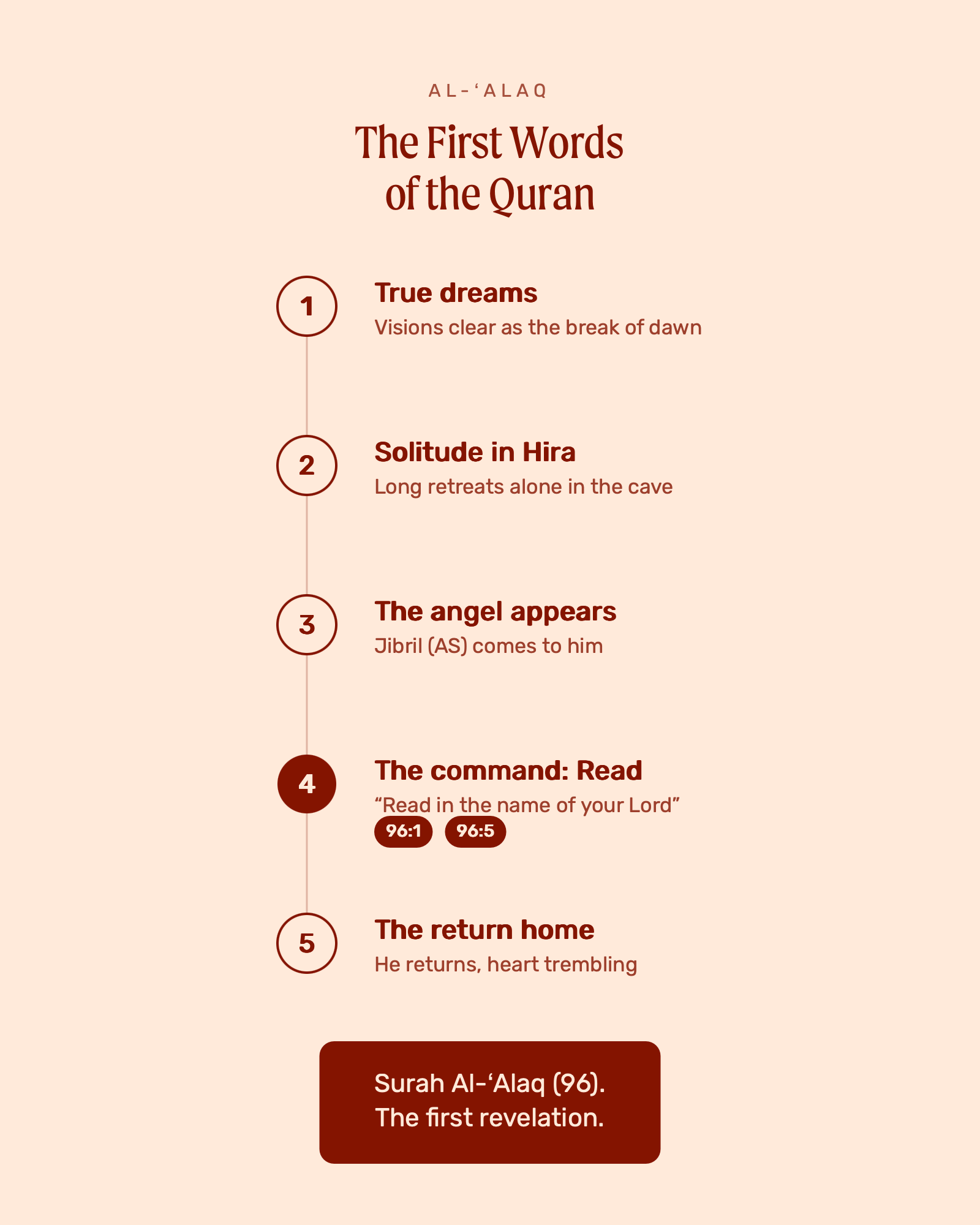
Before he ever received a word, the Prophet ﷺ had begun to change. Our mother Aisha (RA) narrated that it started with true dreams, visions so clear that they would come to pass exactly as he had seen them, like the breaking of dawn.2 Alongside these dreams, a love of solitude was placed in his heart and he would withdraw to the cave of Hira for nights at a time, devoting himself to worship and reflection, then returning to Khadija (RA) only to restock and go back again.
Ustadh Nouman draws attention to a point we often rush past. The coming of this revelation was overwhelming, not gentle. Jibreel (AS) enveloped the Prophet ﷺ and pressed him until he was completely exhausted, three times, before reciting the opening ayat. The Prophet ﷺ returned home with his heart pounding, asking to be wrapped in a blanket, genuinely afraid for himself. This was a man encountering something far larger than ordinary human experience and the Quran itself would later reassure him that he was not losing his mind.
Khadija (RA), the First Comfort
What happened next tells us something about the household that carried this weight. Khadija (RA) did not panic. She reassured her husband with a calm certainty, telling him that Allah would never disgrace him and she pointed to his character as her evidence. He kept ties of kinship even with a difficult family, carried the burdens of those who had no one, was generous to guests and rushed to help in every good cause. Ustadh Nouman notes how remarkable this is, that the one who would go on to comfort all of humanity was, in his most vulnerable moment, comforted by his wife.
She then took him to her elderly cousin Waraqa ibn Nawfal, a man who had become Christian and studied the earlier scriptures. Waraqa recognized at once the one he called the great keeper of secrets, the same angel who had come to Musa (AS) and he warned the Prophet ﷺ that his own people would one day drive him out. That a man so beloved in Makkah could not imagine being hated shows just how sincere and gentle his standing among his people had been.
Does the Story Explain the Quran or Does the Quran Explain the Story?
Here Ustadh Nouman offers the insight that frames the whole series. We usually assume that we study the occasion of revelation in order to understand the Quran better. There is truth in that. He argues, though, that the more powerful relationship runs the other way. Allah calls the Quran a light and light is not something you shine other things onto.3 Rather, it is the light that reveals everything else. The Quran is the commentary on the events of the Prophet’s life, not the reverse. It is what tells us how to see what is happening, the way a wise commentator makes sense of footage a camera has merely captured.
عَلَّمَ الْإِنسَانَ مَا لَمْ يَعْلَمْ
“He taught the human being what he did not know.”
(96:5)
Read this way, these first ayat are not just historical trivia about which words came first. They shed light on the very experience the Prophet ﷺ was living through, reassuring him that what was happening to him was real, was from his Lord and was the truth.
From the Lowest Origin to the Highest Knowledge
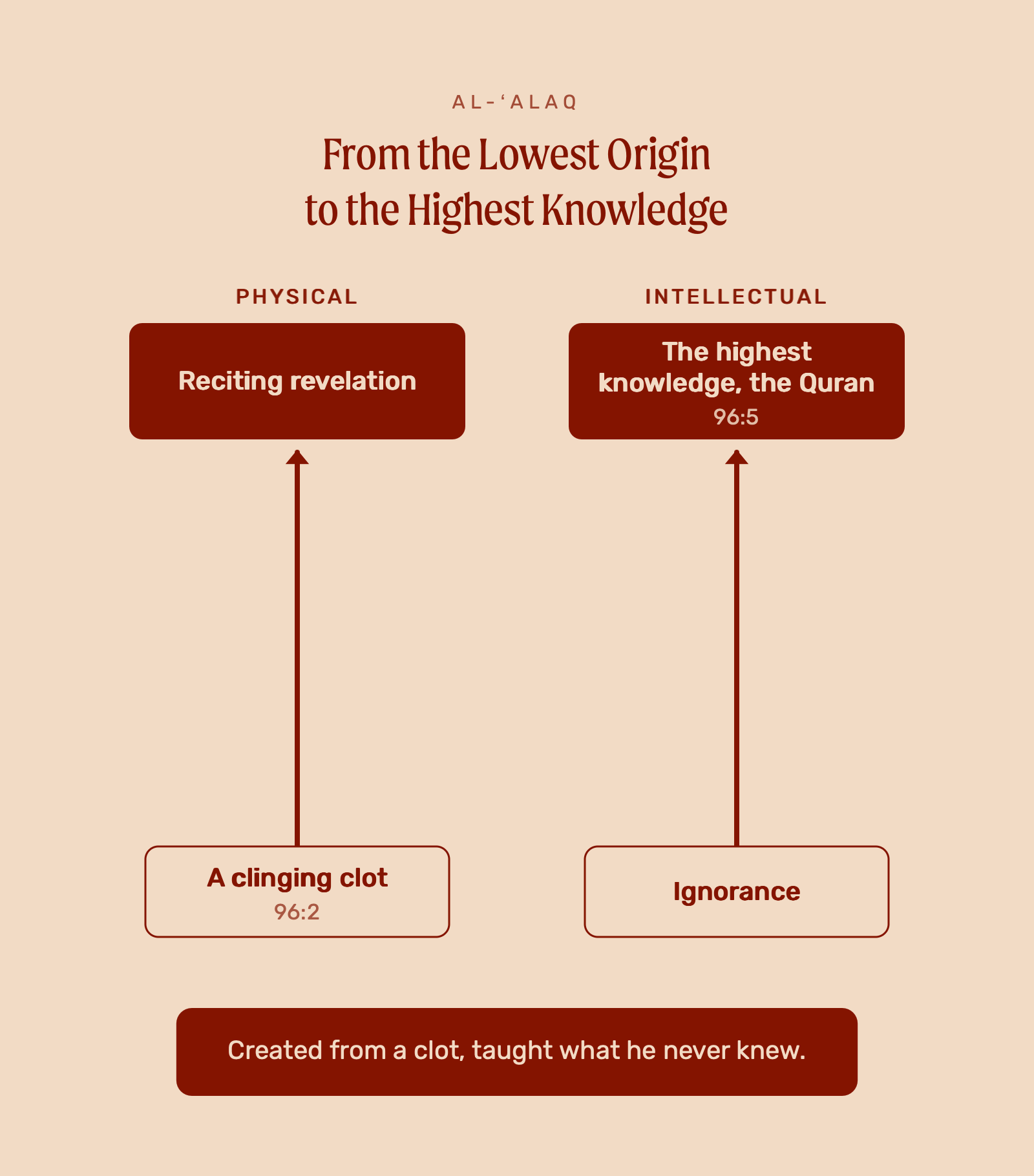
The opening five ayat also carry a quiet argument about the human being. Ustadh Nouman points out that each command to read is paired with a description of Allah as our Lord and each pairing lifts us from something low to something high. In the first, the human is made from alaq, a clinging clot in the womb, a mere piece of flesh and yet is raised to recite the word of Allah.4 In the second, the human is fundamentally ignorant, knowing nothing except what Allah teaches and yet is raised to receive the highest knowledge there is, the Quran itself.
Physically we begin at the lowest point and intellectually we begin with nothing. The surah shows both climaxes meeting in the person of the Prophet ﷺ and by extension in every believer who carries the Quran. Human effort can reach great heights of learning on its own, but the height Allah intends for us only arrives when our knowledge is joined with revelation.
The Takeaway
Surah Al-‘Alaq reminds us that the Quran did not arrive as a comfortable idea but as an overwhelming reality, carried by a Prophet ﷺ who was terrified, honest and utterly sincere. Before we ask what the surah can teach us, it invites us to remember that it is the light and we are the ones being lifted from a clot of flesh and from ignorance toward knowledge we could never have reached alone. That is the weight behind the first word: Iqra.
If this opening has stirred you to sit with these ayat more closely, that is exactly the invitation. You can explore the full Al-‘Alaq: A Deeper Look series on Bayyinah TV, alongside the other surahs being opened up in the Deeper Look collection.
Notes
[1] Quran, 96:1, https://quran.com/96/1 ↩
[2] Sahih al-Bukhari 3, https://sunnah.com/bukhari:3 ↩
[3] Quran, 42:52, https://quran.com/42/52 ↩
[4] Quran, 96:2, https://quran.com/96/2 ↩

At Bayyinah, we are dedicated to helping you connect directly with the words of Allah beyond translation. Founded by Ustadh Nouman Ali Khan, our mission is to create transformative experiences that deepen your understanding and engagement with the Quran.
Study the Quran and Arabic in a systematic and personalized way through Bayyinah TV. Get started today for free.
Check out our newest articles, fresh off the press and ready for you to dive into!