Successful subscription! Thank you for subscribing.
Successful subscription! Thank you for subscribing.
November 2, 2026
So today we are going to be speaking about Abdullah ibn Mas’ud (RA).
As I said when I started off this class, he is not officially one of the Abadilah. Because of his age and because of the time period he lived in, he does not necessarily count as one of them.
From a Virtue Perspective, He Beats All Four of Them
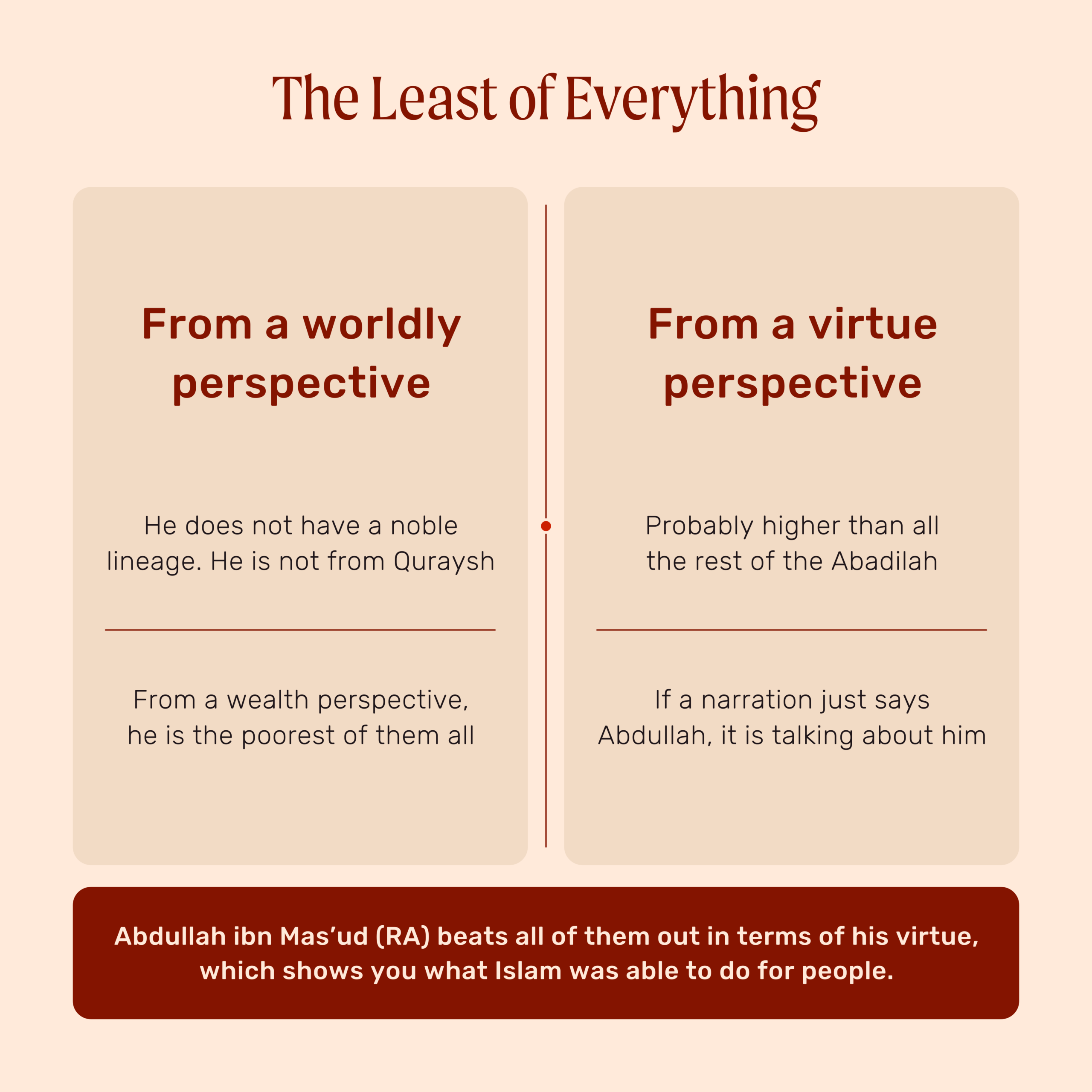
Among the sahaba of the Prophet ﷺ, Abdullah ibn Mas’ud (RA), from a status perspective, from a virtue perspective, is probably higher than all the rest of the Abadilah. Than the other four.
Just from a standpoint of fadl, from a standpoint of virtue, we could say almost certainly that he is better than all of them.
But he died over thirty years before all of them. So he did not live to narrate as many ahadith. He did not live through the fitan. His influence from a political perspective is very, very little, as opposed to the others.
Here is how you can measure where he sits.
Whenever you read a hadith narration, or whenever you see in tafsir that Abdullah said something, without it saying Abdullah ibn anything, it is talking about Abdullah ibn Mas’ud (RA).
That kind of shows you his status. If it just says Abdullah and this is frequent in Al-Bukhari by the way, that automatically shows you that the status Abdullah ibn Mas’ud occupies in Islam is even much higher than the others.
He Had the Least of Everything
Now, what is so amazing about that.
His status from a lineage perspective, as far as where he was from, as far as his appearance is concerned, as far as his wealth is concerned, he was less from a worldly perspective than all the rest of them.
His mother becomes a sahabiyya, but his father is pretty much unknown. He was sold into slavery, it seems, as a young child. He does not have a noble lineage. He is not from Quraysh.
From an appearance perspective, he certainly does not have a dominant appearance. From a wealth perspective, he is the poorest of them all. He is from the mustad’afeen, from the weakest of them.
But subhanAllah, he beats all of them out in terms of his fadl, in terms of his virtue, which shows you what Islam was able to do for people.
Seven or Eight Years Old and Sent Out with the Sheep
He was born in the area of Makkah. He is from Hudhayl and Hudhayl lived on the outskirts of Makkah.
When he was seven or eight years old, he was sent off to learn how to be a shepherd, to learn how to be a ra’i.
This is what the Prophet ﷺ said, that every prophet at some point in their lives was a shepherd. Because being a shepherd teaches you certain things about responsibility. It puts you in a position where you have to take care of your sheep. You learn leadership skills, you learn responsibility, you learn patience.
So Abdullah ibn Mas’ud (RA) is learning a very positive thing at a very young age. He is learning patience and responsibility and amana, which is trust and leadership.
He Worked for a Man Who Became One of the Great Enemies of Islam
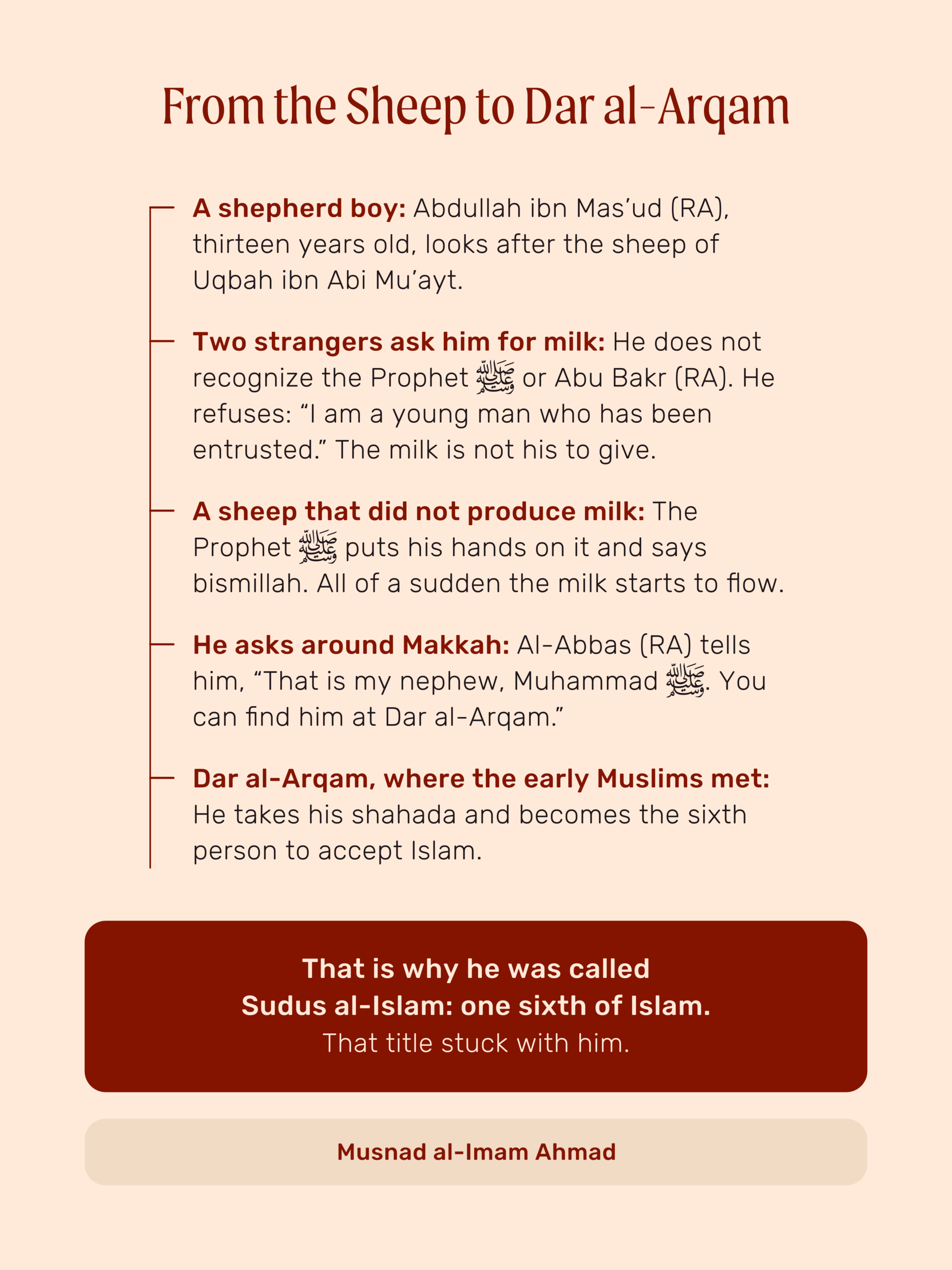
Now, he was a shepherd of a particular man. Uqbah ibn Abi Mu’ayt.
Uqbah ibn Abi Mu’ayt would become one of the greatest enemies of Islam. So he was a shepherd for Uqbah ibn Abi Mu’ayt at the age of thirteen years old.
One of the descriptions of Abdullah ibn Mas’ud (RA) is that he did not use to interact much with people. He lived among the sheep of Uqbah. So Abdullah ibn Mas’ud was just tending to his animals all the time.
Also one of his descriptions is that he was burned by the sun. Ka’annahu min ahl al-badi. He was like one of the dark, dark, dark skinned Bedouins, because he was just constantly out there in the sun taking care of the animals.
Two Men He Did Not Recognize Ask Him for Milk
The way that his Islam starts is very beautiful.
He meets Rasulullah ﷺ not knowing that he is the Prophet.
This is when Rasulullah ﷺ first receives the message of Islam and he is taking Abu Bakr as-Siddiq (RA) into confidence. So what the Prophet ﷺ used to do, he used to take Abu Bakr, they used to walk to the outskirts of Makkah and they would talk.
So once the Prophet ﷺ was walking with Abu Bakr as-Siddiq and he comes across Abdullah ibn Mas’ud (RA) as a thirteen-year-old boy taking care of these animals.
Now watch how disconnected this boy is from a society that is so close to him.
In Makkah everyone knew who the Prophet ﷺ was. This is before Islam. He is as-Sadiq al-Ameen. He is the honest one, the trustworthy one. Abdullah ibn Mas’ud is so disconnected from society that he has no idea who the Prophet ﷺ is. He has no idea who Abu Bakr as-Siddiq (RA) is.
He just sees two men coming to him and they say to him that we are travelers and we are thirsty, so if you could provide us just a little bit of milk, then we would gain some energy, we can move on and we will leave you alone.
He says it to Abdullah ibn Mas’ud in a very polite way.
I Wish That I Could, but I Do Not Own Any of This
Abdullah ibn Mas’ud (RA) was captured by the beauty of Rasulullah ﷺ and the beauty of Abu Bakr as-Siddiq (RA). The smile of the Prophet ﷺ. The character of the Prophet ﷺ.
So he says to Rasulullah ﷺ, look, I wish that I could. I really do wish that I could.
But he says, I do not own any of this stuff.
I am a young man who has been entrusted.
I have been entrusted by Uqbah ibn Abi Mu’ayt not to give anyone any milk, not to give anyone anything from this. I have to take his permission. I do not know if he would be okay with this.
The Prophet ﷺ Liked His Answer
So the Prophet ﷺ liked his answer. He was impressed by his trustworthiness.
How many ahadith do we find from the Prophet ﷺ about amana, about being trustworthy? Rasulullah ﷺ says, la deena li man la amanata lahu. There is no religion for the person of no amana. If you do not have amana, you do not have deen.
So the Prophet ﷺ does not argue with Ibn Mas’ud (RA). He does not say, come on, we will pay you, I will give you some money, which was very common back then. He does not say, tell your owner that a wolf attacked it, or that something happened to it.
The Prophet ﷺ says to him, okay, fine. Bring me one of your animals that does not produce milk.
I understand. You want to be trustworthy. You do not want to bring me one of the goats or the sheep that produces milk. That way, nothing is expected of it anyway.
The Sheep That Did Not Produce Milk
Abdullah ibn Mas’ud (RA) is curious why. He does not understand why the Prophet ﷺ would even ask for something like that. But he says, I went ahead and I brought them a sheep that did not produce any milk.
He says, the Prophet ﷺ put his hands on the udders of the sheep and he said, in the name of Allah.
He says, all of a sudden the milk started to flow from it. The Prophet ﷺ asked me for a bucket. So he brought the bucket and Rasulullah ﷺ filled that bucket.
Abdullah ibn Mas’ud is just watching this in absolute amazement, not knowing what is going on.
He says the Prophet ﷺ himself got all of the milk out of it. He grabbed that bucket, he took a little cup, he drank from it. Thumma saqa Aba Bakr. Then he gave it to Abu Bakr (RA) and Abu Bakr drank as well. Then he took a cup and he gave it to me and he told me to go ahead and drink.
Now, this is nothing for Abdullah ibn Mas’ud. He did not betray his contract with the owner of these animals, because this was an animal that did not produce milk anyway. So he says, I drank from it as well.
He says and I am just looking at the Prophet ﷺ. Then he says the sheep went back to the way that it was. Meaning it went back to not being able to produce milk again.
Rasulullah ﷺ and Abu Bakr (RA) were talking, they were drinking from the milk and as they did that, they thanked Abdullah ibn Mas’ud.
Teach Me These Words You Just Said
Then, as he was about to leave, as the Prophet ﷺ was turning away, Abdullah ibn Mas’ud (RA) says to him: my uncle, teach me these words that you just said.
So he says, tabassama. The Prophet ﷺ smiled and he wiped my chest. He put his hand on my chest. Then he said:
You are a trustworthy, knowledgeable young man.
He praised Abdullah ibn Mas’ud and subhanAllah, it is as if he is making him curious. It is as if he did not answer the question. He did not say that I said bismillah.
Then Rasulullah ﷺ walks away.
He Went Into Makkah Describing Two Men
Abdullah ibn Mas’ud (RA) says that as soon as him and Abu Bakr (RA) walk away, he still does not know who he was.
He says he went into Makkah. I started asking people about them and I started describing them.
He just happened to run into Al-Abbas (RA) and Al-Abbas was selling itr, he was selling perfume. So he said, I described these two men that I saw.
Al-Abbas said: that is my nephew, Muhammad ﷺ. If you want to find him, you can go to Dar al-Arqam and you can find him there.
So Abdullah ibn Mas’ud went running to Dar al-Arqam.
As soon as the Prophet ﷺ saw him, Rasulullah ﷺ recognized him. He was happy. In fact, some of the narrations say that Abu Bakr (RA) says the Prophet ﷺ was telling him about how impressed he was by Abdullah ibn Mas’ud taking that stance when he did.
So as soon as Abdullah ibn Mas’ud sees him, he asks him, what are you calling to? The Prophet ﷺ tells him about Islam and he says, I want to join.
So he asks how he joins. Rasulullah ﷺ tells him to say ashhadu an la ilaha illa Allah wa ashhadu anna Muhammadan Rasulullah. So he repeats after the Prophet ﷺ, he takes his shahada and he becomes the sixth person to accept Islam.
This whole narration is found in Musnad al-Imam Ahmad.
One Sixth of Islam
When he becomes Muslim, he is the sixth person in Islam, he actually gained a nickname. His nickname was Sudus al-Islam. One sixth of Islam.
Because it was very strange that a person like Ibn Mas’ud (RA) was joining this religion. At this point, who had become Muslim? The Prophet ﷺ. Abu Bakr (RA). Khadijah (RA). Maybe a couple of other people.
They just say Sudus al-Islam. That is the sixth. He is one sixth of Islam.
That title stuck with him.
SubhanAllah, one of the scholars, rahimahullah, said that this is a miracle, because if you take Abdullah ibn Mas’ud’s role in Islam as a whole, it is equal to more than one sixth of Islam. Count his role in the Quran, his role in hadith, his role in fiqh.
He is one sixth of Islam. SubhanAllah, what an honorable nickname that is. Sudus al-Islam.
This session ends at his acceptance of Islam and the course continues after it. Study The Five Abdullahs on Bayyinah TV: Bayyinah TV
Notes
This post is adapted from session 26 of The Five Abdullahs on Bayyinah TV and is written in the voice of that session. Every teaching claim, example and aside in it is taken from the session itself. The session quotes no ayat of the Quran; it works from narration and it names its sources aloud where it uses them. Those sources are given in the body at the points the session gives them: the account of his acceptance of Islam is attributed to Musnad al-Imam Ahmad, the hadith on amana and the hadith that every prophet was a shepherd are quoted without a source being named and the remark that the title Sudus al-Islam is a miracle is attributed only to one of the scholars, who is not named.

At Bayyinah, we are dedicated to helping you connect directly with the words of Allah beyond translation. Founded by Ustadh Nouman Ali Khan, our mission is to create transformative experiences that deepen your understanding and engagement with the Quran.
Study the Quran and Arabic in a systematic and personalized way through Bayyinah TV. Get started today for free.
Check out our newest articles, fresh off the press and ready for you to dive into!