
Successful subscription! Thank you for subscribing.
Successful subscription! Thank you for subscribing.

November 5, 2026
Tonight Is Just About Surah Al-Baqarah
Some account of this story occurs in the Quran roughly seven times. Two of those places are more detailed than any other. The first is Surah Al-Baqarah, which is the second surah. The second is Surah Al-A’raf, which is the seventh.
Here is what is remarkable. Those two are not similar at all. What Allah highlights in Al-Baqarah He does not highlight in Al-A’raf. What He highlights in Al-A’raf He does not highlight in Al-Baqarah.
I personally do not want to give you a mixture of both of those. This evening is dedicated to how Allah tells the story in Surah Al-Baqarah, specifically.
I believe this is important, because we have to let Allah tell the story.
It is one thing to collect all the details, organize them in your own way and tell the account. But Allah decided to tell one piece of the story a certain way in one place in the Quran and that needs attention by itself.
Everything on This Earth Was Made for You
We begin in an almost unexpected place. Allah says He is the One who created for you whatever is on the earth, all of it, altogether.1
Please try and remember this. Whatever Allah put on the earth, He made for you, all together. There is not a thing on this earth that He did not put in service to human beings. All of the resources of the earth were made for human beings.
Same ayah. He made the earth for you, then He turned His attention toward the sky and He evenly molded the skies into seven distinct layers. The seven skies, the famous expression.
The beauty of this ayah is that both of those parts have to do with human beings.
The first part is that He made the earth for you. The second part is that He turned toward what? The sky. Where is Jannah?
In the sky.
So in this ayah Allah first talks about the creation of the earth and then completing the project of the sky, which also means completing the project of Jannah.
The Announcement Came Before He Was Even Created
Now, you already know some parts of this story. So you tell me. Where does the story of Adam (AS) begin? Does it begin on the earth, or does it begin in Jannah?
It begins in Jannah.
Keep that in mind, because in the very next ayah Allah tells us something shocking. When your Master said to the angels: I am placing a khalifah on the earth.2
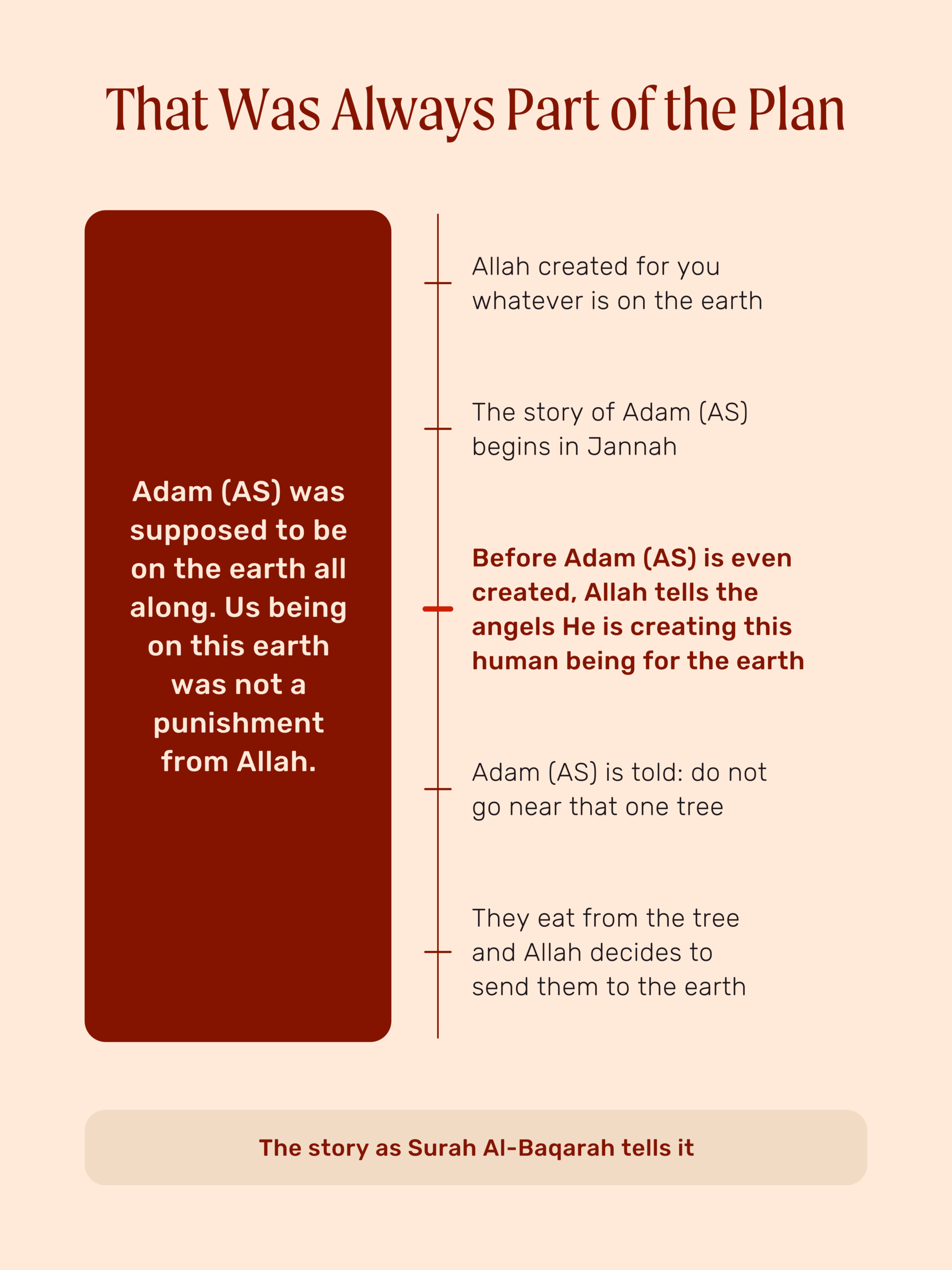
That is a pretty interesting statement to make. You just told me the story of Adam (AS) begins in heaven. Yet before He has even made the human being, Allah is making an announcement to the angels, telling them that He is creating this thing, this human being He calls a khalifah and He is creating this khalifah for the earth.
According to the ayah, where is the khalifah made for? Is he made for Jannah, or is he made for the earth?
For the earth. Before Adam (AS) was even created.
The plan always was that this creature has been designed and created for the earth.
I call this section one of the story, heaven or earth and it is important because a lot of people are carrying around the Sunday school version, which is highly incorrect. That version goes like this. Adam (AS) and his wife, our mother, were having a great time in Jannah, until because of the whisper of Shaytan they decided to eat from that tree. The second they ate from that tree they lost their place in Jannah and as a punishment Allah decided to send them down to the earth.
I am letting you know today that the Quran is telling you something else. He was supposed to be on the earth all along. That was always part of the plan. Us being on this earth was not a punishment from Allah.
There are people who say we are living on this earth because our father Adam made this terrible mistake, that it is all his fault and that we have to pay the price. If he had not eaten from that tree, we would still be chilling in Jannah.
No. You were meant to be here just like he was meant to be here.
Let Me Tell You About the Guy Who Got Shipped to Mississippi
But that creates a really, really big problem. It is a problem I have talked to thousands of young people about, all over the world, the same question over and over again.
There is a man who works at a company. He is a good employee. He is doing a good job. His boss sends an email to the entire department saying we are going to transfer this guy to Mississippi. He is being transferred this week.
The only person who never got that email is the guy himself.
The next week he comes into the office thirty seconds late. His boss says, can I talk to you for a second? You were thirty seconds late. I specifically told everyone in this office to be in the office on time. We do not tolerate this kind of behavior. You are being shipped to Mississippi.
Is that fair?
Everybody else in the company already knew what? That he was going to be transferred.
So the boss says you are being shipped to Mississippi and he says, excuse me. No, no, no. You are not shipping me anywhere because I was late. You are shipping me because you already decided that you were going to ship me. That was the plan all along. That is not my fault. This is a trap.
I am not talking about Mississippi, am I?
Allah created Adam (AS). He always meant to send him where? To the earth.
Then Iblis comes and tells him he needs to eat from this tree. You are just told, do not go near that one tree. That one tree out of all of the trees.
Then Iblis comes and says, hey, by the way. From what I know, you were not created for Jannah. You were created for what? The earth. You need to eat from that tree and let me tell you why. The only kind of people who can stay here are either angels or permanent residents. You are neither of those things. Eating from that tree will either turn both of you into angels, or you will become permanent residents.
I am not making this up. That is all in Surah Al-A’raf,3 which we are not talking about tonight.
So the motivation that was given to Adam (AS) to eat from the tree actually had to do with his transfer. His transfer to where? The earth.
He makes the historic mistake that he makes. Our mother makes the mistake with him. They eat from the tree and Allah decides to send them where? To the earth.
What could they have turned around and said?
Excuse me. You were always going to send us. You issued an email to all the angels that You are creating a khalifah for where? The earth. You even decided that before we were created.
If Allah Already Knows, How Is It My Fault?
That is the question young people ask me all the time.
If Allah already knows what I am going to do, how is it my fault? Allah has already decided where I am going to end up. It is all a setup.
The first human being on the earth was actually the first human being who could have asked that same question directly to Allah.
Adam (AS) and Iblis Have a Lot in Common
I am comparing two individuals. Please listen carefully.
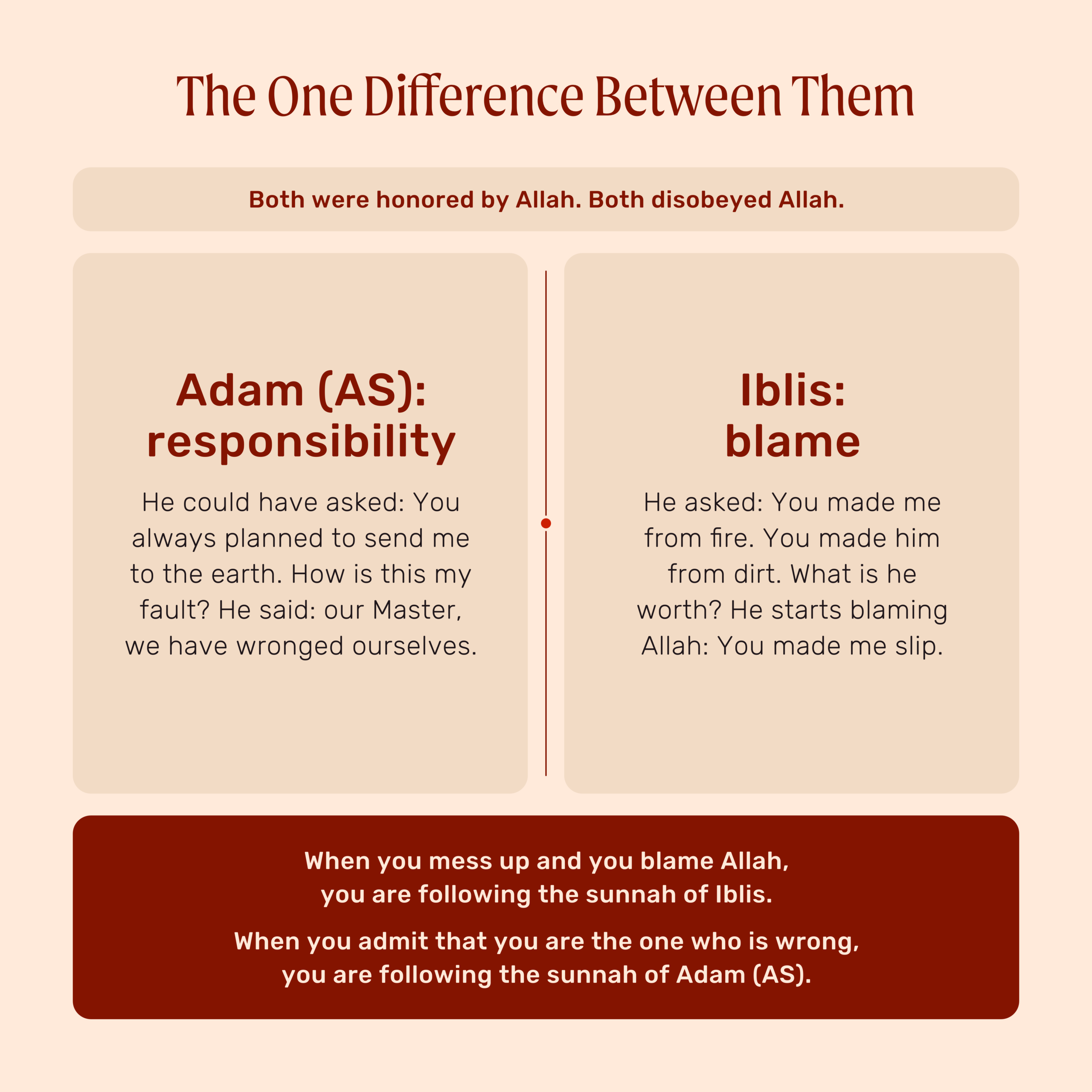
Was Adam (AS) honored by Allah? Yes or no? Yes.
Was Iblis honored by Allah? Yes or no? Yes.
Did Adam (AS) end up disobeying Allah? Yes or no? He did.
Did Iblis disobey Allah? Yes or no? He did.
They have a lot in common. Up until now, they have a lot in common.
There Is Only One Difference Between Them
When Adam (AS) was demoted, when he was sent down to the earth, he could have asked a logical question. His logical question would have been: ya Allah, You always planned to send me to the earth. How is this my fault?
Could he have asked that question? Sure.
Did he ask that question? No.
Iblis also asked a logical question. You made me from fire. You made him from dirt. What is he worth? Look at him.
That is actually pretty logical. It is logical.
Both of them were in a position to ask, or to make a logical complaint to Allah. Yet one of them is cursed forever and for the other one the door of hope remains open.
Why?
Because one of them decides that whether things make sense to me or not, I have to trust the wisdom of Allah. If there is a fault, whose fault is it? My own. I have to take personal responsibility. I did something wrong.
Who is that? Who takes personal responsibility, Adam (AS) or Iblis?
Adam (AS).
Iblis says, actually, You made me slip. You knew I was going to mess up. You caused me to be misled. He starts blaming Allah.
When you mess up and you blame Allah, you are following the sunnah of Iblis. When you mess up and you admit that you are the one who is wrong, instead of saying it was decreed by Allah, you are following the sunnah of Adam (AS).
That is the difference between these two.
Fine. Then You Take Personal Responsibility.
There is a lot of philosophical discussion about predestination. If Allah already knows, how is it my fault? If something bad happens, it happens because Allah let it happen, so how is it my fault?
When people come and ask me this kind of question, I cannot technically do what I really want to do, because it is illegal.
But imagine if I were able to take a shoe and throw it at the guy’s face.
Would you be offended? Who would he be angry with? Me.
Then I could turn around and say, that was the qadar of Allah. You see, Allah decided that you should get hit in the face with my smelly shoe. This was not actually up to me. If it was up to me, I would not have done it.
You see?
The problem is that no matter how much I try to convince him that it was not me, it was who? Allah. He still stays mad at who? Me.
So I say, okay, fine. You want to hold me personally responsible for what I did, instead of blaming Allah?
Then why don’t you take personal responsibility?
The question is entirely about what? Personal responsibility. That is what this question is about.
Adam (AS) decided to eat from the tree despite Allah’s instruction, yes or no? Yes. He had to take personal responsibility and at the end of the day he had to say: our Master, we have wronged ourselves.4 Iblis put the responsibility on Allah. Adam (AS) says we wronged ourselves. Iblis says You made me slip, You made this happen to me, You are the cause.
SubhanAllah.
This is the first part of the story night and the parts that follow carry it to its end. Study Adam in the Angel’s Eyes with Ustadh Nouman Ali Khan on Bayyinah TV: Bayyinah TV
Notes
This post is adapted from the first part of the story night Adam in the Angel’s Eyes on Bayyinah TV and is written in the voice of that session. Every teaching claim, example and aside in it is taken from the session itself. The references below locate the ayat it quotes or works on.
[1] Quran, 2:29, https://quran.com/2/29 ↩
[2] Quran, 2:30, https://quran.com/2/30 ↩
[3] Quran, 7:20, https://quran.com/7/20 ↩
[4] Quran, 7:23, https://quran.com/7/23 ↩

At Bayyinah, we are dedicated to helping you connect directly with the words of Allah beyond translation. Founded by Ustadh Nouman Ali Khan, our mission is to create transformative experiences that deepen your understanding and engagement with the Quran.
Study the Quran and Arabic in a systematic and personalized way through Bayyinah TV. Get started today for free.