
Successful subscription! Thank you for subscribing.
Successful subscription! Thank you for subscribing.

November 24, 2026
The story I want to share with you this evening is one of the final episodes in the life of Musa (AS), toward the end of his career.
So today I am going to talk about the way Allah tells this story in Surah number 26, ayah by ayah, the way Allah tells it Himself.
The Du’aa He Made Running Out of Egypt
As Musa was running away from Egypt, running into the desert to save his life, he prayed to Allah: rabbi najjini min al-qawmi al-zalimin (رَبِّ نَجِّنِي مِنَ ٱلۡقَوۡمِ ٱلظَّـٰلِمِينَ).1 Master, rescue me from the wrongdoing people.
After he makes this du’aa, he gets out of Egypt. He ends up in Madyan, lives there ten years and gets married. In other words, for ten years, Allah answered his prayer. He was rescued from the wrongdoing people.
Go Back to the Wrongdoing People
This is where I want to start. He is up on the mountain. Allah says: wa idh nada rabbuka Musa ani’ti al-qawma al-zalimin (وَإِذۡ نَادَىٰ رَبُّكَ مُوسَىٰٓ أَنِ ٱئۡتِ ٱلۡقَوۡمَ ٱلظَّـٰلِمِينَ).2 When your Master called out to Musa: go back to the wrongdoing people.
Why is that important? What was his du’aa? Rescue me from the wrongdoing people. He has been thanking Allah every day: ya Allah, thank You so much, You rescued me from the wrongdoing people. He finally gets to have a conversation with Allah and Allah tells him: I need you to go back to the wrongdoing people.
Five Things Instead of Yes
Musa is one of five messengers in the Quran with the greatest commitment to Allah, the ulul ‘azm min al-rusul (أُوْلُواْ ٱلۡعَزۡمِ مِنَ ٱلرُّسُلِ). One thing you know about prophets is that when Allah tells them to do something, they do it. In Arabic we say sami’na wa ata’na (سَمِعۡنَا وَأَطَعۡنَاۖ): we hear and we obey. The biggest example of that is the prophets. Ibrahim (AS) is told to jump into a fire. He does not turn to Allah and say: it is kind of hot. He jumps in.
So Allah has just told Musa to go back. Musa can hear Allah Himself, behind the veil. At this point I would expect Musa to say: I hear and I obey.
Here is what Musa says. He does not say one thing. He says five things.
One: They Will Call Me a Liar
Number one: rabbi inni akhafu an yukadhdhibun (رَبِّ إِنِّيٓ أَخَافُ أَن يُكَذِّبُونِ).3 Master, I am really scared that they are going to call me a liar.
Wait. You are talking to Allah right now. Who should you be scared of? Allah. You are talking to Allah and telling Him you are scared of people calling you a liar?
There are some people in the ummah, Allah bless them, who are more Islamic than Islam. You will hear them say: when you fear Allah, you should fear nothing else. Hold on a second. I am pretty sure Musa fears Allah. He is talking to Allah directly and he still says: I am scared. He does not say: ya Allah, I only fear You.
Two and Three: A Tight Chest and a Tongue That Will Not Move
Number two: wa yadiqu sadri (وَيَضِيقُ صَدۡرِي).4 My chest will get tight. Number three: wa la yantaliqu lisani (وَلَا يَنطَلِقُ لِسَانِي). My tongue will stop moving.
These three are connected. When they call me a liar, it is going to make me feel bad, anxious and frustrated. When they all gang up on me and bully me like that, I am going to start having maybe a panic attack. When a person has a panic attack, they have a hard time breathing and that is described as your chest becoming what? Tight. When a person has a panic attack while being insulted and attacked, they are not able to think clearly or say what they were originally going to say.
Four: Send It to Harun
Number four: fa arsil ila Harun (فَأَرۡسِلۡ إِلَىٰ هَٰرُونَ).4 Ya Allah, thank You for the opportunity, but since I cannot speak that well, I know someone who is really good at speaking. My brother. He is awesome. Could You give this mission to Harun (AS) instead?
This is called al-fa’ al-sababiyyah: therefore. Therefore, send it to Harun. In other places in the Quran, he even explains to Allah why: he is a better speaker than I am.5
Five: They Will Kill Me
Number five: wa lahum ‘alayya dhanbun fa akhafu an yaqtulun (وَلَهُمۡ عَلَيَّ ذَنۢبٞ فَأَخَافُ أَن يَقۡتُلُونِ).6 They have a crime recorded against me and therefore I am terrified that they will kill me.
So it started with fear and it ended with fear, but they are different fears. The first was the fear of being called a liar, which means the fear of being humiliated, publicly insulted, falsely accused, degraded and embarrassed. When somebody calls you a liar, you do not bleed. No bones break. You are not physically in any pain. But in number five, what was his fear? They are going to kill me. That is physical.
To him, being humiliated is a much bigger fear than being killed. You would think he would say number five as number one. After all, when he ran away from Egypt, he was afraid they were going to kill him. If number five happens, if he does get killed, the other four are no longer a problem. It is already over. But he puts it at number five and this is Allah’s way of telling us something very powerful.
The most important example of that in the Quran is Maryam (AS). When she had her baby, ‘Isa (AS), she was going to go back with the baby to her community, to the masjid and everybody there knew she was not married. They were going to ask her where this baby came from and the thought of having to answer that question was so devastating to her that Allah tells us her words: if only I could have died before this.7 The fear of being humiliated is so powerful that it is even scarier than being killed. If she had to pick between the two, Maryam picked death. When Musa had to pick which one came first, he picked humiliation.
That Does Not Sound Like Yes
I started by saying that when a prophet is told by Allah to do something, he responds with: we hear and we obey. That does not sound like obey to me. That sounds like: ya Allah, I would love to obey, but I cannot and here are five reasons. That does not sound like yes. That sounds like no, which is pretty shocking.
In Muslim culture, sometimes we become more Islamic than Islam again. People say: when Allah tells you to do something, you must do it. There is no option. You have to surrender, because Islam means submission. Oh yeah? Have you heard of Musa? Allah told him to go and he gave a whole explanation, a whole essay answer, instead of just saying “I hear and I obey.”
What does that teach us? Allah is far more understanding than people are that you are struggling with something. People will tell you to submit immediately and if you do not, then Allah does not like you. But Allah is telling you: talk to Me. Not to people. Tell Allah: ya Allah, I want to obey You, but I am scared. This is what I am scared of. These are my weaknesses. Ya Allah, help me with these things. Musa is not justifying his behavior. He is not saying: I am not going to go. He is saying: ya Allah, I need Your help with these things.
This is why in al-Fatiha we do not just say iyyaka na’budu (إِيَّاكَ نَعۡبُدُ) and go to the next ayah. We say iyyaka na’budu wa iyyaka nasta’in (إِيَّاكَ نَعۡبُدُ وَإِيَّاكَ نَسۡتَعِينُ).8 We will worship You, fine, but we cannot do it without Your help. Sometimes worshiping You gets hard. Sometimes obeying You gets difficult. When it gets difficult, who are we going to ask for help? We turn to You. So Musa turns to Allah and asks for help.
Kalla. Not at All.
Before the break, I have to tell you Allah’s response and you are going to repeat it in Arabic after me. Allah says: kalla.9 Kalla means not at all.
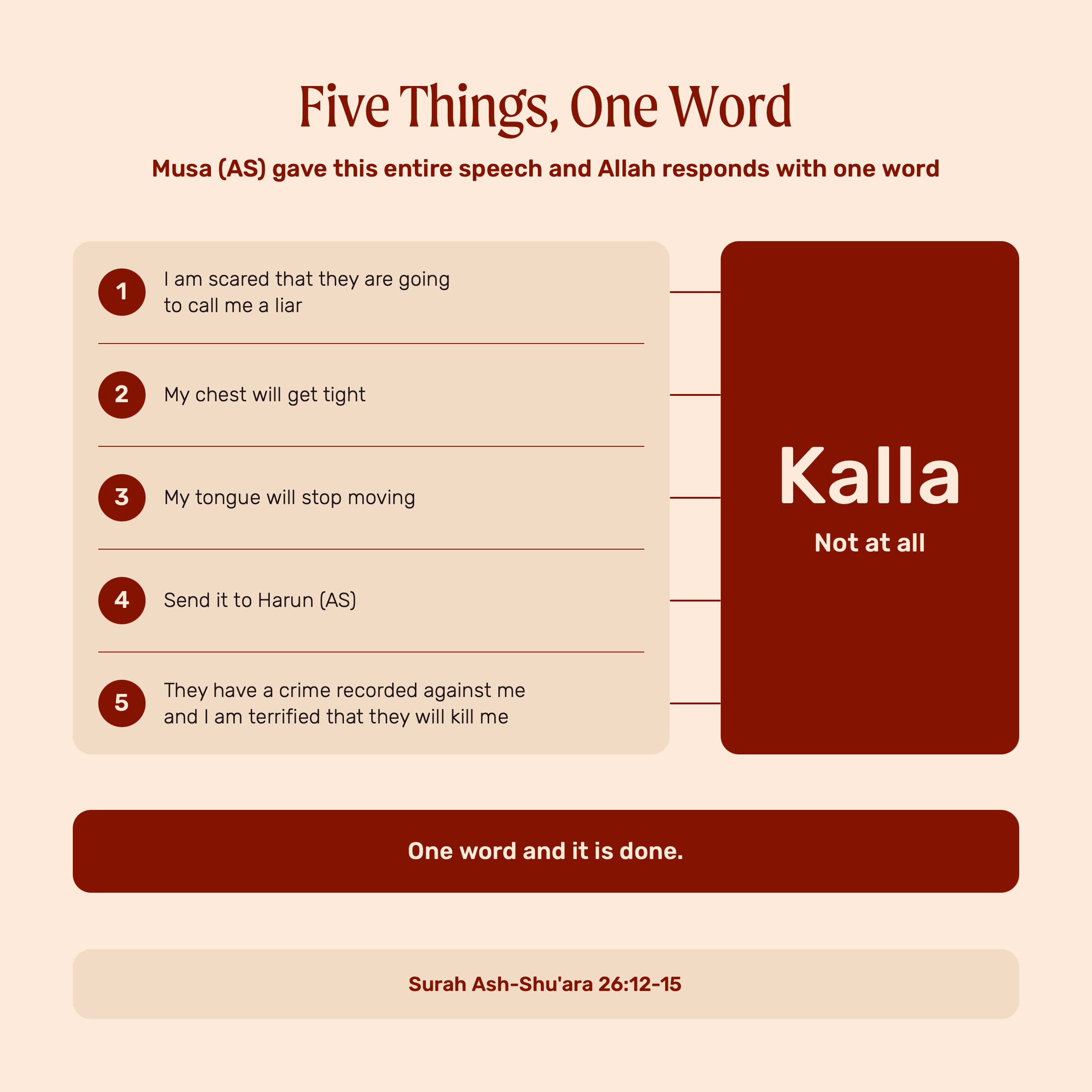
Musa gave this entire speech and Allah responds with one word. Ya Allah, I am afraid they are going to call me a liar. Not at all. Ya Allah, my chest is going to become tight when they call me names. Not at all, your chest will be fine. Ya Allah, my tongue will not move. Not at all, your tongue is going to move just fine. Ya Allah, I am not good enough for this, give the job to Harun. Not at all. You still got the job. I know who I picked. Ya Allah, I am afraid they are going to kill me. Not at all. They are not going to kill you. One word and it is done.
Everybody Needs a Harun
Then He says: fadhhaba, both of you go. Who is both of you? Musa and Harun. So Musa wanted Harun to go instead and Allah says: no, you are still on the job, but I will give the job to Harun additionally.
For those of you familiar with the story, here is the amazing thing. Later on, Musa debates with Fir’awn and Harun never speaks the whole time. He is there, but he does not speak. What was the whole reason Musa wanted him along? He is a better speaker. That leaves you scratching your head. Allah could have told Musa: I already know the future, you are going to do all the talking, you do not need him. But Allah sent him anyway.
If Harun was not going to speak, why was he there? Because sometimes when you have to face a bully or a scary situation, even though you fear Allah and you know Allah is with you, you need a human being next to you. You need support. You need a Harun next to you. Even if they do nothing, the fact that they are there is enough and the moment you start to breathe heavy, they can grab your hand a little and say: easy, breathe, you got this.
So everybody needs a Harun in their life. If someone as brave as Musa needs a Harun, so do you. It does not have to be your sibling. It could be a friend, a spouse, a parent. When you do not believe you can do something, the way Musa did not believe he was good enough, Allah will give you someone next to you, someone who believes in you and you will be able to do the things Allah knows you can do. That is one of the biggest blessings you can have. The right person in your life is part of the rizq Allah has written for you.
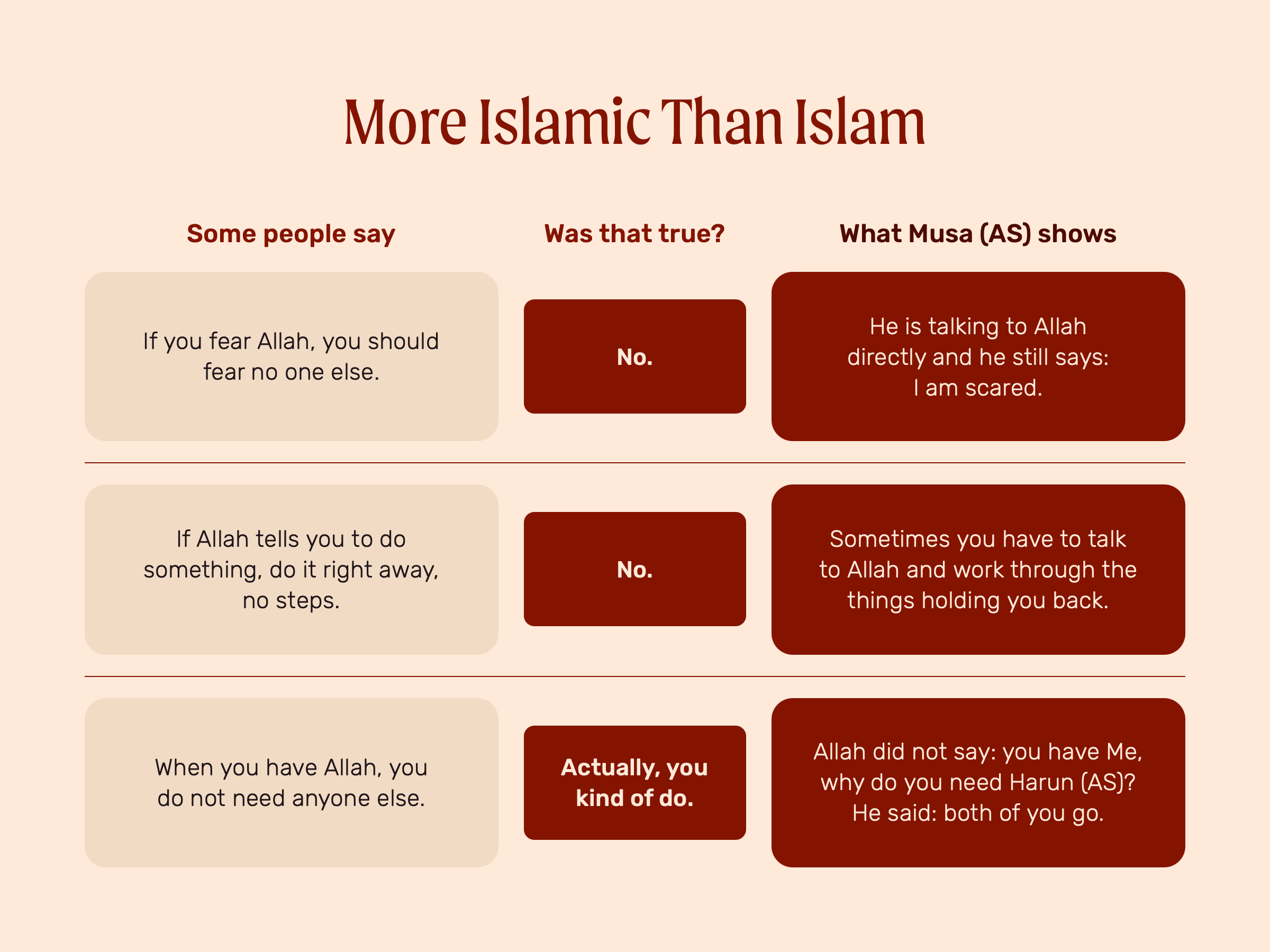
I keep telling you some people are more Islamic than Islam. First they say: if you fear Allah, you should fear no one else. Was that true? No. You can fear Allah and still fear other things. Then they say: if Allah tells you to do something, do it right away, no steps. Was that true? No. Sometimes you have to talk to Allah and work through the things holding you back. The third thing they say is that when you have Allah, you do not need anyone else. Actually, you kind of do. There are people we need next to us and that is okay. “I have Allah, I do not need anyone” is just not how the Quran is. Allah did not tell Musa: you have Me, why do you need Harun? He said: both of you go.
This is the first part of the story night and the parts that follow carry it to its end. Study Moses 3: The Return of Moses with Ustadh Nouman Ali Khan on Bayyinah TV: Bayyinah TV
Notes
This post is adapted from the first part of The Return of Moses story night, Miracles, taught on Bayyinah TV by Ustadh Nouman Ali Khan and is written in the voice of that session. Every teaching claim, example and aside in it is taken from the session itself.
[1] Al-Quran, Surah Al-Qasas, 28:21, https://quran.com/28/21
[2] Al-Quran, Surah Ash-Shu’ara, 26:10, https://quran.com/26/10
[3] Al-Quran, Surah Ash-Shu’ara, 26:12, https://quran.com/26/12
[4] Al-Quran, Surah Ash-Shu’ara, 26:13, https://quran.com/26/13
[5] Al-Quran, Surah Al-Qasas, 28:34, https://quran.com/28/34
[6] Al-Quran, Surah Ash-Shu’ara, 26:14, https://quran.com/26/14
[7] Al-Quran, Surah Maryam, 19:23, https://quran.com/19/23
[8] Al-Quran, Surah Al-Fatihah, 1:5, https://quran.com/1/5
[9] Al-Quran, Surah Ash-Shu’ara, 26:15, https://quran.com/26/15

At Bayyinah, we are dedicated to helping you connect directly with the words of Allah beyond translation. Founded by Ustadh Nouman Ali Khan, our mission is to create transformative experiences that deepen your understanding and engagement with the Quran.
Study the Quran and Arabic in a systematic and personalized way through Bayyinah TV. Get started today for free.
Check out our newest articles, fresh off the press and ready for you to dive into!