Successful subscription! Thank you for subscribing.
Successful subscription! Thank you for subscribing.
November 20, 2026
My intention tonight is to walk you through one of the most important events talked about in the Quran. Famously known as the Battle of Uhud.
To understand it properly, a little bit of history is important.
Part one is the history. That is what I am hoping to discuss with you tonight.
Part two is Allah’s commentary on that history.
What is remarkable about this incident is that the commentary came from none other than Allah himself.
For every small event inside this larger event, He said something about it. He commented so much that there are approximately sixty ayat, a huge chunk of Surah Ali ‘Imran, dedicated to this one event.1
That is exactly what we are not doing tonight. First we need to understand the incident itself, before we understand what He is commenting on.
Nobody Cared About Makkah Before This
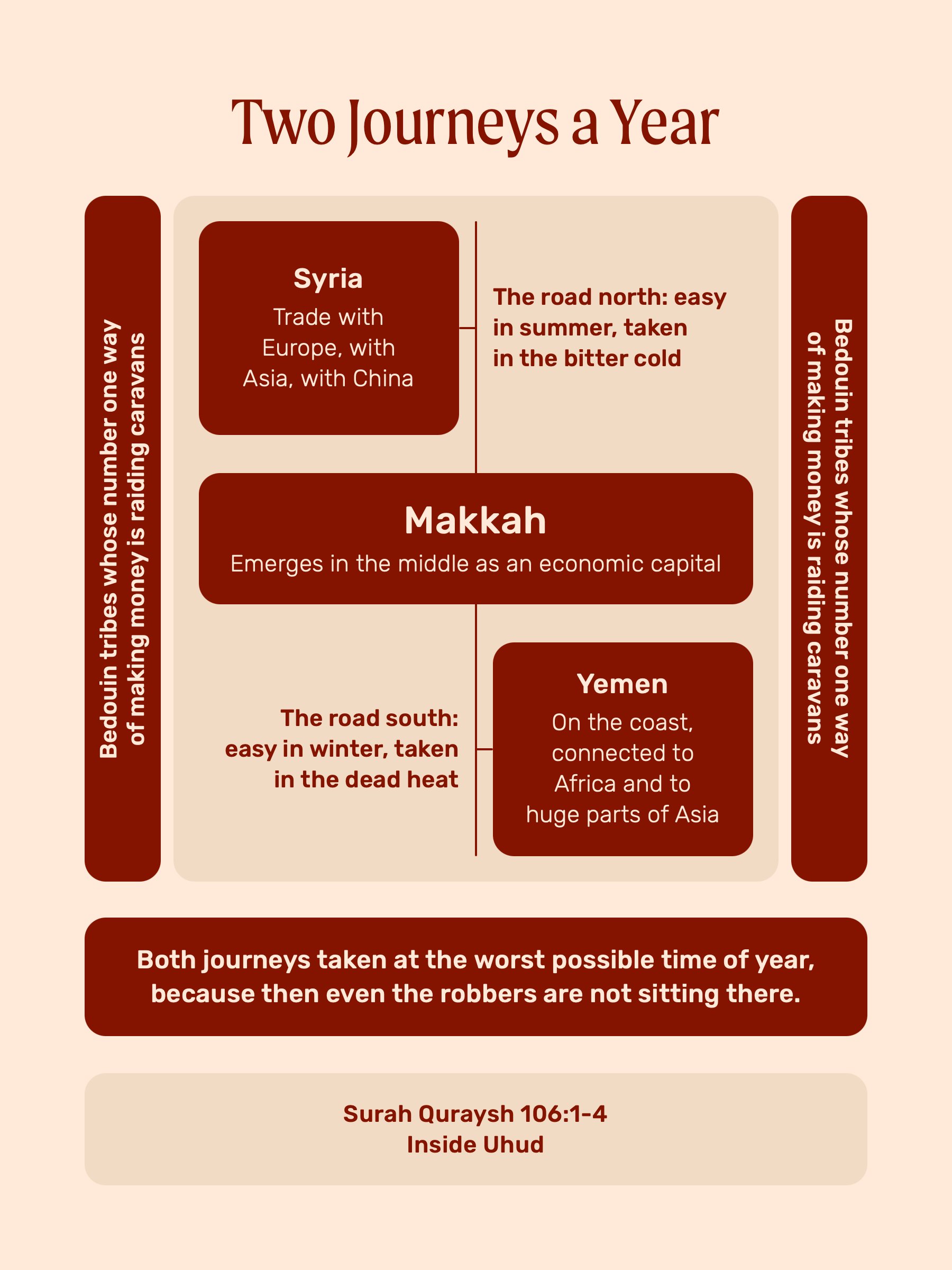
Way south of Makkah, far down, is Yemen.
Well over a century before the Prophet ﷺ was born, Makkah emerged as an economic capital.
Makkah was insignificant before that. Nobody cared about Makkah. The only thing it had going for it was that water sprang up in the middle of the desert. Other than that, it had no importance.
Here is the thing about Yemen. Yemen is on the coast and on the other side of Yemen is water. Yemen is connected to Africa and to huge parts of Asia. So if you want goods from Africa and Asia, you go toward Yemen.
Now on the far end up here, there is Syria. If you want to trade with Europe, with Asia, with China, other parts of that world, you go toward Syria.
Makkah emerges in the middle.
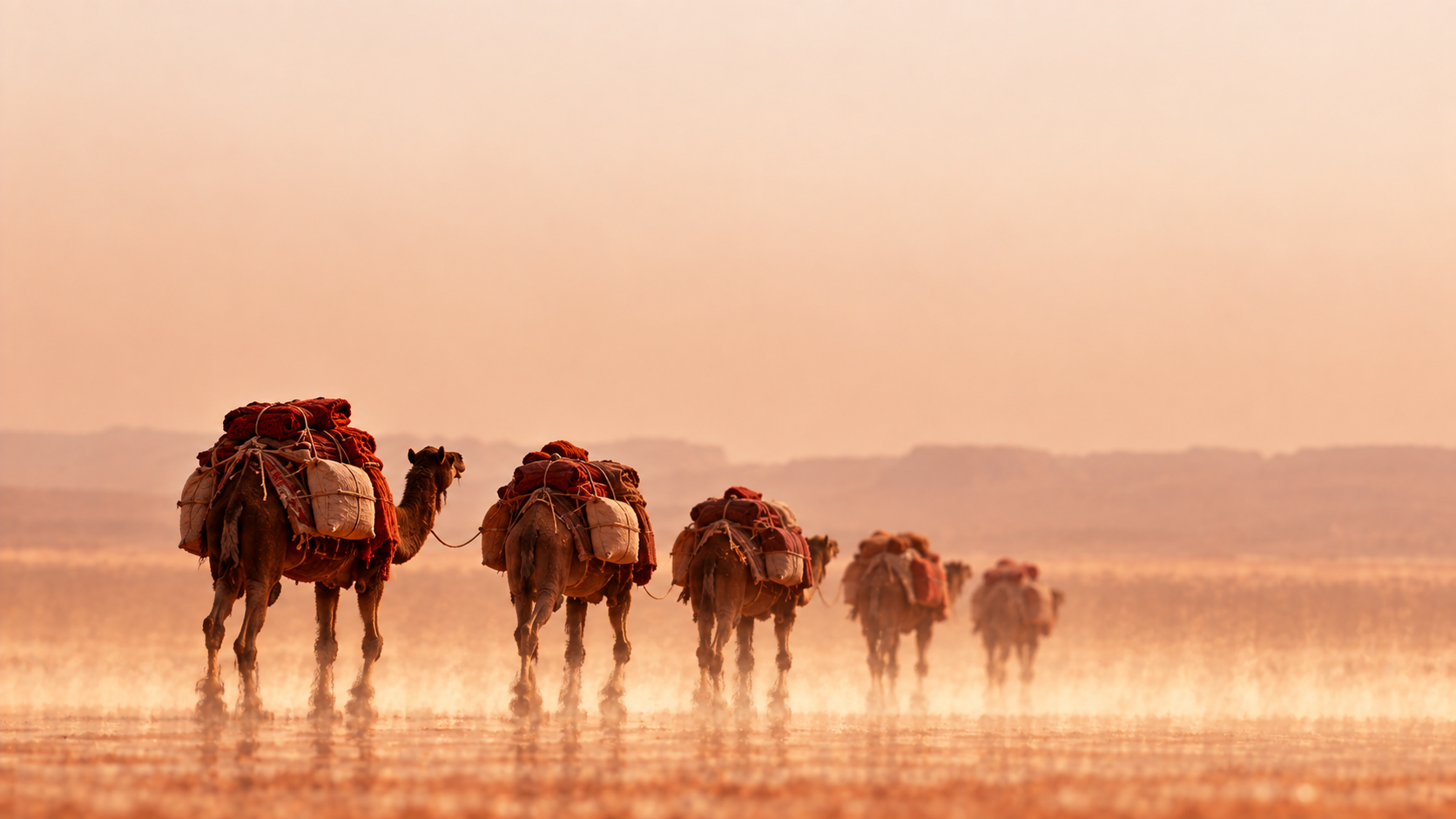
What Makkah does is come up with a plan. We go toward Yemen and buy a bunch of things imported from all over that side of the world. We buy wholesale. Then we walk our caravans all the way to Syria and sell them those products at a higher price and make a lot of money.
The problem is that the pathway is desert and the desert has dozens and dozens and dozens of Bedouin Arab tribes whose number one way of making money is raiding caravans.
Why You Go South in the Summer and North in the Winter
When you head toward Yemen you are getting closer to Africa, so it is not a good idea to go that way in the summer. The African summer is insane. It will kill you. The easier thing is to go that way in the winter.
But when you go toward Syria the weather gets colder, so it is a really bad idea to go north in the winter. What is the easier time to go north? Summer.
The problem is that if you go south when the weather is nice and north when the weather is nice, that is also the best time for the robbers to rob you, because it is good weather for them to sit outside and wait for you.
But if you go south in the dead heat, even the robbers are not sitting there. They run out of food. They get too uncomfortable. So it is safer to travel in the intense heat this way and safer to travel in the bitter cold that way.
Two journeys a year, both of them deliberately taken at the worst possible time of year.
The One Caravan Nobody Ever Robbed
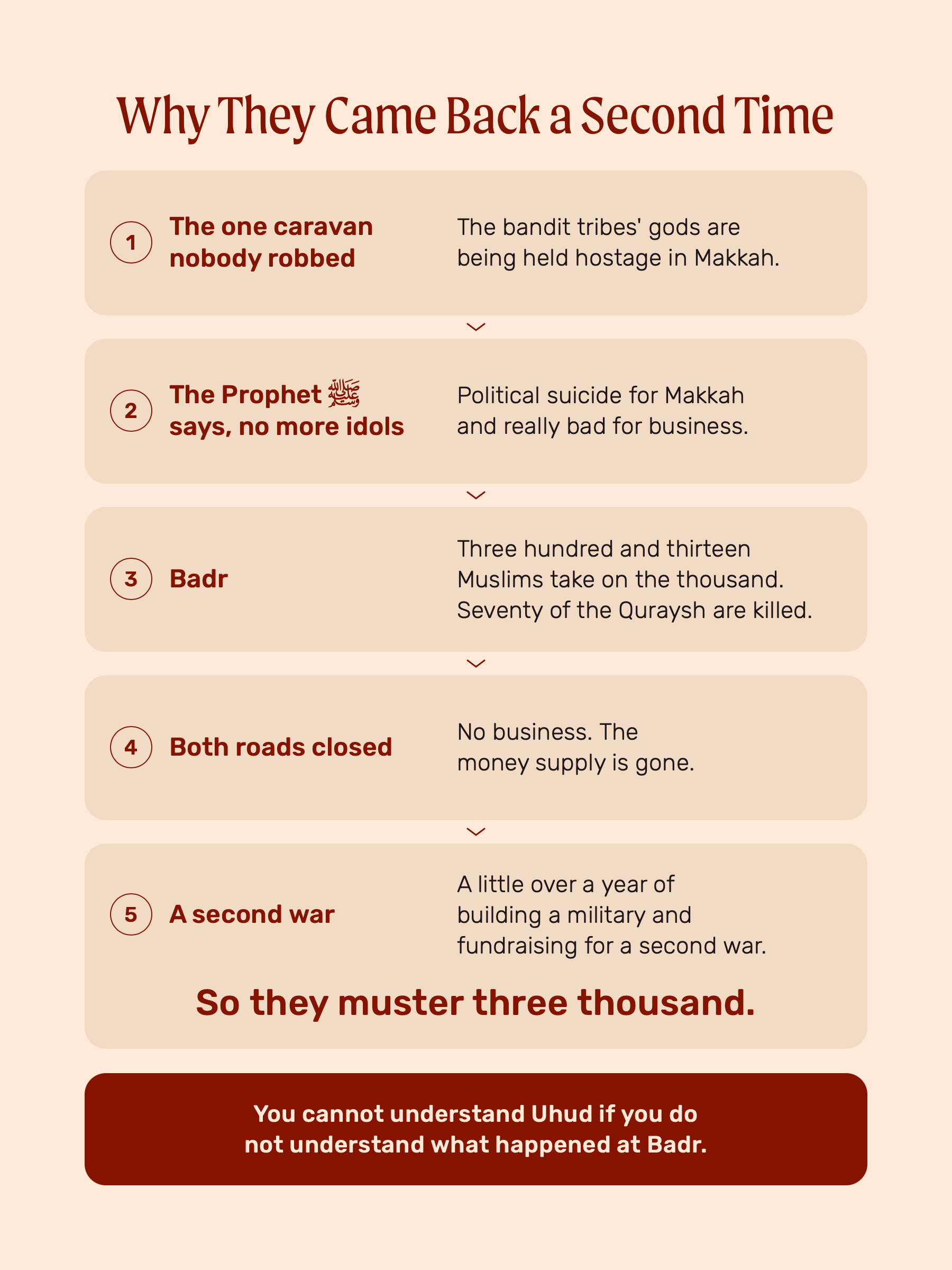
Except everybody else used to get robbed. The people of Makkah were not the only ones trying to do business. They were the only ones who never got robbed.
Why?
Because Makkah had the Ka’bah and the Ka’bah was surrounded by idols and every one of those idols was worshiped by one of these tribes all over the region.
So the Makkans are heading toward Yemen, some bandits move on them, then they recognize them. Hey. You guys are from Makkah. Oh, your god? Is that the four-foot wooden one? Yeah. Yeah. He is going to break when we get home.
Their gods are being held hostage in Makkah. Everybody knows Makkah is the sacred place where you keep your gods to worship.
That is why the Quran says this city was safe and they get to take the convenience journey of the winter and the summer.2
Now the Prophet ﷺ comes and says, no more idols, there can only be one God.
Is that just a religious problem?
No. If we get rid of these idols, who are we going to make angry? All these tribes who never touch us. They are going to say you killed our god, we are going to get you and they are all going to converge on us. What you are asking us to do by accepting one God is political suicide. You are going to make us the number one target in the region.
It is also really bad for business. Once we destroy these idols, these bandit tribes have no reason to respect us on our journey. This business of ours ends completely. We go bankrupt.
At least they could say, well, Makkah has a lot of trees and farmland and we will be fine. No. They cannot say that. It is not a fruitful place, is it? Unless food is brought in from outside, they cannot survive.
So they were also fighting Islam because they said, if we accept Islam we are going to starve to death. We are going to get killed.
The Biggest Caravan They Had Ever Sent
When they trade normally they take the shorter road. Out of Makkah, up this side of Madinah, along the coast to Syria, then back the same way.
Eventually they tried to kill the Prophet ﷺ, but he escaped their plan and when he escaped their plan he ended up in Madinah.
So six months in, the Prophet ﷺ starts sending scouts to observe and of course these caravans are taking their normal road. Two or three of them get attacked. Those were the smaller ones.
Then there was a big one. Worth millions and millions and millions. This one was so important that the governor of Makkah himself was going, because this one meant the year’s income.
His name was Abu Sufyan.
Abu Sufyan takes his caravan along the coast and Allah reveals to the Prophet ﷺ that the biggest caravan ever is coming.
About three hundred or so people gather and muster whatever weapons they have. They are not taking on an army. They are taking on a caravan.
Abu Sufyan gets news quickly that they are coming. He speeds up, goes further along the coast, makes it all the way to Syria. But now they are waiting for him on the way back.
So Abu Sufyan sends an SOS. An emergency letter to Makkah. Our biggest caravan yet is about to get robbed. By who? By the Muslims. Do something.
The Caravan, or the Thousand
The people in Makkah, led by Abu Jahl, muster an army and they have to do it fast. A twenty-four hour turnaround. They put together a quick army of a thousand people.
The Prophet ﷺ finds out they are coming. A thousand of them. How many Muslims are there? Three hundred and thirteen.
He asks his community. We have two options. We can go after the caravan that is worth millions and is unarmed. Or we can go after the thousand who are coming to kill us. What do you think?
You were hoping for the group that has no thorns in it.3 What is the group with no thorns in it? The caravan. You could have had that one.
But Allah wanted the truth to come out as truth.
Allah decided that the three hundred and thirteen who thought they were just going to take a couple of camels would take on the thousand.
That was the Battle of Badr. That is what Badr was.
Meanwhile, while the Muslims are fighting those thousand, what happens to Abu Sufyan and his millions? He makes it back to Makkah safely.
Now Both Roads Are Closed
At Badr, seventy of the Quraysh are killed. Seventy of them.
Now they know this road can never be taken by them again, because the Muslims won at Badr. So the only option left is the other road, the other side of Madinah. But when they send their scouts, they find that road is blocked too.
You know what that means for next year? No business. The money supply is gone. The trade route is blocked. The pipeline is blocked.
So whose economy gets hit immediately after Badr?
The Makkans.
He Walked the Sons Door to Door
Let me tell you what happens right after Badr, because I am not here to talk to you about Badr tonight. But you cannot understand Uhud if you do not understand what happened at Badr.
Who sent the letter saying send a thousand men to deal with the Muslim problem? Abu Sufyan. The governor.
When he comes back to Makkah after Badr, he is humiliated. Nobody wants to be president and lose a war on his watch.
It is worse than that. A couple of his closest allies died. The father of Ikrima, which is Abu Jahl. Another of the higher-ups in the Makkan regime, one of his right-hand men. They joined the fight because they thought it would be easy and both of them died.
Two of the most important politicians in Makkah are dead and they are dead because the president told them to go. Not only did they die, their sons were on the battlefield and watched their fathers die.
So there is mourning in Makkah and there is rage. How could you have let this happen?
From the moment he gets back, Abu Sufyan decides they cannot sit still, because now they understand this problem does not go away until the Prophet ﷺ himself is gone. To do that, I have to convince my people to go to war again.
So he takes a couple of those sons who lost their fathers and he walks them door to door. You people made a lot of money. These men paid with their blood so you could make it.
Yeah.
Well, do you ever want to make money again? Because those roads are closed. If you ever want to make money again, all the profits you made from this trip, hand them back over. We are building an army. You do not get to keep the money from this year.
So for a little over a year, all that happens in Makkah is the building of a military and the fundraising for a second war.
So they muster three thousand. Three times bigger than last time. How many Muslims came out at Badr? Three hundred. By their calculation, ten times as many.
Now we are really going to fix this problem.
What I Am Not Going to Do Tonight
That is the history.
After the event comes the commentary and that commentary is roughly sixty ayat of Surah Ali ‘Imran.
Right after Badr, when the Muslims had won, an ayah was revealed saying that those who disbelieved will spend their wealth to stop people from Allah’s path, then they will spend it, then it will become a source of regret over them, then they will be overcome.4
Have they already spent a lot of money? Yes. Abu Sufyan went door to door asking for the profits back. Allah said it before it happened.
Then He says they will regret spending it. Then He says they will be overcome.
The problem is, Badr went our way. Uhud did not go our way. So how is Allah saying they are going to regret it? It looks like they did pretty well.
We have to answer that question.
This is the first part of the story night. After the break comes the first duel. Study Inside Uhud with Ustadh Nouman Ali Khan on Bayyinah TV
Notes
This post is adapted from the first part of the story night on Uhud on Bayyinah TV and is written in the voice of that session. Every teaching claim, example and aside in it is taken from the session itself.
This post is adapted from the first part of the story night on Uhud on Bayyinah TV and is written in the voice of that session. Every teaching claim, example and aside in it is taken from the session itself.
[1] Al-Quran, Surah Ali ‘Imran, 3, https://quran.com/3
[2] Al-Quran, Surah Quraysh, 106:1-4, https://quran.com/106
[3] Al-Quran, Surah Al-Anfal, 8:7, https://quran.com/8/7
[4] Al-Quran, Surah Al-Anfal, 8:36, https://quran.com/8/36

At Bayyinah, we are dedicated to helping you connect directly with the words of Allah beyond translation. Founded by Ustadh Nouman Ali Khan, our mission is to create transformative experiences that deepen your understanding and engagement with the Quran.
Study the Quran and Arabic in a systematic and personalized way through Bayyinah TV. Get started today for free.
Check out our newest articles, fresh off the press and ready for you to dive into!