Successful subscription! Thank you for subscribing.
Successful subscription! Thank you for subscribing.
November 20, 2026
I have to share this part with you. You need to know this one.
Ibrahim (AS) had a son very late in life. He was pretty much a hundred years old when he had his first child and that first child was Isma’il (AS). Not Ishaq. Isma’il. Then, if we follow the Bible’s reading, about fourteen years later he had another son, Ishaq (AS).
Isma’il is the older brother. Ishaq is the younger brother.
Now, Allah told Ibrahim (AS) to leave Isma’il and his mother in the middle of the desert, near Safa and Marwa. When he came back, Isma’il was, let us say, seven, eight, nine years old. Not too big, but big enough that the two of them could run around and play together.
So he is living with his family in Makkah. His wife is there. His son Isma’il is there. There is no Ishaq yet.
That is when Allah gave him the next test.
Look at What Allah Asked Him For
Falamma balagha ma’ahu as-sa’ya (فَلَمَّا بَلَغَ مَعَهُ ٱلسَّعۡيَ). When the boy reached the age where he could run around with him.
Qala ya bunayya inni ara fi’l-manami anni adhbahuka (قَالَ يَٰبُنَيَّ إِنِّيٓ أَرَىٰ فِي ٱلۡمَنَامِ أَنِّيٓ أَذۡبَحُكَ). My son, I keep seeing in my dream that I am sacrificing you. That I am slaughtering you the way an animal is slaughtered.1
That is pretty tough. He sees that he is slaughtering who? His son. His first son. At that point, his only son.
I have eight children, alhamdulillah. My youngest is almost two years old. I cannot read these ayat and imagine what Ibrahim (AS) must have felt.
If your child runs into the street and there is a truck coming, what does a father do? He gets in front of the truck and throws the child out of the way, without a second thought.
I want you to understand how heavy this thing is that Allah told him to do.
I Know People Who Left Their Religion Over This Story
There are people I know who were Christian. They believe in this story too, in their own version. They are no longer Christian because of this story. They left Christianity and they no longer believe in God at all.
Their reasoning is: what kind of God would tell a father to kill his own son? How can you believe this is a God that loves you, that cares for you, that wants what is best for you and then that same God turns around and tells you to kill your own child? I do not want to be part of a religion where you teach that fathers should be killing their sons and somehow that makes God happy.
Do we have almost the same story? We do. Did Allah ask Ibrahim (AS) to sacrifice his son? He did.
So I need the fathers and the children in this room to understand the story properly, because they missed something.
This whole discussion is going to be about one thing. The sacrifice. By the way, the sacrifice is possibly the single most important story in all of world history. Do you know why?
Because this story was used by the Jews to turn their religion into what it is today. This story was used by the Christians to turn Christianity into what it is today. Our difference with the Jews and the Christians all comes from what? Not the story of Ibrahim (AS) in general. The sacrifice specifically.
I will show you how. First I need you to understand why Allah made him go through this at all.
What a Sacrifice Meant to Everybody Else
Who remembers what I said about the religions of the past? What kind of gods were there?
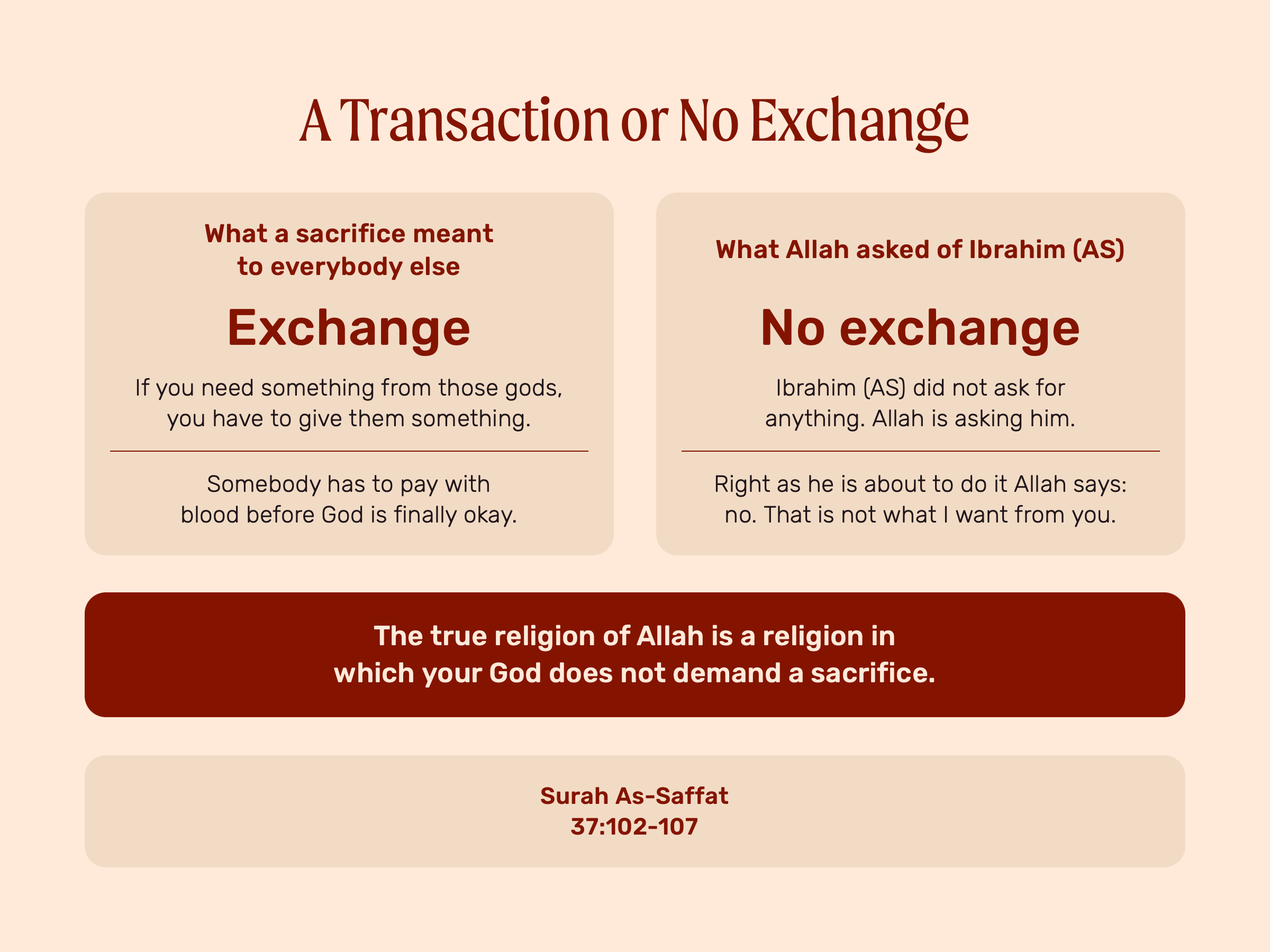
Yes, young man. They get angry very easily. Good. Then what? If you need something from them, you have to give them something. It is a transaction.
In many religions, this is exactly how it worked. They really want the rain to come and it is not coming. So they say, this god must be angry with us. We have to make him a sacrifice. He is not going to give us anything good unless we give him a painful one.
People did this. This is real. Human sacrifice happened all the time in these religions.
Somebody has to pay with blood before God is finally okay. God will not give you what you want until you pay with blood somehow.
Now. Was Ibrahim (AS) raised in one of these religions, with these sacrifices? He was. That was the normal all around him.
Later on, Allah told him: I want you to give me a sacrifice. What sacrifice do I want from you? Your son.
There is a difference here and I need you to understand it.
Nobody Was Asking Allah for Anything
In every other religion, when do you do a sacrifice? When you want something. You do a sacrifice when you want something.
Did Ibrahim (AS) ask for anything? He did not ask for anything. Allah is asking him. He is not asking Allah.
He never said, Allah, I want this or that and Allah said, fine, you want that, then sacrifice your son. There is no give me this and I will give you that.
In our religion it is not an exchange. We do not say, I will give Allah my salah and then Allah will give me a ninety-five on my biology test.
There is no exchange. Allah is not doing a sales deal with us. He makes a demand. He does not say, if you do this, I will give you that.
Is that clear? That is the first difference. Here is the second.
Everything in His Life Was a Demonstration
He goes to do the sacrifice. As he is about to do it, does Allah let it happen, or does Allah stop it?
Everything about the life of Ibrahim (AS) was about demonstration. Listen to that word. Demonstration.
When he was a kid and he said, this star must be God, this moon must be God, this sun must be God, what was that? A demonstration. When he broke all the idols and said the big one did it? A demonstration.
Allah wanted to show not only the Muslims, not only Ibrahim (AS), but every human being who will ever live in this world, that the true religion of Allah is a religion in which your God does not demand a sacrifice.
Even though you are willing to do it, because you think that is what Allah wants, right as he is about to do it Allah says: no. That is not what I want from you. Just slaughter any animal. That is okay.
What is the proof, then? Ibrahim (AS) will do anything for Allah. He will even sacrifice his own child for Allah.
But Allah is not asking him for that sacrifice. Allah is asking him for something much, much, much less. Ibrahim (AS) is willing to do much more and Allah wants to ask him for much less.
Allah was showing the world: Islam is not a religion that wants you to hurt yourself or anyone else you love. Islam is not a religion in which you have to go through pain before Allah is pleased with you.
That is not this religion. No more sacrifices to make a god happy. No more suffering to make a god happy.
Now Read the Passage and Tell Me Which Son
Now listen to the passage.
Falamma aslama wa tallahu lil-jabin (فَلَمَّآ أَسۡلَمَا وَتَلَّهُۥ لِلۡجَبِينِ). When they both surrendered and he laid him down on the rock.2
Wa nadaynahu an ya Ibrahim, qad saddaqta ar-ru’ya (وَنَٰدَيۡنَٰهُ أَن يَـٰٓإِبۡرَٰهِيمُ قَدۡ صَدَّقۡتَ ٱلرُّءۡيَآۚ). We called out to him: Ibrahim, you have now made the dream come true. That is enough. You do not need to do any more.
Inna kadhalika najzi al-muhsinin (إِنَّا كَذَٰلِكَ نَجۡزِي ٱلۡمُحۡسِنِينَ). This is how we reward those who do the best they can.3
Inna hadha lahuwa al-bala’u al-mubin (إِنَّ هَٰذَا لَهُوَ ٱلۡبَلَـٰٓؤُاْ ٱلۡمُبِينُ). This was the ultimate test.4
Wa fadaynahu bi-dhibhin ‘azim (وَفَدَيۡنَٰهُ بِذِبۡحٍ عَظِيمٖ). We replaced him with a great sacrifice.5
So we sacrifice a goat or a cow. Allah calls that great, because now we remember the original sacrifice at Hajj.
Wa tarakna ‘alayhi fi’l-akhirin (وَتَرَكۡنَا عَلَيۡهِ فِي ٱلۡأٓخِرِينَ). Salamun ‘ala Ibrahim (سَلَٰمٌ عَلَىٰٓ إِبۡرَٰهِيمَ). We left him as a legacy for those who came after. Peace be upon Ibrahim.6
Kadhalika najzi al-muhsinin (كَذَٰلِكَ نَجۡزِي ٱلۡمُحۡسِنِينَ). Innahu min ‘ibadina al-mu’minin (إِنَّهُۥ مِنۡ عِبَادِنَا ٱلۡمُؤۡمِنِينَ). Wa bashsharnahu bi-Ishaqa nabiyyan mina as-salihin (وَبَشَّرۡنَٰهُ بِإِسۡحَٰقَ نَبِيّٗا مِّنَ ٱلصَّـٰلِحِينَ). We gave him the good news of Ishaq.7
Allah did not name the son in the sacrifice passage. Then, after the whole thing is finished, Allah says he gave him the good news of Ishaq. Which means Isma’il was not the only child and the good news of the other one comes after.
So these ayat teach us which son it was without naming him. Which son was it? Isma’il (AS).
Where the Land and the Curse Came From
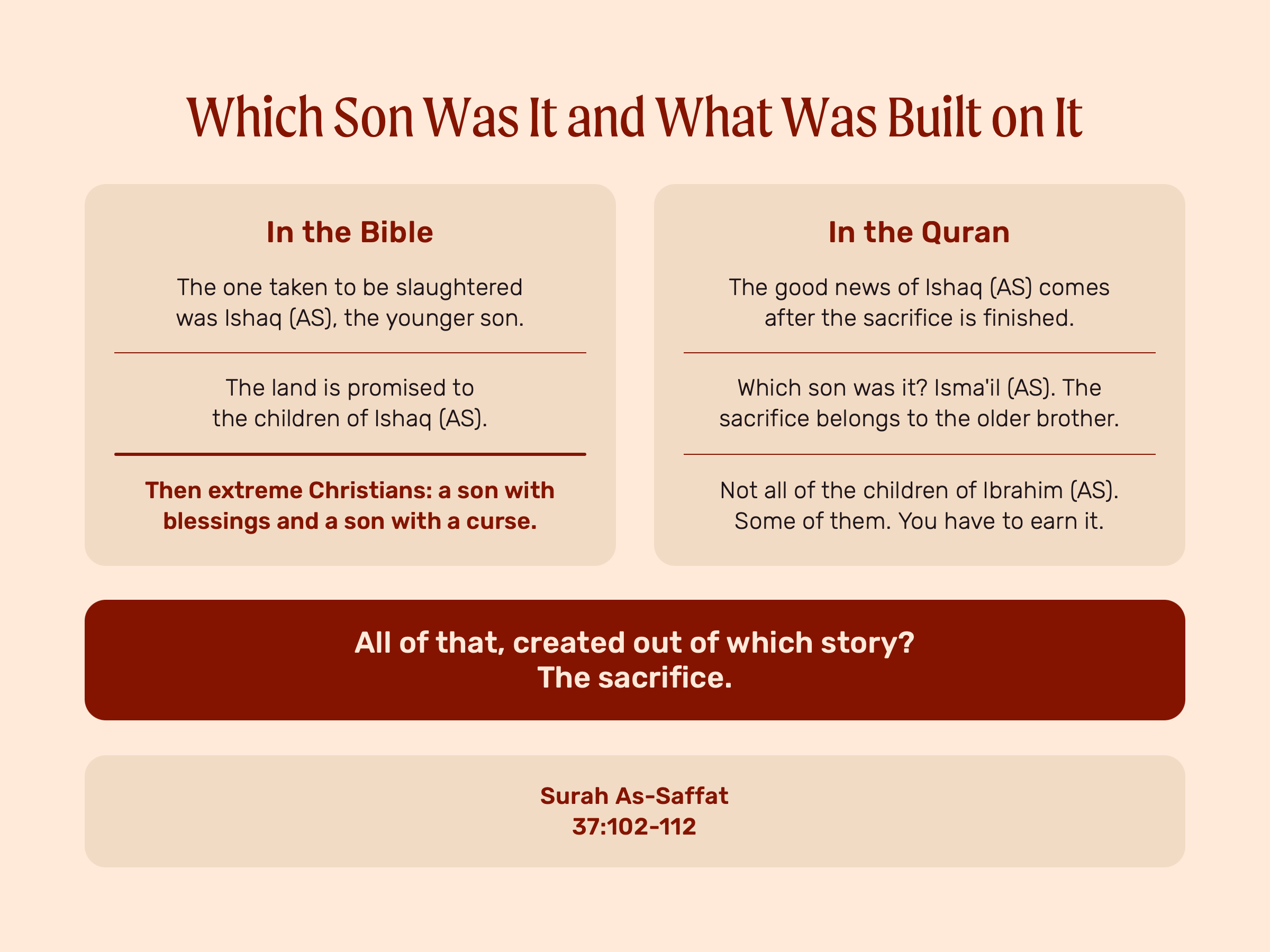
The Bible also tells us that Isma’il was the older son and Ishaq was the younger son. That part is the same. But the Bible, in many places, says the one who was taken to be slaughtered was not Isma’il. It was Ishaq.
Then, once Ishaq was taken and the slaughter did not happen, God was very happy with Abraham and said: now that I am so happy with you, because you passed this test, I am blessing your children through Ishaq. I am promising them this land. This land belongs to them because of this sacrifice. In other places it says that even if you mess up, even if you do messed up things, it is fine. The land still belongs to these children, because you made the sacrifice.
That is the promise given to the children of Ishaq. Who is not part of that promise? The children of Isma’il.
Then the Quran comes along and says, hold on a second. A sacrifice did happen. A son was going to be sacrificed. Which son was it?
Isma’il.
So the whole argument that you are special because of the sacrifice? The sacrifice belongs to the older brother.
Then extreme Christians came along, especially in America and made another story out of it. Ibrahim (AS) had two sons, they said. A son with blessings and a son with a curse. The son with the blessing is Ishaq. The son with the curse is Isma’il. Since the Prophet Muhammad ﷺ is from the children of Isma’il, he is from the cursed children, so that is a cursed religion. Which one is the blessed religion? Christianity.
All of that, created out of which story? The sacrifice.
I need you to understand why they hold the views they hold. Where did that come from? How can we have a conversation with them based on reason, not feelings?
That is the way of Ibrahim (AS). Let us talk based on reason, not feelings.
Nobody Inherits the Blessing
Now Allah makes him a promise. Allah promised to make him a leader.
What was he told in the Bible? All of your children are blessed. In the Quran? Not all of your children. Some of them.
So do they get to be blessed just because they are children of Isma’il or Ishaq? What makes them blessed?
You have to do something to earn it. They do not just become automatic leaders. You have to believe and do good deeds to earn it. That is the only way you can be from the blessed children in the line of Ibrahim (AS).
Do you see now why understanding the sacrifice is such a big deal?
This episode sits in a ten-part series on Ibrahim (AS) delivered over Dhul Hijjah. Study What Everyone Should Know About Abraham with Ustadh Nouman Ali Khan on Bayyinah TV
Notes
This post is adapted from the eighth session of What Everyone Should Know About Abraham on Bayyinah TV and is written in the voice of that session. Every teaching claim, example and aside in it is taken from the session itself.
[1] Al-Quran, Surah As-Saffat, 37:102, https://quran.com/37/102
[2] Al-Quran, Surah As-Saffat, 37:103, https://quran.com/37/103
[3] Al-Quran, Surah As-Saffat, 37:104-105, https://quran.com/37/104-105
[4] Al-Quran, Surah As-Saffat, 37:106, https://quran.com/37/106
[5] Al-Quran, Surah As-Saffat, 37:107, https://quran.com/37/107
[6] Al-Quran, Surah As-Saffat, 37:108-109, https://quran.com/37/108-109
[7] Al-Quran, Surah As-Saffat, 37:110-112, https://quran.com/37/110-112

At Bayyinah, we are dedicated to helping you connect directly with the words of Allah beyond translation. Founded by Ustadh Nouman Ali Khan, our mission is to create transformative experiences that deepen your understanding and engagement with the Quran.
Study the Quran and Arabic in a systematic and personalized way through Bayyinah TV. Get started today for free.
Check out our newest articles, fresh off the press and ready for you to dive into!