Successful subscription! Thank you for subscribing.
Successful subscription! Thank you for subscribing.

October 13, 2026
I want to share with you two easy examples of the development of arguments in the sequence of surahs.
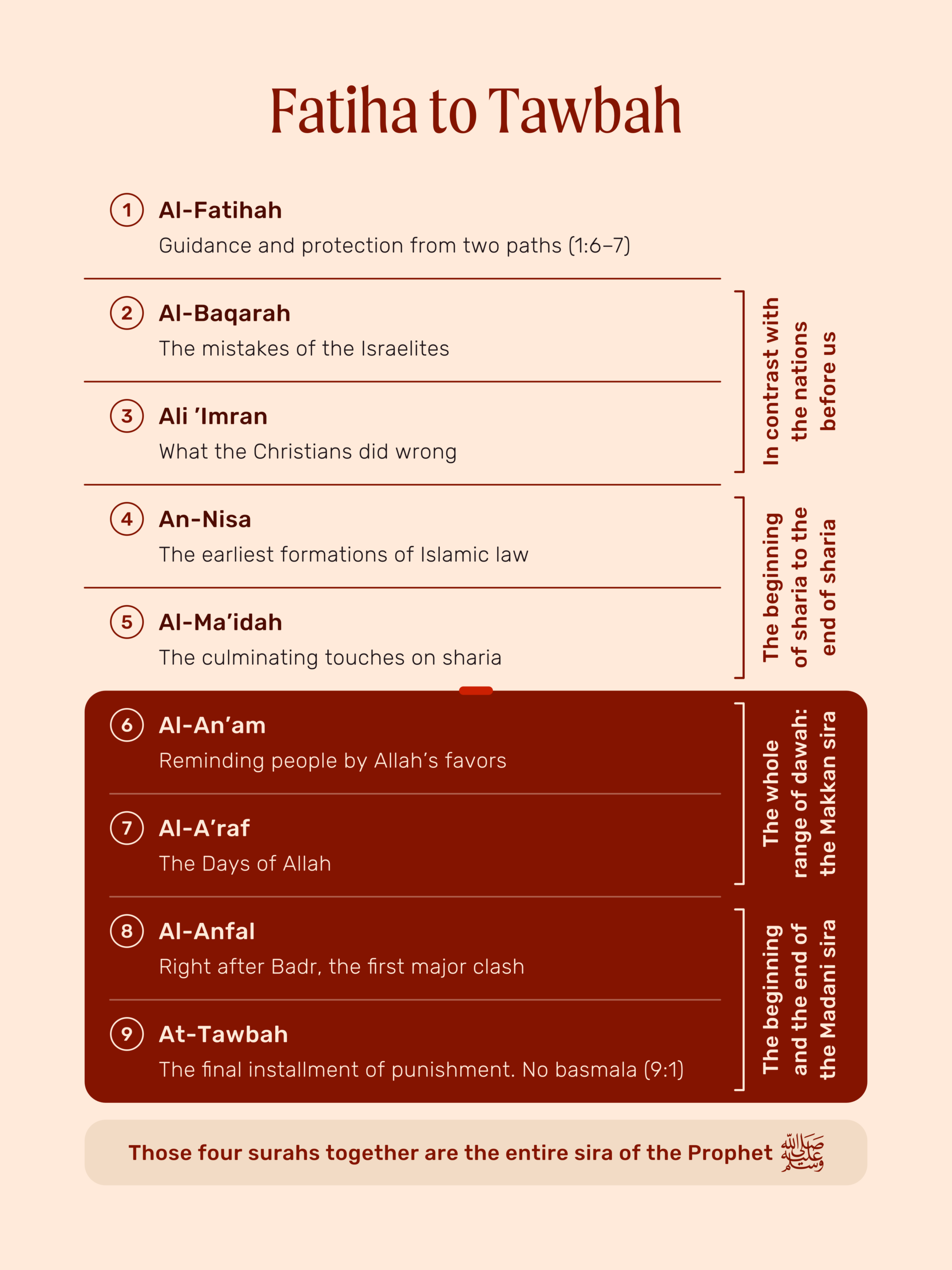
The easiest place to start is the front of the book. Surah number one to surah number nine. Fatiha to Tawbah.
Fatiha Asks and Baqarah and Ali ‘Imran Answer
In Fatiha we ask Allah for guidance. We ask to be shown the straight path. Then we ask for protection from two specific paths: the path of those who have earned Allah’s anger and the path of those who are lost.1
Hold on to those two, because they are exactly the sentiments captured in Baqarah and Ali ‘Imran.
The straight path is highlighted in both of them. But in one it is highlighted at the expense of something else. It is made very clear what the path of al-maghdubi alayhim (ٱلۡمَغۡضُوبِ عَلَيۡهِمۡ) was, so that if you are on it, you can recognize you are on it. That was the Israelites and their mistakes. On the other hand, there is an exhaustive discourse on what the Christians did wrong and that is Surat Ali ‘Imran.
So we take what was discussed in Fatiha and then guidance is elaborated in contrast with the mistakes of the nations that came before us. From the very beginning it is clear. Ihdina as-sirat al-mustaqim (ٱهۡدِنَا ٱلصِّرَٰطَ ٱلۡمُسۡتَقِيمَ).1 Then, dhalikaal-kitabu la rayba fihi hudan (ذَٰلِكَ ٱلۡكِتَٰبُ لَا رَيۡبَۛ فِيهِۛ هُدٗى).2 Ihdina. Hudan.
Now the path has been made clear, so it is time for the ummah to start organizing itself. So what happens down in Surat an-Nisa? Essentially the earliest formations of Islamic law. Inheritance law. Dealing with the hypocrites. Organizing Muslim society. Marriage, who you are allowed to marry, who you are not.
Call it the early phase of sharia, building up from what was started in Baqarah.
Then come the culminating touches and that is Surat al-Ma’idah. What needs to be finished off as far as sharia is concerned and then preaching the message of Islam to both the Jewish and the Christian communities.
So it is the beginning of sharia to the end of sharia. The earliest of the discourse is in Baqarah, the last of it in Ma’idah.
Dawah Is Two Things, So It Takes Two Surahs
From there you jump out of the Madani Quran and into the Makki. Two surahs together, Surat al-An’am and Surat al-A’raf.
Surat al-An’am is focused entirely on the arguments for Allah Himself. Why should you believe in one God and one God alone? What should compel you to be grateful to that God? Shah Waliullah Dehlawi rahimahullah called this tadhkir bi ala’ Allah. Reminding people by Allah’s favors.
That is one kind of dawah. Because dawah is two things. It is tabshir and inzar. It is a kind of positive reinforcement: here are all the reasons you should worship God.
Now contrast that with Surat al-A’raf and you find a huge emphasis on ayyam Allah. Wa dhakkirhum bi ayyam Allah (وَذَكِّرۡهُم بِأَيَّىٰمِ ٱللَّهِۚ).3 Remind them by the Days of Allah.
What are the Days of Allah? These are remarkable moments in history from which we learn many, many lessons. It starts with the story of Adam (AS). Exhaustive lessons from the accounts of Musa (AS). Perished nations, warnings from the mistakes of the past.
So the entire range of what it means to do dawah is completed between An’am and A’raf, six and seven, from the positive to the negative. Which means these two surahs are also a summary of the entire Makkan sira of the Prophet ﷺ. His struggle in Makkah is dawah.
Anfal and Tawbah Are the Two Ends of Madinah
While An’am and A’raf are a summary of the Makkan sira, Anfal and Tawbah are the beginning and the end of the Madani sira. Anfal deals with what happened right after Badr, the first major clash against the disbelievers.
When the doors of dawah were closed, the doors of jihad opened up. The first time they opened, Surat al-Anfal.
That is paired with the last time we clashed with the Quraysh, which is when we have completely taken over them. Makkah has been conquered and the announcement has been made: you have four months to think about Islam or leave.
You know how they say there are clouds before the storm? This is true of the punishment of Allah also. Wa la nudhiqannahum min al-adhab al-adna duna al-adhab al-akbar (وَلَنُذِيقَنَّهُم مِّنَ ٱلۡعَذَابِ ٱلۡأَدۡنَىٰ دُونَ ٱلۡعَذَابِ ٱلۡأَكۡبَرِ).4 We will make them taste the smallest punishment before the biggest one.
While the Prophet ﷺ was in Makkah, only dawah was going on. Once he leaves, it is time for them to start tasting, little by little, what it means to experience divine punishment. The first installment against the Quraysh was Badr. Which surah captures that? Anfal.
There were multiple installments after that. But the final installment is which one? Surat at-Tawbah. It is so final in its nature as punishment that there is not even a basmala at the beginning of it. Bara’atun min Allahi wa rasulih (بَرَآءَةٞ مِّنَ ٱللَّهِ وَرَسُولِهِۦٓ).5 Allah and His Messenger have nothing to do with you.
An’am, A’raf, Anfal, Tawbah. Those four surahs together are the entire sira of the Prophet ﷺ, the whole lifespan, in a nutshell.
Start With the Du’aa of Ibrahim
That was the first example. Now I will take you briefly to the last ten surahs of the Quran.
We are going to start with Fil. You just have to understand the prayer of Ibrahim (AS).
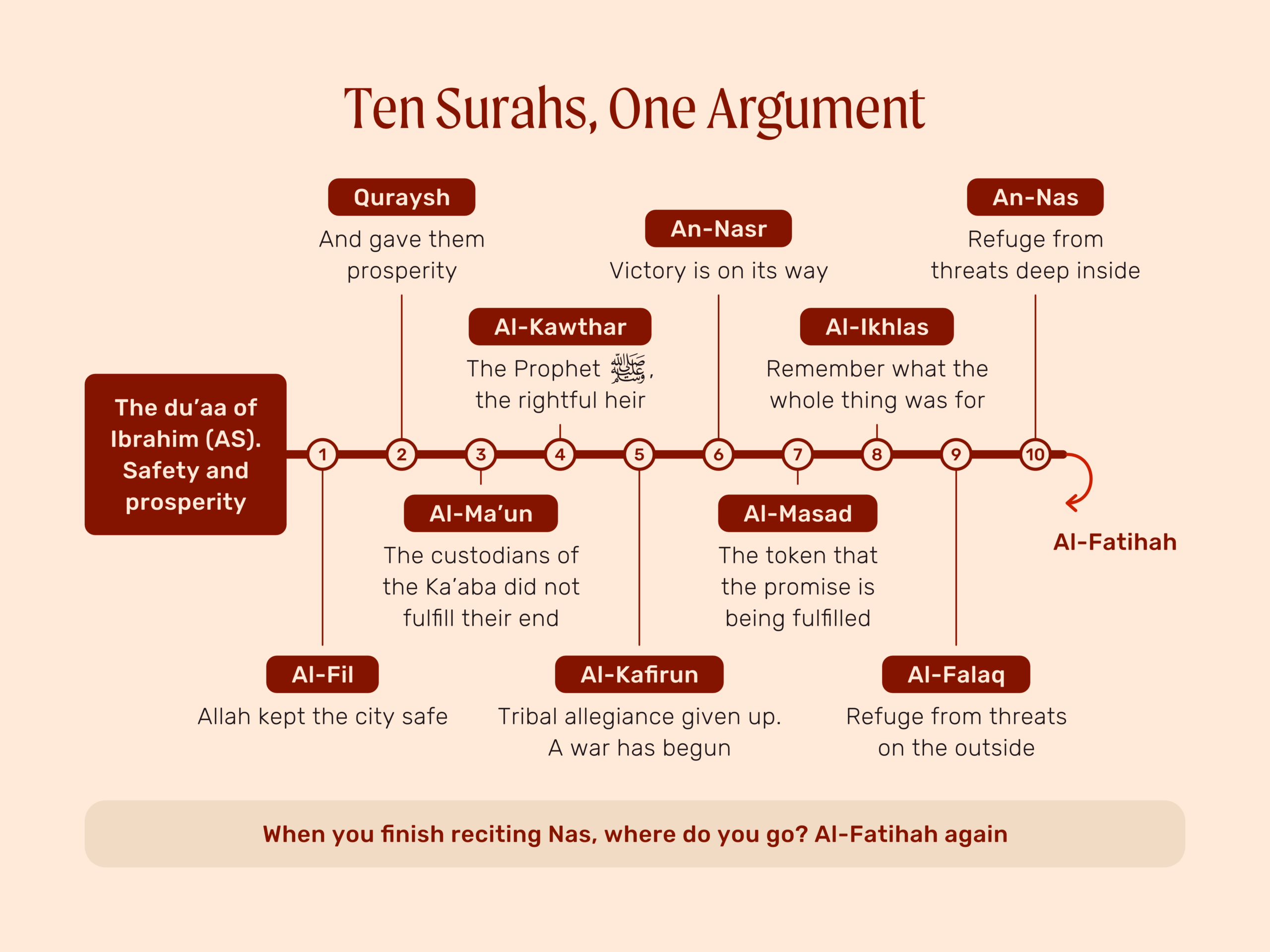
Ibrahim (AS) made a du’a for Makkah, that it should be safe and given all kinds of fruit and that all of this should be provided to the believing offspring of Ibrahim. Safety and prosperity.
Surat al-Fil shows that Allah fulfilled the promise, because He kept the city safe. Surat Quraysh fulfills the promise, because Allah ensured they have what? Prosperity. Rihlata ash-shita’i wa as-sayf (رِحۡلَةَ ٱلشِّتَآءِ وَٱلصَّيۡفِ).6
Now Surat al-Ma’un says something else. Even though Allah fulfilled His end of the promise, the children of Ibrahim (AS) currently in charge of the Ka’aba did not fulfill their end. They are pushing the orphan around, calling the religion a lie, showing off in their prayer.7 They are not worthy of the gifts that came from that du’aa.
But if they are not the qualified ones, then the question arises. Who is the qualified one?
That question is answered in Surat al-Kawthar. Inna a’taynaka al-kawthar (إِنَّآ أَعۡطَيۡنَٰكَ ٱلۡكَوۡثَرَ).8 Clearly the Prophet ﷺ is supposed to be the custodian of the Ka’aba, the rightful heir to the House of Allah his father Ibrahim (AS) prayed for. Why? Because he is going to restore the legacy of Ibrahim (AS). Fa salli li rabbika wanhar (فَصَلِّ لِرَبِّكَ وَٱنۡحَرۡ).9 Prayer and sacrifice.
Kafirun Is Giving Up Your Citizenship
Now notice they are all in the same city. Allah is saying one is worthy and the other is not worthy. A clash has been created between the two and it gets spelled out in the next surah. Qul ya ayyuha al-kafirun (قُلۡ يَـٰٓأَيُّهَا ٱلۡكَٰفِرُونَ).10
You are no longer my people. You are no longer my tribe. I no longer have allegiance to you. Lakum dinukum wa liya din (لَكُمۡ دِينُكُمۡ وَلِيَ دِينِ).11 Even though we are at the same Ka’aba, the same house of worship, no, we do not share the same religion.
This is basically forgoing tribal allegiance. Essentially citizenship. When you let that go, you are an enemy to the tribe you lived in, because the only thing that keeps you safe is loyalty to your tribe. When that has happened, basically a war has begun.
Victory Is Coming and Here Is Your Token
When there is a war, somebody will win and somebody will lose. So the news comes.
Idha ja’a nasru Allahi wal fath (إِذَا جَآءَ نَصۡرُ ٱللَّهِ وَٱلۡفَتۡحُ).12 The aid of Allah and victory are on their way. Wa ra’ayta an-nasa yadkhuluna fi dini Allahi afwaja (وَرَأَيۡتَ ٱلنَّاسَ يَدۡخُلُونَ فِي دِينِ ٱللَّهِ أَفۡوَاجٗا).13 People coming into the religion in huge, huge numbers.
Now, that is in the future. Right now the Muslims are being beat up. A small token of victory is a sign that the major victory is on its way.
Allah has promised the Prophet ﷺ that people are coming into the religion and victory is coming, but it is nowhere to be seen. So Allah guarantees him this. One of the worst people giving you trouble, I will get rid of him for you as a sign that the major victory is coming. What is the next surah? It is that token. Tabbat yada abi lahabin wa tabb (تَبَّتۡ يَدَآ أَبِي لَهَبٖ وَتَبَّ).14
That enemy, his destruction would mark: yes, Allah’s promise is being fulfilled.
You Forget What You Were Fighting For
Now the promise of victory is there and a small guarantee of it is there too. When you are working on a project or a mission for years and years, you know what happens over time? You forget why you were doing it to begin with.
A few brothers got together and wanted to start a masjid. They rented a storefront next to a 7-Eleven and they are praying Fajr there. Eventually they acquire some patch of land. They use up all their savings, they sell their homes to build this masjid.
Once it is a big Islamic center with a nice parking lot and a chandelier, then board member fights begin. About whose name is going to be announced. About who gets the mic after Jumu’ah, because that is really important.
Is it possible that when you are struggling for a long time, your intentions can become rusty?
So once victory is guaranteed, it was essential to remind everyone what this was all about. This was about the legacy of Ibrahim (AS), for which he built the Ka’aba. The reason he built it is that only One God should be worshiped.
Which is why at the end of this whole thing you go back to the most fundamental truth. Qul huwa Allahu ahad (قُلۡ هُوَ ٱللَّهُ أَحَدٌ).15 The ultimate prize is ikhlas. Our sincere, devoted worship of Allah.
It is called Ikhlas without the word ikhlas being in it. So why are the Sahaba calling this one Ikhlas? Because it purifies their intentions for what this entire mission was.
You Won the Prize. Now Protect It.
You can gain the victory and gain this prize. But unlike any other prize, this one has to be protected at all times.
There are threats on the outside that can destroy your faith. Seek Allah’s refuge from them. Qul a’udhu bi rabbil falaq (قُلۡ أَعُوذُ بِرَبِّ ٱلۡفَلَقِ).16
But there is another set and they exist where? Deep inside. Qul a’udhu bi rabbin-nas (قُلۡ أَعُوذُ بِرَبِّ ٱلنَّاسِ).17 People who make it all the way inside your chest and whisper to you and that can destroy that ikhlas that is so precious.
When You Finish an-Nas, Where Do You Go?
When you finish reciting Nas, where do you go? Fatiha again.
There is a direct correlation between Surat an-Nas and Surat al-Fatihah. Fatihah begins with al-hamdu lillahi rabbil alamin (ٱلۡحَمۡدُ لِلَّهِ رَبِّ ٱلۡعَٰلَمِينَ).18 A parallel word to al-alamin is what? An-nas.
There you had two societal tendencies that will corrupt your faith, al-maghdubi alayhim (ٱلۡمَغۡضُوبِ عَلَيۡهِمۡ) and ad-dallin. Here there are also two evil tendencies, but they are not external. They are internal.
What This Whole Effort Is Actually For
At the end of the day I go back to what Hameeduddin Farahi said about this effort to begin with. It is not about pulling out some interesting fun nuances in the Quran. The goal of this entire effort is to do tadabbur into the Quran.
May Allah azza wa jall make us all people of tadabbur into the Quran. May Allah azza wa jall accept the time we spend learning His book as an act of ibada.
This is the last of twenty sessions and the nineteen before it build the method that makes this visible. Study Heavenly Order with Ustadh Nouman Ali Khan on Bayyinah TV: Bayyinah TV
Notes
This post is adapted from the closing session of Heavenly Order on Bayyinah TV and is written in the voice of that session. Every teaching claim, example and aside in it is taken from the session itself.
[1] Al-Quran, Surah Al-Fatihah, 1:6-7, https://quran.com/1/6-7
[2] Al-Quran, Surah Al-Baqarah, 2:2, https://quran.com/2/2
[3] Al-Quran, Surah Ibrahim, 14:5, https://quran.com/14/5
[4] Al-Quran, Surah As-Sajdah, 32:21, https://quran.com/32/21
[5] Al-Quran, Surah At-Tawbah, 9:1, https://quran.com/9/1
[6] Al-Quran, Surah Quraysh, 106:2, https://quran.com/106/2
[7] Al-Quran, Surah Al-Ma’un, 107:1-6, https://quran.com/107/1-6
[8] Al-Quran, Surah Al-Kawthar, 108:1, https://quran.com/108/1
[9] Al-Quran, Surah Al-Kawthar, 108:2, https://quran.com/108/2
[10] Al-Quran, Surah Al-Kafirun, 109:1-6, https://quran.com/109
[11] Al-Quran, Surah Al-Kafirun, 109:6, https://quran.com/109/6
[12] Al-Quran, Surah An-Nasr, 110:1, https://quran.com/110/1
[13] Al-Quran, Surah An-Nasr, 110:2, https://quran.com/110/2
[14] Al-Quran, Surah Al-Masad, 111:1, https://quran.com/111/1
[15] Al-Quran, Surah Al-Ikhlas, 112:1, https://quran.com/112/1
[16] Al-Quran, Surah Al-Falaq, 113:1, https://quran.com/113/1
[17] Al-Quran, Surah An-Nas, 114:1, https://quran.com/114/1
[18] Al-Quran, Surah Al-Fatihah, 1:2, https://quran.com/1/2

At Bayyinah, we are dedicated to helping you connect directly with the words of Allah beyond translation. Founded by Ustadh Nouman Ali Khan, our mission is to create transformative experiences that deepen your understanding and engagement with the Quran.
Study the Quran and Arabic in a systematic and personalized way through Bayyinah TV. Get started today for free.
Check out our newest articles, fresh off the press and ready for you to dive into!