
Successful subscription! Thank you for subscribing.
Successful subscription! Thank you for subscribing.

October 13, 2026
Let me be honest before I start anything. I am pretty intimidated by the subject I am about to cover.
It is something I have been in love with for a long time. Research, study, notes, years of thoughts about it. This is the first attempt I am making to organize all of that and present it comprehensively. So I ask Allah to make the task easy for me and to make it beneficial in your understanding of the Quran.
I am not claiming that what I am about to present is the absolute correct opinion or the ultimate truth of the subject. It is the best that I have been able to understand it.
Now. I have been trying to tackle the order and the organization and the coherence of the Quran since I began studying it. It is actually the first thing I found confusing when I read it in translation. It is not organized in any way I could make sense of compared to any other book.
Because books have logical progression. You study something in chapter one, you build on it in chapter two, you build on that in chapter three.
It does not work that way in the Quran.
Similarly, if books contain history, the history is usually chronological. But in Surat al-Baqarah, the history of the Israelites is not in chronological order at all. Things that happened much later are mentioned sooner and things that happened sooner are mentioned much later.
So there I am, an early beginning student of the Quran, trying to make sense of this.
Four Ways It Could Have Been Arranged and It Is None of Them
Let me take you through the conclusions I came to, one at a time.
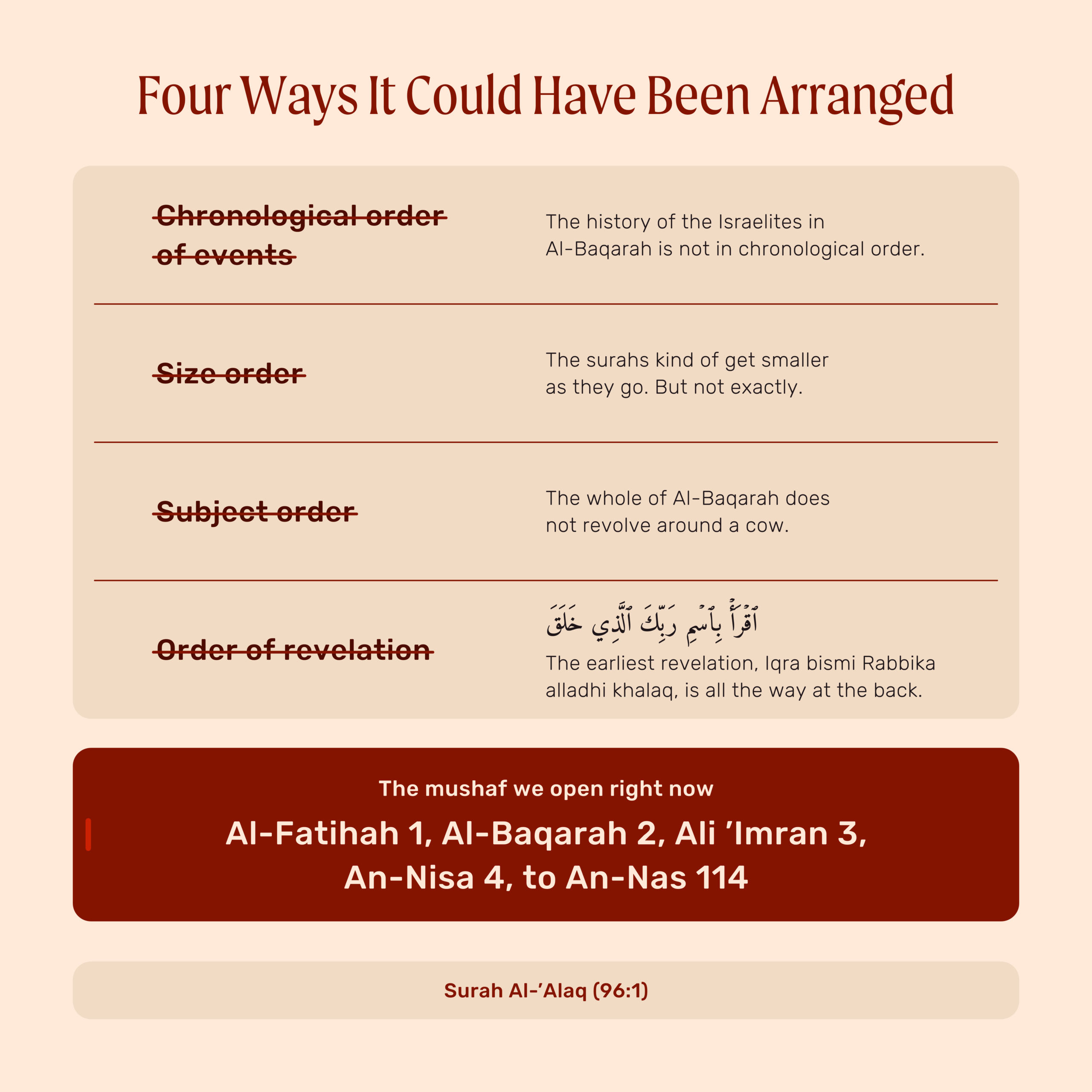
It is not in chronological order.
It is not in size order either. It seems somewhat size order. Al-Baqarah is the biggest surah and they kind of get smaller as they go. But not exactly.
It is definitely not in subject order. Even the titles do not give it away. The surah is famously called Al-Baqarah and yet the whole thing does not revolve around a cow. That is one of many things talked about in there.
It is certainly not in the order of revelation. The earliest revelations given to the Prophet ﷺ were the shortest surahs and the last two juz of the mushaf are basically those short Makki surahs from the earliest time. Yet the earliest of all revelations, Iqra bismi Rabbika alladhi khalaq (ٱقۡرَأۡ بِٱسۡمِ رَبِّكَ ٱلَّذِي خَلَقَ),1 is all the way at the back.
The mushaf we open right now runs Al-Fatihah as one, Al-Baqarah as two, Ali ‘Imran as three, An-Nisa as four, all the way to An-Nas as a hundred and fourteen. That is not the way it was coming down over those twenty-three years.
So the question arises. What is the organization of the Quran and does that even matter?
Four Arguments and I Am Opening With My Weakest
My goal is to share with you why I personally believe the order of the Quran is decided by Allah down to every ayah. Meaning the ayat of Al-Fatihah are in this order because Allah wants them to be.
That part is agreed upon. The sequence of the ayat inside a surah, everybody agrees. The question is the sequence of the surahs themselves.
I hold the view about those too. Al-Fatihah first, Al-Baqarah second, Ali ‘Imran third, An-Nisa fourth. I find it far more convincing that that is the way Allah intends it, by design, revealed to the Prophet ﷺ.
There are counter-arguments to my position and I am going to start with those. The whole thing breaks into four parts.
Part one is the historical argument.
Part two is textual. Are there ayat in the Quran itself that say the Quran’s order should be minded?
Part three is spiritual. It sounds weird. That is okay. When we get to it you will see.
Part four is case studies. Example after example after example, until it starts dawning on you that this organization is way too sophisticated to be the product of the human mind.
The weakest of my arguments are the historical ones. That is where I am starting. As they progress from historical to textual, I become more convinced. From textual to spiritual, I am really convinced. From spiritual to case studies, I am like subhanAllah, okay, I am done, I am finished, heavenly order, I am good.
So we are starting from where there is room for debate, as far as my mind is concerned.
Some of the Companions Had Their Own Copies
There is record that different companions had their own personal written copies of the Quran and different ones were in different orders.
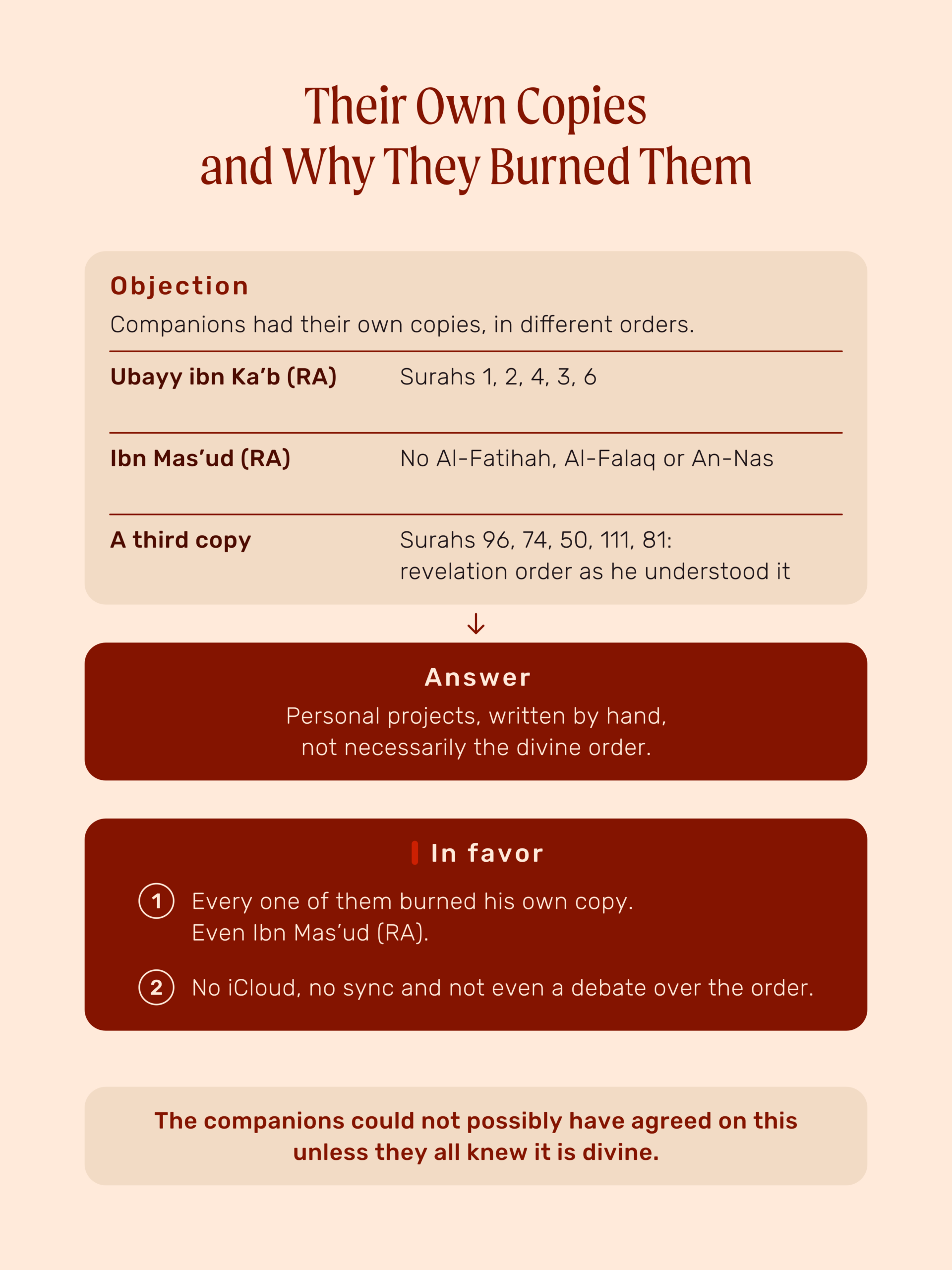
There is a copy written by Ubayy ibn Ka’b (RA). Let me give you his sequence by name and then by our numbers. Al-Fatihah, Al-Baqarah, An-Nisa, Ali ‘Imran, Al-An’am. According to the order we have now, that is one, two, four, three, six. Instead of one, two, three, four, five, six.
Is that a different order? That is very different.
Go to another companion. Ibn Mas’ud (RA). His Quran begins with Al-Baqarah. There is no Al-Fatihah in his written copy at all. Right after Al-Baqarah, what is there? An-Nisa, the fourth surah. Then Ali ‘Imran.
How many surahs in the Quran? A hundred and fourteen. He has a hundred and thirteen already, because he does not write in Al-Fatihah. Then Al-Falaq and An-Nas are not in his mushaf either. So he has three surahs out.
Then there is a third copy. The first surah in it is ninety-six, Iqra bismi Rabbika alladhi khalaq (ٱقۡرَأۡ بِٱسۡمِ رَبِّكَ ٱلَّذِي خَلَقَ). The second is seventy-four, Al-Muddaththir. The third is Qaf, which is fifty. Then a hundred and eleven, then eighty-one and so on. He organized it the way he understood the revelation order to be.
Read those three and you can immediately see how a view forms that says the reason we have the Quran in this order is that the companions got together and decided it. Anyone know the Arabic term for that? Ijma’ as-sahabah. Consensus of the companions. Not revelation, not the wisdom of Allah, just a decision by a group of people.
There Was No Word Document. There Was No Staples.
One response is that the companions compiling the Quran and writing it out may very well not have been aware of the final order as it is supposed to be.
It is not like they had a Word document, guys. It is not like when they had the file and the Prophet ﷺ finally said this one should be here and that one should be there, they could just cut, insert page, paste. They cannot do that. It is written by hand.
It is not like they could go get new paper from Staples or OfficeMax either. Paper is close to impossible to get. Writing is an exhaustive process.
You understand what that means? Once they have it, they have it. That is all they have.
So the fact that a man has it in whatever order he was able to get it is not necessarily because that is how he understood the divine order to be. These are personal projects. They are gathering whatever they can of the Quran and keeping it for themselves, not because they believe this is the order in which Allah wants it.
Then Every One of Them Burned His Own Copy
Let me switch gears and talk about what is in favor historically.
If the order of the Quran according to Allah is a different one, then when Uthman (RA) puts it in this order, is that a small issue or a big issue?
To the sahabah, that is a major issue.
These are people who do not do a single thing they are not sure about. If it has to do with Islam, they want to know it is actually from Allah, actually from the Prophet ﷺ and not something you came up with.
So much so that Abu Bakr as-Siddiq (RA) was nervous about writing anything of the Quran down, because the book form was not there in the time of the Prophet ﷺ. Even though the huffadh were being killed. Even though there was a necessity to preserve it. He is still not willing. Why? Because they are too careful about anything to do with the Quran.
That is the level of sensitivity here.
Now. Nobody raised an issue when the Quran was organized in this way. Nobody said this is wrong.
The ones who had their own sequences? They all burned their copies. Willingly. The one who showed some reluctance, who wanted to hold on to his, was Ibn Mas’ud (RA). Even he burned it.
If he believed his own arrangement to be from Allah himself, would he burn his own copy?
Nope.
They could not possibly have agreed on this unless they all knew it is divine.
There Was No iCloud. There Was No Sync.
Here is the other thing and I need you to understand this one properly.
There are a hundred and fourteen surahs. How many different sequences is that? A hundred and fourteen, times a hundred and thirteen, times a hundred and twelve. You see what I am doing?
If you have ten thousand to a hundred thousand companions, all at different levels of knowledge, is it possible there are a hundred thousand variations?
Is this originally a written record or a memorized record? Are these people on WhatsApp groups? Text messaging? Do they have a synchronized iCloud document of the Quran they are all referring to?
Where is the Quran as far as these people are concerned? It is in their hearts. Human memory can fail. Yes or no? Somebody could become unsure whether this surah was first or that one later. Yes or no?
Are they in constant daily communication? No. Some are days of travel away, somebody could be months away, they are all over the place, the Quran is spreading and spreading. Without an iCloud. Without a sync. Without a server you can go back and refer to, without a quran.com, without nothing.
The only hard drive that contains the Quran is the soft hearts. That is all.
If an oral tradition spreads like that, is it not logical to say there are hundreds of thousands of variations possible? So how many are actually on record? Only the ones that were written down. Within one generation there should have been a disagreement. Was this surah after that one or before it?
The fact that you do not find that. The fact that you do not even have a debate.
The sahabah are not debating this for the same reason you do not find them debating how come there are three raka’at in Maghrib. These are people who want everything about their religion clear, who ask about everything. Why do you not find them asking about certain things?
Because those things are clear as day from the time of the Prophet ﷺ. Everybody is on the same page that it is from Allah.
So the fact that only a few exceptions are found is itself an overwhelming proof. If you think there is debate over hadith, there should be a million times more debate over every surah of the Quran. The fact that it does not exist becomes, in itself, a proof.
This is how the ijma’ of the companions was formed. Yes, they agreed the Quran should be in this order. They only agreed because they were all clear that it is heavenly order. Otherwise that could not have happened.
This is the first of twenty sessions and the textual, spiritual and case-study arguments follow. Study Heavenly Order with Ustadh Nouman Ali Khan on Bayyinah TV: Bayyinah TV
Notes
This post is adapted from session one of Heavenly Order on Bayyinah TV and is written in the voice of that session. Every teaching claim, example and aside in it is taken from the session itself.
[1] Al-Quran, Surah Al-‘Alaq, 96:1, https://quran.com/96/1

At Bayyinah, we are dedicated to helping you connect directly with the words of Allah beyond translation. Founded by Ustadh Nouman Ali Khan, our mission is to create transformative experiences that deepen your understanding and engagement with the Quran.
Study the Quran and Arabic in a systematic and personalized way through Bayyinah TV. Get started today for free.