
Successful subscription! Thank you for subscribing.
Successful subscription! Thank you for subscribing.

October 13, 2026
Somebody said to me, you know, I have been noticing the Quran repeats itself over and over. I have been doing a lot more memorization lately and I noticed this pattern. Do you know why?
Yeah. A lot of people get confused about how the Quran repeats itself. Sometimes the identical phrase is used and sometimes it is the phrase with just a small amount of difference between one and the other. People have trouble with that.
But this to me is actually one of the great linguistic marvels of the Quran. These small distinctions, placed in completely different contexts. Two things that are similar and only differentiated with a very, very subtle distinction and that subtlety is where the juice lies.
So let us explore that today.
Surah Forty-One and Surah Seven, Same Opening
Surah Fussilat, this is number forty-one1. We are going to compare an ayah from it to Surah Al-A’raf, which is surah number seven2 .
Both of them begin exactly the same way.
Let me tell you what that means. If and when, if at all, there is a poke at you from the Shaytan of any kind. If the devil pokes at you, whispers to you, tempts you, gets you to do something, suggests something to you in any way, shape or form, fasta’idh billah (فَٱسۡتَعِذۡ بِٱللَّهِۚ), then seek refuge of Allah.
That is identical in both ayat. If the devil is bothering you, seek refuge of Allah. Fine.
Now Listen to the Two Endings
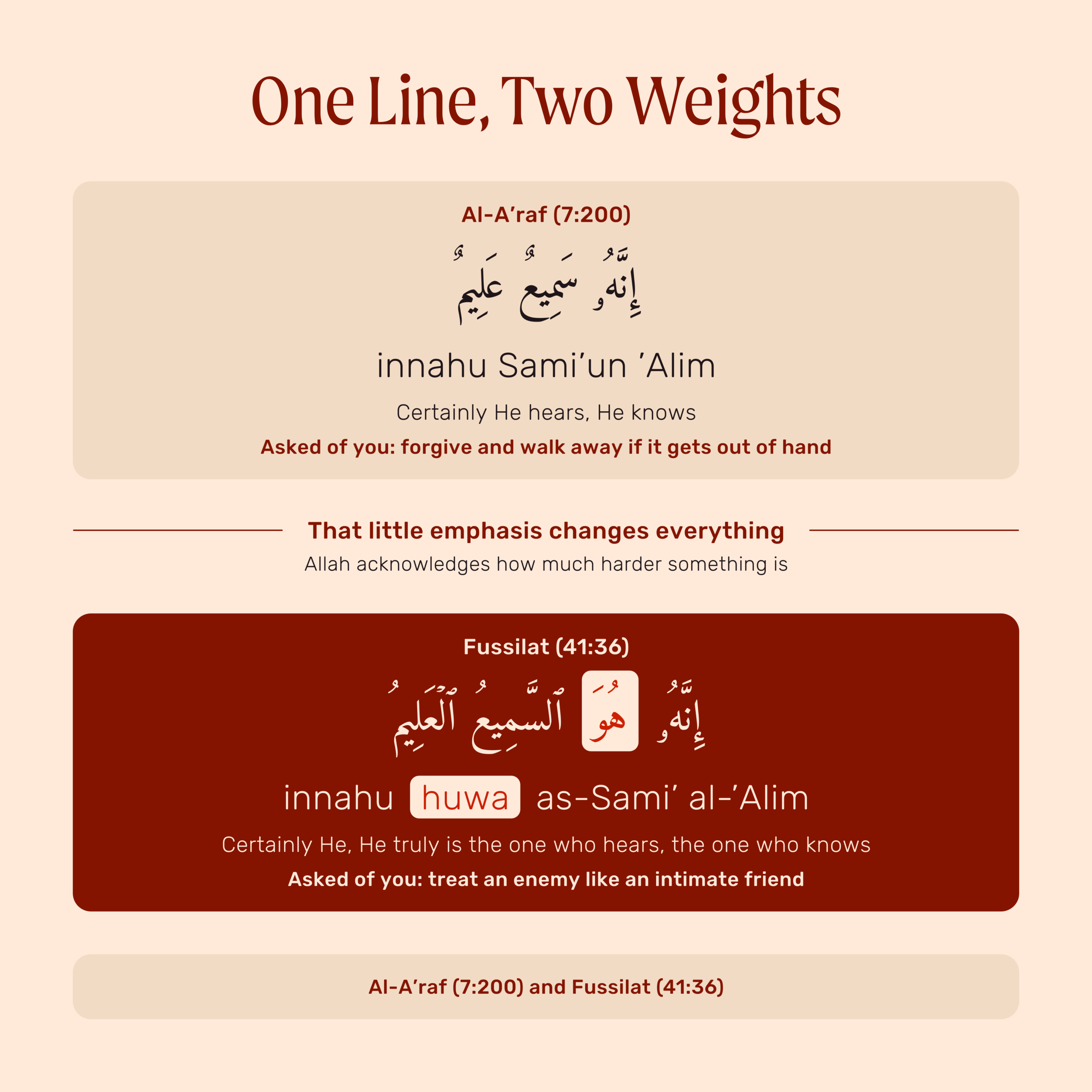
In Fussilat, the ayah ends innahu huwa as-Sami’ al-‘Alim (إِنَّهُۥ هُوَ ٱلسَّمِيعُ ٱلۡعَلِيمُ). Certainly he, he truly is the one who hears, the one who knows.
In Surat Al-A’raf, it ends innahu Sami’un ‘Alim (إِنَّهُۥ سَمِيعٌ عَلِيمٌ). Certainly he is hearing, knowing.
Let me compare the ending again. Certainly he is truly the one, the hearing one, the knowing one. There is an emphatic nature there. The other one, innahu Sami’un ‘Alim (إِنَّهُۥ سَمِيعٌ عَلِيمٌ), certainly he hears, he knows.
So in other words, in one case it is almost as though Allah is telling me that I need to remember more that he hears and more that he knows. He is emphasizing it even more. I better not lose consciousness of the fact that he is hearing and knowing in one of these ayat. In the other one I should be aware of it, but not nearly as intensely.
So what makes them different?
Let Me Start With the Less Emphatic One
I will start with Al-A’raf, the less emphatic one.
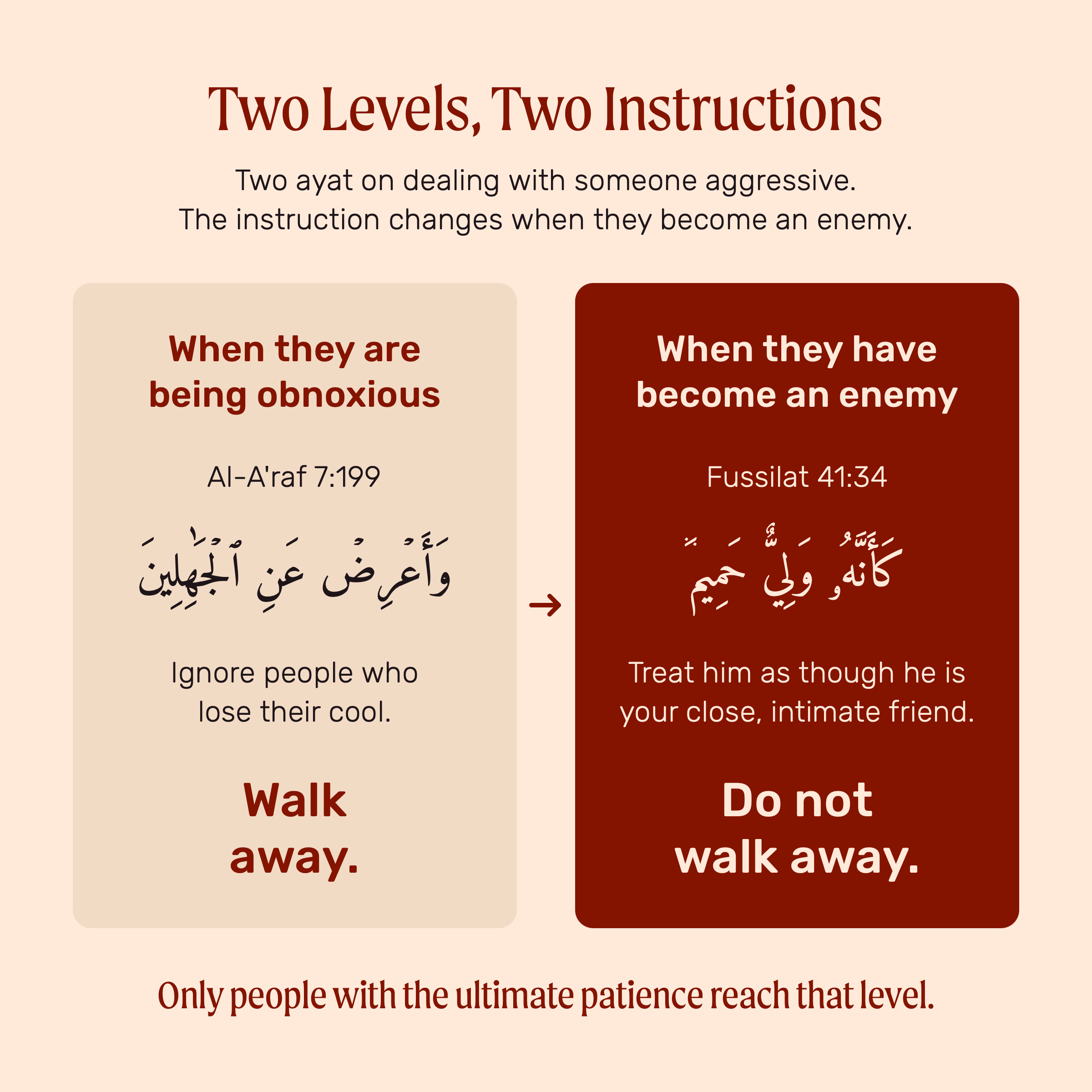
Right before the Al-A’raf ayah, he says khudhil-‘afwa wa’mur bil-‘urfi wa a’rid ‘anil-jahilin (خُذِ ٱلۡعَفۡوَ وَأۡمُرۡ بِٱلۡعُرۡفِ وَأَعۡرِضۡ عَنِ ٱلۡجَٰهِلِينَ).3
Hold on to forgiveness. Command people to decency. Turn away from the jahilin.
Hold on to forgiveness, meaning people are being obnoxious with you and you are going to be kind and respond with forgiveness. Then you are going to call people to decency. Then a’rid ‘anil-jahilin (وَأَعۡرِضۡ عَنِ ٱلۡجَٰهِلِينَ), ignore those who act out of emotion.
Ignore the obnoxious, basically.
What a Jahil Is
Jahil is someone who does not have control over their emotions.
Every Cell in Your Body Is Saying Respond
Now put it in context. Somebody is arguing with you. They are demeaning you. You are supposed to hold on to forgiveness, even though every cell in your body is saying I should respond. No. Hold on to forgiveness.
Then he says, just speak decently. In other words, if they are losing their cool and speaking indecently, you still command to decency.
If none of that is working, you just need to ignore people who lose their cool. A’rid ‘anil-jahilin (وَأَعۡرِضۡ عَنِ ٱلۡجَٰهِلِينَ).
So What Is the Poke, Exactly?
In that context Allah said, when the Shaytan is poking at you.
What is the poke of the Shaytan here?
You want to respond to him in kind. With the anger and the tone that they are speaking to you in.
If you respond in kind, that is the Shaytan winning with his pokes against you.
At that point, you need to know that Allah is hearing what you have to say. Innahu Sami’un ‘Alim (إِنَّهُۥ سَمِيعٌ عَلِيمٌ). He is hearing, he is knowing.
That is one context.
But the Other Context
Allah says wa la tastawil hasanatu wa las-sayyi’ah (وَلَا تَسۡتَوِي ٱلۡحَسَنَةُ وَلَا ٱلسَّيِّئَةُۚ). Good and evil are not the same. Idfa’ billati hiya ahsan (ٱدۡفَعۡ بِٱلَّتِي هِيَ أَحۡسَنُ), respond with what is better.4
Similar, is it not? Respond with what is better. It is also about responding.
But listen. Fa idhal-ladhi baynaka wa baynahu ‘adawah (فَإِذَا ٱلَّذِي بَيۡنَكَ وَبَيۡنَهُۥ عَدَٰوَةٞ).
Even if there is animosity between you and the one you speak with. The one between him and you, there is animosity.
This guy is not just ignorant with you. He is not just obnoxious with you. He has become an enemy to you.
Ka’annahu waliyyun hamim (كَأَنَّهُۥ وَلِيٌّ حَمِيمٞ). It is as though he is your protective, close intimate friend.
Not only should you ignore him this time. You must now treat him as an intimate friend. Not allow your cool to be lost.
Then the Ayah Says It Itself
Then he says, wa ma yulaqqaha illal-ladhina sabaru (وَمَا يُلَقَّىٰهَآ إِلَّا ٱلَّذِينَ صَبَرُواْ).5 That level is not going to be reached or met with by anyone except people who have the ultimate patience.
Wa ma yulaqqaha illa dhu hazzin ‘azim (وَمَا يُلَقَّىٰهَآ إِلَّا ذُو حَظٍّ عَظِيمٖ). Nobody is going to be meeting that level except people that are highly fortunate.
This is not something small.
Put the Two Side by Side
So I want you to understand the comparison here.
You are talking to somebody who is aggressive. But in one case they are far more aggressive. They are like an enemy to you.
In one case you are told, just forgive what they are saying, keep it cool, call to decency and if they really get out of hand, just walk away. Just walk away. A’rid ‘anil-jahilin (وَأَعۡرِضۡ عَنِٱلۡجَٰهِلِينَ).
But in the second case, you are being told, do not walk away. Actually treat them like an intimate friend.
That is almost impossible.
Yeah, I Know. It Is Almost Impossible.
So he says, yeah, I know. It is almost impossible.
It is for people who have incredible patience and who are incredibly fortunate with that thick of a skin.
Which Is Why the Emphasis Is There
Then he says, if the Shaytan pokes at you, seek refuge.
He is the ultimate one that is hearing. He really is listening. He is the knowing.
He emphasizes his hearing and his knowing here like he did not in the other case. Because man. What it takes to remember that Allah is listening and remain friendly to someone who is being an enemy to you.
Ooh.
You better keep in mind that Allah is hearing and Allah is knowing.
That little emphasis changes everything.
Allah Acknowledges What It Costs You
Allah acknowledges how much harder something is, just between innahu Sami’un ‘Alim (إِنَّهُۥ سَمِيعٌ عَلِيمٌ) and innahu huwa as-Sami’ al-‘Alim (إِنَّهُۥ هُوَ ٱلسَّمِيعُ ٱلۡعَلِيمُ).
May Allah help us appreciate the wisdom, the power and, as a matter of fact, the acknowledgment in the Quran.
Allah acknowledges my emotions and yours. What we have to go through when we obey Him. The challenges we have to face when we obey Him.
May Allah ‘azza wa jall just make us love His word more and more and more with every passing day.
Every episode in this series takes one detail of the Quran this seriously. Watch Amazed by the Quran with Ustadh Nouman Ali Khan on Bayyinah TV: Bayyinah TV
Notes
This post is adapted from episode twenty-three of Amazed by the Quran on Bayyinah TV and is written in the voice of that session. Every teaching claim, example and aside in it is taken from the session itself. The session names Surah Fussilat as surah forty-one and Surah Al-A’raf as surah seven and does not state ayah numbers aloud; the references below locate the ayat it works on.
[1] Al-Quran, Surah Fussilat, 41:36, https://quran.com/41/36
[2] Al-Quran, Surah Al-A’raf, 7:200, https://quran.com/7/200
[3] Al-Quran, Surah Al-A’raf, 7:199, https://quran.com/7/199
[4] Al-Quran, Surah Fussilat, 41:34, https://quran.com/41/34
[5] Al-Quran, Surah Fussilat, 41:35, https://quran.com/41/35

At Bayyinah, we are dedicated to helping you connect directly with the words of Allah beyond translation. Founded by Ustadh Nouman Ali Khan, our mission is to create transformative experiences that deepen your understanding and engagement with the Quran.
Study the Quran and Arabic in a systematic and personalized way through Bayyinah TV. Get started today for free.
Check out our newest articles, fresh off the press and ready for you to dive into!