
Successful subscription! Thank you for subscribing.
Successful subscription! Thank you for subscribing.

October 13, 2026
Somebody asked me this.
I am looking at Surah Al-Fatihah right now and I noticed in ayah number three there is Ar-Rahman Ar-Raheem (ٱلرَّحۡمَٰنِ ٱلرَّحِيمِ).1 The Lord of mercy, the Giver of mercy. Why is mercy written twice? What is the difference between the two?
I have talked about that in some detail in my lectures on Al-Fatihah. But here is the brief version.
Both of These Words Are About Mercy
Both of them, in one way or the other, refer to Allah’s mercy.
The challenge with translating them is that they belong to the same origin, so they almost seem synonymous. Which is why a lot of the time in English translation we end up using words that are rather ambiguous. The most beneficent, the most merciful. Or the most merciful, the most kind. These kinds of translations are very common.
The problem with them is you cannot really tell the real essential fundamental difference between the most merciful and the most kind.
So let us explore some of the benefits of these two words together.
One thing first. If I were giving you a talk on the benefits of Ar-Rahman by itself, that would take a while. Where it comes from, its origin, how it is related to the word raham, the womb of the mother. That is a separate subject.
Today, just the distinction between these two and the fact that they come together. What does that produce?
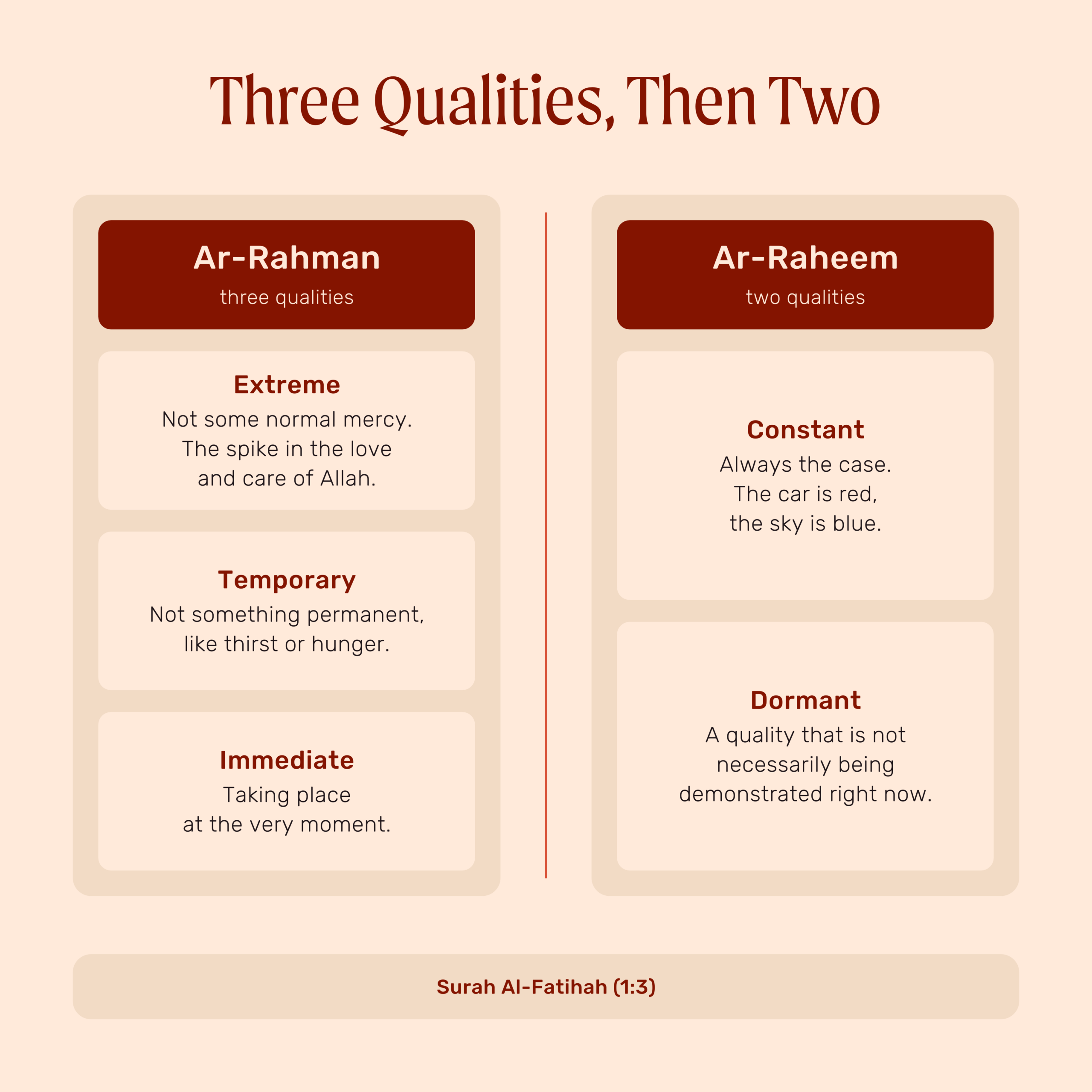
Think of Ar-Rahman as Having Three Qualities
Words that have that aan at the end, that pattern in the Arabic. There is a technical name for the pattern. That is not so important, but it really produces three connotations.
The first is that words like these are extreme in their meaning. If you say someone is knowledgeable and you put that ending on it, now they are extremely knowledgeable. It makes the quality extreme.
The second is that it makes the quality transient. Meaning it is not something permanent.
So in the Arabic language, ‘atshaan, notice the aan at the end, ‘atshaan is someone extremely thirsty. Thirst, as you know, is not something that lasts forever. Jaw’aan is someone extremely hungry and hunger is not something that lasts forever. Similarly ghadbaan is someone extremely angry and as we know, anger does not last forever.
Except in some cases. But anyway. Extreme anger at least does not last forever.
The third one, to put it really simply, is that this pattern is used for something taking place at the very moment. You are not describing someone who tends to be extremely angry, or tends to be extremely thirsty, or tends to be extremely hungry. You are talking about someone who is extremely thirsty, or extremely hungry, or extremely angry right now.
Those are the three implications. Let me repeat them very, very quickly. Extreme. Temporary. Immediate.
Now Put Those Three on the Name
Allah’s mercy, His love, His care is extreme. It is not some normal mercy.
There are moments in a person’s life where they are demonstrating mercy and care. Then there are points where they spike.
Ar-Rahman is describing that spike in the rahma of Allah, the love and care of Allah.
The second one is transient. That is the scary one, because we thought every name of Allah is permanent, so it should always be the case.
Ibn Abbas (RA) describes Ar-Rahman as actually referring to Allah’s mercy as it manifests on this earth, in this life. Which makes sense, because this life is not permanent. So it applies more directly to this life.
Even though temporary sounds a bit philosophically problematic, leave it aside for a second. We will see in a moment how else it applies.
The third thing was that it is happening immediately.
Now Compare That to Ar-Raheem
The next word also has to do with mercy, love and care. But it has two qualities. Remember, Ar-Rahman had three. Ar-Raheem has two.
The first is that it refers to something that is always the case. Not something happening right now, not something happening temporarily. It exists throughout. That is the better way of saying it.
When you call someone patient, you have described a quality that they have. If you describe a car as red, that is a state of the car. It is not something that is going to change. When you say the sky is blue, that is a quality of the sky. Water being pure, same thing.
These are constant states.
The second piece of it is that it is not necessarily taking place. Meaning it is not acted out. It is potential.
To make this easy to understand. If I say about my wife, she is patient. That is a quality that she has. But right now she is not here, so I can talk about her.
Maybe she is not being patient right now. Maybe she is actually being quite the opposite.
In other words, she has the quality of patience, but it does not necessarily mean it is being demonstrated right now.
Similarly you can say somebody is wise, but while they are sleeping, they are not demonstrating the quality of what? Wisdom. So you can have a quality, but it is not being demonstrated.
You get what I am saying? This is very different from Ar-Rahman, is it not? Because in Ar-Rahman it is being demonstrated when? Immediately.
Three qualities of Ar-Rahman. Two qualities of Ar-Raheem. Constant and not necessarily being demonstrated. A dormant quality.
So Now Think About This. Why Is Ar-Rahman First?
Human beings, put it simply, we love immediacy.
I like to give the example of somebody who works all week and they are going to get their paycheck on Friday. But their boss, the one who hands them the paycheck, is not there. Stuck in traffic somewhere.
It is 4:45. I need to go at five, because I need to catch a flight and I need this money. I need to deposit it immediately, because I am going to need this money. I do not see my boss. It is 4:45.
Somebody comes to you and says relax, relax. The boss, he will be here. He is reliable.
He has a quality of what? Reliability.
Yeah, I know he is reliable. But I wish he was being reliable right now.
I do not need his quality of reliability to be dormant. I need it to be taking place at the moment. I need it right now.
You see what I am saying? Human beings, when they have a problem, they do not think about the constancy of a person’s qualities, the one whose help they need. They do not think about the dormant quality. They want that quality manifest. Immediate.
Our immediate concerns need to be met. So, the immediacy. What we want immediately is not just in small amounts either. We want it in big amounts. That is just human nature.
I Am About to Chew Off My Own Arm
Let me give you an example of hunger.
If I am super hungry and I am cranky. I go home. I called my wife ahead of time, hey, do you have anything at home? She says yeah, yeah, good lunch at home.
I get home. Instead of giving me the lunch that she promised, she says to me, what do you want to eat tomorrow?
I say, I do not care. I just need food right now. I am about to chew off my own arm. You just give me some food. I cannot think about tomorrow.
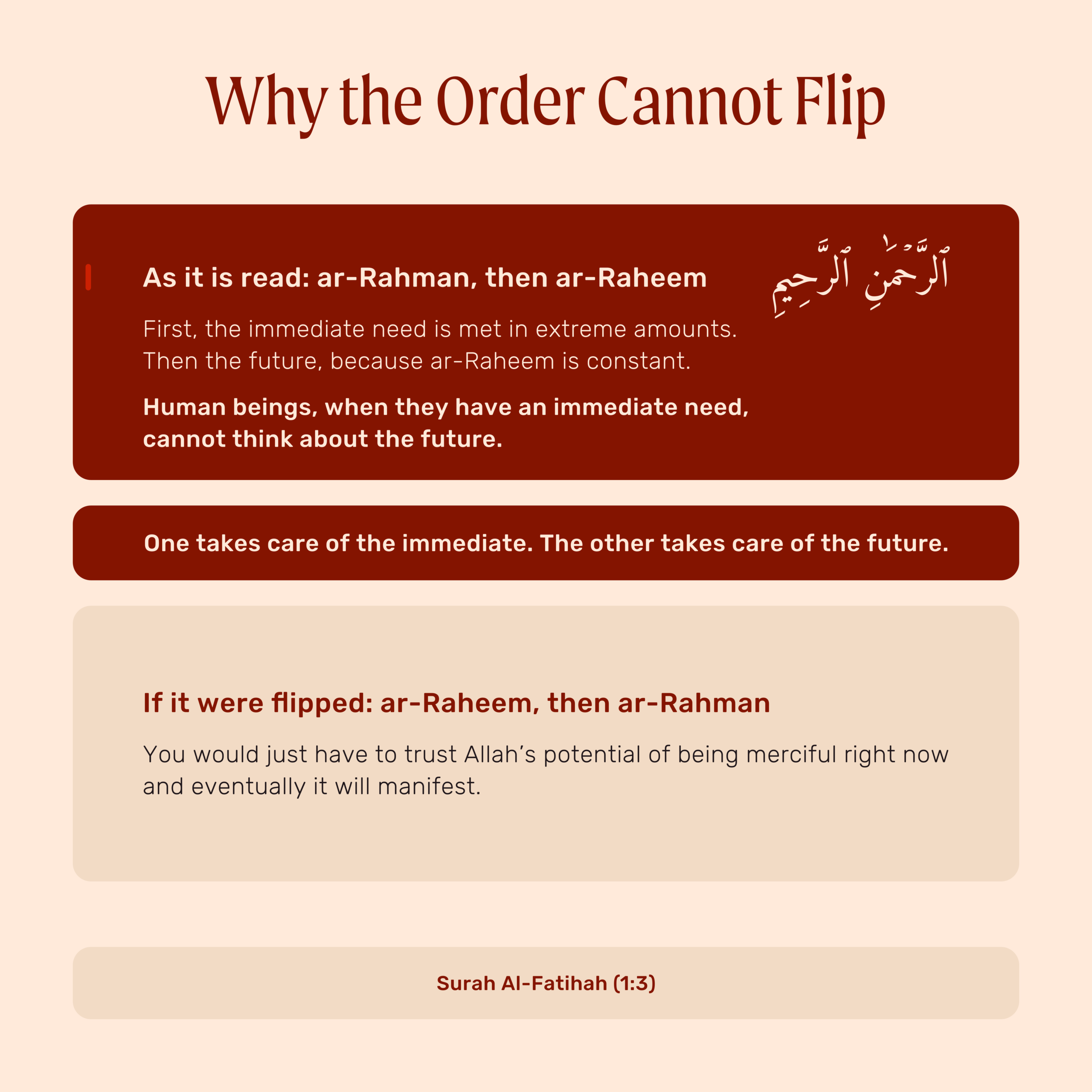
What am I trying to tell you? Human beings, when they have an immediate need, they cannot think about the future. They can only think about the immediate.
When the immediate need is met, if I satiate myself, I eat to my fill, then, what were you saying about tomorrow?
Is that not what happens? It happens with money. If you need to pay the bills, if you need to buy the thing right now, if you need to make the payment, all you can think about is right now. The moment you pay the bill, the moment you fill in the tuition, then you start thinking, how is the savings? How are we going to use them? Do we have enough for next month? Do we have enough for next week?
You start thinking about the future.
Look at the Beauty of These Words
Ar-Rahman is immediate, because human beings are concerned first and foremost with the immediate.
But as soon as the immediate is met and met more than you can imagine, met in an extreme way. Allah’s rahma comes. Allah’s love and mercy comes in extreme amounts and it takes care of your immediate need.
As soon as your immediate needs are met, you start worrying about what? The future.
So Allah says He is also Ar-Raheem. It is constant.
One takes care of the immediate. The other takes care of the future. So awesome.
Now Imagine If This Was Flipped
Why is it not flipped? Why is it not Ar-Raheem Ar-Rahman?
That would actually suggest that right now, you just have to trust Allah’s potential of being merciful and eventually it will what? Manifest.
No, no, no. It manifests right now. You can trust that the potential, that rahma, is something constant. It will always be there.
An Ocean Cannot Be Both
The last thing I will share with you is really beautiful, said by az-Zamakhshari and some other scholars.
Words that are immediate and extreme, they are acting out, like we said. Words that are adjectives like Ar-Raheem are constant and level. They are not extreme and they are not being acted out necessarily.
So he used to compare Ar-Rahman to a violent ocean. Waves crashing on top of each other, water taking on this extreme form. Then he used to compare Ar-Raheem to the calm ocean.
Then he said this.
It is beyond my imagination to think of an ocean that is both calm and its waves crashing at the same time. I cannot do it. It is when I think of that that I realize I cannot encompass the rahma of Allah.
How can He be Ar-Rahman and Ar-Raheem at the same time?
That is what makes these two words incredible.
May Allah make us worthy of His rahma in this life and in the next.
The Companion Said It in One Line
Now you will appreciate the genius of the Companion who says: Ar-Rahman is for this world, Ar-Raheem is for the next world.
Look at that. Look at how he said it.
Ar-Rahman is temporary, just like this world is what? Temporary. Ar-Raheem will always be there, because the next life is what? Permanent.
They could see it immediately. Their analysis of the Quran was on point without a ten minute description. They just got it.
May Allah help us appreciate and reflect on the power and beauty of the Quran.
Every episode in this series takes one detail of the Quran this seriously. Watch Amazed by the Quran with Ustadh Nouman Ali Khan on Bayyinah TV: Bayyinah TV
Notes
This post is adapted from episode eight of Amazed by the Quran on Bayyinah TV and is written in the voice of that session. Every teaching claim, example and aside in it is taken from the session itself. The session works from the Arabic and gives its own renderings; the reference below locates the ayah the written question is about.
[1] Al-Quran, Surah Al-Fatihah, 1:3, https://quran.com/1/3

At Bayyinah, we are dedicated to helping you connect directly with the words of Allah beyond translation. Founded by Ustadh Nouman Ali Khan, our mission is to create transformative experiences that deepen your understanding and engagement with the Quran.
Study the Quran and Arabic in a systematic and personalized way through Bayyinah TV. Get started today for free.
Check out our newest articles, fresh off the press and ready for you to dive into!