
Successful subscription! Thank you for subscribing.
Successful subscription! Thank you for subscribing.

July 29, 2026
Surah At-Tahrim is one of the shorter surahs of the Quran, just twelve verses, yet it is remarkably loaded, carrying within it some of the most instructive moments from the life of the Prophet ﷺ and his household. It is also the last Madani surah in the order of the mushaf; from here to the end of the Quran, the revelation is Makki. This post introduces the surah, where it sits, the surprising incident that opens it and the principle it draws out: that even our deepest love must never lead us to step outside the limits Allah has set.
Where the Surah Sits
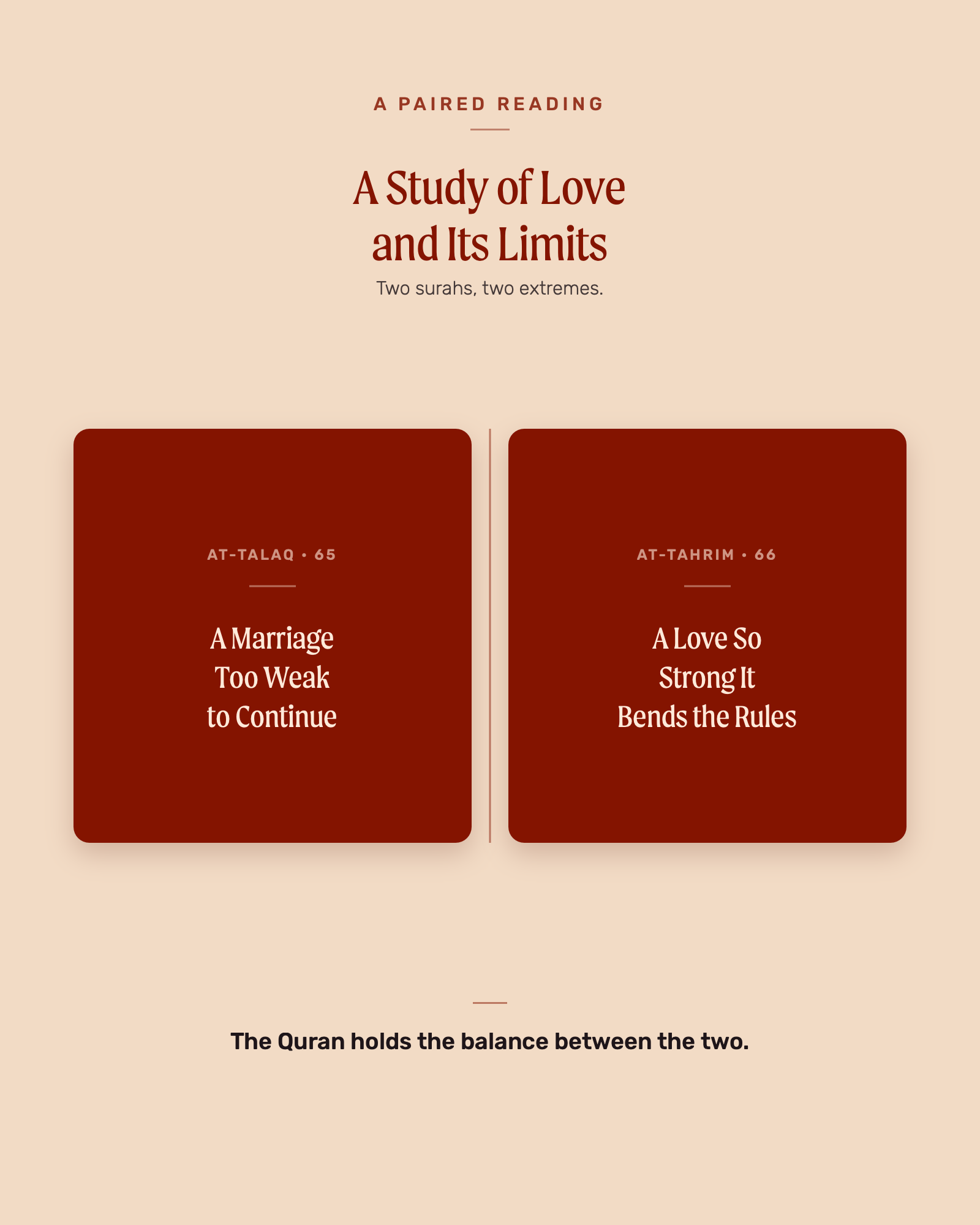
At-Tahrim closes a cluster of Madani surahs running from number 57 to 66, often grouped together for their shared spirit. It even completes a conversation begun at the start of that cluster: in Surah Al-Hadid the believers on the Day of Judgment have light streaming ahead of them and here, at the very end of the group, they are heard praying for that light to be perfected. The cluster of Madani surahs ends and one of its great scenes is brought to a close along with it. More immediately, At-Tahrim is paired with the surah just before it, At-Talaq, the surah of divorce, so that the two sit side by side as a study of love and its limits.
A Marriage Too Strong
The pairing with At-Talaq is striking. That surah dealt with a marriage that has become too weak to continue, where the kindest path may be to part. At-Tahrim shows the opposite danger: a marriage so full of love, a husband and wife so devoted to each other, that the love itself begins to pull a person toward compromising what Allah wants. Two surahs, two extremes and a balance held between them. The Quran had already planted the seed of this theme two surahs earlier, when it warned that among your spouses and your children there can be a trial for you (64:14)1; surahs 65 and 66 then unfold exactly how that can happen and how to keep love healthy.
The Incident That Opens the Surah
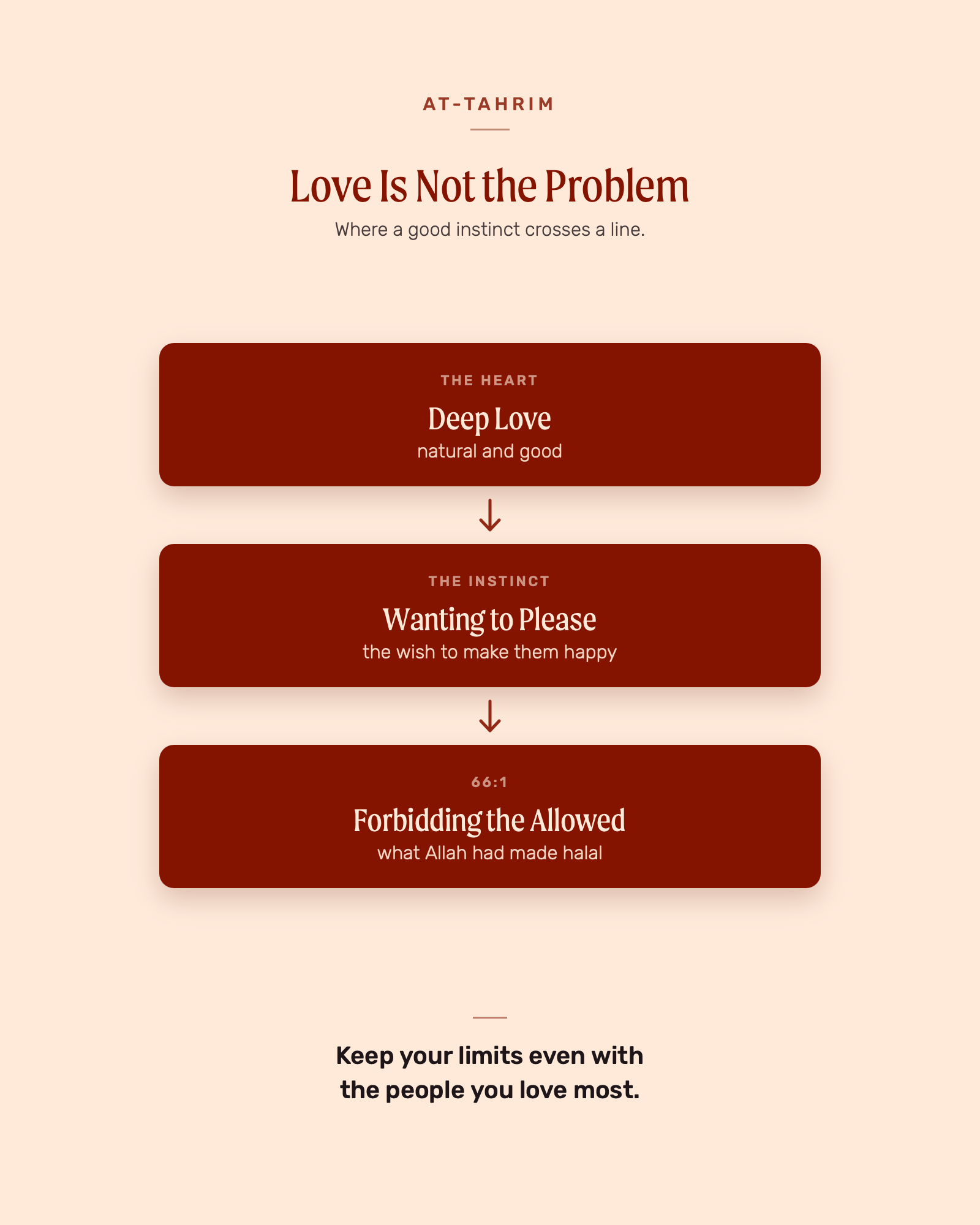
The surah opens with a real moment from the Prophet’s home. According to a narration in Sahih al-Bukhari, out of love for his wives and a wish to keep peace among them, the Prophet ﷺ resolved to give up something perfectly lawful, a kind of honey he enjoyed (Sahih al-Bukhari 4912)2. It was a small, tender gesture. But because he was the Messenger, even a private resolution could become a rule others would follow and so the very first verse was revealed (66:1)3.
يَا أَيُّهَا النَّبِيُّ لِمَ تُحَرِّمُ مَا أَحَلَّ اللَّهُ لَكَ ۖ تَبْتَغِي مَرْضَاتَ أَزْوَاجِكَ
“O Prophet, why do you prohibit [yourself from] what Allah has made lawful for you, seeking the approval of your wives?”
(66:1)
The gentleness of the question is the point. The Prophet ﷺ had done nothing sinful; he had simply let his care for those closest to him tighten a rule that Allah had left open. The surah names that quietly and corrects it. Love is not the problem. Letting love quietly redraw the lines Allah has drawn, that is what the opening verse gently puts back in its place.
When the Household Becomes a Lesson for Everyone
One of the most beautiful features of this surah is how it keeps widening its address. When the Prophet ﷺ is spoken to, the believers are meant to lean in and listen, because what is said to him so often applies to them too. When the mothers of the believers are addressed, they become role models not only for women but for the whole community, men and women alike. A private household is turned into a manual for every family. And the lesson is not limited to marriage: any relationship built on love, between parent and child, between close friends, carries the same quiet risk of letting affection override principle. The surah teaches us to love deeply and to keep our limits at the same time.
The Takeaway
Surah At-Tahrim begins where many of us live: in the pull between loving someone and obeying Allah. It does not ask us to love less. It asks us to make sure that our love, however deep, never becomes the reason we soften, bend or quietly cancel what Allah has made clear. Set beside At-Talaq, it completes a picture of healthy love: strong enough to sacrifice, but never so unbalanced that it costs us our relationship with Allah. Read its opening and it asks each of us the same gentle question it asked the best of creation, where have we let love redraw a line that was not ours to move?
There is far more to Surah At-Tahrim than a single article can hold. You can explore the full At-Tahrim: A Deeper Look series on Bayyinah TV, alongside the other surahs being opened up in the Deeper Look collection.
Related reading: Built Like a Ring: The Hidden Structure of Surah At-Tahrim (the companion post in this series).
Notes
[1] Quran, 64:14, https://quran.com/64/14 ↩
[2] Sahih al-Bukhari 4912, https://sunnah.com/bukhari:4912 ↩
[3] Quran, 66:1, https://quran.com/66/1 ↩

At Bayyinah, we are dedicated to helping you connect directly with the words of Allah beyond translation. Founded by Ustadh Nouman Ali Khan, our mission is to create transformative experiences that deepen your understanding and engagement with the Quran.
Study the Quran and Arabic in a systematic and personalized way through Bayyinah TV. Get started today for free.
Check out our newest articles, fresh off the press and ready for you to dive into!