
Successful subscription! Thank you for subscribing.
Successful subscription! Thank you for subscribing.
July 29, 2026
Few passages in the Quran open with the kind of quiet drama that Surah Al-Fajr, the 89th surah, carries in its first breath. Allah swears by the dawn, by ten nights, by the even and the odd and by the night as it slips awayand generations of scholars have offered dozens of readings of what these oaths point to. This post follows the reading that Ustadh Nouman Ali Khan finds most compelling, one that ties the whole opening to a single event the Arabs of Makkah knew intimately. It is a reading that turns four short verses into an entire spiritual season. Understanding it changes how the rest of the surah lands.
Four Oaths and Thirty Opinions
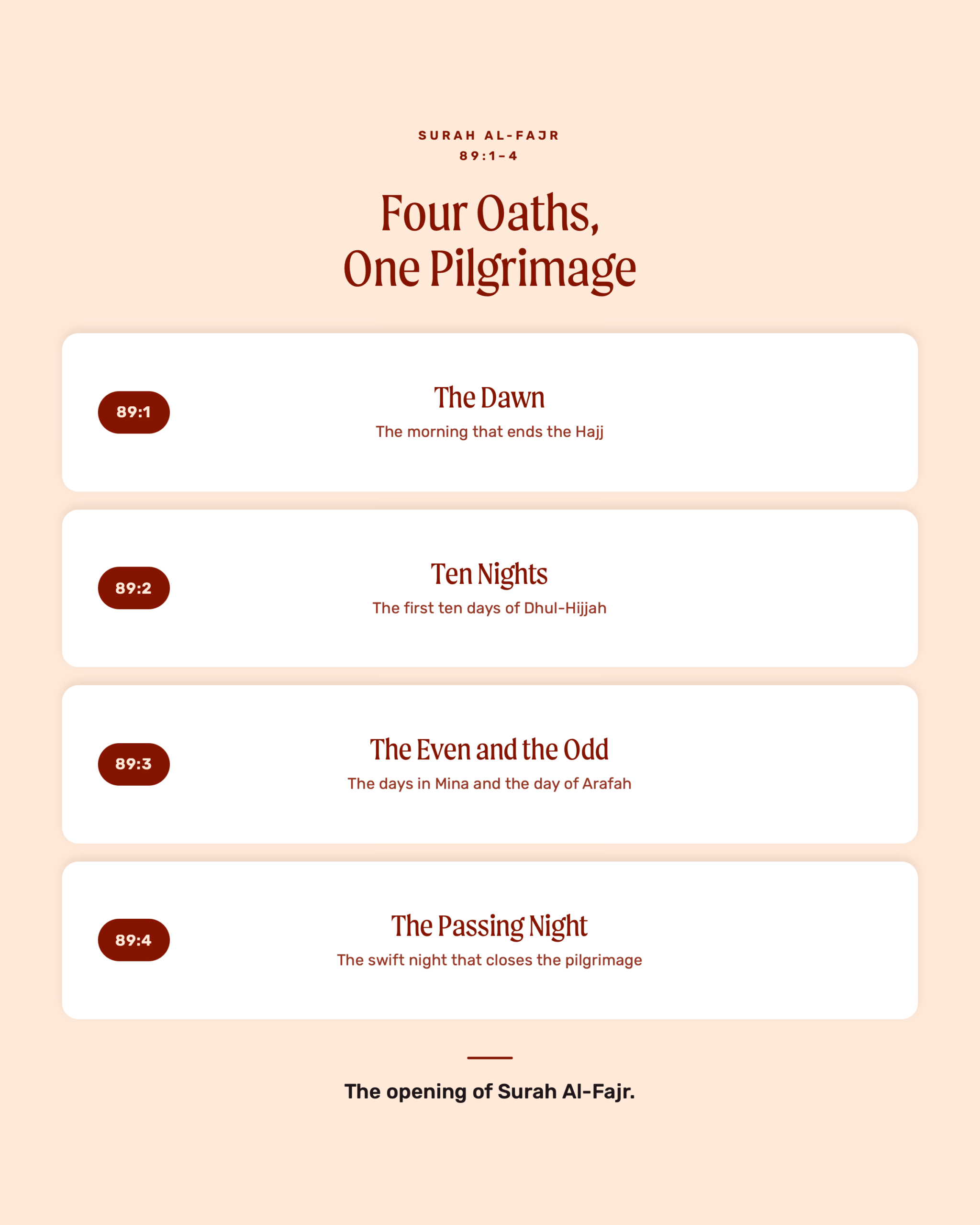
The surah begins with a rush of oaths. Allah swears by the dawn, “By the dawn” (89:1), then by ten nights (89:2), then by the even and the odd (89:3) and finally by the night as it moves on and passes away (89:4).1 The word fajr itself carries the sense of an explosion of light, the darkness tearing open and morning gushing through, so the surah opens on the exact moment when night gives way.2
وَالْفَجْرِ
“By the dawn.”
(89:1)
Ustadh Nouman is honest about the difficulty here. Across these first four verses the commentators have offered somewhere in the range of thirty to thirty-six distinct interpretations and no single one is the only defensible answer. Rather than march through every variation, he shares the reading he finds strongest in light of the surah as a whole, while acknowledging that the door stays open. That kind of academic honesty is worth noticing, because it models how a serious student of the Quran holds an opinion firmly without pretending the other views do not exist.
The Hajj Hidden in the Dawn
The reading Ustadh Nouman leans toward, one already scattered among the views of the early generations, is that all four oaths point to the rituals of Hajj. On this reading the dawn is the final morning that closes the pilgrimage, the morning of the day of sacrifice after the long night at Muzdalifah. The ten nights become the first ten days of Dhul-Hijjah, the season of struggle that builds toward that morning. The even and the odd gesture toward the days pilgrims linger in Mina and toward the singular weight of the day of Arafah and the night that passes away is that swift, exhausting night that closes the whole event and completes the circle back to the dawn.3
One reason this reading holds is the company Al-Fajr keeps. The surah that follows it, Surah Al-Balad, swears by the city of Makkah itself, so these two surahs pair the sacred time with the sacred place, the ritual with the ground it stands on. Hajj also fits the early Meccan setting. The first audiences of these verses had no knowledge yet of the last ten nights of Ramadan, but they knew Hajj better than anything, since the pilgrimage was the one ritual even the idol-worshippers of Makkah never abandoned and it was Hajj that gave the Quraysh their standing in the region.
Enough of an Oath for Those Who Can Restrain Themselves
After the oaths comes the question they were building toward: is there not in all of this an oath worth swearing for those who possess hijr (89:5)?4 Hijr is one of the Arabic words for the intellect and it shares its root with the idea of a barrier, something set up to stop people passing through. Ustadh Nouman points out that many Arabic words for the mind carry this same sense of restraint and holding back, because the real work of the intellect is to rein in the greed, the temper and the appetite that would otherwise run wild inside a person.
That is precisely the spirit of Hajj. A pilgrim leaves behind status, wealth and comfort, dresses in the plain cloth of the shroud and stands before Allah with nothing to distinguish one person from another. It is a rehearsal for the day every soul returns to Allah alone. By asking whether the Quraysh still possessed hijr, the surah is gently accusing them of losing the very restraint their pilgrimage was meant to build. The question lands on us too. When we complete our own acts of worship, do we come back changed or do we return exactly as we left?
The Nations That Built and Fell
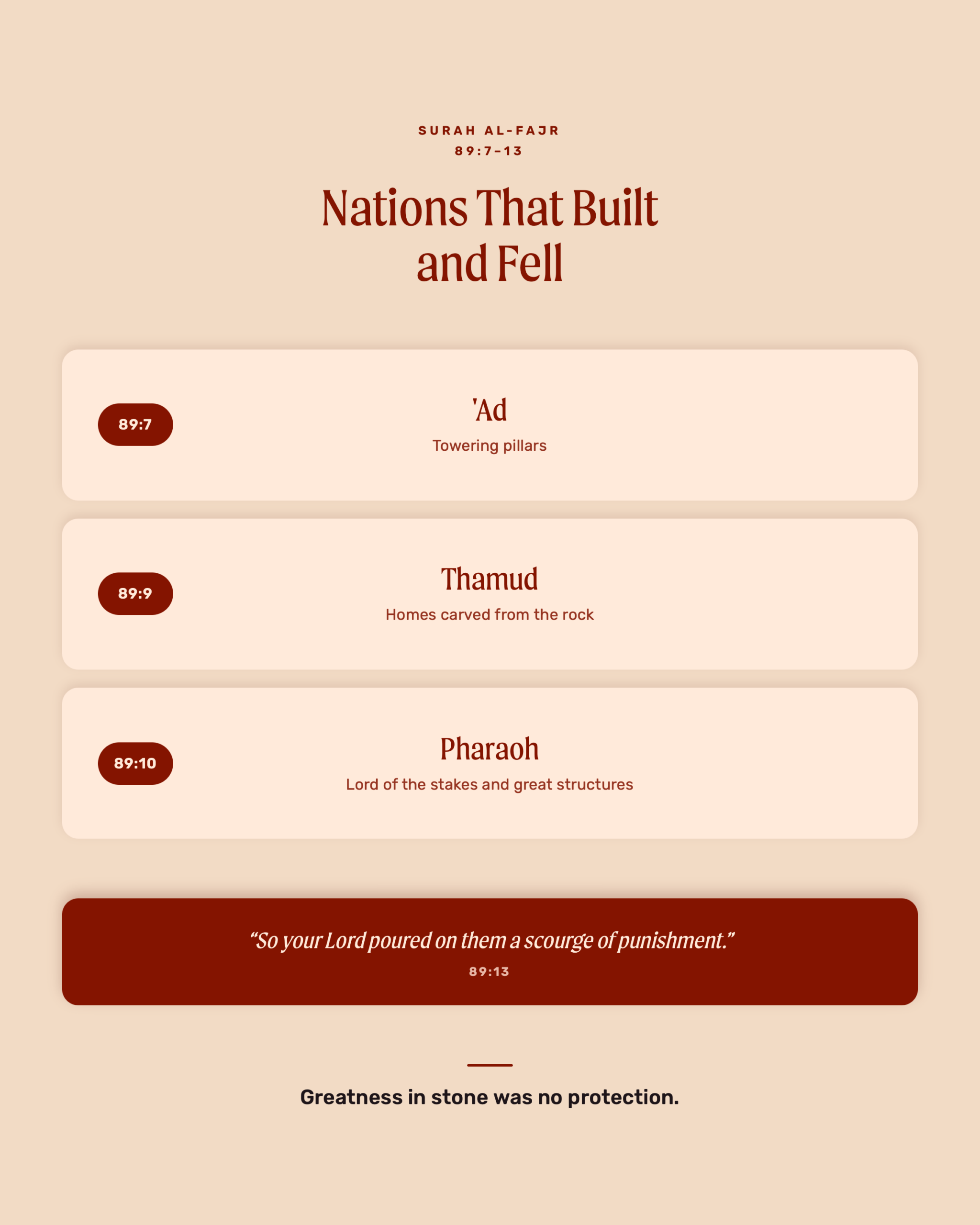
From the human heart the surah widens to human history, asking whether we have considered how our Lord dealt with ‘Ad (89:6), with Iram of the towering pillars (89:7), the like of whom was never created in the land (89:8) and with Thamud who carved their homes out of the rock of the valley (89:9) and with Pharaoh, lord of the stakes (89:10).5 Ustadh Nouman highlights a thread running through every name, which is construction. ‘Ad raised great columns, Thamud hollowed out mountains and Pharaoh, most likely Ramses II, poured more wealth into building than perhaps anyone in recorded history.
أَلَمْ تَرَ كَيْفَ فَعَلَ رَبُّكَ بِعَادٍ
“Have you not seen how your Lord dealt with ‘Ad?”
(89:6)
Grand architecture impresses, intimidates and announces a civilization’s greatness, yet Allah exposes the cost underneath it. These were nations that transgressed in the land and multiplied corruption within it, building their monuments on the backs of the oppressed. So your Lord poured on them a scourge of punishment (89:13), because your Lord is ever watchful (89:14), waiting like a hunter at the place of ambush.6 The warning to the custodians of the Kaaba was unmistakable. Greatness measured in stone and status offers no protection when the spirit that should have restrained a people has drained away.
The Takeaway
The opening of Surah Al-Fajr moves from a single dawn to the sweep of fallen empires and it holds them together with one quiet idea, that everything Allah gives is a test of whether we will stay humble. The pilgrimage was a gift meant to keep a people from becoming another ‘Ad or Thamud and the same question waits for us. When our seasons of worship end, do we carry their humility back into ordinary life or do we forget what they were for?
You can explore the full Al-Fajr: A Deeper Look series on Bayyinah TV, alongside the other surahs being opened up in the Deeper Look collection.
Notes
[1] Quran, 89:1, https://quran.com/89/1 ↩
[2] Quran, 89:1, https://quran.com/89/1 ↩
[3] Quran, 89:2, https://quran.com/89/2 ↩
[4] Quran, 89:5, https://quran.com/89/5 ↩
[5] Quran, 89:6, https://quran.com/89/6 ↩
[6] Quran, 89:14, https://quran.com/89/14 ↩

At Bayyinah, we are dedicated to helping you connect directly with the words of Allah beyond translation. Founded by Ustadh Nouman Ali Khan, our mission is to create transformative experiences that deepen your understanding and engagement with the Quran.
Study the Quran and Arabic in a systematic and personalized way through Bayyinah TV. Get started today for free.
Check out our newest articles, fresh off the press and ready for you to dive into!