Successful subscription! Thank you for subscribing.
Successful subscription! Thank you for subscribing.

November 20, 2026
Let me tell you why the class is called what it is called.
Nobility. That is where we start, first and foremost. What it actually means to be noble in the sight of Allah.
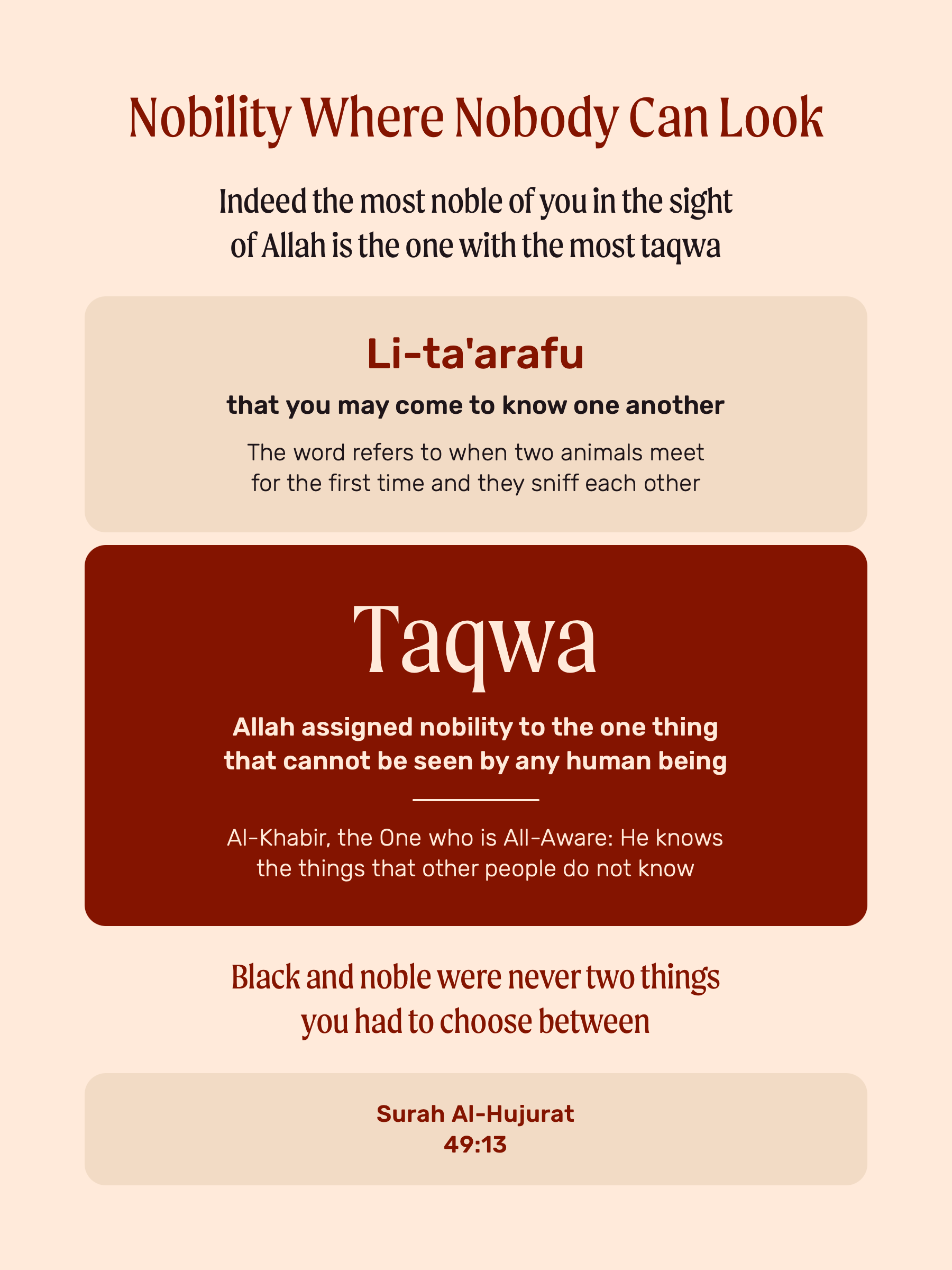
The name was chosen to make one point before anything else gets said. The point is that the terms were never mutually exclusive. Not anywhere in Islamic history. Black and noble were never two things you had to choose between.
The whole thing is based on an ayah, so let us start there.
“That You May Come to Know One Another”
Allah says: O people, We created you from a male and a female and We made you into nations and tribes so that you may come to know one another. Indeed the most noble of you in the sight of Allah is the one with the most taqwa. Indeed Allah is All-Knowing and All-Aware.1
Li-ta’arafu. That you may come to know one another.
That word is doing far more than the translation lets on. Ta’aruf does not mean just to get to know one another. It means to get to know one another in a very intimate way. In a way that you learn from one another. In a way that you benefit from one another.
Here is where the word comes from. In the Arabic language it refers to when two animals meet for the first time and they sniff each other. That is the image sitting underneath it.
So it is not asking somebody’s name. It is a very intimate getting to know one another and benefiting from one another.
Allah Put Nobility Where Nobody Can Look
Then comes the second half of the ayah and there are two beautiful things in it.
The first one. Allah assigned nobility to the one thing that cannot be seen by any human being.
The Prophet ﷺ said taqwa ha huna, taqwa ha huna: piety is here, it is here, it is here, meaning it is in the heart. He said that Allah does not look at your images or at your bodies. He does not look at your external appearances. Instead He looks at your hearts and at your deeds.
Notice that he ﷺ did not restrict that to the hereafter. Even today, right now, Allah looks at your hearts and He looks at your deeds. That is the basis on which Allah, the One who exalts and the One who disgraces, assigns a rank to you. That is the basis on which He assigns nobility to you.
The second thing is the name Allah closes the ayah with. Al-Khabir, the One who is All-Aware. When Allah uses this name in the Quran, He usually mentions it alongside something that cannot be seen by anyone else. Khabir means He is intimately involved with all of your affairs and He knows the things that other people do not know.
This is constant in the Quran. He is with you wherever you are. He knows what is in your hearts.
They Kept Asking Him Who Was the Most Noble
There is an exchange in one hadith.
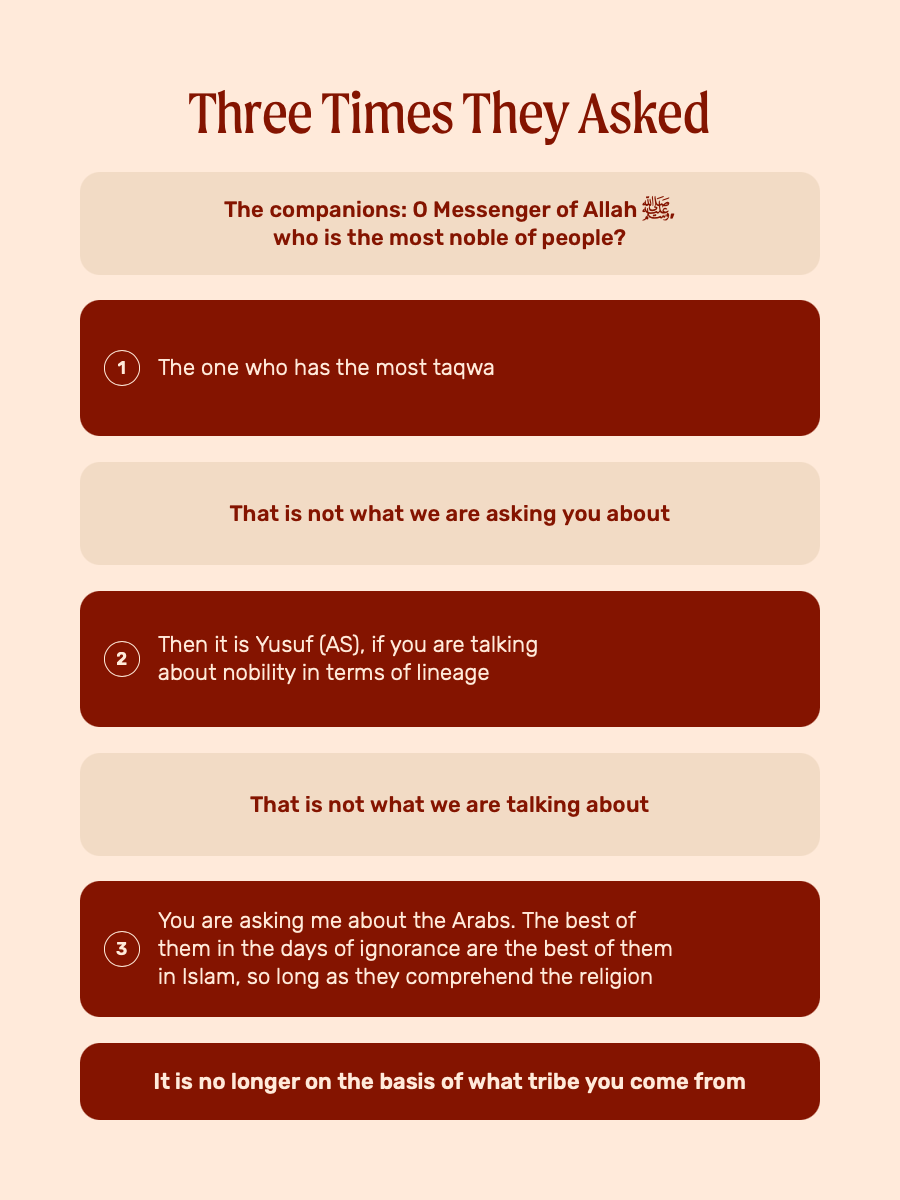
The companions asked him: O Messenger of Allah ﷺ, who is the most noble of people?
The Prophet ﷺ said: the one who has the most taqwa.
Now the Sahaba come back and say, that is not what we are asking you about. Meaning, we know that. We are not talking about that. You get this in regular conversation all the time, right? Well, I am not talking about that, I know that, but I mean something else.
So he ﷺ said, if you are asking about who is the most noble, then it is Yusuf (AS). The Prophet of Allah, the son of the Prophet of Allah, the son of the Prophet of Allah, the son of the Prophet of Allah. If you are talking about nobility in terms of lineage, then nobody is more noble than Yusuf, because the line runs back to Ibrahim (AS).
They said again: that is not what we are talking about, O Messenger of Allah ﷺ.
He said: then that means you are asking me about the Arabs. So he said, the best of them in the days of ignorance are the best of them in Islam, so long as they comprehend the religion.
Three questions, three answers and look at what the third one actually does. He is telling them it does not matter anymore after Islam. The basis of any external superiority now is their fiqh, their understanding. They ascend through Islam. It is no longer on the basis of what tribe you come from. It is no longer on the basis of whether you belong to Banu Hashim or to anybody else. All of these things have been abolished through Islam.
Now Look at the Prophets Themselves
So when we talk about Africans, or about black people in general, let us not even start at the Sahaba. Start higher. What about the prophets of Allah?
Were there black prophets among the ones that were mentioned to us? We find a few. Household names. Names we read in the Quran.
Take Sulayman (AS). He is biblically described as having dark skin. I want to keep that distinction clean, because it matters for what comes next. Bani Isra’il had various colors historically, because their origins were different. Some had Arab origins. Some had Egyptian origins.
Now take Musa (AS). The man Allah spoke to directly, Kalimullah. The man the Quran speaks about more than any other human being in history.
For Musa (AS) we are not working from the Bible at all. The Prophet ﷺ himself described him. He said that when he saw Musa (AS), he resembled the people of two particular Arab tribes and those two tribes were the darkest of the Arabs.
The Prophet ﷺ said Musa (AS) had the blackest skin.
That is part of the problem with Hollywood imagery. Musa (AS) does not look like the man they cast to play him. Even the older movie, The Ten Commandments: we all have a certain image of Moses in our heads. Musa (AS) looks nothing like that.
Some of the early scholars pointed out that when the Prophet ﷺ described him this way to the Sahaba, he was not only describing him physically, although he did do that for some of the prophets. He was showing them the superiority of Musa (AS) despite the color of his skin. There is no man praised more in the Quran and spoken about more in the Quran than him.
So if you have a problem with people of darker skin, you have a problem with Musa (AS). If you have a problem with Musa (AS), you have a serious problem with the Quran and you have a serious problem with faith altogether.
How can a racist be a Muslim? How can a racist be a believer? How can a racist say he loves the Quran, when Kalimullah, the one Allah spoke to, was a man who was dark, extremely dark, as the Prophet ﷺ said?
The Prophet Everybody Argues About
The prophet with the most controversy attached to him in history is ‘Isa (AS), for the simple reason that he is the most highly politicized prophet in history, even though he himself was not necessarily political.
His image has been politicized for thousands of years. In the earliest days of Christianity, the image he was given shifted depending on the culture being reached. To the Persians he looked like the Persian gods. To the Romans he looked like their gods. To the Egyptians he looked like the Egyptian gods. Some of the Hindus in India said he was an incarnation of Lord Vishnu, so they portrayed him that way. Then the Atlantic slave trade and the image of a white God.
I have a personal memory of this. My father teaches at Southern University, which is a historically black college and I went to Xavier University for a time. Xavier is a Catholic university. I remember walking through and seeing a picture of ‘Isa (AS) with dreadlocks and dark skin and my first thought was, this is interesting and it is probably more historically accurate than the images we are used to.
My second thought, right away, was: wait a minute, that is not ‘Isa (AS).
Then I had to ask myself the obvious question. Well, what is ‘Isa (AS)? What does he look like?
Interestingly, we find a disagreement among the Sahaba themselves.
There is an authentic hadith in which the Prophet ﷺ said that while he was sleeping near the Ka’bah, he saw a dark man, the most handsome of dark men you have ever seen, with the most beautiful hair you have ever seen, reaching between his ears and his shoulders. He had combed it and water was dripping from it and he was leaning on two men, making tawaf around the Ka’bah. He ﷺ asked who this was and he was told: this is al-Masih, ‘Isa the son of Maryam (AS). In the same narration he then saw a man with wiry hair, blind in one eye like a floating grape and he was told that this is the Dajjal.
There is another narration where ‘Isa (AS) is described as being of a red complexion with curly hair and a broad chest, while Musa (AS) is described as being of a dark complexion with straight hair and a tall stature. In Arabic, by the way, ahmar technically means red, but it is used for someone who is white. Adam means dark. That is simply how the Arabs described someone with dark skin.
Then there is a narration in al-Bukhari where one of the companions swears an oath by Allah that the Prophet ﷺ did not say that ‘Isa (AS) had red skin and repeats the description of the dark-skinned man.
So what do we do with that?
We should not dispute the way the Christians do about his color, because it does not matter.
You have conflicting narrations. The stronger of them is that he had dark skin, which would also be more historically accurate. But that is not the point. The point is that it was a non-factor and that is part of the wisdom of not portraying the Prophet of Allah at all.
Here is the part that says everything. As one scholar points out, the Sahaba did not care to ask much about this.
That is significant, because those companions asked him ﷺ about everything. They never asked what color Ibrahim (AS) was. They never asked what color this prophet or that prophet was.
It simply did not matter to them.
So it should not become an issue to the point where it becomes politicized.
Everything after this, the biographies of the great people in the Quran and the Sunnah who did indeed have dark skin, sits on top of what we have just established. The measurement was set by Allah, it was placed where no human being can see it and the terms were never in conflict to begin with.
This is the first of four sessions on nobility and race in Islamic history. Watch Black and Noble on Bayyinah TV
Notes
This post is adapted from the opening session of Black and Noble on Bayyinah TV and is written in the voice of that session. Every teaching claim, example and aside in it is taken from the session itself.
[1] Al-Quran, Surah Al-Hujurat, 49:13, https://quran.com/49/13

At Bayyinah, we are dedicated to helping you connect directly with the words of Allah beyond translation. Founded by Ustadh Nouman Ali Khan, our mission is to create transformative experiences that deepen your understanding and engagement with the Quran.
Study the Quran and Arabic in a systematic and personalized way through Bayyinah TV. Get started today for free.
Check out our newest articles, fresh off the press and ready for you to dive into!