
Successful subscription! Thank you for subscribing.
Successful subscription! Thank you for subscribing.

November 20, 2026
When I left you last time, you were all Hanbalis. I love you guys.
Now here is what I actually want to deal with, because there is a lot of confusion around it and I think this is probably the number one most asked question I get. Do we have to follow a madhab or not? How do I approach an authentic hadith when it runs against the madhab I grew up with? At what point am I allowed to use my own reasoning?
What I found, interestingly enough, is that all you really have out there are four or five minute video answers. So I want to go through it properly.
We have an hour.
Why Two Honest Scholars Read One Hadith Differently
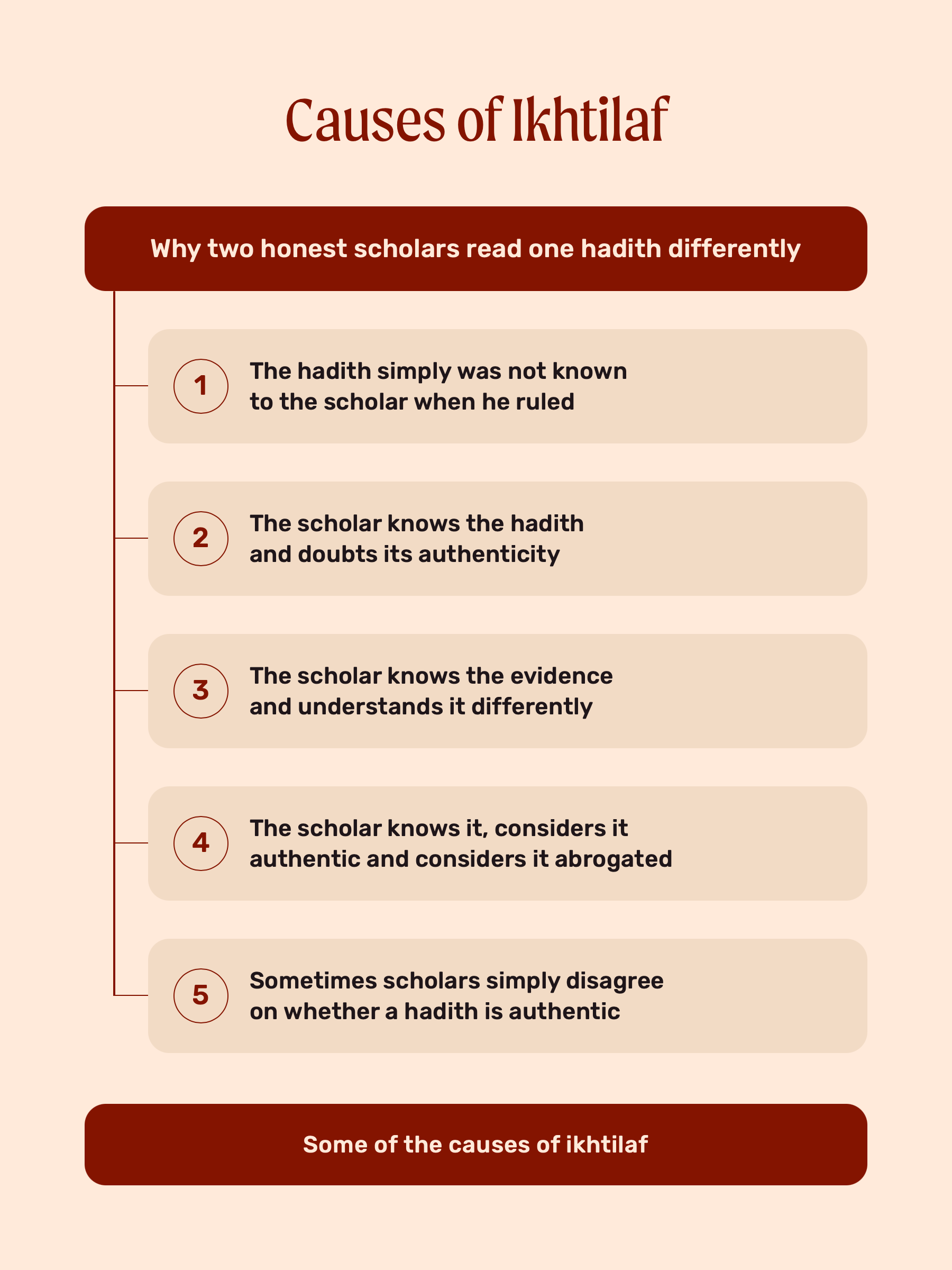
So let me walk you through some of the causes of ikhtilaf. How does this actually happen in the presence of a hadith?
One. The hadith simply was not known to the scholar when he ruled.
People take great offense at that, but we have to be intellectually honest when we study history. There were Sahaba who did not know a certain hadith and there are over a hundred examples of it listed.
Take this one. What is the waiting period of a pregnant woman? Until she delivers.1 What is the waiting period of a widow? Four months and ten days.2 Now what is the waiting period of a pregnant widow?
You see the problem. Two clear texts. So the initial ruling was that she waits the longer of the two. Then a companion came forward and said the Prophet ﷺ permitted a woman to remarry a few nights after her husband died, because she had given birth the day after he died. He ended her waiting period with the shorter of the two. The earlier opinion was reversed.
Two. He knows the hadith and doubts its authenticity.
This is especially the people of opinion. Others are convinced by the narration, he has doubts, so he sets it aside, investigates and relies on his reasoning in the meantime. Until I am one hundred percent sure, I go with my reasoning. It happened among the Sahaba.
Three. He knows the evidence and understands it differently.
The Prophet ﷺ said none of you should pray ‘asr until he reaches Banu Qurayzah. He meant hurry up, do not stop on the way, get there. The Sahaba got delayed and ‘asr was ending on the road. Some prayed on the way. Some waited until they arrived. By then it was past Maghrib and they prayed there.
He ﷺ approved both of them. Even in his time, he understood that the Sahaba can understand things in different ways.
Four. He knows it, considers it authentic and considers it abrogated.
If you do not understand abrogation you will drive yourself insane.
When salah was first made obligatory, people could talk in it. A man would ask his friend how many rak’ahs are left, the way today somebody will ask how many have we done. Then it was abrogated and one companion was away on a journey and came back not knowing. He walks in, says salam, gets nothing. He sneezes, says his part, nothing. Now he is annoyed. What is wrong with you people? Why is nobody talking to me? The Sahaba cannot answer him, so they start signaling him to be quiet and he keeps talking through the entire salah.
Poor guy. Afterward the Prophet ﷺ said, whoever was speaking, let him know that this used to be permitted. He validated what the man did and from then on it was prohibited.
Five. Sometimes scholars simply disagree on whether a hadith is authentic. That is it. That is the whole reason.
A Madhab Is a Set of Tools, Not a Set of Fatwas
So what is our position on following a madhab? A few things to keep in mind.
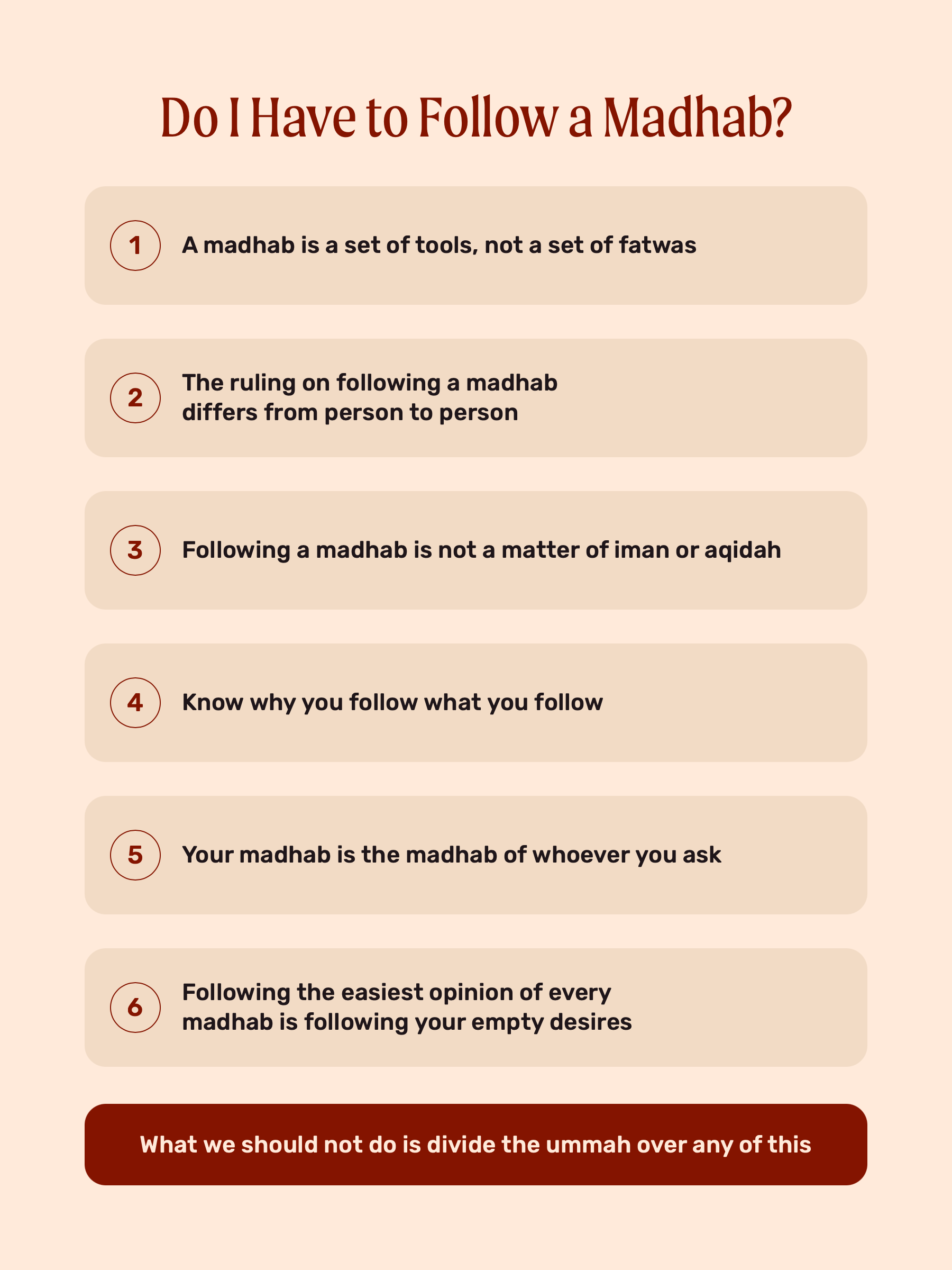
Number one. A madhab is a set of tools. It is a set of principles for deriving opinions, not a set of fatwas. That is one of the greatest misunderstandings of what a madhab even is. There is no such thing as a madhab being a list of opinions, where if you are Shafi’i you do this and if you are Hanafi you do that. If it were true, we would only ever have four opinions on any issue. Instead we find twenty inside the same madhab.
Number two. The ruling on following a madhab differs from person to person. It depends on your capability and where you are. It is not one size fits all.
Number three. Following a madhab is not a matter of iman or aqidah. You cannot say a person is sinful for how he approaches this topic, whether he does taqlid or the opposite.
Think about what that would require. If a person were sinful for not following a madhab, then the minute somebody takes his shahadah you would have to assign him one. Welcome to Islam. Which madhab would you like? Because if he dies that night without one, on that logic, he dies in a sinful state.
It is not an issue of faith. It is an issue of finding the best approach.
Now, taqlid. Technically it means to follow without knowing the evidence.
All four of the imams said that if the hadith is authentic, then it is my madhab. True. But when they said it, they were not speaking to a Muslim who cannot read Arabic and does not know the ABCs of the religion. They were speaking to people in a position to analyze evidence, to understand usul, to know the language of the madhabs, to know the abrogated from the abrogating.
There is another statement and this one is addressed to everyone. One of the imams told his students: do not follow my opinion without knowing my evidence.
Even if you are not going to question it, you should know where it came from. Allah says to ask the people of knowledge when you do not know.3 You do not just ask them what should I do. You ask them why should I do what you are telling me to do. Not confrontationally. Generally speaking, you should know why you follow what you follow. That is how we protect our religion.
Your Madhab Is the Madhab of Whoever You Ask
Now let me throw in a twist, because this one is important.
Ibn ‘Abidin is one of the greatest Hanafi scholars of all time, probably top five in the school. In his Hashiyah he goes on a tangent about following a madhab and listen to what he says.
The madhab of the common person is the madhab of the one who gives him fatwa.
Let me say that again. If you are a layman and you go to a living scholar and ask him, whatever that scholar is, that becomes your madhab.
He adds that there is no point in a common person getting hawkish about it and fighting people over the label. He should be humble instead, because in order to actually be a Hanafi, you need to know what Hanafi usul are in the first place.
I am not putting anybody down here, but be honest. Some of you have a madhab. Did you know the usul of your madhab before you took this class? Probably not. It is just something you grew up with.
I have this in my own family. They grew up as Hanbalis. They all pray like Hanafis. They still say we are Hanbalis.
What that means practically is this. If you are in the position of a commoner, go to someone living. Ask that person your questions. Be consistent with it. Choose someone on the Book of Allah and the Sunnah of the Prophet ﷺ with all the qualifications of a shaykh, someone whose knowledge you trust. Do that and you fall into the discipline of a madhab whether you like it or not.
Taking the Easy One From Every School Has a Name
Then it comes back to you. Am I bound by a madhab? Is it impermissible for me to switch?
Joining opinions across schools is called telfiq. When does it become a problem?
When you just take the easiest opinion in every madhab. You are Hanafi one day, Hanbali the next, Shafi’i the day after and you do not care, as long as it is easy. Not on the basis of evidence. Just because it is easier and hey, I like that one, I will take that one.
One scholar wrote a book on this and said that following the easiest opinion of every madhab is ittiba’ al-hawa. Following your empty desires. That is when it becomes impermissible.
So it is not about changing madhabs. It is about why you are following different opinions. If the basis is that you are looking for a way out, that is dishonesty with Allah.
Here is the other side of it, also from Ibn ‘Abidin in his Hashiyah. Following the established opinion of another madhab in a case of need is permissible, where there is a hardship on you individually or where you are with a group.
Say you are traveling with a group. Your shaykh holds the common Hanafi opinion that you do not combine prayers. The group is going to combine. Every Hanafi scholar in history would tell you to combine behind those imams. Do not inconvenience your group. Do not make it hard on yourself and hard on everybody else.
I have met people on umrah who will not pray ‘asr in the Haram because it is not the Hanafi time. Are you really going to miss salah in the Haram over that? Imam Abu Hanifa would smack you in the face. What is wrong with you? Pray in the Haram.
That is the whole point of the allowance. You stay within the scope of the Sunnah of the Prophet ﷺ. Find another established opinion that suits the situation. It does not mean you have permanently switched.
Finally, it is not impermissible, if you find the evidence on some particular issue more compelling, to follow that evidence. As long as you do not get arrogant about it.
Go Study the Madhab of Your Own People
Here is how it all summarizes.
Taqlid is permissible and ijtihad is permissible. If a person chooses to bind himself to all the opinions of one scholar from Ahl as-Sunnah wa’l-Jama’ah, he is not sinful. If a person does that for the most part and then compelling evidence comes on an issue and he follows it, he is not sinful either.
What we should not do is divide the ummah over any of this. That was never the point of these methodologies. They were approaches to the Sunnah. They are all within the Sunnah of the Prophet ﷺ.
There is a story about one of the most staunch Hanbalis in history. Students came to him from a region that was predominantly Shafi’i and told him they wanted to study with him.
He said, why are you coming to study with me? Go study the madhab of your own people.
They said, why? We are here to study with you.
He said, because I am afraid you will take the madhab of Ahmad, go back and force it on your people and make them hate Ahmad and then hate the Prophet ﷺ. Do not do that. Follow a valid approach that is not going to divide your community.
At the end of the day, by all schools of thought, the madhab of the imam leading the salah is the madhab of the people. Ibn ‘Abidin says that as well.
We ask Allah to show us the truth.
I hope you guys are still Hanbalis. I am just playing.
This session closes a course working through the lives of the four imams one at a time. Watch The Four Imams on Bayyinah TV
Notes
This post is adapted from the ninth session of The Four Imams on Bayyinah TV and is written in the voice of that session. Every teaching claim, example and aside in it is taken from the session itself.
[1] Al-Quran, Surah At-Talaq, 65:4, https://quran.com/65/4
[2] Al-Quran, Surah Al-Baqarah, 2:234, https://quran.com/2/234
[3] Al-Quran, Surah An-Nahl, 16:43, https://quran.com/16/43

At Bayyinah, we are dedicated to helping you connect directly with the words of Allah beyond translation. Founded by Ustadh Nouman Ali Khan, our mission is to create transformative experiences that deepen your understanding and engagement with the Quran.
Study the Quran and Arabic in a systematic and personalized way through Bayyinah TV. Get started today for free.
Check out our newest articles, fresh off the press and ready for you to dive into!