Successful subscription! Thank you for subscribing.
Successful subscription! Thank you for subscribing.

November 2, 2026
Let me tell you at the start what kind of class this is going to be, because it is not only a biography class. We are going to go into a lot of depth, a lot of historical depth, insha’Allah ta’ala. So we are not just going to be studying the biography of these companions, but we are going to look into their historical influences and how we still benefit from them today.
We are also obviously going to have those moments where we are kind of looking at their personal lives. The way they dealt with adversity. The way they dealt with tragedy. The way they dealt with fitna, when there was trials and tribulations and things of that sort.
So it is going to be a very encompassing class, insha’Allah, because we are going to be covering these biographies from many, many, many different angles.
Al-Abadilah Are Four. We Added a Fifth.
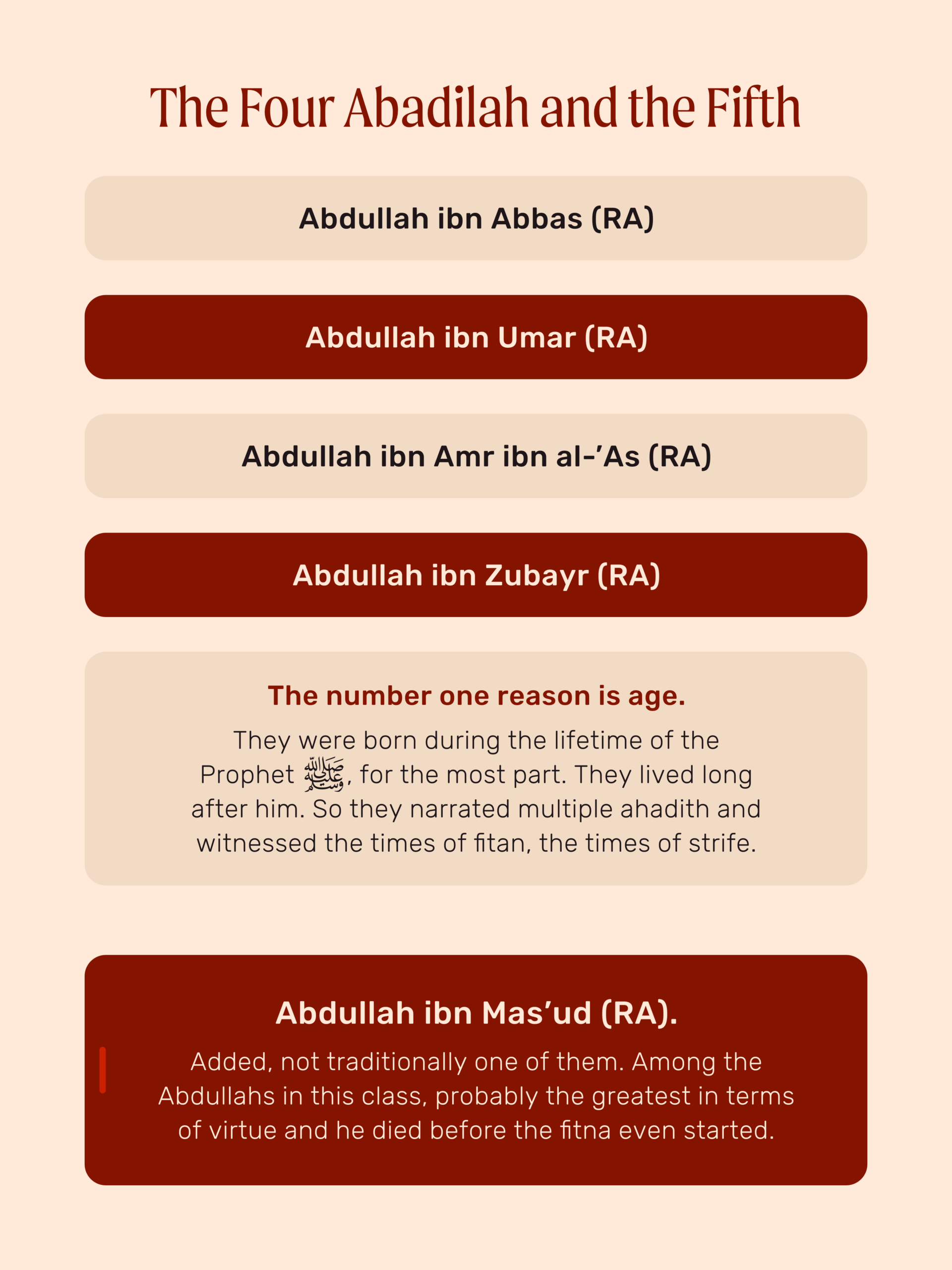
When we talk about this class, al-Abadilah, the Abdullahs: number one, the Abdullahs, al-Abadilah are actually four. We added a fifth one, but they are actually four.
Abdullah ibn Abbas (RA).
Abdullah ibn Umar (RA).
Abdullah ibn Amr ibn al-‘As (RA).
Abdullah ibn Zubayr (RA).
Okay? Those four.
There Are Over Three Hundred Abdullahs in the Sunnah
Now, why are these four in particular al-Abadilah? There are over three hundred Abdullahs in the Sunnah. There are plenty of Abdullahs.
The Prophet ﷺ says, ahabbu al-asma’ ila Allah, the most beloved names to Allah subhanahu wa ta’ala. Which two names? Abdullah and Abdurrahman.
Alright. So obviously once the Prophet ﷺ says that, many of the companions named their kids Abdullah and Abdurrahman. Umar ibn al-Khattab (RA) named multiple kids Abdullah and multiple kids Abdurrahman. We find that from many of the companions of the Prophet ﷺ.
So you will find many Abadilah, many Abdullahs, in the Sunnah of the Prophet ﷺ, in the Seerah of the Prophet ﷺ. It also was a name that actually existed in Jahiliyyah. So there were still people called Abdullah.
So Who Do You Guys Think Is the Best Abdullah?
Let me ask you something. Who do you guys think is the best Abdullah? The absolute best Abdullah from the Seerah of the Prophet ﷺ. What do you guys think?
Ibn Mas’ud (RA)? No.
No, not Ibn Umar.
No, not Ibn Abbas.
How about Abu Bakr (RA)?
Because Abu Bakr, his name was Abdullah ibn Uthman. Abu Bakr was his nickname, but his name was Abdullah ibn Uthman.
So Abu Bakr (RA) is actually the best Abdullah. If it was a matter of virtue, then obviously when we talk about al-Abadilah we would be studying Abu Bakr as-Siddiq (RA).
Among the Abdullahs in this class, Ibn Mas’ud (RA) is probably the greatest in terms of virtue. You might be able to make that argument.
So the question is, why is he not traditionally included in this category and why are we including him in this category?
The Number One Reason Is Age
The number one reason is his age, okay?
These four Abdullahs that are traditionally known as al-Abadilah, they were born during the lifetime of the Prophet ﷺ, for the most part. If not, they were only babies when the Prophet ﷺ received revelation.
They lived long after the Prophet ﷺ.
So they narrated multiple ahadith. They also witnessed the times of fitan, the times of strife.
The Sad Thing About This Class
The sad thing about this class is that every single biography we go through, with the exception of Ibn Mas’ud (RA), we are going to go through the trials and the tribulations.
What their role was in the time of Ali (RA) and the conflict with Mu’awiyah (RA). The khilafah of Abdullah ibn Zubayr (RA). The khilafah of Abd al-Malik ibn Marwan. What happened with al-Hajjaj.
All of these companions, all of the four Abadilah, played a crucial role in these times of fitna and these times of trials and tribulation.
Many of these stories do not have a happy ending.
But the point is to be real and to study their influence politically, okay. From a fiqh perspective, how they influenced schools of fiqh, how they influenced hadith narration, because they are, again, you know, prolific hadith narrators, how they influenced the tafsir of the Quran and how they influenced the various Islamic sciences.
Ibn Mas’ud Is the One With the Happy Ending
Now, Ibn Mas’ud (RA), he died before the fitna even started, okay? He was already a teenager when the Prophet ﷺ received the revelation.
So with Ibn Mas’ud it is a little bit different. With Ibn Mas’ud you actually have a happy ending, okay? Without the fitna. Without the trials and tribulation. Without the battles and so on and so forth.
But with Ibn Mas’ud (RA) we are going to study him as well, because he does have a significant contribution to the various sciences of Islam. So we are still going to study him for that reason and we are including him in this discussion for that reason.
Understanding, though, that traditionally al-Abadilah refers to the four, not Ibn Mas’ud (RA).
When We Start Off, We Start Off With Ibn Abbas
Abdullah ibn Abbas (RA). He has the most extensive biography out of the four.
All of you know, these biographies are not necessarily going to be the same in proportion, but all four of these companions have a special role in the sight of the Prophet ﷺ. Ibn Abbas (RA) perhaps has the most unique biography, the most special role in the life of the Prophet ﷺ and also in the lifetimes of the companions, may Allah be pleased with them and even after the companions.
About Thirty Companions Used to Give Fatwa
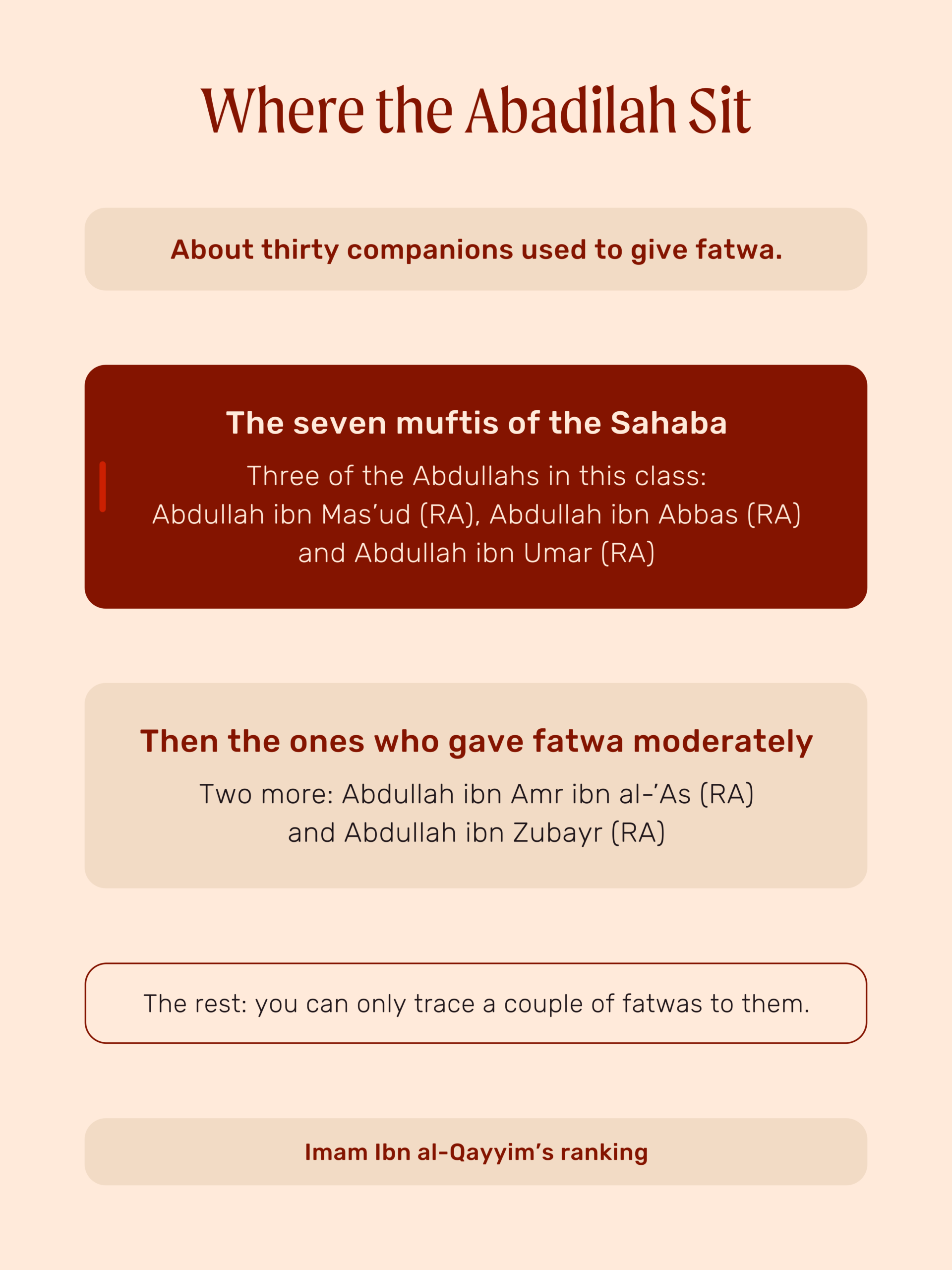
Now, to introduce this discussion. Al-Imam Ibn al-Qayyim (rahimahullah ta’ala) said that the muftis among the companions, the companions that used to give fatwa, were about thirty. Okay? There were about thirty Sahaba that were known for giving fatwa.
Out of those, he said, there is a top seven.
The Seven Muftis of the Sahaba
These seven muftis of the Sahaba, the seven companions that you see fatwa from, the most that you actually see them issuing fatwa, are:
Umar ibn al-Khattab (RA). Ali ibn Abi Talib (RA). Abdullah ibn Mas’ud (RA). Aisha (RA). Zayd ibn Thabit (RA). Abdullah ibn Abbas (RA). Abdullah ibn Umar (RA).
Again. Umar ibn al-Khattab, Ali ibn Abi Talib, Abdullah ibn Mas’ud, Aisha, Zayd ibn Thabit, Abdullah ibn Abbas and Abdullah ibn Umar.
These are the seven fuqaha from the Sahaba. They are the seven muftis of the companions, in the sense that they were the most common to be referred to in regards to matters of fiqh. So you find multiple fatwas from them.
Those are the top seven.
Each One of Them Could Have Their Own Volumes
Imam Ibn Hazm said that those seven that we just mentioned, each one of them could have their own majmu’. They could have their own volumes of fiqh books.
If you just arrange the fatwas of any of those seven companions, you could have volumes of books of fiqh.
Then You Have the Ones Who Gave Fatwa Moderately
Then after them you have companions that used to give fatwa moderately, not as much as the first category.
The first one, Abu Bakr as-Siddiq (RA). The second one, Umm Salama (RA). The third one, Anas ibn Malik (RA). The fourth one, Abu Sa’id al-Khudri (RA). The fifth one, Abu Hurairah (RA). Then Uthman ibn Affan (RA). Then two of the Abadilah, Abdullah ibn Amr ibn al-‘As (RA), then Abdullah ibn Zubayr (RA). Then Abu Musa al-Ash’ari (RA), Sa’d ibn Abi Waqqas (RA), Salman al-Farisi (RA), Jabir ibn Abdullah (RA) and Mu’adh ibn Jabal (RA).
Okay, let me go through them quickly again. Abu Bakr as-Siddiq, Umm Salama, Anas ibn Malik, Abu Sa’id al-Khudri, Abu Hurairah, Uthman ibn Affan, Abdullah ibn Amr, Abdullah ibn Zubayr, Abu Musa al-Ash’ari, Sa’d ibn Abi Waqqas, Salman al-Farisi, Jabir ibn Abdullah and Mu’adh ibn Jabal.
So Imam Ibn al-Qayyim (rahimahullah) said that those people, those Sahaba, were known to give fatwa, but not to the same extent as the first seven that we mentioned.
He said the rest of the companions, you can only trace a couple of fatwas to them.
All of the Abadilah Are In There
So in essence, these were the companions that were resorted to. Obviously all of the Abadilah are included in these roles.
This is the opening session and thirty-one more work through the five lives one at a time. Study The Five Abdullahs on Bayyinah TV: Bayyinah TV
Notes
This post is adapted from the opening session of The Five Abdullahs on Bayyinah TV and is written in the voice of that session. Every teaching claim, example and aside in it is taken from the session itself. The session is a short framing talk and cites its sources by speaker rather than by title: it quotes a narration on the most beloved names to Allah without naming a collection and it attributes the ranking of the companions who gave fatwa to Imam Ibn al-Qayyim and the remark about volumes to Imam Ibn Hazm without naming their books.

At Bayyinah, we are dedicated to helping you connect directly with the words of Allah beyond translation. Founded by Ustadh Nouman Ali Khan, our mission is to create transformative experiences that deepen your understanding and engagement with the Quran.
Study the Quran and Arabic in a systematic and personalized way through Bayyinah TV. Get started today for free.
Check out our newest articles, fresh off the press and ready for you to dive into!