
Successful subscription! Thank you for subscribing.
Successful subscription! Thank you for subscribing.

October 17, 2026
Somebody sent me a written question.
You said Ar-Rahman has three things and Ar-Raheem has two things. What is your evidence? Three things and two things, how can you make this up?
Fair enough. So let me answer it properly. Bear with me, because for the next few minutes you will not understand a word I am saying and that is okay.
Ar-Rahman sits on a particular pattern. That pattern is called the intensive form, the exaggerated form of an active participle. An active participle carries the sense of something happening right now. The ending on this pattern is one of the strongest intensifiers in the language, which is why I said extreme. The specialists of morphology say this form is only used for something passing, something temporary, something that is not going to last.
There. That is where three things comes from.
Now, if I had done that yesterday, there would be people jumping into the lake.
I can explain it that way. That is fine. It just will not benefit you.
Now let me show you what I actually want to do with you.
A Surah Is Not a Chapter
The Quran is made up of how many surahs? One hundred and fourteen. Sometimes people call them one hundred and fourteen chapters.
The first thing I want to tell you is that a surah is not a chapter. No such thing.
Let us talk about chapters. When you have chapters in a book, you start at chapter one, you go to two, three, four. When you get to chapter four, do they repeat what they taught you in chapter one? No. They take what is already covered in one, two and three and they build on it.
Now change the sequence. Take chapter ten and make it chapter three, take chapter two and make it chapter five. Does the book make sense anymore? No.
But is it possible that somebody has only studied Surah Al-Kawthar and somebody else has only studied Surah Al-Baqarah and it still makes sense for both of them? Is that possible in the Quran?
So it is not like a chapter.
Chapters also have a chronology. Earliest writing first, then the later, then the later. Some kind of order.
Is the Quran in chronological order? If it were, Surah Al-‘Alaq would be at the beginning,1 and some of the ayat of Al-Baqarah would be at the very end.
Is it organized by size? If it were, Al-Baqarah would be surah number one and Al-Kawthar would be one hundred and fourteen.
Oh, I know. Maybe it is organized by subject.
Is it? If you ask what the subject of Surah Al-Baqarah is, that is a very difficult question to answer. Because everything in the Quran is in Surah Al-Baqarah.
So Surah Al-Baqarah must be two hundred and eighty-six ayat about cows?
Does that happen? No. A cow comes up. A lot of things in there have nothing to do with beef.
Chapters have a title too. A heading, a name and that name tells you what is in the chapter. Does the Quran do that? No.
So in my view and Allah knows best, it is incorrect from a literature perspective to call a surah a chapter. It is unique. It is its own entity. Every other book has chapters and sections. The Quran has surahs.
In other words, Allah from the very beginning set His own standard.
When you write an essay and hand it to your teacher, your teacher corrects it. Break the paragraph here. Capital letter here. Take this sentence out. Why? Because there is a standard and you are not meeting it.
But the Quran came with its own standard. Which is why you cannot compare the Quran to any other literature.
This is the biggest mistake of non-Muslim scholarship about the Quran. They line it up against other literature and say, well, the Quran’s chapters do not make any sense, its chapters are unorganized.
So I say, listen, my kaafir friend. These are not chapters. You are missing the point altogether.
An Ayah Is Not a Verse
So what is inside a surah? Ayat. Sometimes we translate ayah as verse.
I have a real problem with that too.
In English the word verse is used in two ways.
The first is poetry. Verses of a song. Verses of a poem. Which is a problem, because to call the ayat of the Quran verses is as though we are comparing them to what? Poetry. The Quran emphatically says that He did not teach him poetry, that it is not the word of a poet, that the poets are followed by those who have completely lost their way.2
So when we use the word verse, there is already a problem in the English-speaking mind.
The second issue is that verse comes up when we talk about verses of the Bible. When you want people to think about the Quran, we do not want them thinking about what? The Bible.
There are allegations from Western scholars that the Quran took its information from the Bible. That the Prophet ﷺ used to travel and trade, that he traded in Syria and in Christian regions, heard some of those stories, mixed them up and put them in the Quran.
We do not want to give even the hint of that association.
We have to call it something. I have an idea. We should call it an ayah.
Now Look at What Allah Calls an Ayah
This is one of the most fascinating words in the Arabic language.
The Quran says its units are ayat.3 Fine. But look at what else gets the same word.
Allah says ‘Isa (AS) himself is an ayah.4 Allah says that in Yusuf (AS) and his brothers there are ayat.5 In that story, for most of it, are the brothers the good guys or the bad guys? The bad guys.
So there are ayat inside a prophet and there are ayat inside not-too-good guys.
The tree is an ayah. The mountain is an ayah. History is an ayah, the future is an ayah. Whatever is inside your body, inside your feelings, inside your heart, that is also ayat.6 Your sleep is an ayah. Waking up is an ayah. Marriage is an ayah. Love between a husband and wife is an ayah.
If you properly study the Quran, the conclusion you come to is that Allah uses this word to describe all of reality. All human experience. All truth. Everything in existence.
So once you study the Quran, you do not ask what an ayah is. You start asking what is not an ayah.
Allah swears by the winds that blow.7 So you go outside and there is a breeze and you feel it on you. The next time that happens, remember that you have just experienced the tafsir of an ayah of the Quran. The best tafsir of that ayah is not in a book. It is when you feel the wind.
Same with the ayah asking whether they have not looked at the birds above them, spreading their wings and folding them in.8 Where is the best tafsir of that? When you go and look at a bird.
The ayah is inside the book and the ayah is also outside the book.
What the Root Carries
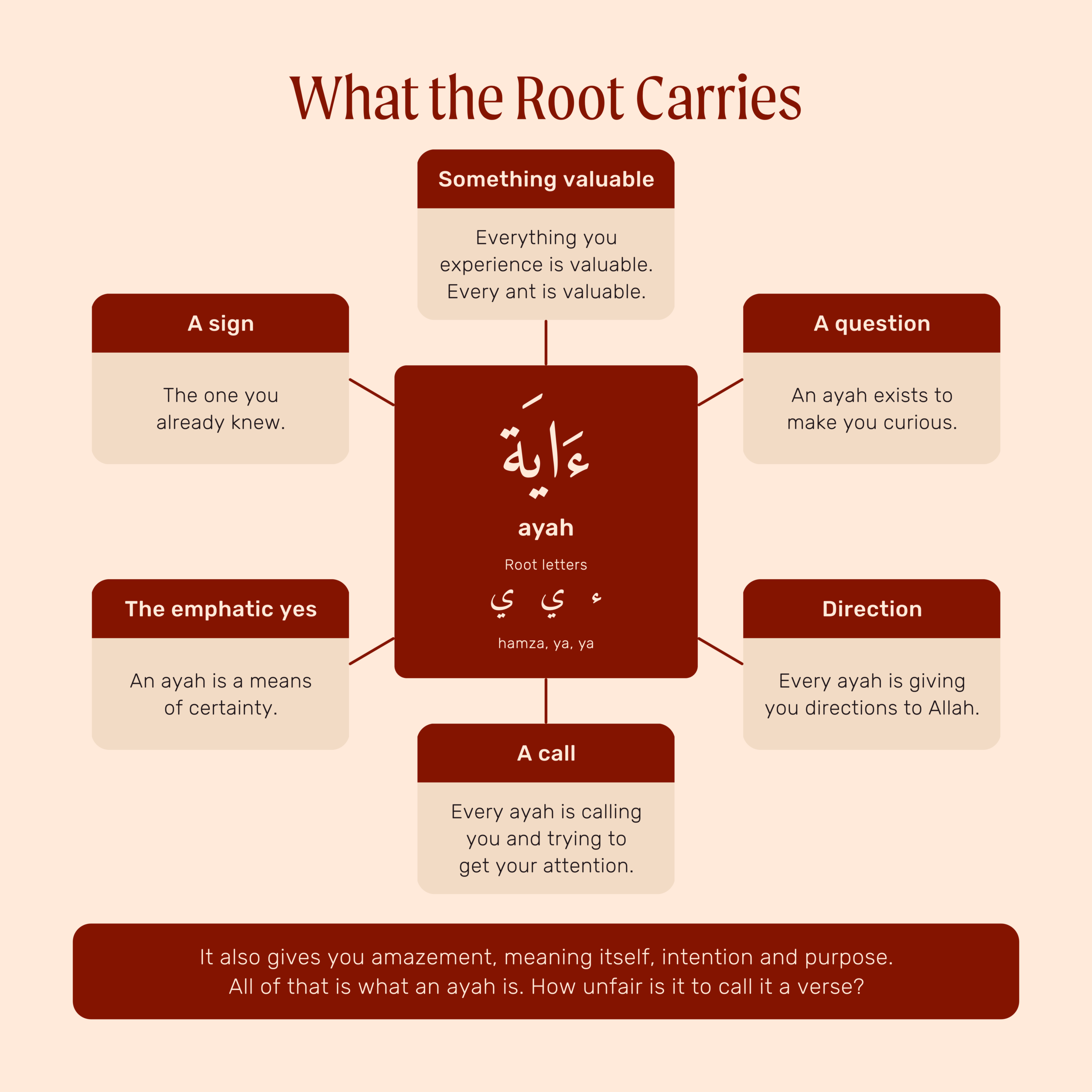
The root letters are hamza, ya, ya.
The Arabs used to say a phrase about a caravan that had moved on. They camp, they spend the night, they have a barbecue and a party and in the morning they pack up. Now, do they take everything? They take everything that has value. The garbage, the burned wood, whatever has no value, they leave.
So when somebody else arrives at that campsite, do they notice people were here? Yes. Do they notice nothing valuable was left? Yes.
So the first meaning of ayah is something valuable.
That means everything you experience is what? Valuable. Every problem. Every gift of Allah. Every challenge in your life. Every day, every night.
Every ant is valuable. SubhanAllah.
That is one meaning. The same root gives you a question, so an ayah exists to make you curious. It gives you direction, because when you see what a camp left behind you know which way they went and every ayah is giving you directions to Allah. It gives you amazement. It gives you the particle that calls out to you, which means every ayah is calling you and trying to get your attention. It gives you the emphatic yes, the one you use when you are completely convinced, so an ayah is a means of certainty. It gives you meaning itself. It gives you intention and purpose. Finally it gives you the one you already knew. A sign.
All of that is what an ayah is.
Now you tell me. How unfair is it to call it a verse?
Three Kinds of Arabic
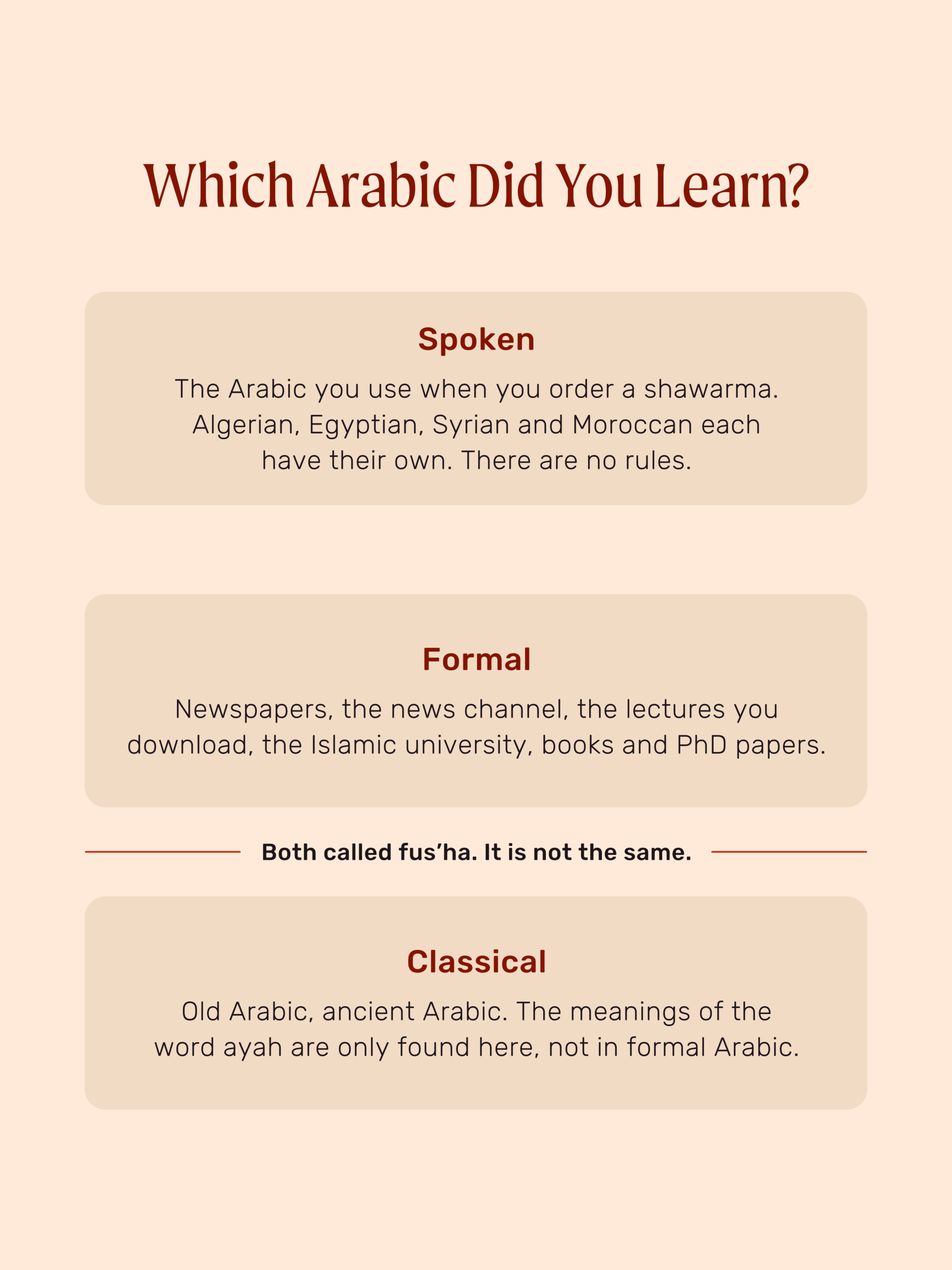
Now let me talk a little bit about Arabic. There are three kinds of Arabic. Spoken, formal and old.
Spoken Arabic is the Arabic you use when you order a shawarma. This is dialect. The Algerians have their own, the Egyptians have their own, the Syrians have their own, the Moroccans have their own and sometimes they are very different from each other.
Especially after colonialism there are influences of French and Spanish that came in and got mixed up in those languages. The Arabs living in America even have English mixed into their Arabic.
There are no rules. You can make it up as you go.
By the way, the Quran is not in spoken Arabic. Alhamdulillah.
Formal Arabic is the Arabic of the newspaper, of the news channel, of the lectures you download, of the Islamic university where the professor teaches, of the books and the PhD papers.
Old Arabic. Classical Arabic, ancient Arabic, call it whatever you want.
Here is the common mistake. Nowadays formal Arabic is called fus’ha. So people say the Quran is in fus’ha and I am also learning fus’ha, which means it is the same.
It is not the same. There is contemporary fus’ha and there is old fus’ha. You have to maintain a difference between those two if you are going to make correct analyses of the Quran.
The Dirty Glasses
Let me leave you with a visual, so you understand this problem.
You have glasses. Those glasses have a little bit of dirt on them. You put them on and you do not even realize the dirt is there. Now everything you look at looks dirty.
Now, old Arabic is clean glasses. The new Arabic, even the new formal Arabic, is still some kind of dirty glass.
So when you look at a diamond with dirty glasses, you see something shiny, but it is still dirty. Not that impressive.
Now look at the same diamond with clear glasses. What do you see? Oh my God, that is amazing. That is incredible.
The problem is not with the diamond. The problem is with your glasses.
We have to look at the Quran not through formal Arabic, but through classical Arabic. The problem is that classical Arabic died. It died out in the desert. Thank Allah they protected it, so we can go back and dig and find those meanings again.
How many meanings of the word ayah did I give you today? You will not find those in which Arabic? Formal Arabic. You will only find them in classical Arabic. Because the modern Arab, even if he speaks really good Arabic, does not know that Arabic anymore. It is a research study now.
So we have to go back and learn that language, so we can analyze the Quran with the proper lens.
This solves huge problems for us and we are only getting started.
This is the opening session. Study Divine Speech with Ustadh Nouman Ali Khan on Bayyinah TV: Bayyinah TV
Notes
This post is adapted from the opening session of Divine Speech on Bayyinah TV and is written in the voice of that session. Every teaching claim, example and aside in it is taken from the session itself.
[1] Al-Quran, Surah Al-‘Alaq, 96:1, https://quran.com/96/1
[2] Al-Quran, Surah Ya-Sin, 36:69, https://quran.com/36/69; Surah Al-Haqqah, 69:41, https://quran.com/69/41; Surah Ash-Shu’ara, 26:224, https://quran.com/26/224
[3] Al-Quran, Surah Al-‘Ankabut, 29:49, https://quran.com/29/49
[4] Al-Quran, Surah Maryam, 19:21, https://quran.com/19/21
[5] Al-Quran, Surah Yusuf, 12:7, https://quran.com/12/7
[6] Al-Quran, Surah Fussilat, 41:53, https://quran.com/41/53
[7] Al-Quran, Surah Adh-Dhariyat, 51:1, https://quran.com/51/1
[8] Al-Quran, Surah Al-Mulk, 67:19, https://quran.com/67/19

At Bayyinah, we are dedicated to helping you connect directly with the words of Allah beyond translation. Founded by Ustadh Nouman Ali Khan, our mission is to create transformative experiences that deepen your understanding and engagement with the Quran.
Study the Quran and Arabic in a systematic and personalized way through Bayyinah TV. Get started today for free.
Check out our newest articles, fresh off the press and ready for you to dive into!