
Successful subscription! Thank you for subscribing.
Successful subscription! Thank you for subscribing.

October 17, 2026
The last session of Divine Speech is dialogue in the Quran and to give you a sample of how beautiful and how powerful dialogue in the Quran is.
I am going to tell you a story.
The dialogue I have chosen for the end of the seminar is the one between Musa (AS) and Fir’aun.
When your Master made a call to Musa, go to the wrongdoing nation.1
Where is Musa (AS)? On top of the mountain, having a conversation with Allah. That is where we begin, in Surah Ash-Shu’ara, surah twenty-six.
Not one person. Go to the nation. Which nation? The nation of Fir’aun. Do they have no taqwa? Do they have no fear at all?
The problem is that Musa (AS) is a fugitive, wanted for murder, running from that very place. Now he has to go back and address all of them.
I need you to understand the irony here. As he left Egypt, he made sure not a single person saw him. As he goes back, he has to make sure every single person sees him.
Then it changes. You do not just go to the nation. You go straight to who?
Fir’aun.2
Go to him, both of you and say: we are the messenger of the Master of all nations.
Listen, I am translating carefully. Where is the obvious problem?
Not messengers. Messenger. Singular. Two men, one messenger.
Why? Because rhetorically Allah is saying these two are supposed to be inseparable. As though they are not two. They are one.
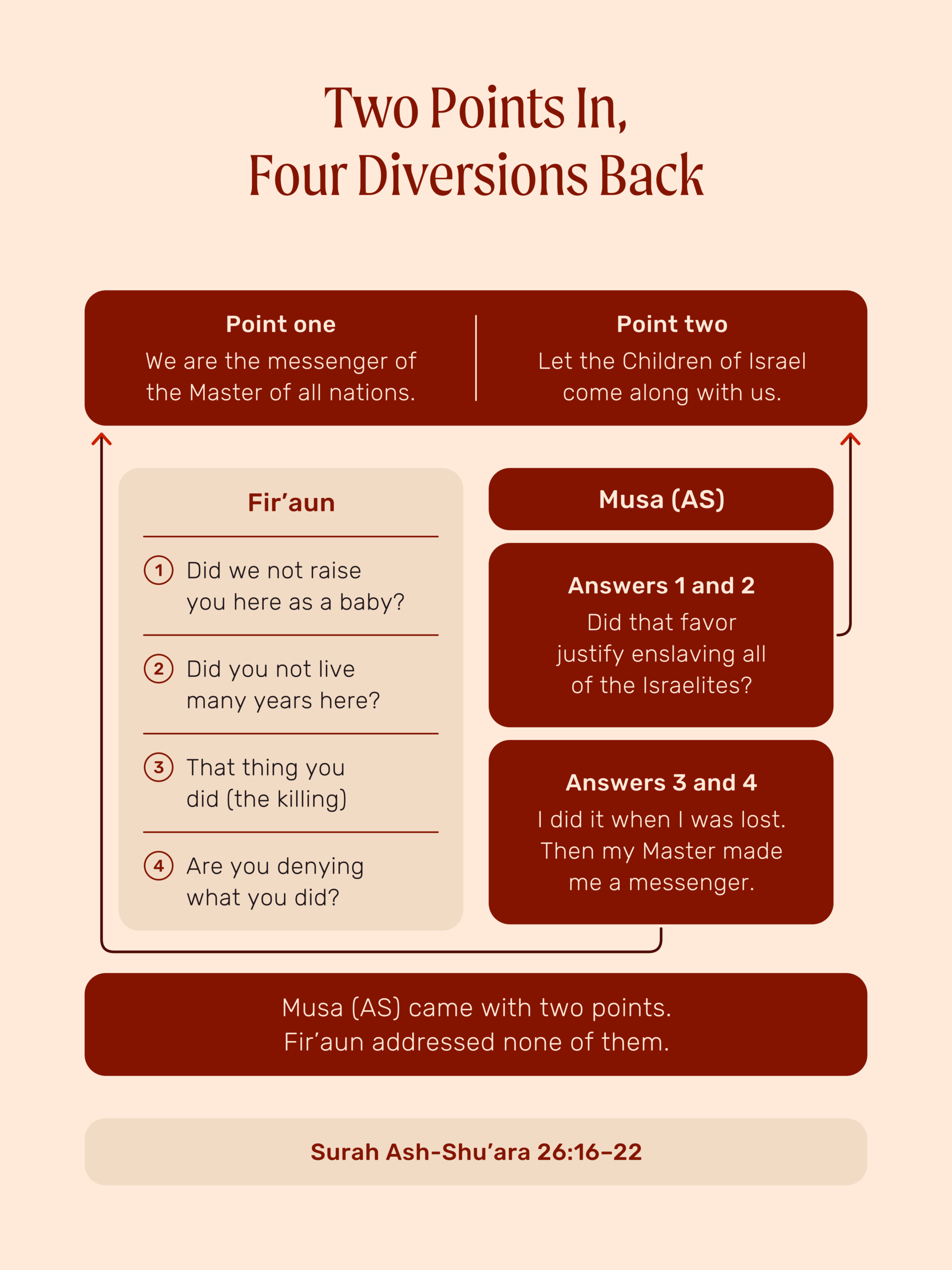
Then the second thing they are told to say: you had better let the Children of Israel come along with us.3
Two Points In, Four Diversions Back
When you walk into the court of a king, you walk in with humility and you praise him. Since Musa (AS) lived in that house and he was wanted for murder, he is supposed to walk in and apologize.
He walks in covered in dirt. His brother is with him. He has a stick in his hand. Fir’aun is up on his throne, looking down on two men who have no power whatsoever.
They say: we are two inseparable messengers of the true Master of all peoples.
What true Master? There are generals in that courtroom. There are security guards. Who do they call master? Fir’aun. These two walk in and say we represent the real Master of all nations. Not just another nation. All nations. Which means including your nation.
They walked into the king’s court and said, actually, you are not the king.
Then the second thing: if you know what is good for you, you had better let the Children of Israel come along with us.
Now what do you think happens to somebody who talks like that to Fir’aun?
Before I tell you, keep track. Point one, we are a messenger of Allah. Point two, let Bani Isra’il go. Two points, both of them insulting. Please do not forget them.
So Fir’aun turns back to him: did we not raise you here as a baby?4 Calling him a baby makes him feel like he is nothing.
Did you not live many years of your life here? Where is your loyalty? This is your house. You should have more respect for the owner of it.
Then: you did that thing of yours that you did.
What did he do? He killed somebody. But Fir’aun does not say you killed a guy. He says, that thing you did. I am not telling everybody else here, but you know what you did, right?
Then, look at the irony, Fir’aun calls Musa (AS) a kafir. What it means here is: are you denying what you did?
That is four things. Raised as a baby. Many years here. The crime. Are you denying it. Musa (AS) came with how many points? Two. How many has Fir’aun addressed?
None of them.
Fir’aun is a genius, man. Evil genius. He completely changed the subject and came out attacking.
Watch Him Catch the Cannonball and Send It Back
He came on a command from Allah to talk about two things. So of the four things Fir’aun brought up, what has to be addressed right away?
The murder.
So he catches that immediately.5 Yes, I did do that. I am not denying it. I did do it, then.
Notice he does not say I killed a person. If Fir’aun will not say it, he is not going to incriminate himself either. I did it at the time. I was lost at the time. As a result, I ran away from all of you.
All of you? I thought he was only talking to Fir’aun. All of a sudden he is talking to everybody in the court.
I ran away from you people when I used to be afraid of you. Meaning: I am back because I am not afraid of you anymore. None of you.
Then: when I ran away, my Master gave me firmness and wisdom and solid decision-making and made me from those who are sent.
Look at the genius of that. Yes, I committed a murder, but as a result of running away from here Allah made me a messenger.
Which was point number one, was it not?
You know what I am reminded of? Kung Fu Panda 2. At the end, when he is getting shot at with cannonballs and he catches the cannonball and, yeah, inner peace and sends it right back.
So: by the way, thanks for that favor you did for me. You raised me as a baby, I spent many years here, I acknowledge it, you provided housing for me.
Did you provide me that housing so that it could justify enslaving all of the Israelites?
Whoa. That was point number two. I will take your change of subject and slap you back with it and make you feel stupid too.
Nobody in That Whole Court Stood Up for Their God
It is not only two people talking. There are people in that court listening and they are confused, because nobody survives this long with Fir’aun.
Fir’aun has to engage the actual subject now. So he starts with the first point by making fun of it.
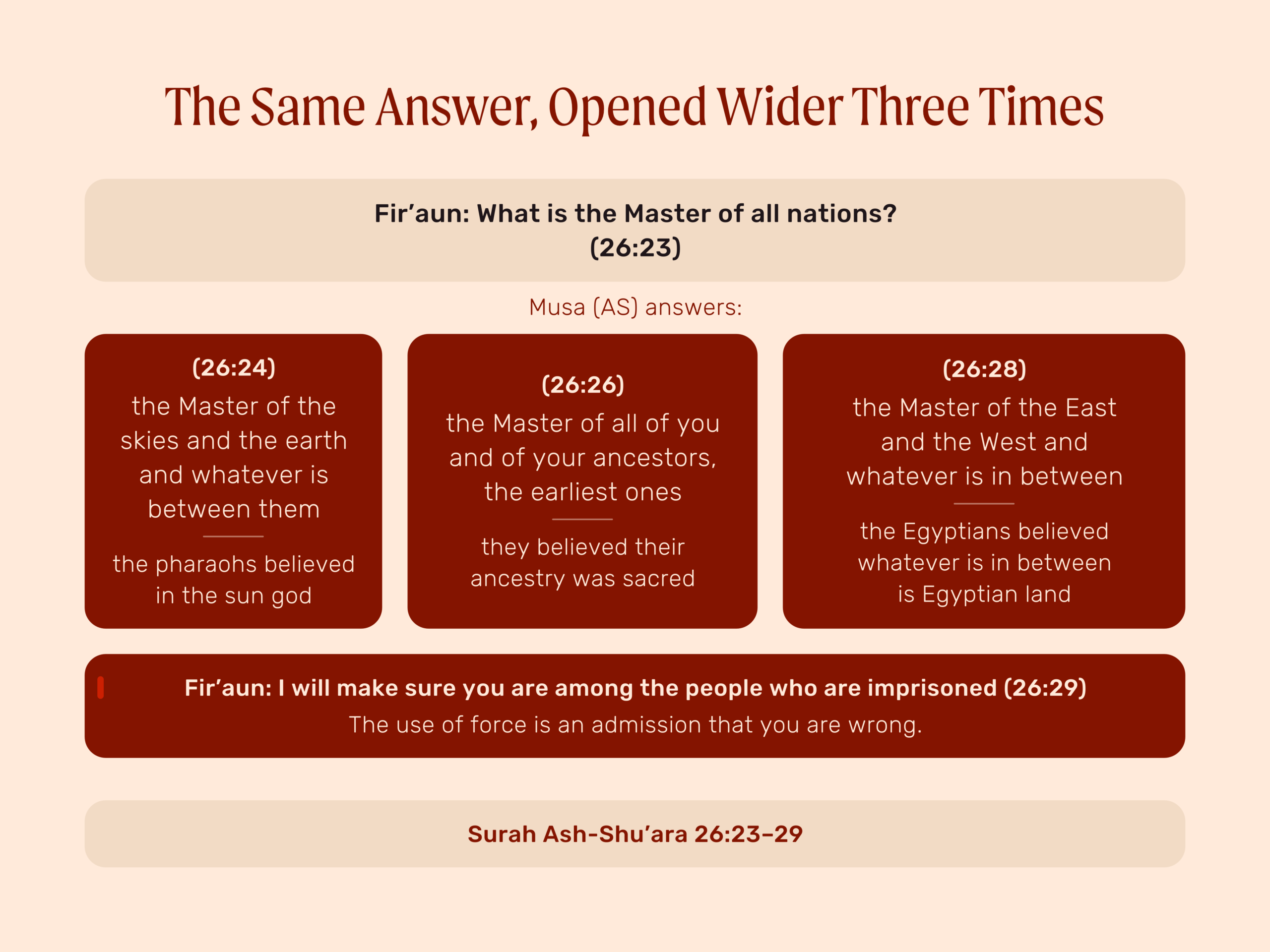
What is the Master of all nations?6
Notice he does not say who. He says what.
Musa (AS) is not deterred. He answers as though a serious question was asked. He is the Master of the skies and the earth and whatever is between them, if all of you are looking to be convinced. This matters because the pharaohs believed in the sun god and that the pharaohs are the children of the sun.
He is not talking to the king now. He is talking to everybody else. That is an insult to a king. In the presence of a king you speak only with the king.
Then Fir’aun notices something. Musa (AS) has now talked about another God besides himself three times.
He expects the people who work under him to believe in him as God. If you genuinely believe in a God and somebody says that is not the real one, should you not be offended? Should somebody not get up and say watch your mouth?
Nobody in the entire court got up. Nobody defended Fir’aun. Some are enjoying it. Some have even become curious. There is a real Master, really? Who is this Master?
So Fir’aun is angry now, not only with Musa (AS). He is angry with his own people, because none of them are angry.
He says to his crowd: are you people not listening to what he is saying?7 Why are none of you offended? Hey, why are you smiling back there?
Musa (AS) acts like he did not even hear it. He is not only your Master. He is the Master of all of you and of your ancestors, the earliest ones. They believed their ancestry was sacred, so he is saying my Master owns your ancestry too.
He is becoming more and more offensive. By the way, did he get off of his point?
Look at where we are. One man walked in from the desert with nothing, a stick in his hand, his brother beside him who is considered a slave. The other was on a throne. Now the tables have turned and one man is controlling the room while the other is losing control of his own court.
Allah is moving the balance of power inside the room.
Now Fir’aun turns to his people: this messenger of yours.8
Whoa. He did not call him Musa. Why? Because the room looked so impressed that it almost felt like they had already accepted him as a messenger. So, let us welcome the one who has apparently been sent to all of you. Clearly he is not sent to me. Let me tell you, he is crazy. Stop listening to him.
Musa (AS) is very calm. He is also the Master of the East and the West and whatever is in between, if a few of you can understand.
Now he has gone way too far. You know why? Because the Egyptians believed the sun rises and sets in the Egyptian Empire and whatever is in between is Egyptian land.
He is saying, my Master is the true Master of the Egyptian land. So if you guys understand what I am saying, let us get rid of this idiot and worship the true God.
He is asking for a military coup. In the middle of the conversation.
When You Answer With Force, You Have Already Lost
Fir’aun catches wind of it. This is not just about some faith anymore. This conversation is becoming dangerous for my kingdom.
So: if you take any other god besides me, I will make sure you are among the people who are imprisoned.9
It is important that he did not just threaten prison. It is prison among others.
That was to instill fear into the people in the room. Do not get any ideas. I had better not see a shahada in this room. You understand?
Musa (AS) realizes the time for talking is over. If he speaks any more he is going to get hauled away.
When you have a debate with somebody, because this is a debate, is it not and the one you are debating says, you had better stop talking or I will throw you in jail. Instead of responding with an argument, you respond with the threat of force.
When you respond with force, you have accepted the defeat of your arguments. You had none left, which is why you reached for the only other weapon you have.
So the use of force is actually an admission that you are wrong. Because your words were not enough.
Now everybody in that room knows Fir’aun has been defeated. He has been crushed. In front of his people, in his house, in his court.
I am going to stop here.
But I will tell you why I shared this dialogue at the end. I shared it to give you the overall goal of Divine Speech, which is to illustrate that the Quran is a living text. The Book describes the narrative in a way that takes you inside the world. You get inside and it is an incredible place. It is, in my personal opinion, so underestimated.
My eventual goal is to make Arabic easy to learn for every human being on this planet.
I am so very grateful for the love and the appreciation you have given myself and all of my team. If Allah does not give us a chance to meet again, I hope you and I meet in a much, much, much better place.
This is the last session of the course and the twelve before it build the method that makes an exchange like this readable. Study Divine Speech with Ustadh Nouman Ali Khan on Bayyinah TV: Bayyinah TV
Notes
This post is adapted from the final session of Divine Speech on Bayyinah TV and is written in the voice of that session. Every teaching claim, example and aside in it is taken from the session itself.
[1] Al-Quran, Surah Ash-Shu’ara, 26:10-11, https://quran.com/26/10-11
[2] Al-Quran, Surah Ash-Shu’ara, 26:16, https://quran.com/26/16
[3] Al-Quran, Surah Ash-Shu’ara, 26:17, https://quran.com/26/17
[4] Al-Quran, Surah Ash-Shu’ara, 26:18-19, https://quran.com/26/18-19
[5] Al-Quran, Surah Ash-Shu’ara, 26:20-22, https://quran.com/26/20-22
[6] Al-Quran, Surah Ash-Shu’ara, 26:23-24, https://quran.com/26/23-24
[7] Al-Quran, Surah Ash-Shu’ara, 26:25-26, https://quran.com/26/25-26
[8] Al-Quran, Surah Ash-Shu’ara, 26:27-28, https://quran.com/26/27-28
[9] Al-Quran, Surah Ash-Shu’ara, 26:29, https://quran.com/26/29

At Bayyinah, we are dedicated to helping you connect directly with the words of Allah beyond translation. Founded by Ustadh Nouman Ali Khan, our mission is to create transformative experiences that deepen your understanding and engagement with the Quran.
Study the Quran and Arabic in a systematic and personalized way through Bayyinah TV. Get started today for free.
Check out our newest articles, fresh off the press and ready for you to dive into!