
Successful subscription! Thank you for subscribing.
Successful subscription! Thank you for subscribing.

July 29, 2026
Surah At-Talaq is a short Madani surah, just twelve verses, named after one of the most painful experiences a family can go through: divorce. Yet for a surah about the breakdown of a marriage, its tone is remarkably full of hope. Tucked right inside its legal instructions are some of the most beloved promises in the entire Quran. This post introduces the surah, its two halves and the astonishing promise it places at the very heart of life’s hardest moments.
A Surah in Two Halves
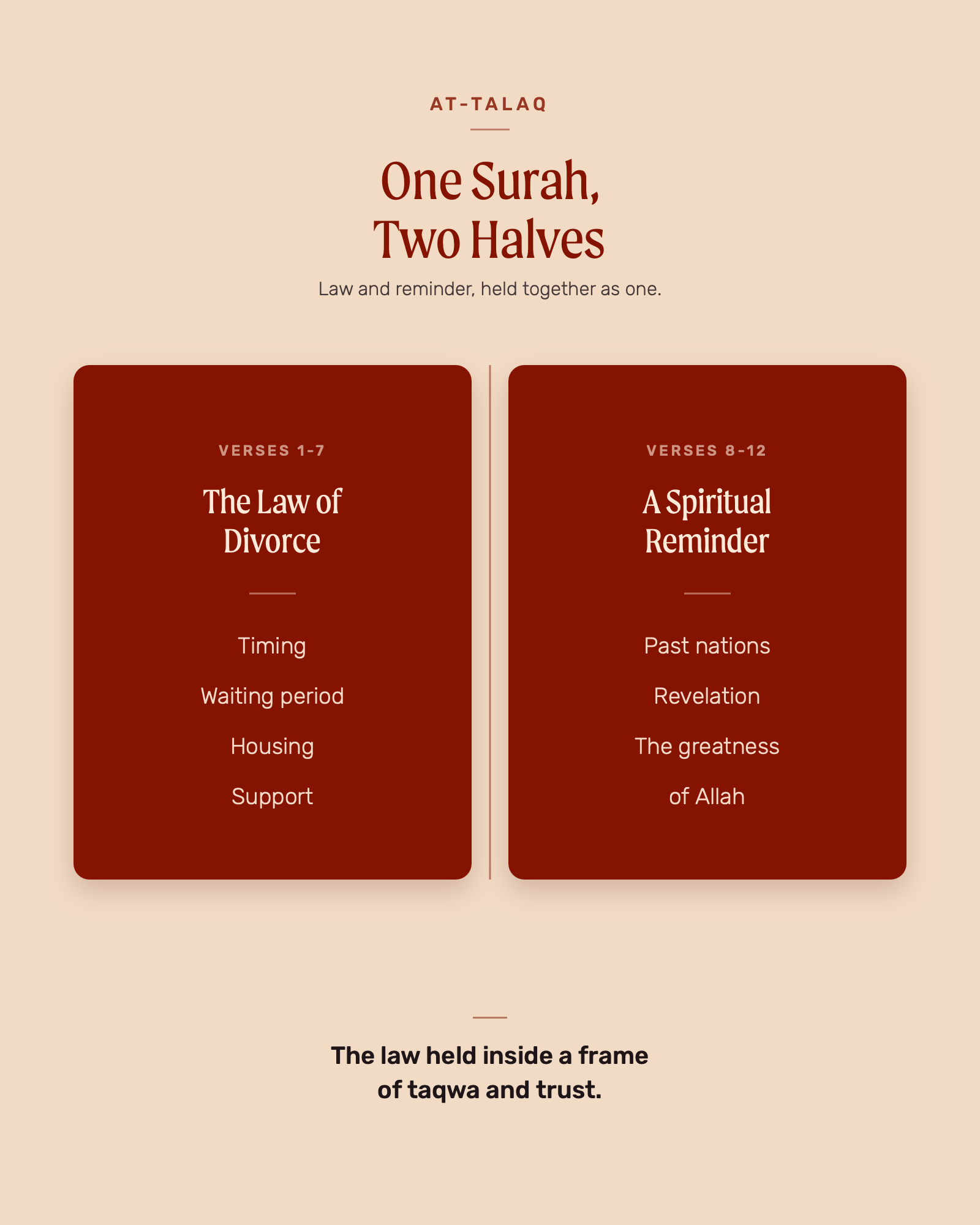
At-Talaq divides cleanly into two parts. The first seven verses lay out regulations around divorce: its timing, the waiting period, housing and maintenance, witnesses and care for a pregnant or nursing wife. The last five verses then shift into something that at first seems unrelated, a powerful spiritual reminder about past nations, revelation and the greatness of Allah. The surprise is how naturally the two halves belong together: the law of a breaking marriage is held inside a frame of God-consciousness and trust, so that even legal detail keeps pointing the heart back to Allah.
The Hardest Moment, Wrapped in Taqwa
Notice how the very first verse frames the entire subject. Even as it sets out the procedure for divorce, it commands the believers to fear Allah their Lord and not to wrong one another in the process (65:1)1. This matters because divorce is exactly the moment when people feel most justified in being cruel, in score-settling, withholding and lashing out. The surah refuses to let the breakdown of a relationship become a licence to abandon God-consciousness. The harder the situation, it implies, the more taqwa it demands.
A Way Out and Provision You Didn’t Expect
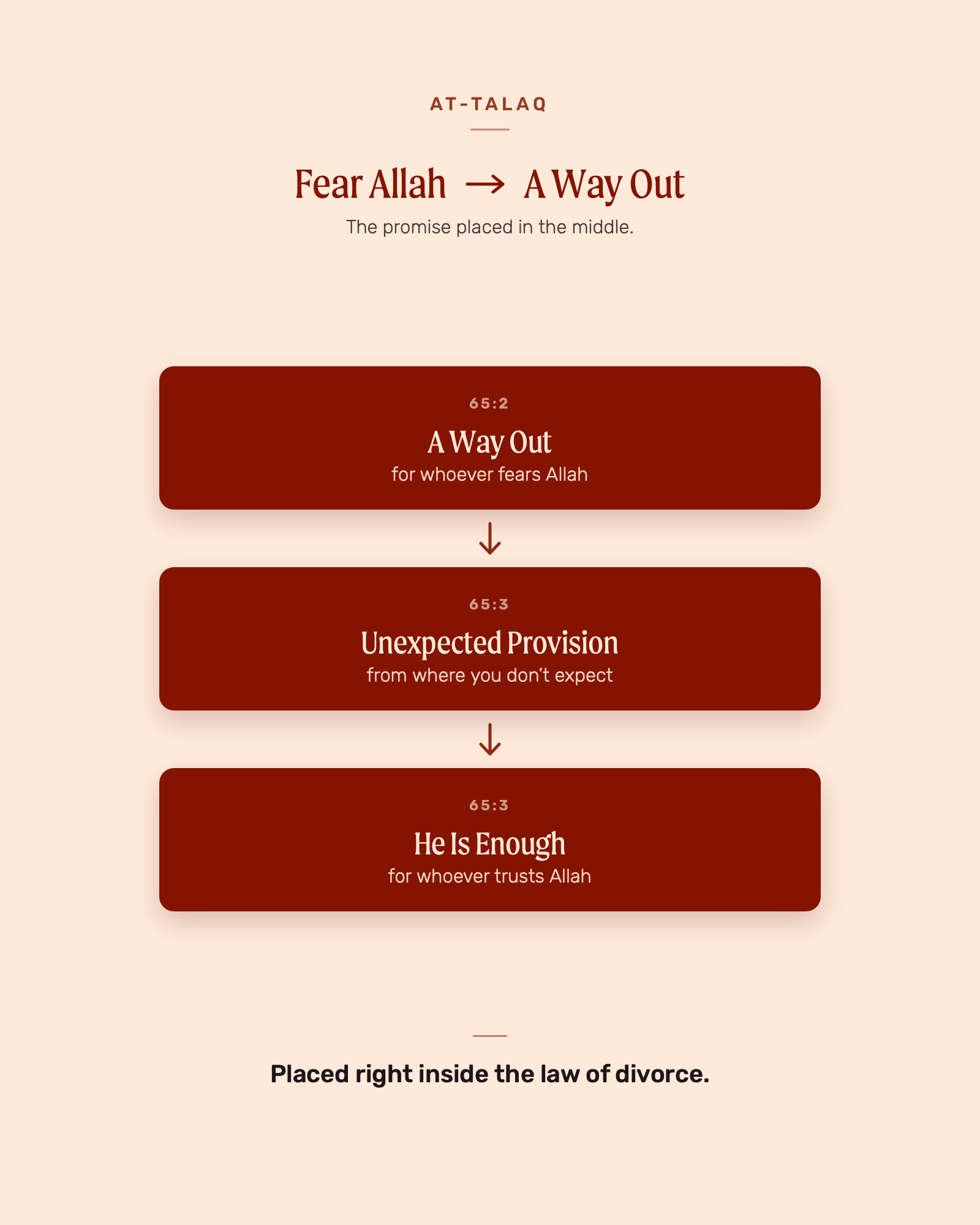
Then, right in the middle of the divorce regulations, the surah pauses to make a promise that has comforted believers for centuries (65:2-3)2.
وَمَن يَتَّقِ ٱللَّهَ يَجْعَل لَّهُۥ مَخْرَجًا
“And whoever fears Allah, He will make for him a way out.”
(65:2)
وَيَرْزُقْهُ مِنْ حَيْثُ لَا يَحْتَسِبُ
“And He will provide for him from where he does not expect.”
(65:3)
Whoever is mindful of Allah, He will make for them a way out and provide for them from where they never imagined; and whoever puts their trust in Allah, He is enough for them. Look at where this promise sits, not in a passage about worship or paradise, but inside the law of divorce, one of the most frightening, uncertain moments in a person’s life, when the future suddenly looks impossible and the provision a marriage once gave seems gone. Precisely there, the surah promises a way out and provision from the unseen. It is as if Allah anchors the most anxious human situation to the most reassuring promise He gives.
No Soul Beyond Its Capacity
The first half closes with the same gentle realism. Each person is to spend according to their means and Allah does not burden any soul beyond what He has given it; after hardship, He will bring ease (65:7)3. Even the financial obligations of divorce are scaled to capacity, never crushing. The law is firm, but it is never heartless and it always leaves the door open to relief.
The Takeaway
Surah At-Talaq takes the wreckage of a broken marriage and surrounds it with God-consciousness, mercy and hope. Its rules are not cold procedure; they are wrapped in a promise that the one who fears Allah will be given a way out and provided for from where they never expected. Read it in any hard transition, not only divorce and its central promise speaks directly to you: hold on to Allah and the door you cannot see is already being opened.
There is far more to Surah At-Talaq than a single article can hold. You can explore the full At-Talaq: A Deeper Look series on Bayyinah TV, alongside the other surahs being opened up in the Deeper Look collection.
Related reading: When Your World Is Breaking, Look Up: Reading the End of Surah At-Talaq (the companion post in this series).
Notes
[1] Quran, 65:1, https://quran.com/65/1 ↩
[2] Quran, 65:2-3, https://quran.com/65/2 ↩
[3] Quran, 65:7, https://quran.com/65/7 ↩

At Bayyinah, we are dedicated to helping you connect directly with the words of Allah beyond translation. Founded by Ustadh Nouman Ali Khan, our mission is to create transformative experiences that deepen your understanding and engagement with the Quran.
Study the Quran and Arabic in a systematic and personalized way through Bayyinah TV. Get started today for free.
Check out our newest articles, fresh off the press and ready for you to dive into!