Successful subscription! Thank you for subscribing.
Successful subscription! Thank you for subscribing.

October 25, 2026
There is a specific kind of shame that lives in the closed project. Not the loud shame of a public failure, but the quieter kind, the kind that sits in the back of your Google Drive in a folder you never open. The Notion workspace you stopped updating. The course you built, launched and then quietly stopped talking about. The initiative that had a real run and then just, at some point, didn’t anymore.
I think a lot of builders carry this. We talk endlessly about starting things. We don’t really have a language for ending them well.
The surah that starts with time
Okay so I want to anchor this in something Ustadh Nouman has taught, because it reframes the whole question.
In his explanation of Surah Al-‘Asr, Ustadh breaks down the word ‘asr itself and it’s not what most of us were taught. The root carries the image of squeezing, like pressing olives, fluid coming out drop by drop. He explains that time doesn’t announce itself leaving, it drips. “You think you have time, but before you know it, Maghrib has come.” And then there’s Farahi’s addition, which Ustadh highlights: al-‘asr is specifically used for time that’s already gone, the good old days, the time you didn’t take advantage of. So the word carries two things at once: urgency about the little time remaining and regret about what’s already passed.
The surah then says every human being is already in loss, not heading toward it, already in it, already drowning. The word used is fee, meaning “in,” not “approaching.” Ustadh points out this is deliberate. We don’t see it because this life is mataa’ al-ghuroor, a means of deception. We think we’re running toward success when we’re often running toward our own exhaustion.
What I took from this and what I keep returning to: time is not neutral. It is squeezing. And Imam Razi’s commentary in this same passage is that loss means missing opportunities you could have taken advantage of, squandered chances, not just material loss. If that’s the definition, then clinging to a project past its season is itself a form of loss. You are spending time you don’t have, on something whose window has closed.
Quitting from fear versus closing from clarity
These are not the same thing and I think the confusion between them is why so many of us can’t make the call cleanly.
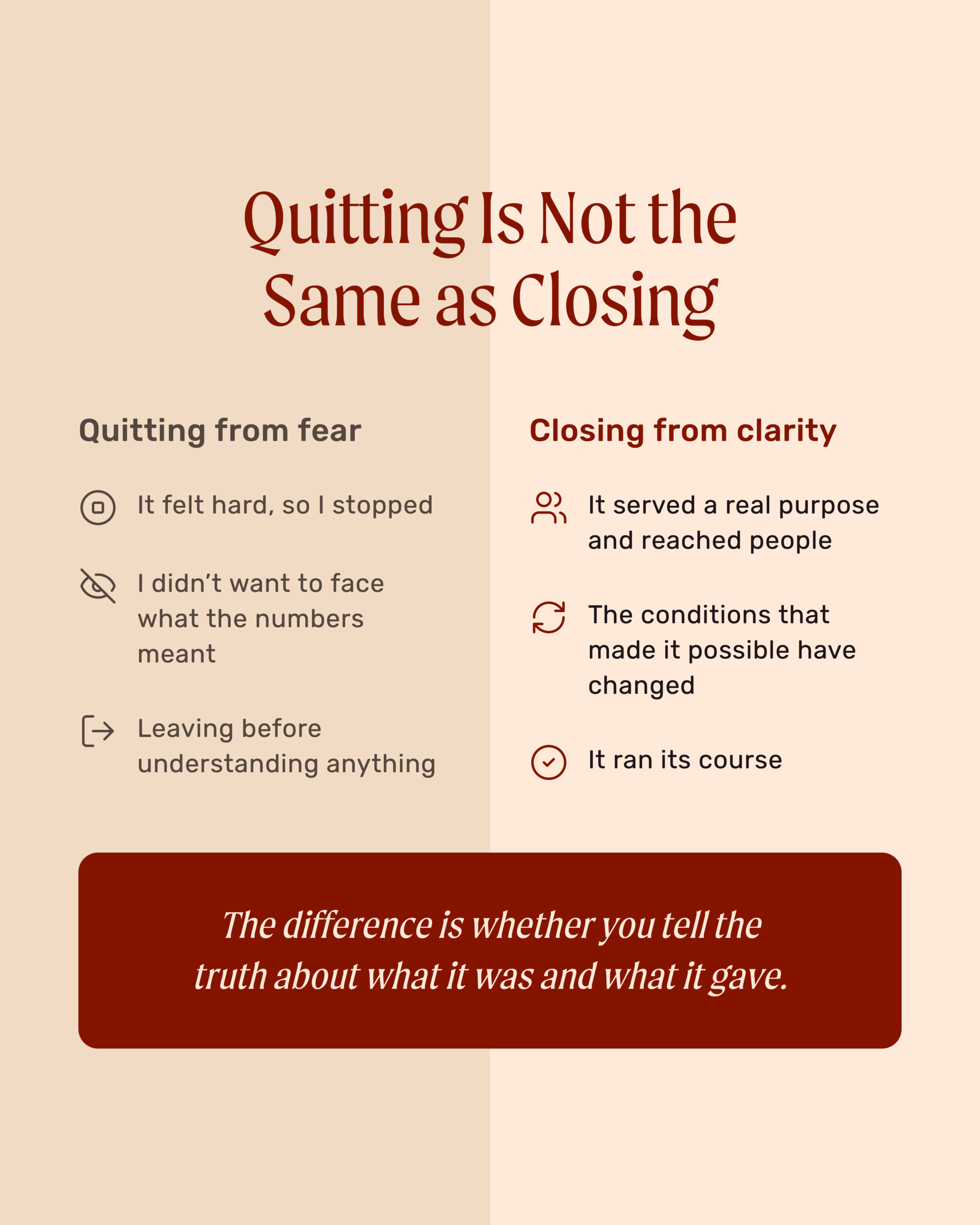
Quitting from fear looks like: the launch didn’t go well, it felt hard, I don’t want to face what the numbers mean, so I stop before I have to reckon with it. There’s no honesty in it. You’re leaving before you’ve understood anything.
Closing from clarity looks different. It looks like: this served a real purpose. It reached people. It did something. And now the conditions that made it necessary, or possible, or sustainable, have changed. The thing ran its course.
Tanveen from India wrote to us after Issue 3 about a project she had run for almost two years, a community-learning initiative she’d poured herself into. She said she kept it going well past the point it made sense because she didn’t want people to think she was a quitter. And what she eventually realized was that the people she had served didn’t need her to keep running the container, they needed her to have the courage to say: this chapter is complete and here is what came out of it.
That’s not quitting. That’s closing well.
Closing well is itself amana
This is the part people don’t expect. How you close something is a trust. The people who participated in it, who believed in it, who built alongside you, they deserve a real ending, not just a fade-out, not a landing page that just stops loading one day.
Amana doesn’t only apply to what you build. It applies to how you let it go.
A reader building a Quran memorization tool wrote to us something I’ve been thinking about since, that there’s a version of closing something that honors it and a version that abandons it. The difference is whether you tell the truth about what it was and what it gave before you let it go.
I don’t think we model this well in the Muslim entrepreneur space. We talk about hustle, about istiqama, about not giving up. Those are real values. But sometimes the most honest thing you can do is say: this was real, it mattered and it’s done.
You are allowed to close it
Surah Al-‘Asr ends with an exception, illa, those who believe and do righteous deeds and counsel each other toward truth and toward patience. Ustadh makes a point about the structure here: the exception is not a separate sentence, it’s part of the same one. The whole surah is one sentence. Every human being is in loss, except. The except does not erase the loss, it redirects it.
What this means for me is that the goal was never to avoid loss entirely. It was to use the time that’s being squeezed out of you in a way that is worth something. Sabr in this context is not just endurance, it’s the patience to do things properly, including the ending.
So here is the permission, as plainly as I can give it.
If you built something and it ran its course, you are not a failure. You are not someone who couldn’t stick it out. If you counseled yourself honestly and the answer was: the season for this has passed, then closing it with care and honesty is exactly what the work deserves. Starting well gets all the attention. Closing well is just as much a part of the craft.
The project that served its season is not a project that failed. It is a project that was used fully, the way Ustadh describes time being used, with awareness that it’s dripping, so you don’t waste a drop of what’s left.
May Allah give us the clarity to know when something has run its course, the courage to close it with honesty and care, and the wisdom to release it without shame.
If this resonated with where you are right now, we’d love to have you in the Bayyinah Works community. Join the newsletter at bayyinah.com/works.

At Bayyinah, we are dedicated to helping you connect directly with the words of Allah beyond translation. Founded by Ustadh Nouman Ali Khan, our mission is to create transformative experiences that deepen your understanding and engagement with the Quran.
Study the Quran and Arabic in a systematic and personalized way through Bayyinah TV. Get started today for free.
Check out our newest articles, fresh off the press and ready for you to dive into!