
Successful subscription! Thank you for subscribing.
Successful subscription! Thank you for subscribing.
July 24, 2026
Surah Al-Kahf is famous for its four stories: the People of the Cave, the man with two gardens, Musa (AS) and al-Khidr and Dhul Qarnain. Read quickly, they can feel like a loose collection. Look at how the surah is arranged, though and a deliberate design appears, one where the stories mirror one another and even sit in a meaningful order.
This post traces that structure and then looks closely at the two stories placed back to back at the heart of it, Musa (AS) and Dhul Qarnain.
A Surah Built as a Ring
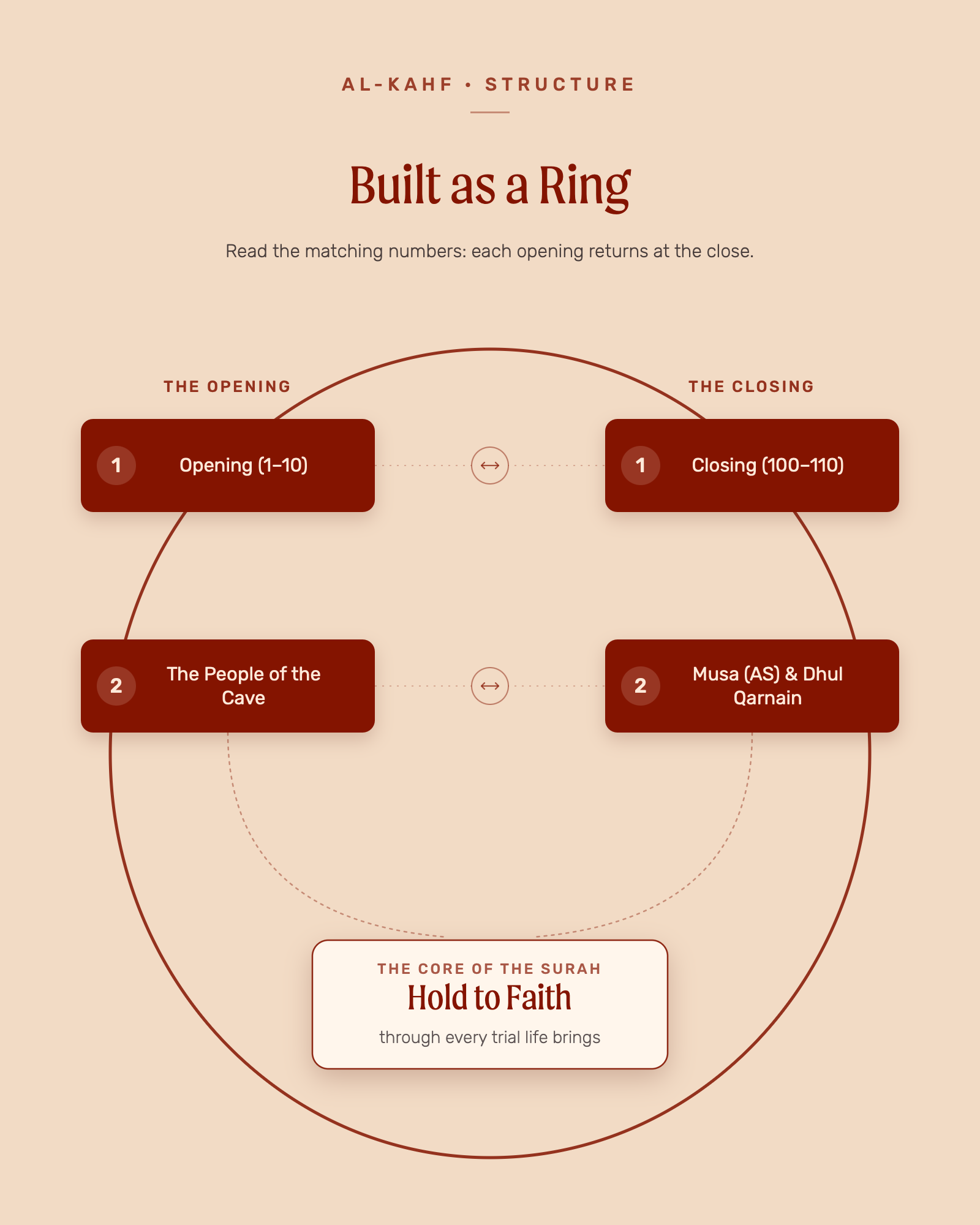
The surah opens and closes on matching passages, ayat 1-10 answering ayat 100-110, beginning with praise to the One who sent down the Book to His servant (18:1).1 Move inward and the story of the Cave near the start pairs with the two stories near the end and the whole surah folds toward its middle, where its central message sits. The outer edges speak to the inner core and the order of the stories is part of the teaching, not an accident.
Power and Powerlessness
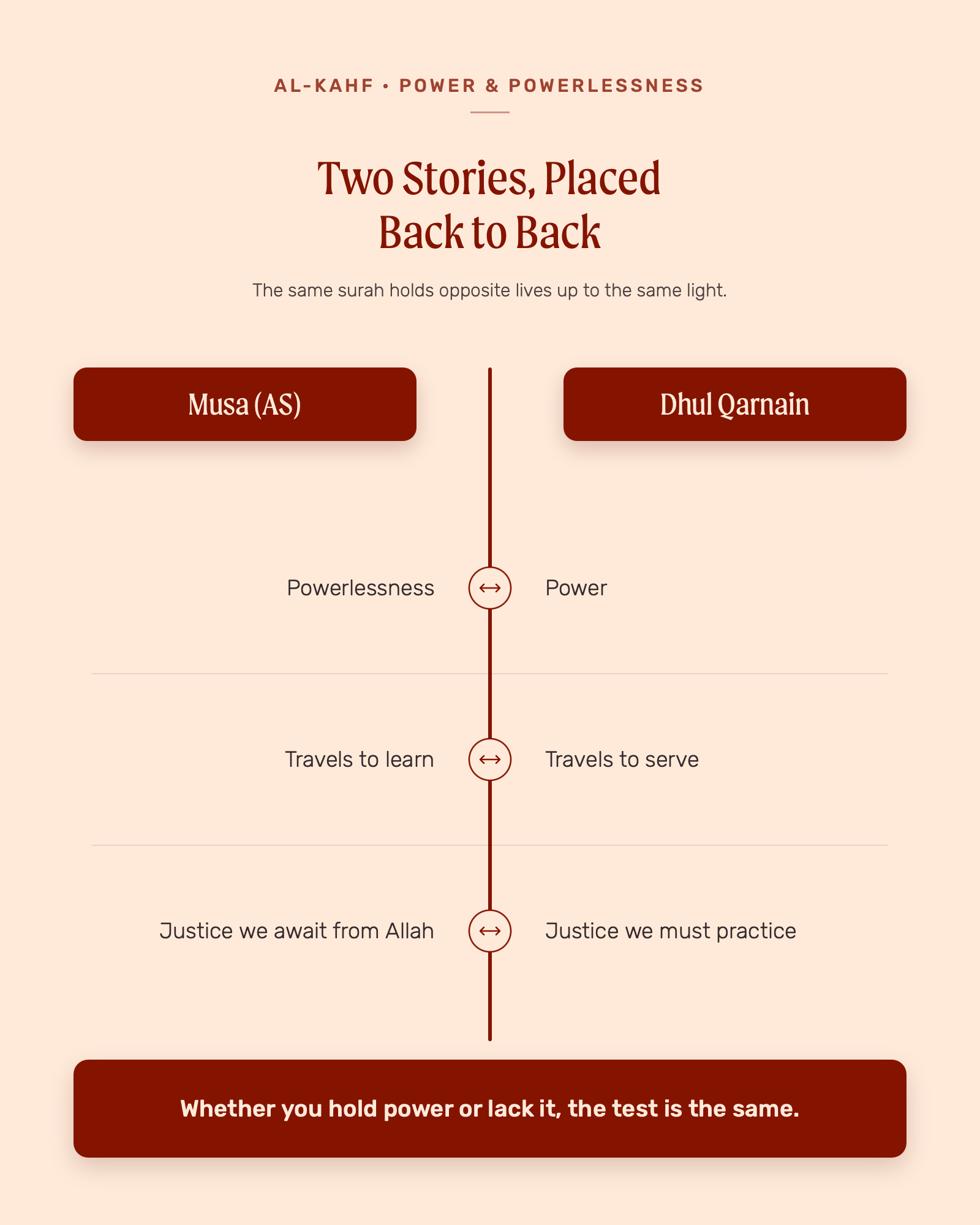
The two stories at the heart of the surah are built as opposites. Musa (AS) sets out with no nation behind him, unsure he can even reach his destination, declaring he will press on even if it takes him ages (18:60).2 His one resource on the journey is a packed meal that runs out. Dhul Qarnain, by contrast, is introduced as someone Allah established in the land and gave the means to everything (18:84).3 One story is steeped in powerlessness, the other in power and the contrast is the point.
Two Kinds of Service
Their journeys point in opposite directions too. Musa (AS) travels in order to learn, for his own benefit, asking,
هَلْ أَتَّبِعُكَ عَلَىٰ أَن تُعَلِّمَنِ مِمَّا عُلِّمْتَ رُشْدًا
“May I follow you so that you teach me some of what you have been taught of right guidance?”
(18:66)
That request is entirely about himself (18:66).4 Dhul Qarnain travels the other way, arriving everywhere as a benefit to others. Placed side by side, the two stories hold a tension every believer feels: the inward, spiritual quest to enrich your own soul and the outward quest to serve and change the world. Neither one is meant to be a whole life on its own and the surah refuses to let us treat either as the only valid path.
Two Kinds of Justice
Justice appears in two forms across these stories. Al-Khidr damages a boat and takes a life in ways that look, to human eyes, like injustice, until we are told this was the interpretation of what Musa (AS) could not bear patiently (18:82).5 Dhul Qarnain, given authority over a people, is told he may punish or treat them with kindness (18:86).6
إِمَّآ أَن تُعَذِّبَ وَإِمَّآ أَن تَتَّخِذَ فِيهِمْ حُسْنًا
“Either you punish or you treat them with kindness.”
(18:86)
The lesson is that justice in Allah’s hands can look like injustice to us and still be perfect justice, while justice in human hands must follow the clear, fair policy that Dhul Qarnain models. We are not given al-Khidr’s license, because we do not have his knowledge.
What Allah Chooses Not to Tell Us
Right at the start of the journey, Musa (AS) is warned that he will not be able to be patient with what he is about to see (18:67).7 And that is exactly the point of the gray, unresolved corners of these stories. We are simply not made privy to everything; some chapters of history and some reasons behind events are kept from us. Part of being guided is being at peace with the questions Allah leaves unanswered, humble before what we cannot fully encompass.
The Same Ending, Mirrored
Even the endings rhyme. Musa (AS) and al-Khidr part after a wall is repaired and then explained; Dhul Qarnain builds a mighty wall and says that when his Lord’s promise comes, He will level it, calling the whole thing a mercy from Allah (18:98).8 One story moves from breaking to mercy, the other from mercy to breaking, mirror images that close the pair. This is what the structure keeps showing: nothing here is randomly placed.
The Takeaway
Surah Al-Kahf is not a scrapbook of unrelated tales. It is one connected design, folded so its end answers its beginning and its paired stories teach by contrast: power and powerlessness, serving yourself and serving others, the justice we await from Allah and the justice we must practice ourselves. Read it as a whole and the placement of every story becomes part of the message.
There is far more symmetry in Surah Al-Kahf than a single article can hold. You can explore the full Al-Kahf: A Deeper Look series on Bayyinah TV, alongside the other surahs being opened up in the Deeper Look collection.
Related reading: How to Approach the Quran: The Mindset That Unlocks Its Guidance (the companion post in this series).
Notes
[1] Quran, 18:1, https://quran.com/18/1 ↩
[2] Quran, 18:60, https://quran.com/18/60 ↩
[3] Quran, 18:84, https://quran.com/18/84 ↩
[4] Quran, 18:66, https://quran.com/18/66 ↩
[5] Quran, 18:82, https://quran.com/18/82 ↩
[6] Quran, 18:86, https://quran.com/18/86 ↩
[7] Quran, 18:67, https://quran.com/18/67 ↩
[8] Quran, 18:98, https://quran.com/18/98 ↩

At Bayyinah, we are dedicated to helping you connect directly with the words of Allah beyond translation. Founded by Ustadh Nouman Ali Khan, our mission is to create transformative experiences that deepen your understanding and engagement with the Quran.
Study the Quran and Arabic in a systematic and personalized way through Bayyinah TV. Get started today for free.
Check out our newest articles, fresh off the press and ready for you to dive into!