
Successful subscription! Thank you for subscribing.
Successful subscription! Thank you for subscribing.

November 20, 2026
We are starting something and I want to tell you what it is.
Myself and Qari Ibrahim Bakir are doing a series called The Quran for Hearts & Minds: The Power of Maqamat. If you are not familiar with the subject, the way to introduce it is fairly easy.
Allah revealed a book to us that is unlike any other book.
The Quran Does Not Move in a Straight Line
It is not structured with chapters and paragraphs moving forward in a linear fashion. If you look at it from a literature perspective, if some non-Muslim was just reading a translation of the Quran, they would say this book is not linear.
So here is the question I want to start with. What kind of effect does the Quran have on you when it moves up and down, changes subjects, repeats stories? What does that do to a reader?
One Aisle of the Library at a Time
Think about how Allah made us. We are intellectual. We are philosophical. We are emotional. We are spiritual. We think about sociological concerns, we think about legal concerns, we think about beauty, we think about history. Our minds are scattered in so many directions.
Now, if you wanted to take one of those concerns, what do you do?
Philosophical? You pick up a book on philosophy. History? You pick up a book on history. Society? Sociology. Law? You pick up a legal book or a constitutional book. Your emotions, your psychology? You pick up a book on psychology or spirituality.
Each of these is almost a different aisle. A different wing of the library.
Here is the thing about that. When a university student is sitting in a philosophy class, they are not thinking about history. They are not thinking about law. They are not thinking about other areas of life. They are thinking about this one subject. If they are thinking about nature, they are not thinking about society.
One mind frame at a time. That is how we operate.
Think of the Human Psyche as Buttons
Now this is a bad analogy, so bear with me.
If you think of the human psyche, our whole way of internalizing the world, as multiple buttons, then when you listen to the Quran it is like it is pressing all of those buttons simultaneously. It is touching all of those pieces at once.
One of the big pieces the Quran touches is emotions.
It is a very powerful book in terms of what effect it has on your emotions and mine when we listen to it, when we contemplate it. So it is not only a book I am supposed to contemplate and ponder and do tadabbur on. That is one side of the dimension. That tadabbur is supposed to have a direct impact on my emotions.
The Quran Did Not Come Only for Scholars
It did not come only for people who are going to spend thousands of hours pouring over every ayah.
The Quran came for every human being. There are people working on a farm. There are people driving a taxi today. There are people working at a store. There are people cooking food at home. There is the young, there is the old, there are people from all walks of life that the Quran came to speak to. That includes the scholar too, of course. It is a guidance and a message for all of humanity.
Think about what that requires.
If this book is for everybody, there had to be a system by which feeling the emotions of the Quran and as a result contemplating the Quran with those emotions in mind, would become easy.
Recite It Slowly. Recite It Beautifully.
So look at what Allah gave us. He instructed His Prophet ﷺ, warattil al-Quran tartila (وَرَتِّلِ ٱلۡقُرۡءَانَ تَرۡتِيلًا). Recite the Quran in a slow, rhythmic fashion.1 The Prophet ﷺ himself told us to recite it rhythmically, to recite it beautifully.
There is a divine music to the Quran. There is a divine essence to the Quran that is captured in the melody of the recitation.
It is not music like musical instruments or concerts or anything like that. It is a different experience altogether.
What Song Is That?
One time I was at a gas station listening to Quran recitation. It was a little bit loud and I was pumping my gas.
The guy from the other car comes up to me. He goes, what song is that?
It is not a song.
But what is it? It feels like a song.
I said, that is God. That is God’s words.
He goes, can I get it.
It stopped him in his tracks.
The Man I Am Sitting With
In the introduction that opens the series, Qari Ibrahim Bakir is described as a scholar and a world-renowned reciter of the Quran. He graduated from Al-Azhar University and specializes in the interpretation of the Quran and in the maqamat of its recitation. He holds an exceptionally rare ijazah in Quran recitation, with a chain of narration that puts only thirty-five teachers between him and our Prophet ﷺ, through the companion Abu Musa al-Ash’ari (RA). He has even trained a couple of the imams of Masjid al-Haram in Makkah.
The introduction also replays a clip of him from last year’s Maqamat series explaining what a maqam is and it is worth slowing down for.
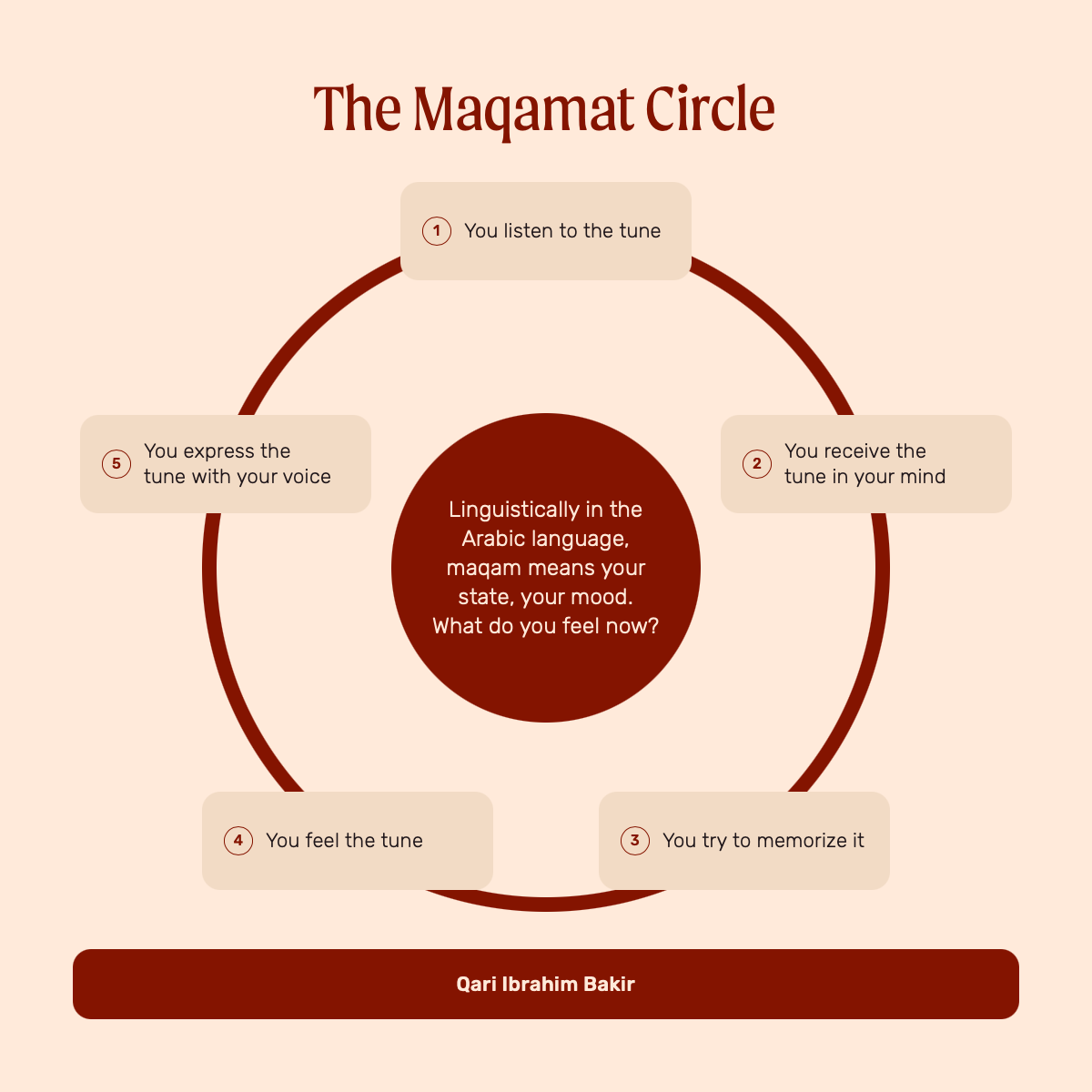
Maqamat is an Arabic word. It is the plural of maqam and as he puts it, the word has two definitions. There is the linguistic maqam and there is, let us say, the scientific one.
“Linguistically in the Arabic language, maqam means your state, your mood. What do you feel now?”
Then he describes it as a circle. “You listen to the tune, then you receive the tune in your mind. You try to memorize it, then you feel the tune, then you express the tune with your voice. That is the maqamat circle.”
His Cats and Birds on a Bench in Denmark
He said something to me about how this book arrives.
“The beauty of the Quran, it comes recited. Not as a book that you have to read only.”
Then he started telling me stories.
“I have a lot of stories, even with animals. Even with my own cats. If you recite the Quran with one tune, you can tell the impression on the animal itself. With a different tune, different. If you recite with no tunes, nothing is going to change.”
He had a story about birds too.
“I walk a lot and recite sometimes. One time I just got tired, I sat at a bench in Denmark and I was just sitting reciting Quran and these birds just started coming and sitting next to me. The moment I stopped reciting, they all flew up. Sometimes I was reciting with some tunes and these things happened to me. I couldn’t even record it, because I was in the feeling, in the mood. I didn’t like to bother myself at the time.”
The First Link Was the Recitation
I asked him to share a story about his mom, because it speaks to this part of the Quran’s experience.
“Wallahi, things you cannot even imagine, with my mom or even my wife. A lot of stories where the beauty of the recitation of the Quran is the first thing that brought them to Islam.”
Then the sequence. “They go through the beauty of the recitation of the Quran, then they come back to learn what Allah said. The first link was the recitation.”
The Funnel They Teach You in Business School
I went to business school and in marketing they have this funnel concept. They have had it for decades.
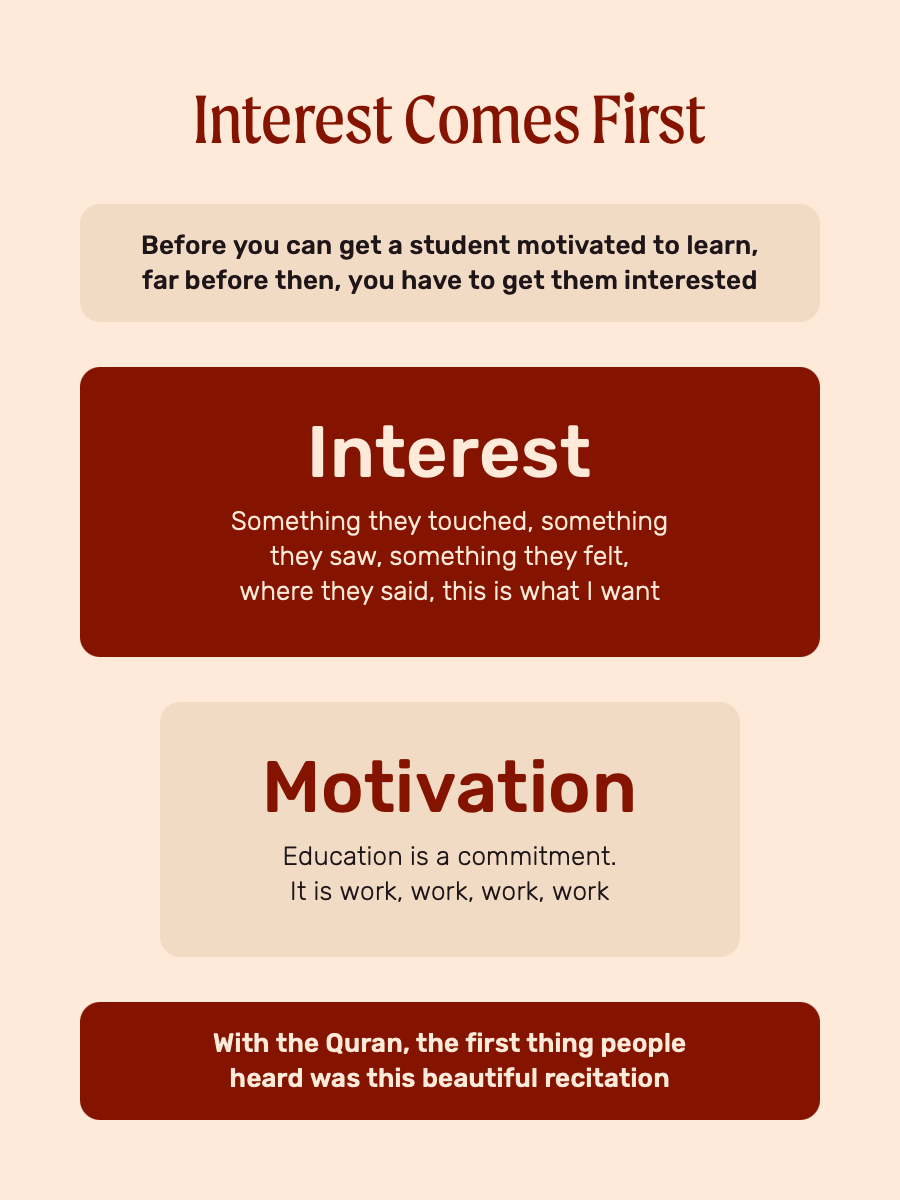
The funnel goes like this. If you want to educate someone, understand that education is a commitment. They have to sign up for a class, pay a fee, leave work, take the train, take the bus, get to the university, sit in the classroom. That is a lot of effort. Even after they sit down, they have to pay attention, take notes, do the homework. It is work, work, work, work.
So you need motivation. You cannot do all of that without an engine.
Before you can get a student motivated to learn, far before then, you have to get them interested.
The interest will not come from the classroom.
The interest comes from something they touched, something they saw, something they felt, where they said, this is what I want. If that thing is powerful enough, then they are willing to go through the expense of time and money and comfort to get it. Because what they saw was so attractive that they are willing to go through anything for it.
Now go back to the Quran. The first thing people heard was this beautiful recitation.
It is not just the words either. You could give somebody words on a piece of paper. But hearing the words being recited is not the same as reading them off a page. When you hear them recited in this incredible, powerful way, it is not just touching the mind. It is touching the heart.
Hearts and Minds and Why We Called It That
We named it The Quran for Hearts & Minds for a reason.
The style of recitation and the way in which the qari is supposed to deliver the emotions of the ayat, has this unspoken effect on the listener. It takes them into the world of the Quran. In my view it is the most powerful way to take somebody into the world of the Quran.
Because we are not just supposed to have a relationship with the Quran where we understand the Quran. We are supposed to have a relationship with the Quran where we feel the Quran. You cannot feel the Quran if you do not connect it with your own feelings and you cannot connect with your own feelings…
Qari Ibrahim finished that thought for me.
“Except with the maqams. Without tunes, forget about it.”
One Emotion at a Time
So that is what I am excited to do.
Over the course of these episodes we are going to take one emotion at a time. We will take some of the very emotionally charged moments in the lives of prophets and in the lives of the people mentioned in the Quran and try to understand what those emotions actually were. Then I am going to have Qari Ibrahim recite those ayat and we will see if we can feel those emotions as we hear him recite them.
My hope is that as we listen to these episodes and watch them and really enjoy the recitation with our hearts, we develop a lifestyle habit of connecting to the Quran intellectually, emotionally and spiritually.
Six more episodes take one emotion at a time and put it to recitation. Watch The Quran for Hearts & Minds with Ustadh Nouman Ali Khan and Qari Ibrahim Bakir on Bayyinah TV: Bayyinah TV
Notes
This post is adapted from episode one of The Quran for Hearts & Minds: The Power of Maqamat on Bayyinah TV and is written in the voice of that session. Every teaching claim, example and aside in it is taken from the session itself, with Qari Ibrahim Bakir’s contributions quoted as he gave them.
[1] Al-Quran, Surah Al-Muzzammil, 73:4, https://quran.com/73/4

At Bayyinah, we are dedicated to helping you connect directly with the words of Allah beyond translation. Founded by Ustadh Nouman Ali Khan, our mission is to create transformative experiences that deepen your understanding and engagement with the Quran.
Study the Quran and Arabic in a systematic and personalized way through Bayyinah TV. Get started today for free.