
Successful subscription! Thank you for subscribing.
Successful subscription! Thank you for subscribing.
November 20, 2026
Every year the Hajj season comes around and we tell the story the same way. The khutbah, the talks, the reminders, all of it goes to Ibrahim (AS). As it should. He is the one who built the house. The sacrifice is his, the rituals trace back to him, the legacy is his.
I think there is a piece missing from that equation.
Ibrahim (AS) made a du’aa that people would come to this house from every corner of the world. From every nook and cranny. Every valley. Every open road. People should come here.1
That did not happen for thousands of years.
He built the house and then for thousands of years, it was not a place where Allah alone was worshiped. So the question I want to sit with, before we ever get to Ibrahim (AS), is this one: how did we get here? How did we get to the point where we get to make the Hajj at all?
That is why I call this the Prophet’s Road to Hajj. We are going to talk about Ibrahim (AS). We are going to talk about him at the very end.
The Ka’bah Was a Multi-Faith Prayer Room
If you were born around the time of the Prophet ﷺ, you would not think of the Ka’bah as the place where Allah alone is worshiped. Not even close.
You would think of it as a temple with multiple idols in it. A multi-religious temple. Some people believe in Lat. Some believe in Manat. Some believe in Uzza. Some believe in something else entirely. Whatever idol you believe in, this is the central place to keep it and you come and perform your rituals.
La ilaha illallah Was a Religious Problem
The messenger of Allah ﷺ declares his message. La ilaha illallah.
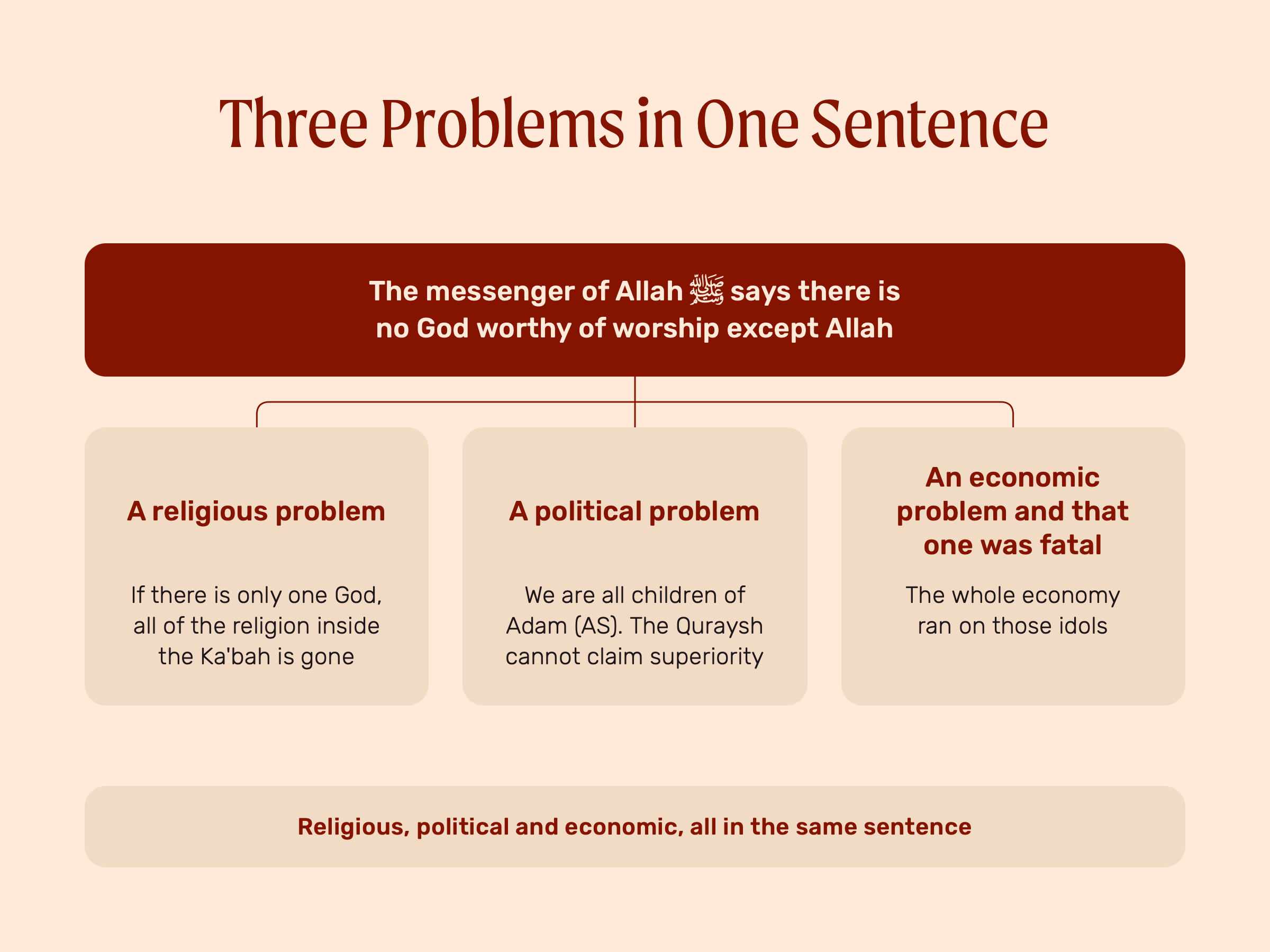
Religious problem number one. If there is only one God, then all of the religion inside that temple is gone. Not modified. Gone. Every one of those other religions is fine with coexistence. You can believe what you want. You can have your idol.
He comes with something that does not accept any other idol and does not accept any compromise on God. There is only one.
On top of that, very early on, he is claiming that this house was never meant to be a temple at all. It was built by Ibrahim (AS) for the worship of the one true God. Which means what you have been doing in here all this time is a violation of the sanctity of a masjid.
So that is one problem and it is a big one.
It Was a Political Problem Too
Islam comes and says we are all children of Adam (AS) and all the children of Adam have been honored.2
If we are all children of Adam (AS), then quite literally all of us are genetically equal, even though we are genetically varied. You can come from this tribe or that tribe or the other one.
So what makes you proud of your tribe? Who my father was and who his father was.
Go back far enough. Who is everybody’s father? Adam (AS).
Which means we are all essentially from the tribe of humanity. We are all equal, you see. Tribal superiority becomes a serious problem. You cannot claim superiority based on race. If all human beings are equal, they have fundamental equal rights.
Now the Quraysh cannot claim superiority, not even within their own ranks. They had hierarchies among themselves. Those are gone too.
It Was an Economic Problem and That One Was Fatal
The early revelation talks about the one who pushes the orphan away and does not feed the poor.3
Who is that talking to? That is not talking to poor people. That is talking to rich people. That is about the people pushing the orphan around, manipulating the poor in society, cheating people in business.
The Quran is coming after economic corruption and economic corruption is not done by the poor. The poor barely have enough money to be corrupt with.
Now watch how deep the economic problem actually goes, because the whole economy ran on those idols.
The Ka’bah was a religious center. So when any tribe in the region wanted to show religious respect, where did they go? They went to the Ka’bah.
Because of that, the Ka’bah became a center of religious tourism. People coming, staying, worshiping, spending. So there is a hospitality industry. A hotel industry. Restaurants. They are making very good money off people arriving from everywhere.
Then there is the trade. Because it is the religious center, the trade runs through Makkah as well. You buy in Yemen, you carry it up through Makkah, you sell it in Syria. Syria is connected to Europe, so you pick up European products there. Then you bring all of it back down through Makkah, take it to Yemen and sell it onward into Africa.
Asia to Africa, Africa to Europe, all of it running through one canal and the canal is Makkah.
The only reason that works is that the idols are there. That is the only reason it works.
So when the Quran comes and the messenger of Allah ﷺ says there is no god worthy of worship except Allah, listen to what the Quraysh are actually hearing. If we destroy the idols, every tribe in the region becomes our enemy. They will hate us, because we attacked their gods. Then we cannot run our business the way we normally do. Our economic pipeline dies. Nobody visits the house, so the tourism money stops.
We go bankrupt overnight and then people will kill us.
That is the calculation. Religious, political and economic, all in the same sentence and they had to preserve it.
They Were Not Coming Back Alone
The ideological conflict escalates.
So they decide they are never going after him by themselves again.
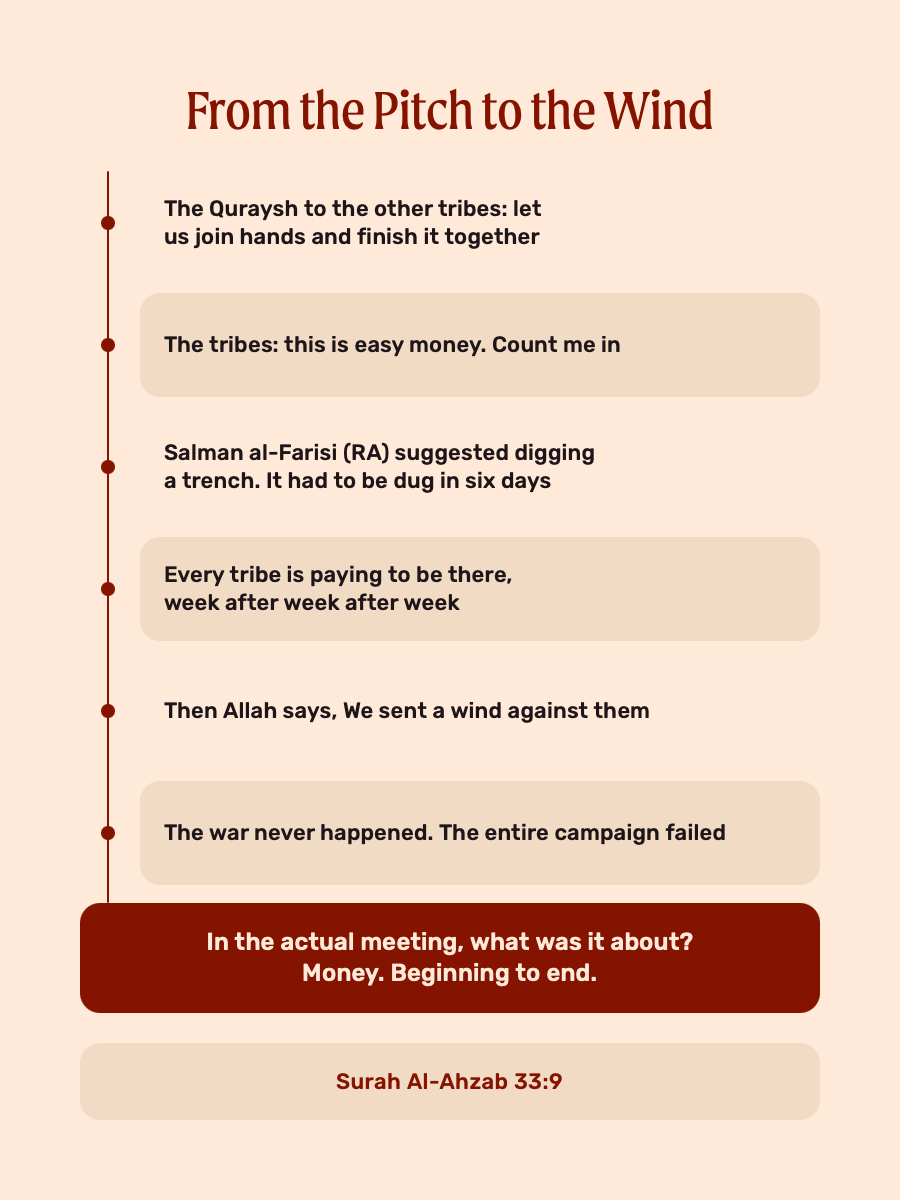
They start having conversations with the Ahbash and the other tribes in the region. Look, Islam is a problem for us. We have gone to war with these people twice. Right now they are our problem, but soon enough they are going to be your problem too. Let us join hands and finish it together. We will overrun them with numbers.
Then comes the second part of the pitch. We have fought them on the battlefield twice. I do not think we should go to the battlefield again. I think we should attack the city itself.
Which city? Madinah.
When you fight on a battlefield, who dies? Soldiers, on both sides. When you take military action inside a city, who dies? Men, women, children, civilians.
They were proposing a genocide and they were fine with it. Let us go into Madinah, kill every last man, woman and child, end all of this. Then we have an entire city’s wealth to distribute among ourselves.
A lot of the tribes in the area heard that and thought, this is easy money. Count me in. We will send some of our troops.
Then ask what those same tribes were going to tell their own people back home. They were going to say we are trying to save our way of life, because Muhammad ﷺ is a threat to our way of life. We are trying to save freedom in the Arabian Peninsula. We are trying to save the democracy of multiple gods.
That is what they announced. In the actual meeting, what was it about?
Money. Beginning to end. That was the only incentive.
It is a very simplistic reading to say this was just Islam versus kufr. Their ultimate kufr was the worship of the dirham.
What a war gets announced as and what a war is actually about are rarely the same thing. That has been true for as long as there have been wars.
Ten Thousand Men and Six Days of Digging
A faction in Arabic is a hizb. The plural is ahzab.
So the legions that assembled to come and kill every Muslim in Madinah gave this event its name, the battle of al-Ahzab. Surah number 33 of the Quran is commenting on this situation. The Quran does many things and one of them is that the Quran records history.
Some reports say ten thousand men were on their way.
You know that Salman al-Farisi (RA) suggested digging a trench, because Madinah is fortified behind by mountains and on the side by mountains, so only the front is open. That trench had to be dug in six days. Six days. The entire city is out there digging under the instruction of the messenger of Allah ﷺ. This is in Shawwal, in the fifth year.
Allah mentions it directly. You who believe, remember the favor of Allah upon you when armies came against you.4 Not an army. Armies.
Here is how a siege was supposed to work. In the ancient world you do not attack a fortified city. You camp around it and you wait. Eventually they run out of food, they run out of supplies, they start starving and they give up. So the Quraysh settle in. We cannot get through the trench, we tried a few times, fine. We will wait them out.
Are the Quraysh out there alone?
No. They have brought a lot of tribes with them and every one of those tribes is paying to be there. Setting up a military camp is expensive. The tents, the animals, feeding the soldiers, security, cooking, the makeshift hospital for whoever gets sick. You are building an entire temporary city and you have to keep paying for it week after week after week.
Then Allah says, We sent a wind against them.4
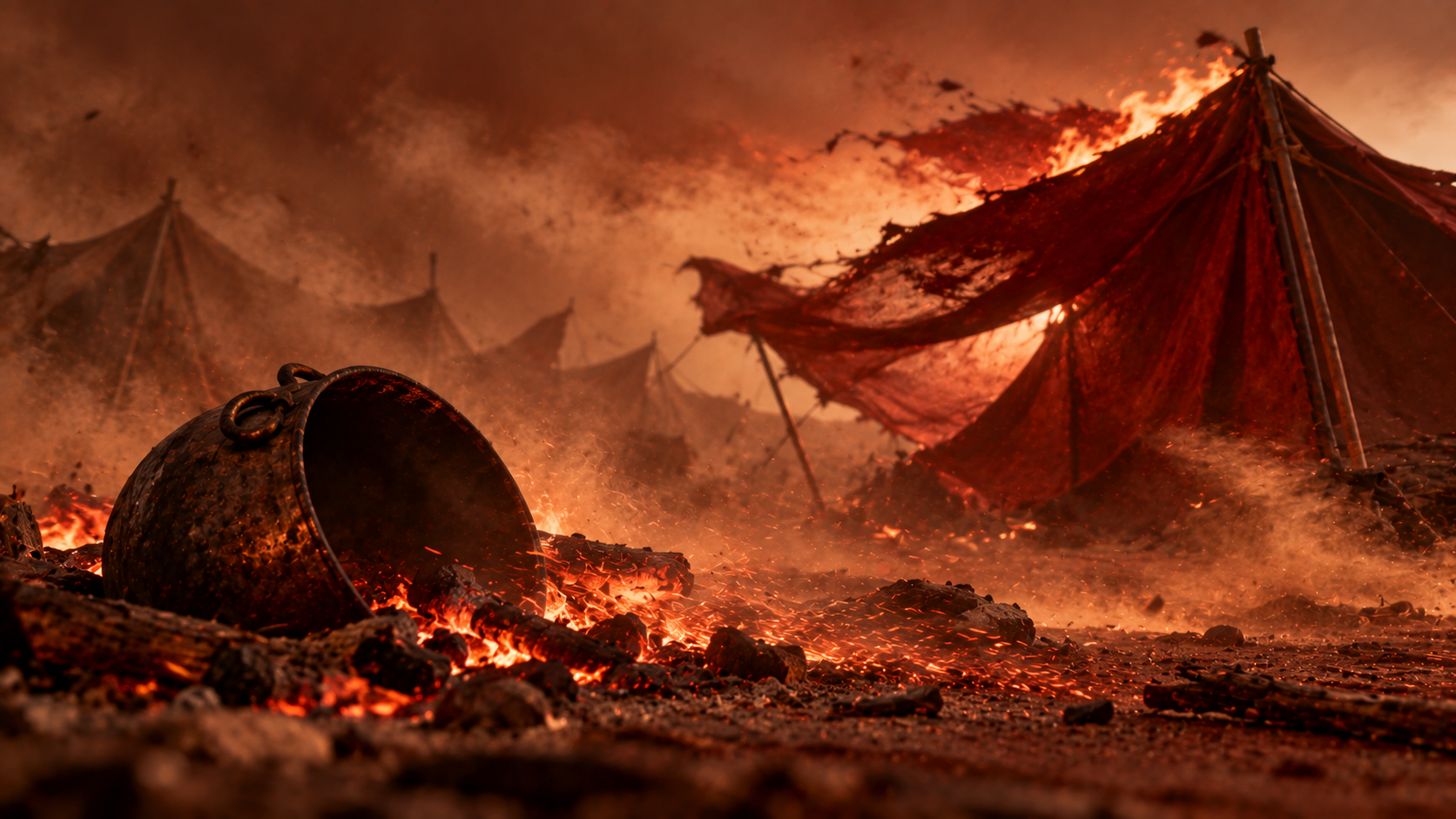
A windstorm in the desert. Sand in the men’s eyes, sand in their mouths, sand in the animals’ eyes. It knocks over the fires they are cooking on. A tent catches. The horses bolt. The camels go wild. Nobody can get it under control.
Some of the tribes start looking at each other. I thought this was going to be easy money. I think I am going to go home.
They trickle away. Eventually the Quraysh realize this is not going to work and they go home too.
The war never happened. The entire campaign failed.
Now count what it cost them. This time they also cost everybody else a great deal of money. You talked me into this. Easy money, you said. I went out into the desert and barbecued myself for a few weeks and went home poorer. Next time you have a request, go ask somebody else.
They lost face. They lost their standing with the very tribes who used to look up to them as the high and mighty Quraysh. That is an enormous diminishing of their political capital in the region.
Then He Saw a Dream
About a year and a few months later, the Prophet ﷺ sees a dream. He is making Umrah and he is shaving his head. He tells the Muslims about it. We are going to go make Umrah.
Sit with the situation for one second. Fourteen or fifteen months ago, those same people were at your door, thirsty for the blood of every man, woman and child you have. That is who is waiting at the other end of this trip.
Here is what I want you to take from all of it.
The first time the Muslims set out to visit the house of Allah, to make tawaf, to do the sa’i, to sacrifice the animal, to shave the head, all of those rituals we now perform as Hajj, it was a venture in which every one of them could have been executed simply for having formed the intention.
That is the road. That is how we got here.
This is the first of nine sessions tracing how the Hajj came to be established. Study Prophet’s Road to Hajj with Ustadh Nouman Ali Khan on Bayyinah TV: Bayyinah TV
Notes
This post is adapted from the opening session of Prophet’s Road to Hajj on Bayyinah TV and is written in the voice of that session. Every teaching claim, example and aside in it is taken from the session itself.
[1] Al-Quran, Surah Al-Hajj, 22:27, https://quran.com/22/27
[2] Al-Quran, Surah Al-Isra, 17:70, https://quran.com/17/70
[3] Al-Quran, Surah Al-Ma’un, 107:2-3, https://quran.com/107/2-3
[4] Al-Quran, Surah Al-Ahzab, 33:9, https://quran.com/33/9

At Bayyinah, we are dedicated to helping you connect directly with the words of Allah beyond translation. Founded by Ustadh Nouman Ali Khan, our mission is to create transformative experiences that deepen your understanding and engagement with the Quran.
Study the Quran and Arabic in a systematic and personalized way through Bayyinah TV. Get started today for free.