Successful subscription! Thank you for subscribing.
Successful subscription! Thank you for subscribing.
November 22, 2026
Why Department-by-Department Beats a Memo
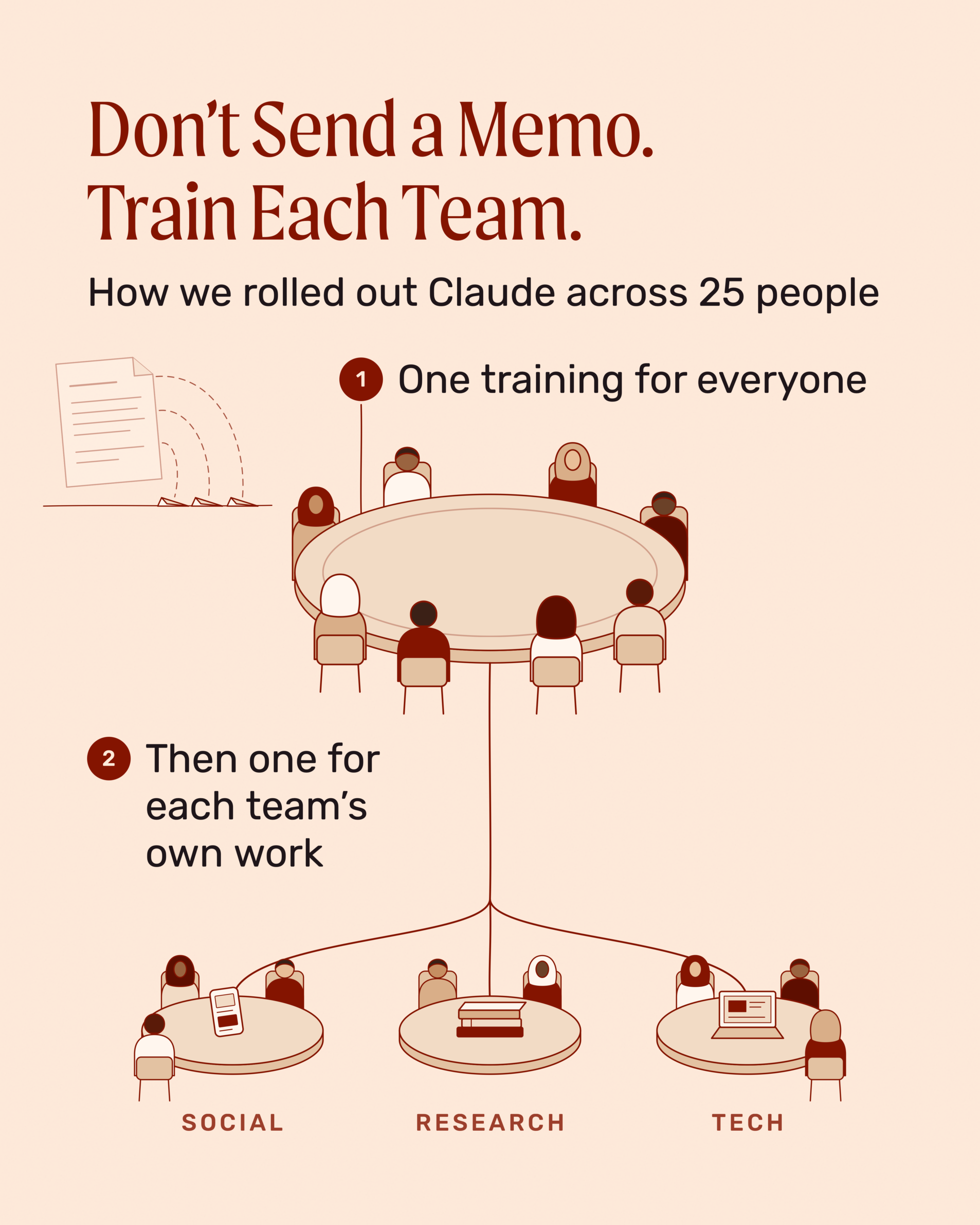
The honest version of this story starts with a temptation I’m glad I resisted. The easy move, when you’re switching the whole company from ChatGPT to Claude, is to send a company-wide message: here’s why, here’s the link, go. I know roughly what would have happened if I had. Almost nothing. Not because the team isn’t interested, but because a memo about a tool is not the same as knowing what to do with it on a Tuesday afternoon when you have three things due.
So we did it the slower way. I ran a training in our global monthly meeting first, just to get everyone in the same room with the same frame. Then we did separate sessions per department. The reason that matters is that the social team and the research team and the tech team are not running the same problems. What an AI tool means for someone cutting a transcript is completely different from what it means for someone sourcing an Arabic grammar point. A single demo does not survive contact with those differences.
The per-department sessions took more of my time. They were worth it.
The Mapping Exercise
Before each department session I asked the same question: what are the things you do every week that are high-volume and low-variance? Not where do you want AI to be eventually, but what do you actually do on repeat right now.
This gets you somewhere useful fast. Most teams have three or four of these. They’re usually the tasks people do on autopilot, which also means they’re the tasks where small errors accumulate without anyone catching them. We mapped those first, then we mapped where the work required judgment that had to stay human and then we looked for the overlap points, the places where AI could handle the load and hand off to a person for the call.
That exercise is not glamorous but it is what kept us from deploying AI in places where it would have quietly made things worse.
Concrete Wins
The one I get asked about most is the transcript pipeline. For Quran Week we end up with a large volume of session recordings and the social team needed to get content out fast. We started feeding the full set of transcripts into Claude Cowork, because it handles multi-document work without you having to copy and paste your way through the afternoon, and asked it to split the material into 3 sets of 7 social posts, each versioned for the platform. So not one post reformatted, but actually different angles for Instagram versus X versus LinkedIn. The time difference compared to the old process was significant. The quality needed editing, but the editing was faster than writing from scratch.
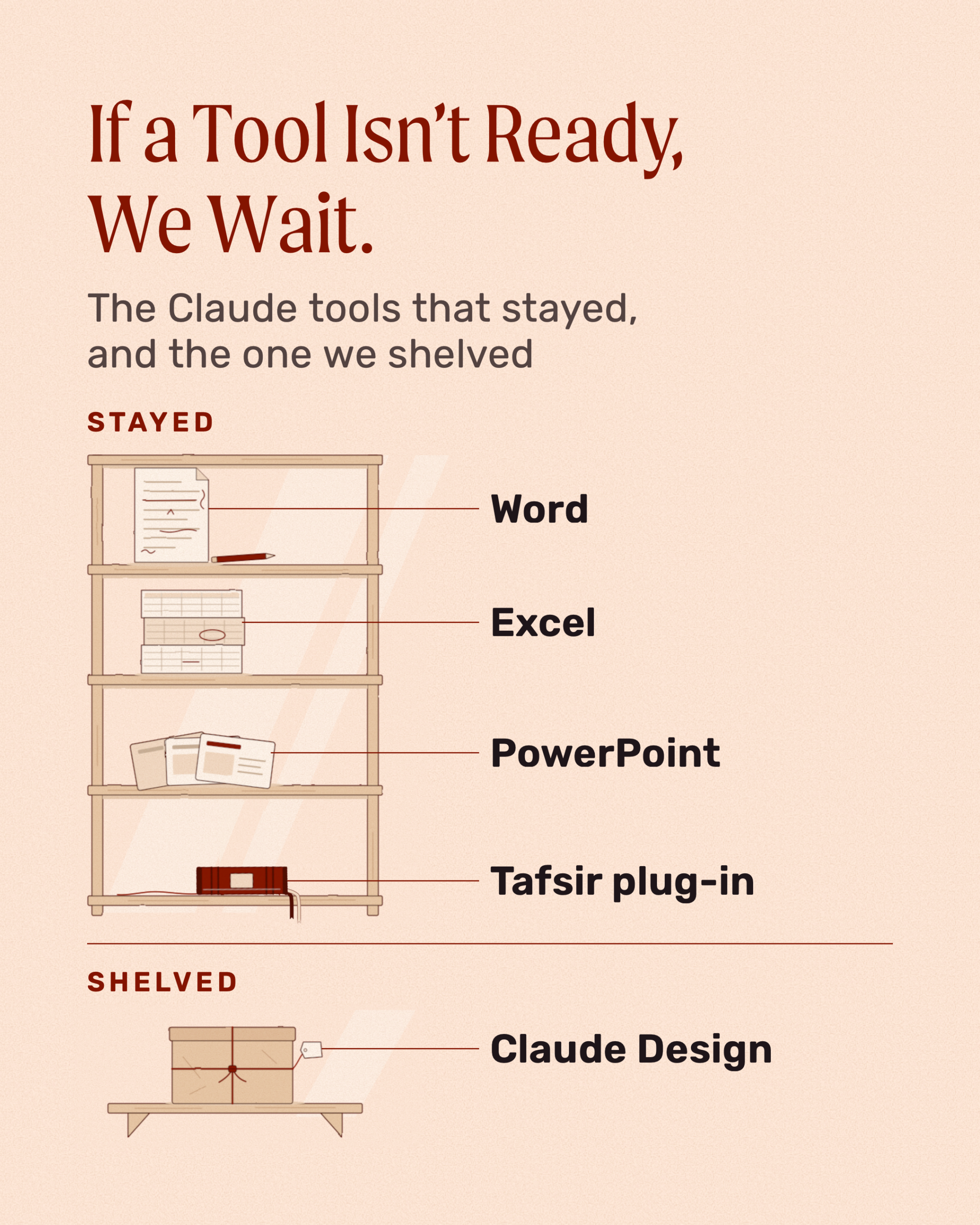
The Office add-ins came in quietly and stayed. Claude in Word for first drafts of longer internal documents, Claude in Excel when someone on the team needs to do something they only do twice a year and can’t remember how. Claude in PowerPoint for decks. None of these are dramatic but they add up across a team that isn’t primarily technical.
The one that took the most setup but might be the most interesting for people reading this is what our researchers are using. There’s a Claude plug-in that lets them pull snippets from specific tafsir books directly into their workflow rather than switching between tools. The books are curated, the sourcing is traceable and it cuts out a whole category of error that used to happen when someone was working fast and paraphrased something from memory.
What We Shelved and Why
We tried Claude Design. It isn’t there yet, not for what we need. Our visual identity is specific and the outputs weren’t landing close enough to warrant the correction time, so we kept Canva and built a connector to run Claude through it instead. That works better.
The principle here is that “not using it for X” is a real decision and not a failure. We shelved it because the standard didn’t drop to meet the tool. The tool has to meet the standard or we wait.
The Higher Bar
Here’s the part people don’t expect: our guardrails got stricter after we adopted AI, not looser. When the content you’re producing is about the Quran, or is drawing on tafsir, or is going out under Ustadh Nouman’s name, the margin for drift is very small. A generic Islamic-sounding sentence that isn’t sourced is not neutral. It’s a problem.
So the tech team built an internal tool that helps source authentic Islamic information when building apps or pipelines that touch religious content. The idea was that if we’re going to use AI at scale for this kind of work, we needed a layer that could help verify sourcing rather than just generate plausibly correct-sounding text.
Build Something Real With It
Deploying AI across a team of 25 people did not make us faster at the cost of being less careful. That was the thing I was most worried about going in, and I think the department-by-department approach, the mapping exercise and the decision to shelf what wasn’t ready are what kept it from going that direction. It’s still a live process. We’re still adjusting.
If any of this is useful to you or if you’ve done something similar and made different calls, we’d genuinely want to know.
Join the Bayyinah Works newsletter at bayyinah.com/works for more on how we build and what we’re learning.

At Bayyinah, we are dedicated to helping you connect directly with the words of Allah beyond translation. Founded by Ustadh Nouman Ali Khan, our mission is to create transformative experiences that deepen your understanding and engagement with the Quran.
Study the Quran and Arabic in a systematic and personalized way through Bayyinah TV. Get started today for free.
Check out our newest articles, fresh off the press and ready for you to dive into!